
society
Politics Is Grassroots: How the NWOBI POLITICAL DYNASTY and the Diaspora Are Rewriting APC Mobilisation in Enugu

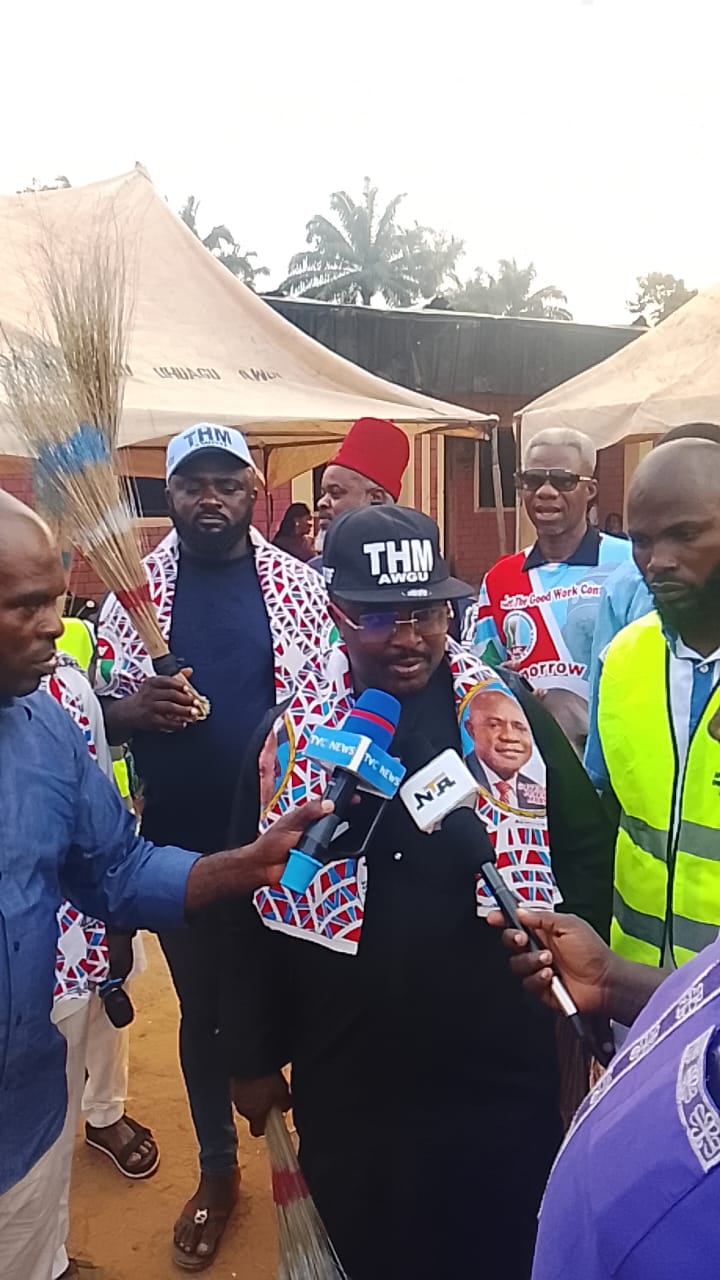
Politics Is Grassroots: How the NWOBI POLITICAL DYNASTY and the Diaspora Are Rewriting APC Mobilisation in Enugu.
By George Omagbemi Sylvester | Published by SaharaWeeklyNG.com
“From Awgu Ward II to the Global Nigerian Diaspora, a New Model of Political Organisation Emerges Under the Leadership of High Chief Francis Ossy Nwobi and Prince Barr. Smart I. Nwobi.”
On Sunday, 18 January 2026, Awgu Ward II in Enugu State became more than a routine political gathering point; it transformed into a symbolic theatre of Nigeria’s evolving democratic mobilisation.
The official flag-off of the All Progressives Congress (APC) E-Registration Exercise in the ward marked a strategic convergence of grassroots politics, elite coordination and diaspora engagement, anchored by two influential figures of the Nwobi political dynasty: High Chief Francis Ossy Nwobi, CEO of Fontana Oil Ltd and Prince Barrister Smart I. Nwobi, CEO of Nwobi Attorneys Chamber South Africa and President of the Nigerian Union South Africa (NUSA).
Their joint appearance and declaration of support for the APC sent a clear political message: MODERN NIGERIAN POLITICS CANNOT SUCCEED WITHOUT SYNCHRONIZING LOCAL LEGITIMACY WITH DIASPORA INFLUENCE.

Grassroots as the Foundation of Power. Addressing party faithful, community leaders and residents of Awgu Ward II, High Chief Francis Ossy Nwobi articulated a philosophy that has increasingly gained traction among political theorists and democratic reform advocates: “Politics is grassroots.” This assertion is not rhetorical. It reflects a long-established principle in political science that durable political authority flows upward from community consent, not downward from elite imposition.
Political scholar Robert Putnam famously argued that democratic success is deeply linked to social capital and civic engagement at the local level. In similar vein, High Chief Nwobi emphasised that his entry into partisan politics was driven not by ambition, but by conviction and specifically, conviction inspired by what he described as the visible governance outcomes and developmental strides of His Excellency, Dr. Barrister Peter Ndubuisi Mbah, the Executive Governor of Enugu State.
By anchoring his support in observed governance performance rather than partisan sentiment, Nwobi framed political participation as a civic responsibility rooted in accountability, not personality worship.
Governor Peter Mbah and the Governance Question. Since assuming office, Governor Peter Mbah has consistently positioned governance around efficiency, institutional reform and results-driven administration. While political opinions may differ across ideological lines, there is broad consensus among policy analysts that performance-based legitimacy is fast replacing rhetoric-based loyalty in Nigeria’s sub-national politics.
Development economists such as Amartya Sen have long argued that the true test of leadership lies not in promises, but in capability expansion; how governance tangibly improves citizens lives. It is within this analytical framework that supporters, including High Chief Nwobi, situate their endorsement of the Enugu State governor.

This framing is crucial for international audiences and it demonstrates a shift away from identity politics toward measurable governance outcomes, a transition many African democracies are still struggling to achieve.
Diaspora Power and Political Modernisation. Perhaps the most strategic dimension of the Awgu Ward II event was the formal recognition of Prince Barrister Smart I. Nwobi as Diaspora National Coordinator and leader of the “Tomorrow Is Here Movement.” This development underscores a growing political reality. The Nigerian diaspora is no longer a peripheral actor in national politics.
With remittances consistently ranking among Nigeria’s largest sources of foreign exchange, the diaspora has evolved from an economic contributor into a political stakeholder with organisational capacity, global networks and advocacy leverage.
As President of NUSA and a legal practitioner based in South Africa, Prince Smart I. Nwobi embodies what migration scholars describe as transnational political agency, having the ability of migrants to influence political processes across borders. Political sociologist Thomas Faist notes that such actors often serve as bridges between domestic politics and global democratic norms.
In his address, Prince Nwobi pledged both local ward-level mobilisation and diaspora-wide political support for the APC and its flagship leadership in Enugu State. This dual-track approach reflects a sophisticated understanding of contemporary politics: votes are local, but legitimacy is increasingly global.
The APC E-Registration as Institutional Reform. The E-Registration exercise itself represents a critical component of internal party reform. Across democratic systems, party institutionalisation is recognised as essential to political stability. According to Samuel Huntington, weak parties produce unstable democracies, while strong, transparent party systems deepen democratic culture.
By flagging off the E-Registration process in Awgu Ward II, the APC demonstrated an attempt (however incremental) to modernise its membership database, improve internal accountability and expand participation. When viewed through this lens, the event transcended symbolism and became a test case for party renewal at the grassroots level.
The presence of influential local and diaspora leaders added credibility to the exercise, reinforcing public confidence in the process.
A Political Dynasty, Not a Personality Cult. Critically, the narrative emerging from Awgu Ward II was not one of personal glorification, but of institutional continuity and civic duty. The Nwobi political dynasty, as presented, positions itself not as a family empire, but as a political tradition rooted in service, organisation and community legitimacy.
Political historian Alexis de Tocqueville warned that democracies fail when elites detach from the people. In contrast, the Nwobi model (as articulated during the event) seeks relevance through constant engagement with ordinary citizens, reinforcing the democratic chain between leaders and the led.
Implications for Enugu State and Beyond. For Enugu State, the Awgu Ward II mobilisation signals growing internal cohesion within the APC and a recalibration of its grassroots strategy. For Nigeria more broadly, it illustrates an emerging political pattern: diaspora actors are no longer content with commentary; they are now active organisers and mobilisers.
International observers often criticise African politics for elite capture and weak civic participation. Events such as this complicate that narrative, revealing a more nuanced political landscape where local wards and global citizens intersect.
Furthermore: Tomorrow Is Here, If the Grassroots Decide. The official flag-off of the APC E-Registration Exercise in Awgu Ward II on 18 January 2026 was not merely a party activity. It was a political statement and one that reaffirmed a timeless democratic truth. Which is “Power begins with the people.”
Through the combined leadership of High Chief Francis Ossy Nwobi and Prince Barrister Smart I. Nwobi, the event showcased a model of political engagement that merges grassroots legitimacy with diaspora strength, local accountability with global perspective.
As political philosopher Hannah Arendt observed, power exists only where people act together. If Awgu Ward II is any indication, Nigerian politics may be witnessing a gradual, if uneven, return to that foundational principle.
“Tomorrow, indeed, is here and we as grassroots have already moved.” According to Prince, Barrister Smart I Nwobi.





FOPCHEN Seeks Wider Engagement As Court Defers Hearing
OTA, OGUN STATE — The High Court of Ogun State, Ota Division, on Thursday resumed hearing in the ongoing matter involving cultural and societal concerns, before adjourning proceedings till Thursday, July 2, 2026, for continuation of hearing.
At the resumed sitting on May 28, 2026, counsel representing the various parties revisited key issues in the case and made further submissions before the court.
The matter, which has continued to generate public interest across different sectors, again drew attention from legal observers and stakeholders who described the case as one with significant implications for societal values, cultural identity and constitutional interpretation.
Speaking after the proceedings, the Foundation for the Protection of Cultural Heritage in Nigeria, popularly known as FOPCHEN, renewed its appeal for dialogue and constructive engagement among Nigerians, stressing that sensitive cultural and moral issues should not be left entirely within the confines of the courtroom.
According to the group, broader conversations involving traditional institutions, civil society organisations, religious leaders and policy stakeholders remain necessary in addressing issues relating to national values and social responsibility.
Legal analysts at the court premises noted that arguments being canvassed by parties in the suit could shape future legal interpretations surrounding cultural and moral questions in the country.
Following submissions by counsel, the presiding judge adjourned the matter till Thursday, July 2, 2026, to enable parties further prepare and respond to issues raised during the hearing.
The development has continued to spark reactions among observers, with many Nigerians closely monitoring the proceedings ahead of the next hearing date.

US-Based Society Lady, Fehintola-Brat Extends Eid-El-Kabir Greetings To Muslims
United States based fahionista of class, Chief (Mrs) Ayoola Fehintola-Brat has extended a warm greetings to Muslim faithful all over the world on the occasion of the 2026 Eid-El-Kabir celebration.
Fehintola-Brat who is the Balogun Egbe Obaneye Obinrin Akile Ijebu, and the Yeye Asofin of Idenaland in her message to Journalists urged Muslim to continually uphold the enduring values of sacrifice, obedience, faith, and compassion, which are central to the significance of Eid-El-Kabir festival.
A quiet philantropist whose humanitarian services has won her several laurels urged Muslims to use the spiritual occasion to pray for the peace co-existence of Nigerians regardless of religious, social and political leanings stressing that the oneness of the country should not be underplay.
In a related development, she expressed her felicitations to all sons and daughters of Ijebuland on the forthcoming Ojude Oba 2026 celebration, tasking age-groups otherwise known as Regbregbe to be more proactive in giving back to their immediate communities.
According to her, the beauty of the age-groups in Ijebuland is the need to contribute immensely to the development of the land in no small means. “This we will continue to achieve with God on our side”, she concluded.
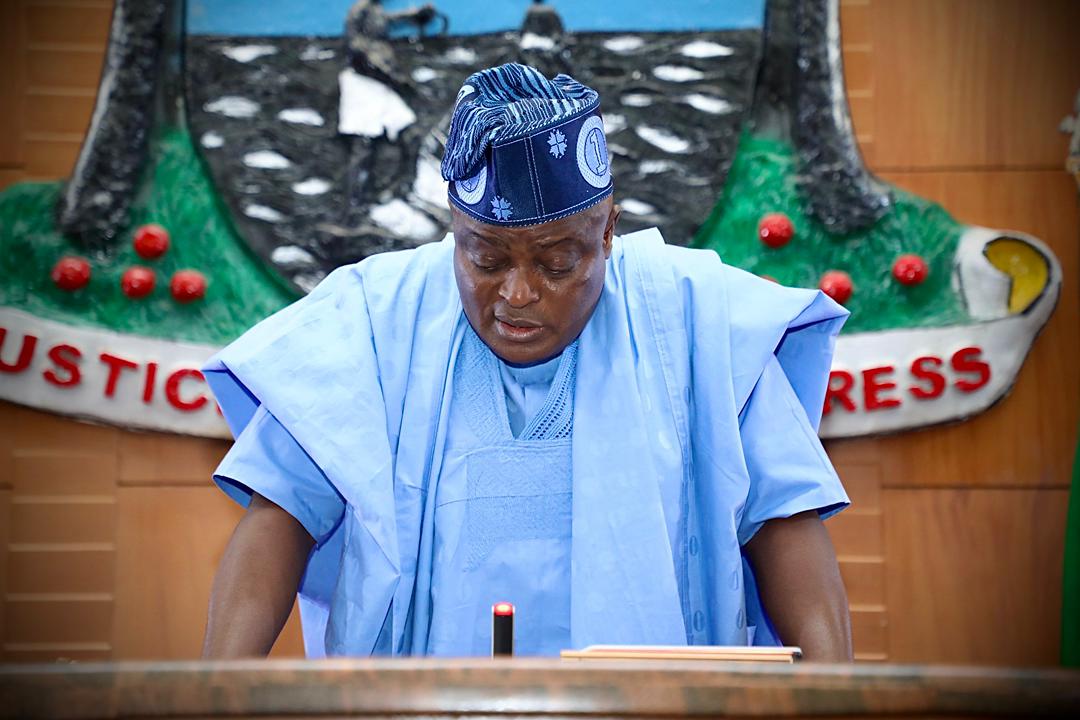
Sallah: Obasa Felicitates Muslim Ummah, Commends Nigerians for APC Primaries Turnout
The Speaker of the Lagos State House of Assembly, Rt. Hon. Mudashiru Obasa has extended warm felicitations to Muslims in Lagos State and across Nigeria on the occasion of Eid al-Adha.
In a statement released by his Chief Press Secretary, Mr. Dave Agboola, Obasa described the festival as a season of sacrifice, reflection, and gratitude, urging the faithful to continue to uphold the values of peace, unity, and love that strengthen the nation.
He noted that the celebration of Eid al-Adha is not only a spiritual milestone but also a reminder of the importance of togetherness and collective responsibility in building a stronger society.
He, likewise, emphasized that the festival provides an opportunity for Nigerians to renew their commitment to national progress and to support leadership that prioritizes development and prosperity.
Obasa, however, commended Nigerians, particularly members of the All Progressives Congress (APC), for their massive turnout during the recently concluded party primaries. He described the participation as a clear demonstration of the people’s confidence in the government of President Bola Ahmed Tinubu and their belief in the administration’s vision for a greater Nigeria.
“The APC primaries have shown the resilience of our democracy and the confidence Nigerians have in the leadership of President Bola Ahmed Tinubu and the Renewed Hope Agenda. This is a strong message that our people are ready to continue supporting policies that will drive growth and prosperity,” Obasa stated.
The Speaker further encouraged Muslims to celebrate responsibly, stressing that the joy of Eid should be accompanied by prayers for the continued peace and progress of Lagos State and Nigeria.
“As you celebrate with family and loved ones, may this season bring joy, peace, and prosperity to your homes. Let us remain united in our resolve to build a stronger nation,” he added.
On behalf of the Lagos State House of Assembly, Obasa wished all Muslims a happy and fulfilling Eid al-Adha celebration.


- Société Nationale des Pétroles du Congo (SNPC) Chief Ominga to Speak at African Energy Week (AEW) 2026 as Congo Accelerates Gas Expansion May 29, 2026
- South Africa: Deputy President Mashatile arrives in India for a Working Visit May 29, 2026
- Seychelles: President Visits Key Development Sites on Coetivy Island May 29, 2026
- Accelerating regional action to advance mental health care in Africa May 29, 2026
- President of the Republic of Seychelles Meets Young La Digue Talent Ahead of London Showcase May 29, 2026
- United Nations Economic Commission for Africa (ECA) launches regional initiative to accelerate women’s digital entrepreneurship across four African countries May 29, 2026
- Ethiopia: International community must act to safeguard press freedom ahead of national election May 29, 2026
- CORRECTION: Annual Meetings 2026 (AM2026): African Development Bank (AfDB) 2025 Trade Finance Report Highlights Resilience of African Financial Institutions After Covid-19 May 29, 2026
- Why Big Tech Could Become Nigeria’s New Gas Partner May 29, 2026
- African Energy Chamber (AEC)-Venezuela Alliance Accelerates Pathways into South-South Energy Expansion May 29, 2026
- Société Nationale des Pétroles du Congo (SNPC) Chief Ominga to Speak at African Energy Week (AEW) 2026 as Congo Accelerates Gas Expansion May 29, 2026
- South Africa: Deputy President Mashatile arrives in India for a Working Visit May 29, 2026
- Seychelles: President Visits Key Development Sites on Coetivy Island May 29, 2026
- Accelerating regional action to advance mental health care in Africa May 29, 2026
- President of the Republic of Seychelles Meets Young La Digue Talent Ahead of London Showcase May 29, 2026
- United Nations Economic Commission for Africa (ECA) launches regional initiative to accelerate women’s digital entrepreneurship across four African countries May 29, 2026
- Ethiopia: International community must act to safeguard press freedom ahead of national election May 29, 2026
-

 news6 months ago
WHO REALLY OWNS MONIEPOINT? The $290 Million Deal That Sold Nigeria’s Top Fintech to Foreign Interests
-

 society4 weeks ago
SOCIAL MEDIA IS NOT A BATTLEFIELD COMMAND – WHY THE NIGERIAN ARMY’S ACTION AGAINST JUSTICE CRACK IS A NATIONAL SECURITY IMPERATIVE
-

 celebrity radar - gossips4 months ago
Dr. Chris Okafor Returns with Power and Fire of the Spirit -Mounts Grace Nation Altar with Fresh Anointing and Restoration Grace on February 1, 2026
-

 celebrity radar - gossips6 months ago
Prophet Kingsley Aitafo Releases 2026 Prophecy: ‘Nigeria Will Rise, but the World Must Prepare for Turbulence’