
celebrity radar - gossips
PRESIDENTIAL ELECTION 2023: Do Not Expect Any Miracle At the Supreme Court Anene Nwachukwu

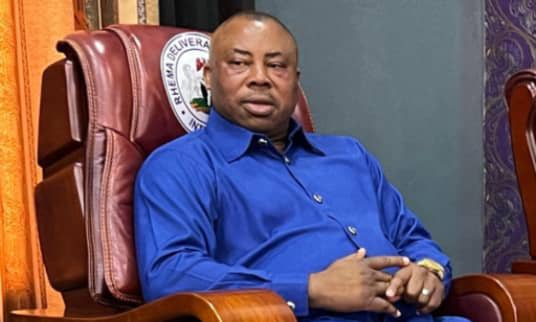
PRESIDENTIAL ELECTION 2023: Do Not Expect Any Miracle At the Supreme Court Anene Nwachukwu
Rhema Deliverance Missions annual convention is always heralded with huge anticipation and 2023 convention is not an exception, with the theme Behold I Give Unto You Power, it promises to be one to be talked about in many months to come with the huge expectations of reign of power, healing, restoration and deliverance. Dr. Anene Nwachukwu, the General Overseer in this interview with Dave Agwazim discussed salient nation issues, expectations at the convention and so much more.
Enjoy the excerpt.
The Presidential Election Petition passed their judgment affirming President Bola Ahmed Tinubu winner of the election eliciting mixed reactions across the country, as one of the clergies prophesied pre 2023 general election, whats your reaction to this judgment?
Well, as a Nigerian, we have accepted the verdict of the Court, but that Presidential Election Tribunal is not the final court of the land. The contestants, thats Peter Obi and Atiku Abubakar have rejected the judgment, and they have promised to head to Supreme Court. I believe that they have taken the right step because until you get to the final court and the final court rules against an issue, then you accept the judgment, but as far as that Appeal Court is not a final Court, they still have the right to appeal.
We Nigerians, we received the judgment with mixed reactions knowing fully well that during the election, we participated fully and the process that led to the declaration is clear in totality. As some of the issues raised in that Tribunal were not addressed, Nigerians are not satisfied with certain issues raised, especially in the area of violence, and method of results declaration. INEC promised Nigerians that theyre going to electronically transmit the results into their server, that was the reason why government spent billions of naira to procure BVAS and if the government knew that theyre not going to use the BVAS, why do we spend such humongous amount and the Tribunal is telling us that INEC has the right to declare results without BVAS?
We would not have spent such money on that failed project as such amount of money could have lifted our economy. However, as a Christian, the Bible says we should obey those in authority, and since INEC has declared Tinubu the winner, we will all support his Government, unless if God proves otherwise, so we received the judgment with mixed reactions.
Sir, as the Labour Party candidate, Peter Obi and his PDP counterpart Atiku Abubakar have approached the Supreme Court, do you see them spiritually, reclaiming the mandate or upturning the decisions of the Tribunal?


Well, since the matter is in Court, I dont want to take a decision since I am not the Chief Judge of the Federation, neither am I one of the Judges, but I believe that there won’t be difference from what we saw at the Appeal Court happening, as a Man of God, our duty is to pray for our Leaders that they do things right. Before the judgment of Appeal Court, I said it that there is nothing changing, I made it openly, I said it categorically. It is not because I am in support of the way the election went, but we have to abide by the laws of the land. The Bible charges us to be obedient to authorities and laws. I am a law-abiding citizen, if you look at my office, youll see Tinubus portrait and that Sanwoolu hanging. We were part of the election here, we saw what happened, but since they have been declared, we have to support them.
Just a few weeks ago Sir, the President marked his 1st 100 Days in office, how can you appraise his administration so far?
Personally, I dont believe in 100 Days in Office, I hate it with passion, somebody is elected to work for the people, whether youre 100 Days or 1 Year, you should be able to deliver democratic dividends to Nigerians, there is nothing to celebrate in 100 Days in office. What we are expecting is, let there be reduction in fuel price, let there be reduction in dollar exchange rates, let there be reduction in food prices in the market, let our mothers buy foodstuffs cheaper and cook for their families.
Nigerians are really suffering. As a Pastor, on the 1st Friday of the month of September I shared 300 bags of rice and 200 cartons of Indomie here in the church. The kind of fights I saw people engage in over 10kg of rice was unprecedented. I went by the side and started weeping, I was not weeping because I am happy, I wept because even people we thought are rich or okay so to say, well dressed were fighting over 10kg of rice. I said to myself, 1st Friday of October, during our Convention, I will increase it to 500 bags and also implore members to donate to it for us to have even more to give out because the rate of hunger in the land is alarming.
If you go to so many Churches, youll see that for people to transport a few children to church is not easy. If you go to church with about seven children, youll spend up to N10,000 on transportation which many families cannot afford attending church services like they used to do in the past due to the untold hardship in the land and rising transportation cost. It is affecting so many things, children are no longer going to churches today, because transport doesnt come less for them. Many parents leave their children at home on Sundays, and the level of crime rate will increase, at least we teach them moralities in the church, which is helping many of them to reduce involvement in crime and other social vices.
The way things are going now, I dont know, there seems to be no solution in sight, dollar is hitting above N1,000, and everything in the market is skyrocketing, whats the hope for the poor man?
The same market where politicians go to is the same market where the poorest of the poor goes too. And, you see, somebody that has up to 8 children for example, with all them in schools, their school fees, their feeding money, and taking care of them in a week, you know what it is. Feeding 8 people three times a day, you know how much you will spend in a week, so government should alleviate the sufferings of the people, the purpose of government is to affect people positively, shouldering citizens needs, making the citizens comfortable and feeling proud that theyre Nigerians.
Today, everyone is finding a way to travel outside the country for greener pastures, people believe the economy has nosedived, nothing is working out, but we are still praying that God will see us through.
The rising hardship can be related to the removal of Petroleum subsidy and since the government is not going back on it, what do you think, in your analysis that the government should do at this point to ameliorate the astronomic rate of hardship and poverty in the land?
There are things Government can do for the citizens, I am not against removal of subsidy, but it would have been done in a very gradual process, not suddenly. Before you remove subsidy, at least you get people palliatives on time, you increase workers salary, you increase food production, you reduce the rate of dollar. These are the necessary things to be put in place. And, when you look at the condition of our country today, you will agree with me that there is no solution in sight.
Look at the level of poverty in the land, people are doing all sorts of things to meet up, and to feed their families. I think that what I would have advised is that Government should have put up some precautionary measures to alleviate the sufferings of the masses. The masses are suffering. One of the ways to alleviate the sufferings of the masses is to ensure steady power supply at a reduced tariff, theres ongoing debate that electricity tariff has increased, what for? When you removed subsidy, it is like giving somebody food and giving him nail as toothpick, it doesnt work. Giving us steady power supply at low tariff is one way to help the people. People can use the light to barb, to cook, I mean the artisans can function perfectly with steady affordable electicity.
Sir, finally on the state of the nation, recently, Federal Government released N500billion palliatives to each States, do you think thats a right call? Do you think these palliatives given to the Governors will get to the masses?
I am totally against it 100%. We are enriching the Governors, the Governors will give it to their Commissioners, and the Commissioners will give it to their cronies and family members. The people that the palliatives were meant for in particular will not get it. Politicians will share it house by house among their colleagues and political party members. If Government wants to do such a thing, they would have used it the way it will affect the masses. Reduce electricity tariff with that money. There are so many places we will plug the palliative fund, that it will affect people directly. Food production, reduce the price of fertilizers, reduce the price of rice in the market, reduce the price of beans and garri, at least, we will take our palliatives from there.
Sir, Rhema 2023 Convention comes up in a few days, can you talk about it?
Our 2023 Convention is coming from October 4th to 8th, and the theme says Behold, I Give Unto You Power. It is time to remind believers that God has endowed us with the power and the gift to manifest. He says these signs shall follow them that believe, and they shall cast out demons”. He has given you power, fortified you. He says they shall tread upon snakes and scorpions, many types of things, and nothing by any means shall hurt them. God has given us power to make wealth, Deuteronomy 8:18 But thou shalt remember the Lord thy God: for it is he that giveth thee power to get wealth, that he may establish his covenant which he swear unto thy fathers, as it is this day, power to subdue our enemies and power to make impact. So, we want to remind every believer that God created man in His own image, and He given them dominion, power over every creation. So we need to exercise our authorities, by letting people know they are not created to be under certain influences and powers, but created to be in charge, fruitful, multiply, and replenish the earth. So that is the theme of Our Convention.
What are the expectations of Rhemites?
The expectations is that the sick will be healed, the barren will conceive, the jobless will get job, after our prayer, the attackers destinies will stop. We are going to pray for every Family here, that nobody will end 2023 in crisis.
Your last word for Nigerians and followers of Oracle TV?
I believe in Nigeria, I believe that we have no other country except this one, and I believe that whosoever that has ears, let him hear, Nigeria will bounce back again; Nigeria will still be respected amongst communities of the World, thats my advice. Let us remain steadfast, play our part in nation building and pray for God to endow our leaders with requisite wisdom to build this nation up.




celebrity radar - gossips
Adron Homes Celebrates Visionary Chairman, Aare Adetola Emmanuel King, at 51
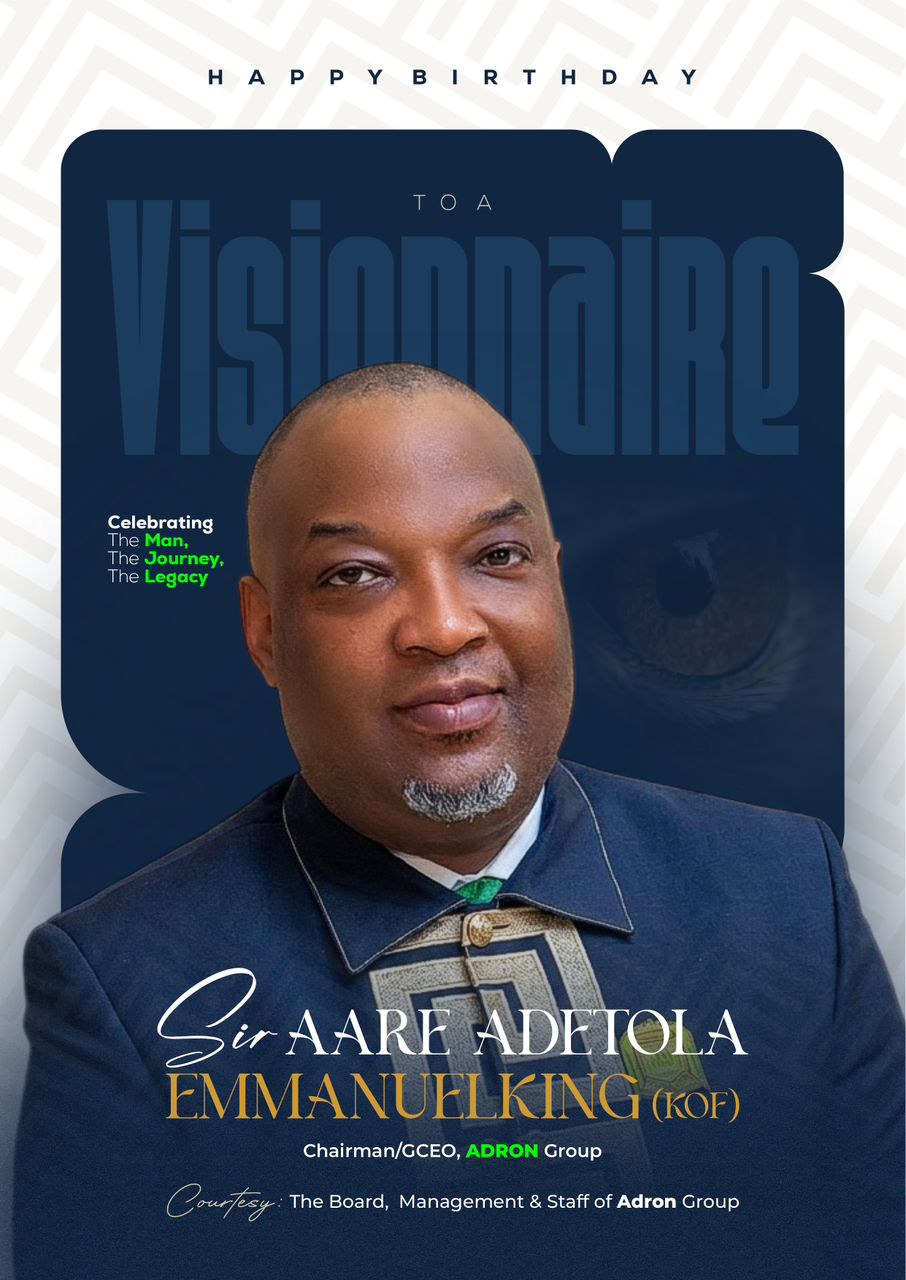
Adron Homes Celebrates Visionary Chairman, Aare Adetola Emmanuel King, at 51
The management and staff of Adron Homes and Properties Limited have joined family, friends, associates, and well-wishers across the globe to celebrate their Chairman and Chief Executive Officer, Aare Adetola EmmanuelKing, as he marks his 51st birthday.

In a statement released by the company, the milestone was described as a celebration of an exceptional leader whose vision, resilience, and entrepreneurial brilliance have not only transformed Adron Homes into a household name in Nigeria’s real estate sector but have also redefined affordable housing across the country.
Under his dynamic leadership, Adron Homes has continued to expand its footprint, delivering value-driven residential solutions while empowering thousands of Nigerians with opportunities for home ownership. His commitment to excellence, innovation, and customer satisfaction has remained the driving force behind the company’s sustained growth and industry leadership.
The statement further highlighted Aare EmmanuelKing’s passion for nation-building and community development, noting his significant contributions to job creation, youth empowerment, and the promotion of socio-economic development through real estate investments.
“As a leader, mentor, and visionary, Aare Adetola EmmanuelKing has consistently inspired a culture of excellence, integrity, and dedication within the organization. His ability to turn bold ideas into reality continues to position Adron Homes as a trailblazer in the industry,” the statement read.
The company expressed profound gratitude for his steadfast leadership and prayed for continued wisdom, strength, and sound health as he embarks on another year of impactful achievements.
As he celebrates his 51st birthday, the entire Adron Homes family proudly honours a man whose legacy continues to shape the future of real estate in Nigeria.
Happy 51st Birthday, Aare Adetola EmmanuelKing!
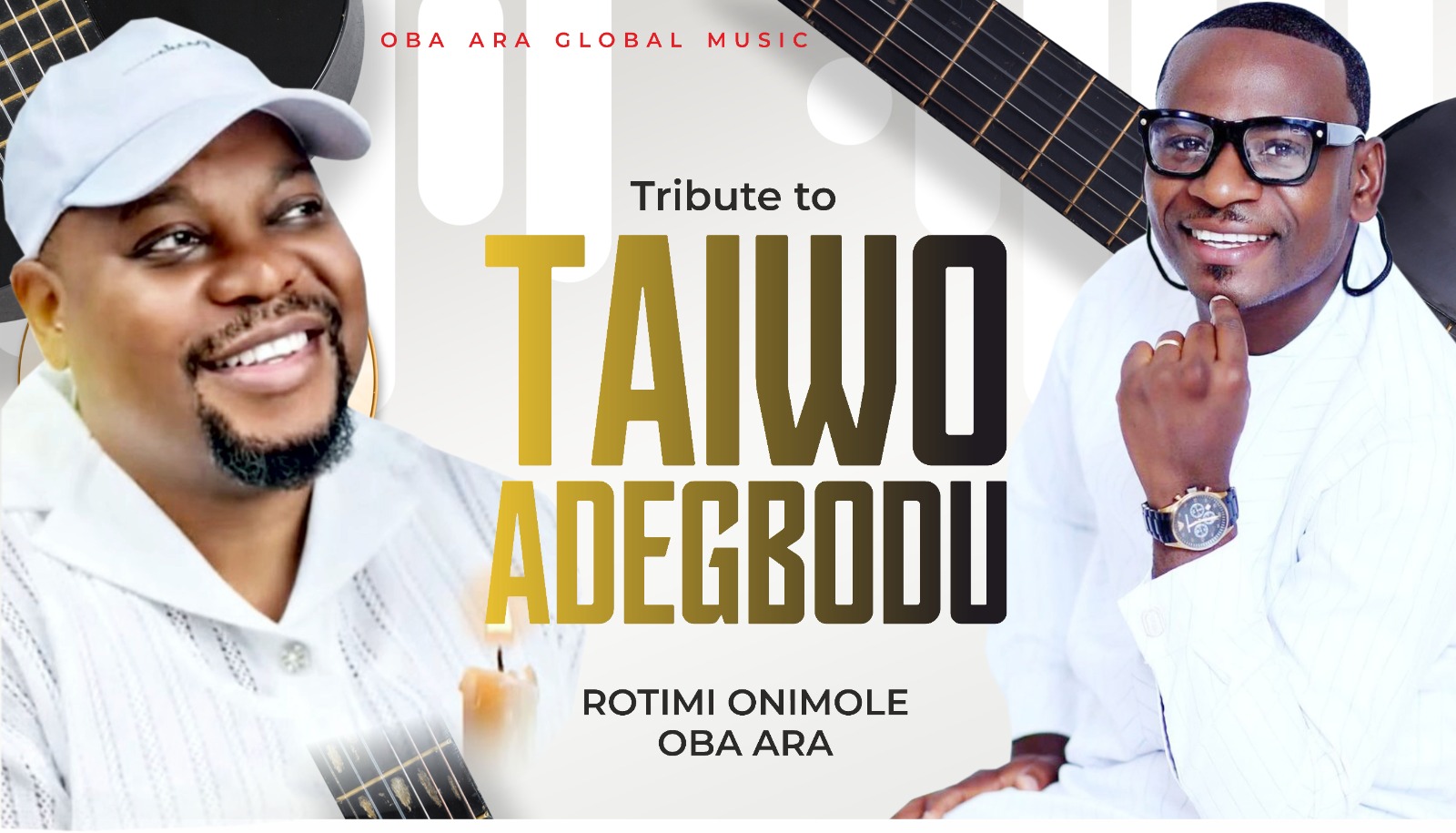
Oba Ara Releases Emotional Tribute to Late Taiwo Adegbodu
Taofik Afolabi
The gospel music community continues to grieve the painful loss of Taiwo Adegbodu, a beloved figure whose sudden departure left a deep void among fans, colleagues, and loved ones. In response to this loss, renowned gospel minister Rotimi Onimole, popularly known as Oba Ara, has released a moving tribute song that captures both the sorrow of the moment and the enduring legacy of the late singer.
Oba Ara, a proud son of Isale Eko, channels raw emotion throughout the song, using heartfelt lyrics and soul-stirring melodies to reflect on his personal connection with Taiwo Adegbodu. In the tribute, he openly expresses how deeply the news of Adegbodu’s passing shook him, describing it as a painful and unexpected loss that is difficult to come to terms with.
The song goes beyond mourning, it celebrates the life, ministry, and impact of Taiwo Adegbodu. Oba Ara highlights the late artist’s dedication to spreading the gospel through music, his inspiring voice, and the spiritual influence he had on many within and beyond Nigeria. Through powerful verses, he paints a picture of a man who lived for God and touched countless lives through his ministry.
Listeners have described the tribute as both comforting and deeply emotional, as it resonates with the collective grief of the gospel music community. It serves as a reminder that although Taiwo Adegbodu is no longer physically present, his music, message, and legacy will continue to live on.
In honoring his late colleague, Oba Ara not only pays his respects but also offers a source of healing for fans and fellow ministers, using music as a tool to process grief and celebrate a life well lived.
celebrity radar - gossips
Buratai, Fagbemi , Shagaya, Olofa, Others Eulogise Olowu Kuta’s Olori On 60th Birthday, Foundation Launch

Buratai, Fagbemi , Shagaya, Olofa, Others Eulogise Olowu Kuta’s Olori On 60th Birthday, Foundation Launch
Eminent personalities across the Nigeria stormed the TFK Event Centre, Bala Mohammed Way, Guzape, Abuja, to celebrate the 60th birthday of Olowu Kuta’s Olori, Queen Jumai Amoke and her Foundation Launch on Saturday 28, March 2026.

From former Chief of Army Staff, Lt Gen TY Buratai rtd, to the Minister of Justice and Attorney-General of the Federation, Prince Lateef Fagbemi; Olofa of Offa, HRM Oba Mufutau Gbadamosi. Even top businesswoman and socialite, Chief (Mrs) Bola Shagaya, was in attendance.


Other dignitaries were newly promoted Deputy Inspector-General of Police and former AIG Zone 2 , Lagos , Adegoke Fayoade, Major General Abdumalik, Major General Samuel Adebayo rtd (Fmr CDI);
Major General Anthony Omozoje rtd (Fmr Copp);
Alhaji Tajudeen Owoyemi (Asiwaju of Offa and CEO Radisson Hotel Nigeria;
Dr Waheed Olagunju, former managing director of Bank of Industry, Oniba of Iba, Lagos State, HRM Oba Dr Suleiman Raji ;
Justice Falola, Olu of Ile-Ogbo , Oba Adetoyese amongst many traditional rulers and captains of industry too numerous to mention.
Speaking at the occasion, the Chief Host, Olowu of Kuta, HRM Oba Dr Adekunle Oyelude Makama, CON , Tegbosun iii, who is also the husband of the celebrant commended Queen Jumai for ‘ her slender arms full of kindness’ to establish such humanitarian Foundation, ‘Amoke Children and mother in Need Foundation’ at a time Nigerians are going through economic crisis occassioned by the global meltdown.
Olowu also commended her steadfastness and love for the less privileged and downtrodden.
The monarch refrenced the task before his wife’s humanitarian gesture said her best is yet to come.
” Olori Amoke Jumai, I celebrate you. You will celebrate 70, 80, 90 and continue to shine as you continue to put a smile on people’s faces. I love you, “Olowu Kuta added.
To Lt Gen Buratai, a former army chief and former Nigerian Ambassador to Benin Republic, the reward of hard work is more work.
Buratai, who also doubles as Balogun Agba of Owu Kuta, a chieftaincy title reserved for a generalismo congratulated Queen Jumai for attaining the age of 60 in good health.
The retired army General said he’s not surprised by the turn out of eminent personalities across the country to celebrate the Olowu Kuta’s Olori because she merited it through her hospitality to all, adding that Allah the most merciful, most beneficial would accept all her act of ibadah.
The minister of Justice, Prince Fagbemi, was full of praises for Queen Jumai for deeming it fit to have a place in her heart to accommodate the needy and less privileged in ‘our society.’
Prince Fagbemi urged the guests to contribute generously to support the Foundation in order to continue to alleviate poverty and put a smile on the faces of the people.
” I congratulate you on your 60th birthday and Foundation Launch. I wish you many happy returns of the day and many more fruitful services to the country and motherland”, Prince Fagbemi added.
The celebrant, Queen Jumai who was grining from ear to ear thankfully said she was excited by the turn out and the response of the people to her foundation.
Queen Jumai, however, promised to continue to use her resources and donations received for the good of the needy and less privileged in the society.
” I want to appreciate my own Kabiesi Olofa of Offa , for his presence and im I’m using him as a point of contact to all other Kabiesis present here, the minister of justice and Attorney-General, you’re welcome, sir; Mrs Bola Shagaya, I salute your enterprise, Lt Gen Buratai, I’m grateful, sir; DIG Fayoade, Justice Falola and other dignitaries too numerous to mention, I thank you, all. To my darling husband, Kabiesi Olowu , I thank you immensely for your support. And to my family and friends, I thank you , all. E se pupo!”, she said.


-

 society6 months ago
Religion: Africa’s Oldest Weapon of Enslavement and the Forgotten Truth
-

 news4 months ago
WHO REALLY OWNS MONIEPOINT? The $290 Million Deal That Sold Nigeria’s Top Fintech to Foreign Interests
-

 society6 months ago
“You Are Never Without Help” – Pastor Gebhardt Berndt Inspires Hope Through Empower Church (Video)
-

 celebrity radar - gossips2 months ago
Dr. Chris Okafor Returns with Power and Fire of the Spirit -Mounts Grace Nation Altar with Fresh Anointing and Restoration Grace on February 1, 2026