
society
Primate Ayodele’s Prophecy Fulfilled As Deadly Flood Hits UAE, Kenya, Burundi (VIDEO)

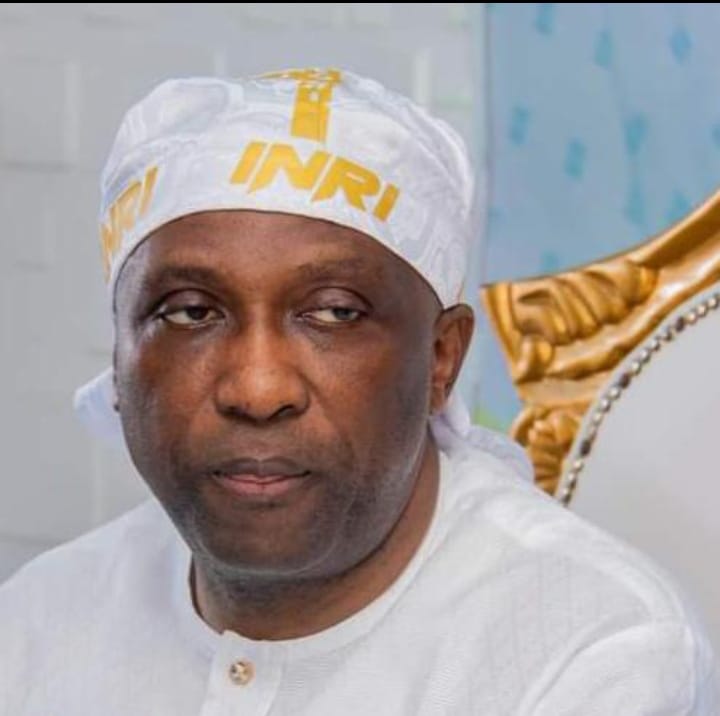
Primate Ayodele’s Prophecy Fulfilled As Deadly Flood Hits UAE, Kenya, Burundi (VIDEO)
If only leaders of nations are committed to listening to God-given instructions and warnings, the world would be a better place free of unnecessary chaos and panic but the incessant ignoramus attitude towards divine instructions by leaders make people become endangered in their own world.
God has blessed us with vessels that he speaks through, he has provided us with prophets like Primate Ayodele who on a daily basis shares the mind of God with mankind. Through vessels like Primate Ayodele, God warns presidents of countries ahead of time against unpleasant happenings but at all times, these warnings are ignored and sometimes, citizens sacrifice their lives because of the obstinacy of their leaders.
There is currently an issue of flooding globally which has led to the death of several people, displacement of thousands, destruction of properties worth billions of dollars and panic across continents but these could have all been avoided if leaders of the countries had listened to Primate Ayodele when he warned them in 2023 and early 2024.
The United Arab Emirates, a nation that had never recorded any heavy rain fall until a few weeks ago, is still counting losses and struggling to get back on its feet due to a deadly flooding that swept through the country.
The rainfall, which flooded streets, uprooted palm trees and shattered building facades, has never been seen in the Middle Eastern nation since records began in 1949. In the popular tourist destination Dubai, flights were canceled; traffic came to a halt and schools closed.
One-hundred millimeters (nearly 4 inches) of rain fell over the course of just 12 hours on Tuesday, according to weather observations at the airport – around what Dubai usually records in an entire year, according to United Nations data.
The rain fell so heavily and so quickly that some motorists were forced to abandon their vehicles as the floodwater rose and roads turned into rivers.
Meanwhile, Primate Ayodele had warned first in 2022 that he foresees climatic problems in the world which would cost a lot of money, lives and properties. He revealed then that the issue of flooding will come up in places that it has never happened before. He called on world leaders not to take climatic problems with levity because it will turn out to be very serious.
These were his words:
‘’I am seeing water and ecology problems, floods in Africa and many places that it hasn’t happened before … .natural catastrophe is imminent in 2023/2024. The issue of climatic problems must be taken very seriously, they must not joke with it….what we are saying will cost the world a lot of money, lives and properties..’’
@primateayodele #primateayodele #iescworldwide #world #cnn #EU #europe #european #politics #peace #safe #SAFETY #food #water #climatechange
In his 2024 prophecy to the United Arab Emirates, Primate Ayodele called for prayers against disasters that will cause problems in the country.
These were his words:
‘’UNITED ARAB EMIRATE: The Emirate should pray against any disaster that will cause problems in the country. I foresee an unexpected incident in the Emirate that will require the people to be more careful than ever before.’’
Unfortunately, the prophecy has been fulfilled with the unexpected disastrous flooding that has shut down activities in the highly revered United Arab Emirates.
In the same vein, Kenya is currently battling with the effects of flooding that swept through almost half of the country.
At least 32 people have been killed and two are missing after flash floods swept as a result of the flood. Some 103,500 people in all have been affected.
Kenya has registered heavy rain since mid-March but downpours have intensified over the past week, leading to mass flooding. The Kenyan Red Cross says it has carried out over 188 rescues since the onset in March.
Some roads in the Kenyan capital of Nairobi were closed Wednesday and several neighborhoods remained submerged after another day of heavy rainfall.
In Primate Ayodele’s 2024 prophecies to the nation, he called on Kenyans to pray against flooding and cases of collapsed buildings.
These were his words
‘’KENYA : The spirit of God says Kenyans must pray against assassinations and the killing of any governor. I foresee there will be bomb scares and killings. They must pray against floods and cases of collapsed buildings. The spirit of God says the efforts of the Kenyan President William Ruto will be troubled and not appreciated. He should pray not to encounter a crisis in his government Cabinet. He must be careful against protests even as health workers will go on street protests in Kenya.’’
Similarly, People in Burundi are struggling to cope with flooding after months of heavy rains, with hundreds of thousands being displaced and many homes and schools damaged.
The relentless rain has resulted in the level of water in Lake Tanganyika rising considerably, causing chaos for communities living along its shores.
Lake Tanganyika’s rising waters have invaded the port of Bujumbura, Burundi’s economic capital, disrupting business there and elsewhere in the country.
This has also fulfilled the prophecy of Primate Ayodele warning African countries that there will be flooding and other natural disasters.
Primate Ayodele has always said that he doesn’t celebrate the fulfillment of his prophecies and doesn’t pray that they come to pass but world leaders have to start following divine instructions for the sake of their citizens and in order to avoid calamities like this.




society
Grace Nation: Harvest of Babies 2026 Records Miracle Birth and Dedication of Twins as Conference Concludes
“Guard your fruitfulness—identify and avoid distractions.”
The 2026 edition of Harvest of Babies, the flagship family liberation conference of Grace Nation Global, concluded with remarkable testimonies, including the reported safe delivery of a baby boy during the programme and the dedication of multiple “miracle babies.”
Miracle Delivery and Baby Dedications
One of the standout testimonies involved a woman whose pregnancy had gone beyond term and was reportedly scheduled for surgery. According to accounts shared during the conference, she was prayed for after being identified during one of the sessions. She later delivered a healthy baby boy without complications during the course of the event.
The conference also witnessed the dedication of several children described as long-awaited blessings, including twins after 15 years, a baby boy after 9 years, and a baby girl after 7 years. The dedications formed a major highlight of the closing moments of the programme, reinforcing the conference’s focus on fruitfulness and restoration.
Teaching on Fruitfulness
Continuing his teaching series on “Fruitfulness,” the Generational Prophet of God and Senior Pastor of Grace Nation Worldwide, Dr Chris Okafor, emphasized the importance of addressing the root causes of life’s challenges.
“If the cause of a battle is not confronted, the cycle may continue,” he said, adding that spiritual discipline—particularly prayer—remains a key tool in overcoming limitations such as barrenness, whether physical, financial, or generational.
He described prayer as a necessary channel for divine intervention, stressing that understanding one’s spiritual foundation is essential to overcoming recurring challenges.
Guarding Your Fruitfulness
Dr. Okafor also warned about distractions that may hinder progress, urging believers to remain focused on principles that sustain growth and fulfillment.
“Every kingdom operates by principles,” he noted. “If you allow distractions around you to take your focus away from those principles, you may delay your manifestation.”
He encouraged participants to be intentional about their environment, relationships, and spiritual discipline in order to maintain their breakthroughs.
What Hinders Fruitfulness?
The cleric identified curses and ignorance as major obstacles to fruitfulness. According to him, some challenges may stem from longstanding family patterns, but these can be broken through spiritual understanding and alignment.
He reiterated that blessings—particularly those pronounced through spiritual authority—have the capacity to reverse negative cycles and establish fruitfulness.
“Ignorance allows problems to persist,” he said. “But when you gain understanding and follow divine instruction, transformation begins.”
Looking Ahead
Although the 2026 Harvest of Babies conference has ended, organizers say the testimonies and experiences from the event will have a lasting impact. Many participants expressed faith that by this time next year, they will return with their own testimonies of fruitfulness.
The conference closed on a note of expectation, with attendees looking forward to future editions and continued manifestations of what they described as divine intervention. By Sunday Adeyemi [email protected]


society
GEN CHRISTOPHER GWABIN MUSA SUPPORT INITIATIVE EXTENDS WARM BIRTHDAY FELICITATIONS TO PRESIDENT TINUBU ON 74TH BIRTHDAY

GEN CHRISTOPHER GWABIN MUSA SUPPORT INITIATIVE EXTENDS WARM BIRTHDAY FELICITATIONS TO PRESIDENT TINUBU ON 74TH BIRTHDAY
The Gen Christopher Gwabin Musa Support Initiative has extended heartfelt congratulations to His Excellency President Asiwaju Bola Ahmed Tinubu, GCFR, on the occasion of his 74th birthday.
In a statement released to the press, the Initiative conveyed warm wishes for the President’s personal well-being and for his continued leadership of the nation. The statement, signed by the Convener, Ibrahim Dahiru Danfulani, Sadaukin Garkuwan Keffi/Betara Biu, expressed hope that the coming year would bring the President “renewed strength and more wisdom in guiding the nation.”
The statement further noted that the Grand Patron of the Initiative, His Excellency Gen Christopher Gwabin Musa, OFR, Minister of Defence of the Federal Republic of Nigeria, joined in celebrating the milestone. It added, “Wishing Your Excellency continued good health, vitality, and determination as you lead the country towards greater unity and progress.”
The message underscores support for President Tinubu’s administration and its national objectives, marking the birthday as an occasion to reaffirm commitment to the nation’s unity and advancement under his stewardship.
society
Dominion City to Host Global Camp Meeting, “2 Nights of Glory” 2026 in Lagos, Enugu …Calls for Moral Renewal
*Dominion City to Host Global Camp Meeting, “2 Nights of Glory” 2026 in Lagos, Enugu
…Calls for Moral Renewal
Lagos – Dominion City has announced plans to host its annual Global Camp Meeting alongside a special “2 Nights of Glory” gathering in April 2026, with events scheduled to be held simultaneously in Lagos and Enugu.
The week-long programme is expected to draw tens of thousands of participants onsite and millions of virtual attendees from across the globe.
The Global Camp Meeting will run from Wednesday, April 1 to Monday, April 6, featuring daily sessions at 8:00 a.m. and 5:00 p.m. The “2 Nights of Glory” is slated for Friday, April 3 and Saturday, April 4 at the Golden Heart Place, Km 22 Lekki-Epe Expressway, beside Lagos Business School, Ajah, Lagos.
Organised by Dominion City, a global church focused on raising transformational leaders, the conference will centre on revival, spiritual renewal, and practical teachings. This year’s theme, “Redigging the Wells of Our Fathers,” underscores a call to return to foundational values and principles.
Speaking ahead of the event, Nobbert Onaga, President, Golden Heart Foundation and Senior Pastor, DC Lagos & Europe, emphasised the need for moral reawakening as a pathway to national transformation. He described the Church as “the pillar and foundation of truth,” noting that the conference aims to confront moral decline and restore core values within society.
“We are going back to foundational truths that established the Church. These truths will help repair societal damage and reposition the Church as a source of hope and light,” Onaga said.
Also speaking, Shola Olapade, Senior Pastor of Dominion City Headquarters, highlighted the Church’s role in addressing ethical and cultural challenges, particularly among young people. He added that the programme would go beyond spiritual teachings to include sessions on artificial intelligence, innovation, business, media, arts, and career development.
“We are equipping people not just spiritually, but with relevant 21st-century skills to thrive in today’s world,” Olapade noted.
The conference will feature teachings and ministrations from a lineup of international ministers, including Dr. David Ogbueli, Dr. Charles Ndifon, Andres Bisonni, Pastor Randy Mitchell, Apostle Ikechukwu Peter Nnajiofor, Dr. Ferdinand Nweke, Apostle Ben Hanyani Ndobe, Evangelist Dan Scott, and Dr. Chiefo Ejiofobiri.
Music ministrations will also be led by notable gospel artists such as Grace Idowu, Rhema Onuoha, Once More Six, David Nkennor, Anthony Kani, and GUC.
Organisers disclosed that over 30,000 participants are expected to attend in person, with free transportation provided from designated locations across Lagos to ease access. In addition, free medical services will be offered daily, building on previous outreaches that benefited over 1,700 people.
To ensure safety and order, more than 200 traffic marshals will be deployed in collaboration with relevant authorities.
Beyond its spiritual impact, organisers project that the event will stimulate local economic activity across hospitality, transportation, and retail sectors.
The Global Camp Meeting remains a key platform for spiritual impartation, leadership development, and societal transformation, aligning with Dominion City’s mission to equip believers to influence their communities positively.
Participation is open to the public, with registration available online for both physical and virtual attendance. //END.//
*PHOTO CAPTIONS:*
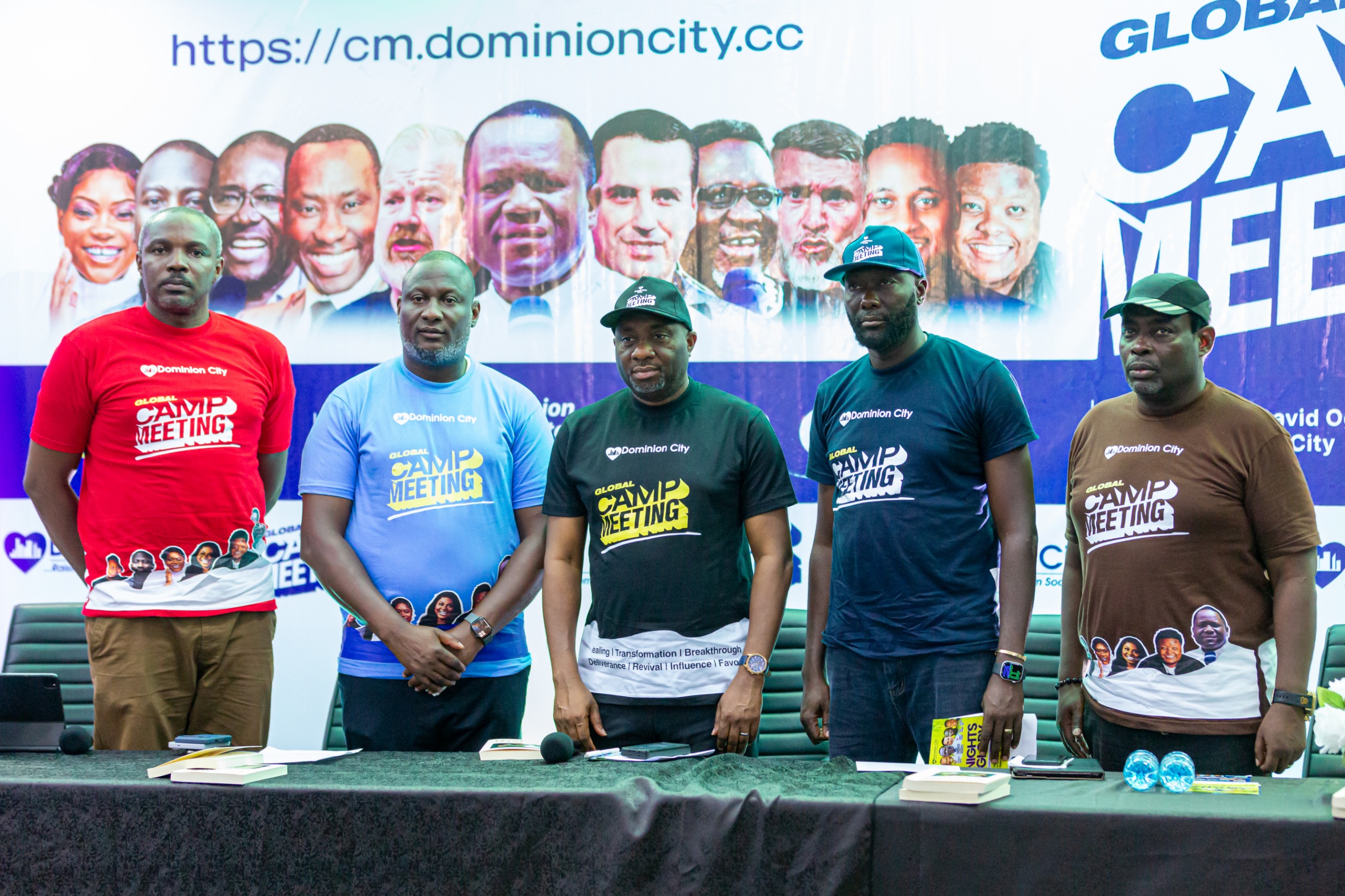
L-R: Dr. Godwin Efobi, Head, Medical Team, Dominion City Headquarters (DCHQ); Pastor Shola Olapade, Senior Pastor, DCHQ; Pastor Nobbert Onaga, President, Golden Heart Foundation and Senior Pastor, DC Lagos & Europe; Pastor Chuks Anochie, Head of Security and Traffic Control, Dominion City Headquarters (DCHQ), Camp Meeting 2026; Pastor Josh Tim Vaduchi, Head of Event & Programmes, DCHQ, during the press briefing of the forthcoming Global Camp Meeting, held the weekend of 2026 at the Dominion City Headquarters (DCHQ), Lagos.
L-R: Pastor Chuks Anochie, Head of Security and Traffic Control, Dominion City Headquarters (DCHQ), Camp Meeting 2026; Pastor Shola Olapade, Senior Pastor, DCHQ; Pastor Nobbert Onaga, President, Golden Heart Foundation and Senior Pastor, DC Lagos & Europe; Dr. Godwin Efobi, Head, Medical Team, DCHQ; and Pastor Josh Tim Vaduchi, Head of Event & Programmes, during the press briefing of the forthcoming Global Camp Meeting, held over the weekend in 2026 at the Dominion City Headquarters (DCHQ), Lagos.


-

 society6 months ago
Religion: Africa’s Oldest Weapon of Enslavement and the Forgotten Truth
-

 news4 months ago
WHO REALLY OWNS MONIEPOINT? The $290 Million Deal That Sold Nigeria’s Top Fintech to Foreign Interests
-

 society6 months ago
“You Are Never Without Help” – Pastor Gebhardt Berndt Inspires Hope Through Empower Church (Video)
-

 celebrity radar - gossips2 months ago
Dr. Chris Okafor Returns with Power and Fire of the Spirit -Mounts Grace Nation Altar with Fresh Anointing and Restoration Grace on February 1, 2026