
Education
PROFER SOLUTIONS TO NIGERIA’S PROBLEMS, ABIODUN CHARGES NIGERIAN GRADUATES

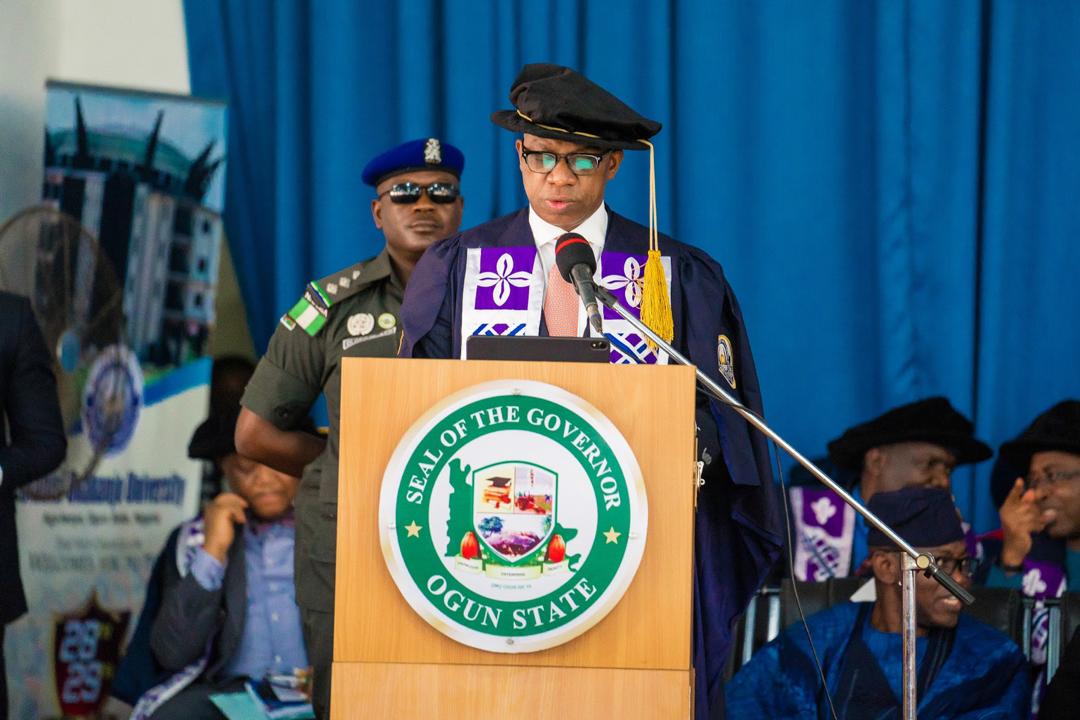
Ogun State Goverrnor, prince Dapo Abiodun, has urged NIgerian graduates to use the knowledge gained in their fields of study to proffer practical Solutions to the numerous challenges confronting the nation.

Goverrnor Abiodun who made the call at the 28th and 29th Convocation ceremony of the Olabisi Onabanjo University, Ago-Iwoye, said as those who had received both academic and moral training, it was expected of them to think of things that would benefit not them alone, but the society at large.

“One thing is sure, all of you are leaving the University with your certificates documents to go to the university of life where there is no paper certificate. Your certificates are what you can do for yourself and contribute to the be development of humanity.

“The University had inculcated in you neccessary employable skills, expertise and Technical competence needed to fit in and compete well in the outside world. Your education is to set you on the right path and make you a better global citizen”, he said.
He said though the University was facing some challenges, it has made tremendous achievements by ensuring interrupted academic calendar in the past eight years, expansion of academic Programmes, provision of hostel facilities and full digitalization of the University operations.

Prince Abiodun reiterated that as part of his admission’s agenda to build the State together, efforts have been made for a continued mutual benefit between the town and the institution, adding that it would continue to create and strengthen interface for cross fertilisation of ideas between industry and academia.
While appreciating the founding fathers of the University for laying a solid foundation, Goverrnor Abiodun empathized that to equip products of the State higher institutions with required competencies to face life challenges, government would continue to provide the enabling environment for its institution to achieve their objectives.
He congratulated the awardees for contributing to the development of the school and the society at large, calling on well meaning individuals, organizations and corporate bodies as well as alumni to partner wirh his administration in taking the school to greater heights.
In her welcome address, the Pro-Chancellor, Olabisi Onabanjo University, Mrs. Mosun Belo Olusoga who noted that the university had gone through massive infrastructural development in all of its campuses, advised the graduating students to be positive, proactive, focused and live their life with passion, adding that they should not be discouraged as they step into a new world.
The Vice- Chancellor, Olabisi Onabanjo University, Prof. Ganiyu Olatunji Olatunde in his remarks noted that discussions was currently ongoing with various corporate organizations on the need to construct 100 units of housing for staffs of the institution, which he said would boost the residential status of the institution, adding that the university under his charge had ensured prompt and regular payment of salaries.
He commended the state governor for approving the rehabilitation of the institutions internal roads, particularly the road leading to the Professional Chair Complex and the staff quarters, charging the graduating students to be worthy ambassadors of the institution.
Delivering his convocation lecture with the theme, ‘ The integrity Challenge in Nigerian Higher Education: Towards Creating a New Normal’, the Provost, Anti-Corruption Academy of Nigeria, Prof. Olusola Akinrinade who disclosed that corruption in the higher institution of learning is nothing new, added that corruption in any form is destructive to good governance and the overall welfare of the society.
Akinrinade noted that some of the best ways to tackle corruption in the higher institution, include implementing anti-corruption initiatives and structural reforms necessary to reduce the opportunity for corruption within the system, taking steps towards enhancing prevention mechanisms by entrenching good governance and transparency in their academic and administrative processes and implementating of sanctions and enforcing the rule against infractions.
Responding on behalf of the awardees, the Minister of Finance, Budget and National Planning, Mrs. Zainab Shamsuna Ahmed noted that the task of service to the nation is a collective one and a responsibility that everyone carries, adding that as a product and an alumni of the institution, she is glad to be associated with the relentless effort of the institution in producing some of the best brains that have made significant, social, economic and political development of the country.
Ahmed who commended President Muhammadu Buhari for taking the country out of recession in 2016 through the Nigeria Economic Recovery and Growth Plan, a medium term plan for four years,(2017-2020), added that the main ficus of the plan was to pull the economy out of recession and send the country back to the path of inclusive and sustainable growth.
She added that the Nigeria Economic Recovery and Growth Plan was also designed to diversify the economy, restore economic growth, create jobs, empower youths and develop human capital, as well as the development of infrastructure and improving the ease of doing business, adding that one key result of the plan, was that the country was able to exit recession quickly.
The Hon. Minister of Finance, Budget and Planning, Mrs Zainab Shamsuna Ahmed, the Olu of Ilaro and Paramount Ruler of Yewaland, Oba Kehinde Olugbenle and Major General Sansadeen Awosanya were awarded with Honorary Doctorate Degrees.
Ajayi Jesulayomi Opeyemi, from the department of Engineering and Chinozor Justice from the department of Basic and Medical Sciences graduated as the best students for the 2017/2018 and 2018/2019 sessions, the duo got automatic employment into the state civil service




Education
GIRAU INTERNATIONAL SCHOOL, MILLENNIUM CITY KADUNA, OPENS ADMISSION FOR THE 2025/2026 ACADEMIC SESSION

*GIRAU INTERNATIONAL SCHOOL, MILLENNIUM CITY KADUNA, OPENS ADMISSION FOR THE 2025/2026 ACADEMIC SESSION
Girau International School (GIS), a premier educational institution located in the heart of Millennium City, Kaduna, has officially announced the commencement of admissions for the forthcoming academic year. The school invites applications for its comprehensive educational streams: *Early Years, Primary, Secondary, and Islamiyya*.
Renowned for its unwavering commitment to academic excellence and holistic development, GIS stands as a beacon of learning in Northern Nigeria. The institution is built on a foundational philosophy dedicated to providing *world-class education* that meets international standards while being firmly rooted in positive cultural and moral values.
The school’s mission extends beyond conventional academics. With a dedicated focus on *nurturing young minds and shaping future leaders* of tomorrow, GIS employs a curated blend of innovative teaching methodologies, a blended curriculum, and state-of-the-art facilities. The environment is meticulously designed to ensure that every student excels *academically, socially, and morally*, preparing them to thrive in a dynamic global landscape.
*A CAPACITY FOR EXCELLENCE*
GIS boasts significant capacity to deliver on its promises:
* *Modern Infrastructure:* The campus features purpose-built, technologically integrated classrooms, advanced science and computer laboratories, expansive sports facilities, and dedicated learning spaces for creative and performing arts.
* *Qualified Faculty:* The school employs a team of highly trained, experienced, and passionate educators who are specialists in child-centered and participatory learning.
* *Blended Curriculum:* The academic programme seamlessly integrates the Nigerian/British curriculum ensuring international best practices, complemented by a strong emphasis on character building, leadership skills, and Islamic ethical teachings in its Islamiyya section.
* *Secure and Conducive Environment:* Situated within the serene and secure Millennium City layout, the school provides a safe, inclusive, and stimulating atmosphere ideal for learning and personal growth.
Prospective parents and guardians seeking an educational partnership that prioritizes excellence, discipline, and comprehensive development for their wards are encouraged to secure a place.
Admission forms are available at the school’s administration office. Early application is advised due to limited vacancies across all classes.


NIGERIA’S EDUCATION STRIDES, GLOBAL ACKNOWLEDGMENT: When Evidence Travels from Jigawa
…as President Tinubu set to commission Africa’s largest schools complex in Lagos
By O’tega Ogra
There is a quiet shift happening in Nigeria’s education system. You will not find it in speeches neither will you find it in long policy documents. But if you look closely, you will see it in something far more difficult to dismiss. Evidence.
Last week in San Francisco, at the Comparative and International Education Society (CIES) conference, data from classrooms in Jigawa State was presented before a global audience. Not projections. Not estimates. A record of what is happening inside a public system in Nigeria. 
That distinction matters. For years, much of what the world has understood about education in countries like ours has been assembled from a distance. National averages. Modelled estimates and reports written long after the fact. What was presented this time came from within. Attendance tracked daily. Teachers reassigned based on need. Classrooms observed as they function. All under a digitalised ecosystem.
In Jigawa, under the JigawaUNITE foundational learning digital programme, the numbers tell a simple story. Within roughly 150 days of implementation which commenced at the end of 2024, 95 previously understaffed schools were fully staffed. Pupil teacher ratio moved from 114:1 to 70:1. Daily attendance rose from 39 per cent to 77 per cent. This remarkable improvement was not achieved by expanding the workforce. It came from reorganising what already existed under a digital umbrella.
There is something instructive in that. Nigeria has never lacked policy. What we have often lacked is the discipline of execution. The ability to take what already exists and make it work as intended. That is where the real shift is beginning to show.
But it would be too convenient to reduce this to one programme.
At the federal level, the direction has also been adjusting. The Minister of Education, Dr. Maruf Tunji Alausa, has placed measurable outcomes, foundational learning, and teacher quality back at the centre of policy. UBEC, the Federal Government’s Universal Basic Education body, continues to drive national interventions around school improvement and teacher development, even as it insists that reform must remain system-led and not fragmented.
The First Lady’s education interventions, through the Renewed Hope Initiative, have reinforced education as a national priority, particularly around access, learning materials, and inclusion. These are different levers, but they are part of the same ecosystem.
And then there is the fiscal reality.
Recent reforms under President Bola Ahmed Tinubu have increased allocations to subnational governments, creating more room for states to act. In a federation like Nigeria, that matters. Because education is not delivered from Abuja. It is delivered in states. In schools. In classrooms.
What Jigawa has done is to use that room and the Executive Governor of the state, the State Universal Basic Education Board, and their partners on the JigawaUNITE project, New Globe, must be given kudos.
However, Jigawa is not alone in this journey.
In Kwara, efforts to align teaching with actual learning levels are beginning to correct a structural mismatch in classrooms. In Lagos and Edo, structured pedagogy and closer monitoring are improving consistency in teaching. Across the entire ecosystem, state governments, federal institutions like UBEC, and delivery partners like NewGlobe are pushing at the same question from different angles.
How do children actually learn better?
In a prior reflection, Ifeyinwa Ugochukwu, VP at NewGlobe, captured the urgency clearly. With the right tools, training, and use of data, foundational learning outcomes can improve at scale. The real risk, she noted, is delay, allowing learning gaps to become permanent.
That warning should not be ignored because the context remains difficult. Nigeria still carries one of the largest out of school populations in the world. Learning gaps remain. Progress in one state does not resolve a national challenge, but it does something else.
It proves that movement is possible.
What was presented in Washington did not claim success. It demonstrated function. It showed that a Nigerian sub-national can generate evidence that holds up in a global room. That reform does not always require something new. Sometimes it requires using what already exists more honestly and more efficiently.
The real question now is whether this remains an exception.
Or whether it becomes a pattern.
Because reform at scale is never built on isolated wins. It is built on systems that can reproduce them.
And perhaps that is why the timing matters.
This week, another subnational, Lagos State, is expected to commission the Tolu Schools Complex in Ajegunle, a sprawling 36-school integrated facility spread across 11.7 hectares, designed to serve over 20,000 students, and described as the largest school community in Africa. 
There is a connection here that should not be missed.
On one hand, a classroom system in Jigawa is learning how to organise itself better. On the other, a state like Lagos is building the physical scale required to carry thousands of learners at once.
One is structure. The other is capacity.
Real progress sits where both meet because education reform is not only about what we build, it is about how well what we build actually works.
For once, the data was not explaining Nigeria from the outside.
It was coming from within.
And it carried weight.

FAB Luxury Court Sets A Rare Benchmark For Excellence In Africa
~By Oluwaseun Fabiyi
Fab Luxury Court distinguishes itself as the premier choice for reliable investors and proactive developers in Nigeria and Africa.While numerous real estate entities operate within the country, Fab Luxury Court stands out for its exceptional honesty and integrity, delivering on the promises showcased on its social media page to distinguished customers globally.
As of now, no investors, whether domestic or international, have expressed regret over investing in or partnering with Fab Luxury Court. The company’s commitment to accessibility, accountability, and transparent financial reviews sets it apart from its contemporaries, rendering it a prized asset among its extensive clientele worldwide. Thousands of customers continue to patronize Fab Luxury Court due to its impeccable integrity and visionary approach.
*Why is Fab Luxury Court a worthwhile investment that warrants prompt consideration rather than hesitation?*
Fab Luxury Court’s security measures are exemplary and deserving of commendation, providing investors with capital protection through a robust structured framework, transparent reporting, and comprehensive legal documentation, thereby guaranteeing outstanding and secure returns.
Fab Luxury Court has further cemented its position as a leading developer and real estate powerhouse in Nigeria and Africa, currently managing several high-end estates in Maryland, Ikeja, Lagos and its surrounding areas.Fab Luxury Court demonstrates its unwavering commitment to excellence in Nigeria’s real estate sector through its best-selling estates in Ikeja.
Undoubtedly, partnering with and patronizing Fab Luxury Court will significantly contribute to securing your future; as you plan to associate with them in 2027, we encourage you to maintain a positive outlook and unwavering confidence in your future wealth.


- Century Group Joins African Energy Week (AEW) 2026 as Floating Production Storage and Offloading (FPSO) Partner, Showcasing Regional Offshore Expansion April 10, 2026
- Climate Litigation Surge Reshapes Energy Policy as Africa Seeks Stronger Legal Voice April 10, 2026
- ES-KO Secures Five-Year Catering & Facilities Management Contract Renewal with TotalEnergies EP Congo April 10, 2026
- Beyond the Court: The Kalahari Conference Solidifies its Status as Africa’s Premier Sports & Lifestyle Destination April 10, 2026
- Africa Sports Unified Launches Pan-African Sports Deals Tracker to Improve Market Visibility and Decision-Making April 10, 2026
- Nigeria and Senegal Must Follow Ghana and Mozambique Against Exclusionary Practices April 10, 2026
- Sheraton Nouakchott marks the entry of Marriott International in Mauritania April 10, 2026
- Eritrea: Seminar to Nationals in Nairobi and Its Environs April 10, 2026
- African financial institutions call for coordinated financing solutions to unlock Africa’s digital transformation April 9, 2026
- African Energy Chamber (AEC) Supports Perenco Partnership to Advance Industry 4.0 Skills in Central Africa April 9, 2026
- Century Group Joins African Energy Week (AEW) 2026 as Floating Production Storage and Offloading (FPSO) Partner, Showcasing Regional Offshore Expansion April 10, 2026
- Climate Litigation Surge Reshapes Energy Policy as Africa Seeks Stronger Legal Voice April 10, 2026
- ES-KO Secures Five-Year Catering & Facilities Management Contract Renewal with TotalEnergies EP Congo April 10, 2026
- Beyond the Court: The Kalahari Conference Solidifies its Status as Africa’s Premier Sports & Lifestyle Destination April 10, 2026
- Africa Sports Unified Launches Pan-African Sports Deals Tracker to Improve Market Visibility and Decision-Making April 10, 2026
- Nigeria and Senegal Must Follow Ghana and Mozambique Against Exclusionary Practices April 10, 2026
- Sheraton Nouakchott marks the entry of Marriott International in Mauritania April 10, 2026
-

 news4 months ago
WHO REALLY OWNS MONIEPOINT? The $290 Million Deal That Sold Nigeria’s Top Fintech to Foreign Interests
-

 society7 months ago
“You Are Never Without Help” – Pastor Gebhardt Berndt Inspires Hope Through Empower Church (Video)
-

 celebrity radar - gossips2 months ago
Dr. Chris Okafor Returns with Power and Fire of the Spirit -Mounts Grace Nation Altar with Fresh Anointing and Restoration Grace on February 1, 2026
-

 celebrity radar - gossips4 months ago
Prophet Kingsley Aitafo Releases 2026 Prophecy: ‘Nigeria Will Rise, but the World Must Prepare for Turbulence’