Connect with us

society

RESIDENTS URGE IGP TO INVESTIGATE POLICE OFFICER OVER INVASION OF ENUGU COMMUNITY WITH THUGS

Published

on

RESIDENTS URGE IGP TO INVESTIGATE POLICE OFFICER OVER INVASION OF ENUGU COMMUNITY WITH THUGS.


By Our Reporter
For allegedly Invading his own community with thugs, brutalizing and inflicting grievous injuries to his cousin and a widow, over his desire to grab a coconut tree, Residents of Achi Agu community in the Oji River area of Enugu State,  have appealed to the Inspector – General of Police, IGP Usman Alkali Baba, to investigate and prosecute the erring  Sargent Daniel Ikechukwu Mgbejiofor.
 In what was described by their community leaders,  as a case of  ” Brothers Against Brother “, Police in Enugu, it was learned, has declared a manhunt for the Serving  Police Seargent in Abuja, Daniel Mgbejiofor, with Force Numbers F/512231, who allegedly inflicted grievous bodily harm on his half brother and willfully destroyed properties of his relative, after he was said to have invaded his village with some thugs, over a coconut tree dispute with a widow.
Seargent Mgbejiofor, who was later found to be a Specialist Police Officer attached to the  Logistics and Supplies (works Department) Abuja, Under  Commissioner of Police,  CP Shuaibu, was said to have evaded arrest and escaped from  Enugu State, back to  Abuja,  when the Oji River Police  Division, despatched an invitation letter requesting his presence over the case of  ” Conspiracy /Assault ” preferred against him.
According to the Investigation  Police Officer, IPO,  Corporal Kingsley  Nnaji, ” Seargent Daniel Mgbejiofor and his group are yet to be apprehended, after the incident that happened in Enugu – Agu Achi, Oji River Local government Area.”
 ” We gave his community chairman and the community security an invitation that if they see them, that they should bring them down to the station, they should invite them. We learned that they are not stable, they are not staying at home, they came back and after the issue, they went back again. we would have rooted his invitation through his office in Abuja, but we don’t have his force numbers, without which, we can not do much. what I extracted from the crime diary is Assault occasioning harm, wounding and malicious damages “, Nnaji said.
One of the victims of the alleged invasion, Mr. Chukwuebuka  Mgbejiofor, who was said to have been brutalized by Daniel,  stated  that  ”  Seargent Daniel had invaded my house on Good Friday, April 2nd, 2021 at about 6pm, in the company of his two  biological brothers, Godwin, Chinedu and three other  unidentifiable hefty men, demanding for an apology from me, over what he claimed was my role in the coconut tree dispute between his father Mr. Ephraim Mgbejiofor and  my widowed mother, Mrs. Philomena Mgbejiofor , I refused to follow them to apologize to his father because I told him that I never insulted or assaulted his father and that I didn’t do any wrong by saving the poor widow Philomena, who was being beaten up by his father Ephraim “
Narrating further his ordeal in the hands of the Seargent and his group, Chukwuebuka recalled that March ending, he was slapped severally by the Sergeants father,  Ephraim, for daring to separate him from beating up his widowed mother, over the right to plucking from a coconut tree belonging to another late uncle named  Ebenezer  Mgbejiofor.
  ” I pushed my mother away from him and he got angry asking if I was trying to challenge him, my uncle Ephraim went home and lied to his children that I challenged him and his children called me and threatened to deal with me whenever they come home. So, on Good Friday,  immediately I came back from work and was sweeping our compound, I heard sounds of motorcycles, suddenly Sargent’s Daniel entered our backyard with his group and they started beating me, broke our chairs and used the  broken pieces to injure me, just because I refused to follow them to go and apologize and beg their father for the offense I didn’t commit.”
“As if the earlier beatings and injuries were not enough, they came again on April 7th,2021, to my place of work and continued their beating, because they said that I refused to apologize to their father, after one week grace they gave to me. They attacked me, wounded me, and continued the beating until I fainted and they left me there in the pool of my blood until a good Samaritan from our community named killer Joe Uzo despatched a car that brought me to his house and after taking photographs of my injuries with his phone, he called the DPO  of Oji River Police Division, informing him that I was coming to make a formal report”.
“At Oji River Police Division, they took my photographs and statements and asked me to go and take care of myself as the people that committed the crimes had fled. They now gave me police invitation letters for the Sargent and brothers, which I sent through the chief security Officer of our community.”
According to the 26years old Tiller, Despite the trauma, intimidation, injuries inflicted on him and his mother by the Ephraim Mgbejiofors family, Ephraim has unlawfully through malicious prosecution, gone to a customary, and Magistrate court to secure an improper eviction order aimed at quitting them from his late father’s brother, Ebenezer’s house, where they are residing since his father’s death, Claiming that as the oldest surviving son of late Mgbejiofor,  he owns everything in the family.
He appealed to the Governor of Enugu State, His Local Government Chairman and the Inspector – General of Police, IGP Usman Alkali Baba, to call for proper and independent investigations, with a view to protecting their lives and granting him and his widowed mother justice.
“I have been on medical treatment since then and the suspects have refused to surface in our village again, rather his father is making life unbearable for us in our own house “, Chukwuebuka said.
In an interview with the village head, Nze Cyril Obitulata, he frowned at the move by Ephraim to evict the widow, Philomena, and his son from  Late Dr. Ebenezer Mgbejiofors house.
Collaborating the allegation of unlawful eviction against the widow,  Nze  Obitulata, declared that the house in dispute does not belong to Sergeant Daniel’s father, Ephraim Mgbejiofor .
” I have spoken to Ephraim informing him that he has no  ‘ locus stand’ to evict the widow,  because, he is not the rightful owner of the house. For the fact that the deceased Philomena’s husband is late, they had children who are alive. I have told Ephraim to leave the property alone but he is still pursuing it and I don’t know why”, he lamented.
 “It is the property of late Dr. Ebenezer Mgbejiofor , who had his own children, who are supposed to inherit the house or any other person from his lineage, has more claims over the house than any other person from any other group,” Nze said.
Lamenting further over Ephraims contest on the property, the Village Leader, who is also an Engineer, said thus:  ” I don’t know why Ephraim is contesting with the widow,  Philomena, over that property,I have told him severally to leave the house alone.
For the coconut tree,  I don’t know much, I heard that they planted it for one of Ebenezer’s sons and if so, it means that Ebenezers son owns it by our tradition, just as the compound belongs to them. “
Speaking on earlier attempts to reconcile the disputing families, he confirmed that he had tried in the past to bring the two families together so that peace will reign in the community.
 ” I didn’t go to the village during the  Easter holiday, I was in Enugu. I heard of the matter concerning fighting,  though nobody reported it officially to me. I don’t know much about the case, but I was told that there was a fight “.
” In our tradition, when a man marries two wives, after his demise, the first son of the first wife is the real owner of the house. I have told Ephraim that he has no right to evict Philomena from that house because she has the consent of Ebenezers late wife and children to stay there,  he Concluded.
 When our Correspondent contacted Sargent  Daniel, he denied all the allegations against him, claiming that he was not aware of any invitation from the police.
” All these things are just mere allegations. Chukwuebuka is my cousin, actually, we have problems in the family, which I traveled down to the village as a peacemaker during the Easter celebration. Though we scheduled a family meeting I was disappointed that only a few people came. I was surprised to see these allegations. My father has no issues with Philomena and it’s on record that Philomena’s husband divorced her. before his death “, he said.
The police officer also said that there was no fighting between him and the victim. ” I can’t fight Chukwuebuka because I am about 20 years older than him. I only visited him with my brothers for discussion, after I had called him over on phone to my house, but he didn’t come. He even came to apologize to my father and we made peace, there was no beating and I don’t know how he got bruises”, he stated.

society

PROFESSIONAL PROFILE OF CHINEDU NSOFOR (CEO, WORK WHILE IN SCHOOL GROUP)

Published

on

PROFESSIONAL PROFILE OF CHINEDU NSOFOR (CEO, WORK WHILE IN SCHOOL GROUP)


Chinedu Nsofor is a dynamic and seasoned technocrat, a visionary social worker, an International Development Expert, and an accomplished programmes development and management expert with over 15 years of diverse professional experience. He is a trailblazer in youth empowerment, job creation, and social innovation, renowned for his creative problem-solving skills and unmatched ability to transform challenges into sustainable opportunities.


PROFESSIONAL PROFILE OF CHINEDU NSOFOR (CEO, WORK WHILE IN SCHOOL GROUP)


With a strong academic foundation—holding a B.Sc. in Social Work from the University of Nigeria, Nsukka, and an M.Sc. in Social Work (Industrial Social Welfare) from Ladoke Akintola University of Technology, Ogbomoso—he combines intellectual depth with practical expertise. His distinguished career reflects his unwavering commitment to tackling unemployment in Nigeria, a mission he has pursued through pioneering initiatives such as the Work While in School Programmes, the IMOFINTEC project for 5,000 youths, and several other impactful programmes across tertiary institutions, government bodies, and international organizations.


Recognized as a versatile project management expert, innovative business development strategist, creative writer, professional biographer, media consultant, and Wikipedian, Nsofor’s influence extends across social, economic, and academic spheres. His professional track record includes leadership roles in reputable organizations such as the Nigeria Association of Economists, Global Coalition for Sustainable Environment, Iwuanyanwu Foundation, the Imo State Government Committee on Science and Technology Roadmap (2020–2030), and Asia Pacific Sports International, where he has served as Nigeria’s Programmes Director.


Heiss is also currently the Country Director (Nigeria), RapidHeal International, a health intervention firm with its global headquarters in Malaysia. Beyond his rich portfolio, he is celebrated for his divine wisdom, inspirational leadership, and Midas touch in wealth and job creation, having directly empowered over 50,000 youths across Nigeria with life-transforming skills. Passionate, resourceful, and impact-driven, Chinedu Nsofor stands out as a nation-builder whose contributions continue to shape lives and institutions to the glory of God.

Continue Reading

Politics

Customs at the Crossroads: When Lawmakers Look Away and the Executive Looks Aside

Published

on

Customs at the Crossroads: When Lawmakers Look Away and the Executive Looks Aside

Customs at the Crossroads: When Lawmakers Look Away and the Executive Looks Aside


By Dr. Bolaji O. Akinyemi


In a democracy, legislative oversight is the scalpel that cuts through deceit, inefficiency, and corruption in public institutions. It is the people’s last institutional shield against abuse of power. But what happens when that shield becomes a shelter for the very rot it is meant to expose? And what happens when the Executive arm, whose duty is to supervise its agencies, pretends not to see?


Customs at the Crossroads: When Lawmakers Look Away and the Executive Looks Aside


The unfolding drama between the National Assembly and the Nigeria Customs Service (NCS) reveals more than a policy dispute. It exposes a dangerous triangle of confusion, complicity, and economic sabotage. At stake is not only the rule of law but the survival of an economy already gasping under inflation, a weak naira, and suffocating costs of living.


The House Talks Tough


In June 2025, Nigerians saw a glimpse of legislative courage when the House of Representatives Committee thundered at Customs:

> “Nigerian Customs Service, by June 30, must not collect CISS again. You are to collect only your 4% FOB assigned by the President. Even the 7% cost of collection you currently take is illegal—it was an executive fiat of the military, not democratic law. Any attempt to continue these illegal collections will be challenged in court. The ‘I’s have it.”

The voice was firm, the ruling decisive. Nigerians expected a turning point.

But the righteous thunder of the House was quickly muffled by the Senate’s softer tone, which suggested not the enforcement of the law but a readiness to bend it.


Senate: Oversight or Escape Route?


At a Senate Customs Committee session, Senator Ade Fadahunsi admitted openly that Customs has been operating illegally since June 2023. Yet rather than demand an end to illegality, he extended a lifeline to Comptroller-General Bashir Adeniyi:

> “If we come back to the same source… the two houses will sit together and see to your amendment so you will not be walking on a tight rope.”


But should Adeniyi be handed a loose rope while Nigeria’s economy hangs by a thread?

Instead of accountability, the Senate Customs Committee floated adjustments that would make life easier for Customs. The nation was given hints about fraudulent insurance and freight data, but instead of sanctions, what we saw was a search for escape routes. This is not oversight—it is overlook.


Smuggling and Excuses


The Senate Committee also lamented cross-border smuggling—Nigerian goods like cement flooding Cotonou, Togo, and Ghana at cheaper prices than in Nigeria. Senator Fadahunsi blamed the Central Bank’s 2% value deposit for encouraging the practice.

But where are the Senate’s enforcement actions—compliance checks, stiffer sanctions, cross-border coordination? None. The result is predictable: smugglers prosper, reserves bleed, and ordinary Nigerians pay more for less.


A Bloated Customs Budget


The Service’s 2024 capital allocation ballooned to ₦1.1 trillion from ₦706 billion. Instead of channeling these resources into modern trade systems, Customs is expanding empires of frivolity—such as proposing a new university despite already having training facilities in Gwagwalada and Ikeja that could easily be upgraded.


Oversight is not an afterthought; it is the legislature’s constitutional duty. To see waste and illegality and yet propose amendments that would legalise them is to turn oversight into overlook.


Customs has about 16,000 staff, yet many remain poorly trained. Rather than prioritise capacity building, the Service is busy building staff estates in odd locations. How does Modakeke—an inland town with no border post—end up with massive Customs housing projects, while strategic border towns like Badagry, Idiroko, and Saki remain neglected? Is Bashir Adeniyi Comptroller-General of Customs—or Minister of Housing?


The 4% FOB Levy: A Policy Blunder


The central controversy is the Federal Government’s plan to replace existing port charges with a new 4% Free-On-Board (FOB) levy on imports.

Nigeria is an import-dependent nation. This levy will instantly hike the costs of cars, spare parts, machinery, and raw materials—crippling industries and punishing consumers.

Already, the consequences are biting:

A 2006 Toyota Corolla now costs between ₦6–9 million.

Clearing agents who once paid ₦215,000 for license renewal must now cough out ₦4 million.

New freight forwarder licenses have jumped from ₦600,000 to ₦10 million.

Customs claims the revenue is needed for its modernisation programme, anchored on a software platform called B’Odogwu. But stakeholders describe this so-called “Odogwu” as epileptic—if not comatose. Why commit trillions to a ghost programme that will be obsolete by January 2026, when the Nigerian Revenue Service is set to take over Customs collections?


Industry Raises the Alarm


The Manufacturers Association of Nigeria (MAN) has warned that the levy will worsen inflation, disrupt supply chains, and hurt productivity.

Lucky Amiwero, President of the National Council of Managing Directors of Licensed Customs Agents, calls the levy “economically dangerous.” His reasoning is straightforward:

The 4% FOB levy is much higher than the 1% CISS it replaces.

Peer countries like Ghana maintain just 1%.

The new levy will fuel inflation, raise the landed costs of goods, and destabilise the naira.

He also revealed that the Customs Modernisation Act, which introduced the levy, was passed without Senate scrutiny or meaningful stakeholder consultation. He estimates that the levy could add ₦3–4 trillion annually to freight costs—burdens that will be transferred directly to consumers.


Who Is Behind the “Odogwu” Masquerade?


The haste to enforce this levy, despite its looming redundancy, raises disturbing questions. Who benefits from the “Odogwu” project draining trillions? Why the rush, when NRS will take over collections in a few months?

This masquerade must be unmasked.


The Price Nigerians Pay

For ordinary Nigerians, this policy translates into one thing: higher prices. Cars, manufactured goods, and spare parts are spiraling beyond reach. A nation struggling with inflation, unemployment, and a weak currency cannot afford such reckless experiments.

So, while the Senate looks away, the Executive cannot look aside.

The Executive Cannot Escape Blame.


It is easy to focus on the failings of the legislature. But we must not forget: the Customs Service is an agency of the Federal Ministry of Finance, under the direct supervision of the Honourable Minister of Finance, Mr. Wale Edun.

If Customs is breaking the law, wasting resources, or implementing anti-people policies, the buck stops at the Executive’s table. The Minister of Finance is Chairman of the Customs Board. To fold his hands while the Service operates in illegality is to abdicate responsibility.

History gives us a model. In 1999, the Minister of State for Finance, Nenadi Usman, was specifically assigned to supervise Customs and report directly to the President. Meanwhile, Ngozi Okonjo-Iweala focused on broader fiscal and economic policies. That division of responsibility improved accountability. Today, the absence of such an arrangement is feeding impunity.

President Tinubu and his Finance Minister must act decisively. Oversight without executive will is a dead letter.

A Call to Accountability

The truth is stark:

Customs has been operating illegally since June 2023 to the Senate’s own confession.

The 4% FOB levy will deepen inflation and worsen economic hardship.

The Ministry of Finance bears ultimate responsibility for Customs’ conduct.

Until importing and consuming, Nigerians demand accountability—of the Comptroller-General, the Senate, and above all, the Finance Ministry—this bleeding will continue.

Nigerians deserve better. They deserve a Customs Service that serves the nation, not a privileged few. They deserve a House that enforces its resolutions, not one that grandstands. They deserve a Senate that upholds the law, not one that bends it. And above all, they deserve an Executive that does not look aside while illegality thrives under its ministry.

Only public pressure can end this indulgence. If Nigerians keep silent, we will keep paying the price—in higher costs, weaker currency, and a sabotaged economy.

Citizens’ Charge: Silence is Not an Option

Fellow Nigerians, the Customs crisis is not a drama for the pages of newspapers—it is a burden on our pockets, our businesses, and our children’s future. Every illegal levy is a tax on the poor. Every abandoned oversight is an open invitation to corruption. Every silence from the Executive is an approval of impunity.

We cannot afford to fold our arms. Democracy gives us the power of voice, the duty of vigilance, and the right to demand accountability. Let us demand that:

The Senate and House of Representatives stop playing good cop, bad cop, and enforce the law without compromise.

The Ministry of Finance takes full responsibility for the Customs Service, supervising it in the interest of Nigerians, not vested interests.

The President intervenes now, before the Service crosses the dangerous line of turning illegality into policy.


History will not forgive a people who suffered in silence when their economy was bled by recklessness. Silence is complicity. The time to speak, to write, to petition, to protest, and to demand is now.

Customs must serve Nigeria—not sabotage it.

Dr. Bolaji O. Akinyemi is an Apostle and Nation Builder. He’s also the President of Voice of His Word Ministries and Convener Apostolic Round Table. BoT Chairman, Project Victory Call Initiative, AKA PVC Naija. He is a strategic Communicator and the CEO, Masterbuilder Communications.

Email:[email protected]
Facebook:Bolaji Akinyemi.
X:Bolaji O Akinyemi
Instagram:bolajioakinyem

Continue Reading

religion

Apostle Johnson Suleman: Firebrand of Faith, Prophet to the Nations, Voice to a Generation

Published

on

Apostle Johnson Suleman: Firebrand of Faith, Prophet to the Nations, Voice to a Generation

Apostle Johnson Suleman: Firebrand of Faith, Prophet to the Nations, Voice to a Generation


By Femi Oyewale


In the beginning, there was just one man with a burning vision. Today, that man has become a global force whose voice thunders across continents, whose prayers ignite miracles, and whose mission is transforming destinies worldwide. He is Apostle Johnson Suleman, the fiery Restoration Apostle, the humanitarian preacher, and the global trailblazer reshaping the Christian faith for a new generation.


Apostle Johnson Suleman: Firebrand of Faith, Prophet to the Nations, Voice to a Generation


From Auchi to the World


Born in Auchi, Edo State, Nigeria, Apostle Suleman’s rise from humble beginnings to international prominence is nothing short of remarkable. What started as a divine calling has now evolved into a global mandate, reaching millions through Omega Fire Ministries International (OFM).


His story is the classic tale of vision meeting conviction—of a man who dared to believe God not just for himself, but for nations. From a modest congregation, OFM has spread like wildfire, with branches in Africa, Europe, Asia, the Americas, and beyond.


The Man & The Mission


Apostle Johnson Suleman: Firebrand of Faith, Prophet to the Nations, Voice to a Generation


To know Suleman is to understand passion—passion for God, for people, and transformation. He lives by one mantra: populate Heaven, depopulate Hell.


His pulpit is a battlefield, his voice a trumpet, his words a sword. Through his fiery sermons, prophetic declarations, and healing crusades, countless men and women testify of divine encounters—cancers healed, destinies restored, impossibilities overturned.


But beyond the pulpit lies the heart of a humanitarian. Suleman’s mission has always extended beyond preaching. He funds scholarships for the underprivileged, empowers widows with homes, sets up businesses for struggling families, and supports countless orphans. In times of crisis, he has sent relief materials across regions, proving that true ministry is not only heard—it is seen.


The Impact


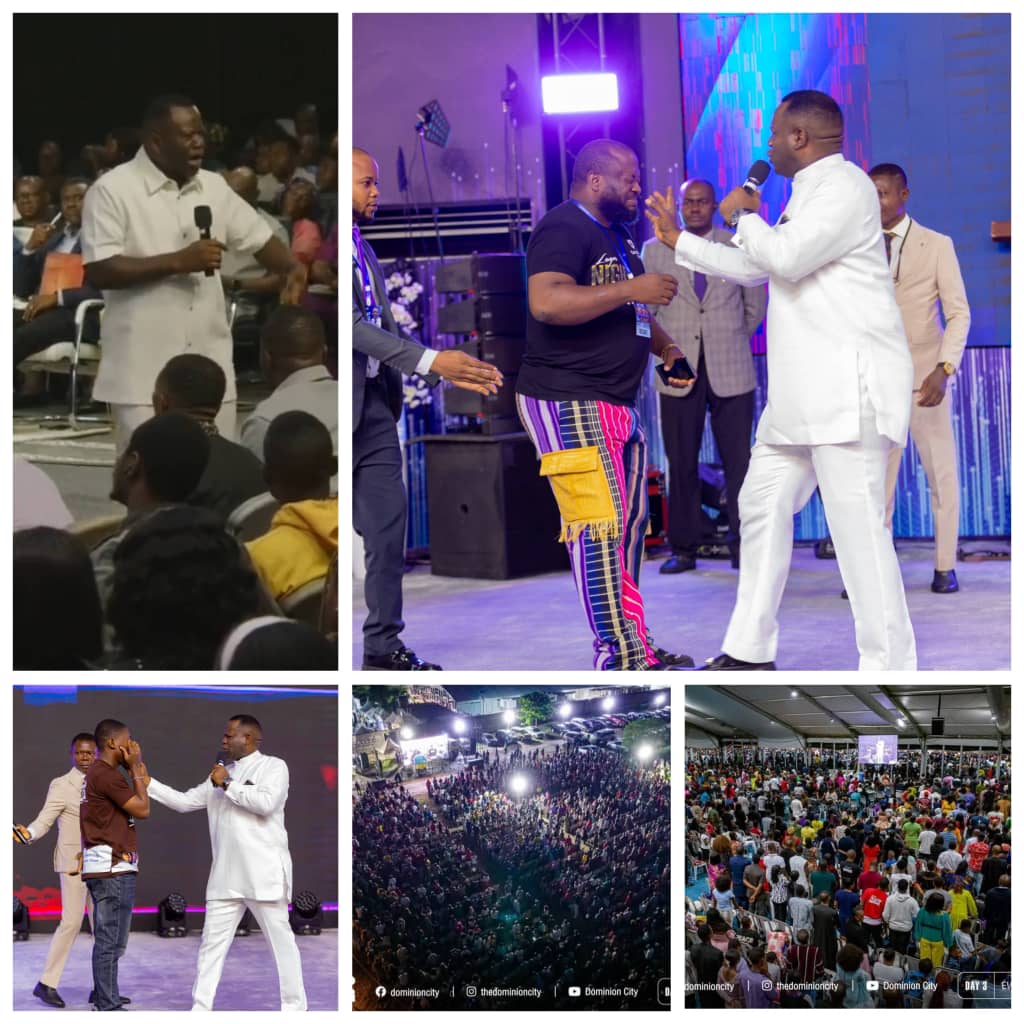
Step into one of his crusades, and the atmosphere tells its own story. Stadiums overflow. Multitudes gather, hungry for hope. From London to Houston, Dubai to Johannesburg, crowds testify to healings, deliverance, and restoration.


Through Celebration TV and other digital platforms, Suleman’s voice penetrates homes, villages, and cities, giving access to millions who may never step into a physical church. His boldness in confronting social ills and speaking truth to power has also established him as a fearless voice beyond the church walls.


The Global Moves


Apostle Suleman is not just a Nigerian voice—he is a global phenomenon. His recent international crusades draw audiences in their tens of thousands, breaking barriers of race, culture, and language.


From prophesying to presidents to laying hands on ordinary citizens, his message is universal: God still speaks, God still heals, God still restores.


Each global tour solidifies his place as one of the most influential Christian leaders of the 21st century. He is as comfortable commanding a crowd in Chicago as he is in Accra, as bold in Paris as he is in Abuja.


The Legacy in Motion


Apostle Johnson Suleman is more than a preacher—he is a movement. A man consumed by vision, driven by compassion, and equipped with an anointing that refuses to be confined by borders.


From Auchi to America, from pulpits to palaces, from widows to world leaders, his impact is undeniable. And as the Restoration Apostle continues to blaze trails across nations, one thing is certain: his legacy is still unfolding, and his global moves have only just begun.


Continue Reading

Cover Of The Week

Trending