Connect with us

celebrity radar - gossips

Stakeholders Offer Security Options At NAOSRE Dinner Night

Published

on

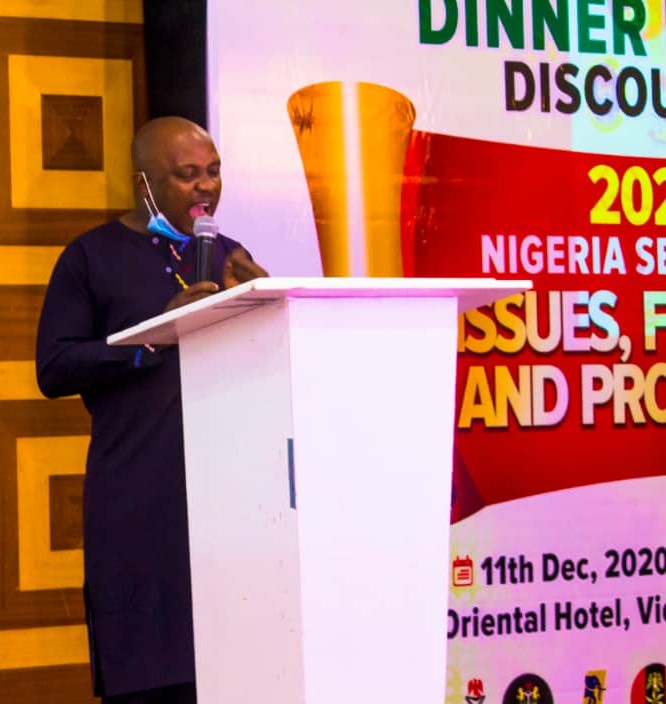
A special security event convoked by the leadership and members of the National Association of Online Security Reporters (NAOSRE) on December 11 in Lagos, 2020, brought new light on the insecurity bedeviling Nigeria. 
The brainstorming event––NAOSRE’s maiden Dinner Night and Discourse–– was organized by the body’s new executives that took over the helm of affairs barley two months ago, specifically on October 29.
NAOSRE’s members comprised professional journalists with strong media credentials who have worked with the conventional media and are now reporting on digital platforms, some of them, Nigeria’s finest hands in security reportage.
Established with the main objective to provide accuracy, transparency in relaying security news, the association also stands as the long expected information bridge between citizens and security agents.
To this end, it has successfully established a sustainable working relationship with key security players in the corporate world and security agencies in Nigeria, including but not limited to the Nigerian Army, Nigerian Navy, Nigerian Air Force, Nigeria Police Force and Nigeria Customs Service as well as Federal Road Safety Corps.
Without doubt, NAOSRE’s clout in Nigeria’s security stratosphere was displayed by the event of December 11, which, as it were, has passed into history as a watershed in the annals of security discourse in the country.
The Dinner Night and Discourse drew participants, guests and speakers from the safety and security agencies, the legislative arm of government, traditional leadership and corporate organizations and of course, the media––both traditional and the digital media.
Interestingly, the evening of intelligent discourse with a theme: “2021 Nigeria Security: Issues, Funding and Prospect,”  unlocked a plethora of security solutions and ideas.
Expectedly, the convergence of key players in the security circle opened the windows set of suggestions which  would embellish 2021 security policy formulation and implementations in a manner  that Nigeria would be one of the secured countries on the continent.
Femi Oyewale,  NAOSRE’s President, in his welcome address, set the tone for the event:
“Today’s security discourse was birthed out of the need to address the security issues in Nigeria, bearing in mind that 2020 has been a very tough year for citizens, businesses and indeed, the security sector.”
Oyewale’s remark was, unmistakably, the needed bullet that  hit the bull’s eye, considering the various security challenges that reared up in the course of the year, culminating in the catharsis of the #ENDSARS protest.
It  provided room for elaborate sharing of ideas  and offered a 360-degree view of Nigeria’s security apparatus. Each security apparatus spoke on the unique challenges confronting their efficiency on the job, as well as also informed the public about the gains and the good strides that have been achieved by their respective organisations.
From the Federal Road Safety Corps, FRSC, came a detailed analysis of the use of hi-tech speed sensors to check recklessness of drivers on Nigerian roads, and thus secure road transportation in the country.
Superintendent Route Commander, SRC, E. Olasehinde who represented Bisi Kazeem, the spokesman for the Commission,  elaborated the professional working abilities of  Corps Marshal of the Federal Road Safety Corps (FRSC), Dr Boboye Oyeyemi. He  disclosed that the Corps has  “Embraced technology in all its  operations.”
He hinted that a drivers’ license issued by FRSC  in Nigeria can validate a user’s  driving permission  across many countries in the world. He however sued for strict adherence to driving rules and codes by road users to mitigate the growing list of disasters on Nigerian roads.
The National Public Relations Officer  of the Nigeria Customs Service, NCS,  Deputy Comptroller Joseph Attah, gave a wide-angle view of the new developments.  “We are not relenting. We continue to do our best to drastically reduce smuggling to the barest minimum,” he assured.
Represented by  Uche Ejesieme, PRO Tin Can Island Port, the Customs Service elaborated its deployment of intelligence in the discharge of its duties at all the country’s points of entry.
The Customs particularly advocated for synergy among security agents in view of the multifaceted dimensions of border security.
Superintendent  Adebisi Adewunmi, who represented Commissioner of Police,  Lagos State Police Command, Hakeem Odumosu, highlighted: “There is need to spend money and there is need to inject more funds in the security apparatus from military to the Police.”
Speaking further, he said: “In Lagos, Policemen work 24/7. They are overstretched. But with proper funding, everyone will sleep with their eyes closed.”
Adewunmi, however, noted that the work of the police is further made difficult by online mischief-makers who created unnecessary panic. “Please join hands with the police, tell us our wrongs, but don’t encourage sensational journalism that can further breach the peace in society,” he appealed to NAOSRE.
Adewunmi acknowledged the positive development arising from  the fallout of the #ENDSARS protest: “We have been promised an improved salary and retirement package.”
Major Osoba Olaniyi, who represented Brigadier General  Sagir Musa, Acting Director, Army Public Relations, disclosed that “Nigerian Army is conducting internal security operations in 34 states.”
Major Olaniyi, Acting Deputy Director, 81 Division Army Public Relations, explained: “We accept criticism because we are a professional institution. However, what we don’t want is casting aspersion on us, because it has the tendency to weaken the resolve of those still fighting and dishonour the memories of our fallen heroes; it also has the tendency to undermine national unity.”
Olaniyi, responding to concerns raised about members of Police and Army impunity when dealing with civilians affirmed:  “Irrespective of whatever uniform we wear, we still share the same humanity with members of society. And we shall try to remain humane with you.”
Both the Police and Army agreed that there are bad eggs among their operatives.
“The military is still high on discipline. We still don’t condone indiscipline,” Major Olaniyi who speaks for  Army formations in  both Ogun and Lagos States,  asserted.
He nonetheless advised the  public to report cases of infractions to 81 Division and 9th Brigade, stressing that Lieutenant General Tukur Buratai, the Chief of Army Staff, has zero tolerance for indiscipline among officers and men especially in relating with the general public.
Corroborating Major Osoba’s submission, Superintendent Adewunmi added that: “There will always be Judas among people. The same applies to the Nigeria Police. But be assured that we are doing all we can to train our men on how to relate with the public.”
He gave the anecdote of how some communities rose to protect Police officers and prevented  attacks on police stations located in their neighbourhood. “Citizens should imbibe the spirit of supporting security agents at all times,” he requested.
Various speakers from the non-security sector further expanded the evening discourse.
Dr Tony Akposheri, veteran Nollywood actor, who represented Prince Honourable Ned Nwoko, Grand Patron, NAOSRE, pointed out that the public has roles to play in the security of our society.
“We cannot leave everything to the government,” he noted and further submitted: “Nigerian security discourse is timely at this time of our nation, not the issue of sacking service chiefs; if they are sacked and the right things are not in place the situation will not improve.”
Dr Akposheri  noted further that: “Our security personnel are not adequately well taken care of and the number of security operatives in this country is not adequate,” he said, pointing out other deficits including working with obsolete tools and technology.
In his view, “Children of security agents should enjoy free education from primary school to university.” This, he averred, would boost the morale of security operatives.
“We are not happy with the state of the Nigerian Police. They are not well remunerated. There should be transparency in what goes to them as earnings and allowances,” Akposheri declared.
Barrister Yinka Oguntimehin who represented Aare Ona-Kakanfo of Yoruba land, Otunba Gani Adams, dwelt on how the police institution has decayed over time. He recounted the heart-breaking revelations on a recent radio programme  about the poor salary of policemen.
Aside, he added the dehumanizing condition of service Police officers are subjected, starting with the barracks where they live which have degenerated into squalor, and the burden of providing the basic tools of their jobs including their uniform, beret and boots and even the charge sheets in their stations.
While commiserating with the police force for the loss of its members during the ENDSARS saga, Oguntimehin observed: “As a matter of fact, a better police service was what the youths had demanded.”
Although, the Guest Speaker of the event, Senate Committee Chairman on Air Force, Senator Bala Ibn Na’Allah, was unavoidably absent ––having had to fly back home earlier on that day as he was bereaved––he nonetheless made a vital contribution that became one of the main takeaways from the event.
With the participants listening to him on phone, Senator Na’Allah avowed that “A lot of issues need to be addressed if we must reverse the insecurity facing Nigeria.”
He was blunt in holding the country’s elite responsible for the degeneration of security. “There must be an institutional commitment on the part of the government to curb some of the security challenges,” he said.
Continuing, he further asserted:  “It has dawned on everyone and the government  that there is an urgent need to address security issues affecting the country.”
Other highlights of the night include messages of support from the Speaker, Lagos State House of Assembly, Rt. Hon. Mudashiru Obasa, whose message was delivered by a Principal Officer of the House, Honourable Noheem Adams representing Constituency: Eti-Osa I.
In his message, Speaker Obasa who is also the Chairman Nigerian body of Speakers, assured Lagosians and indeed Nigerians of qualitative legislative contributions to a safer society. “As legislators, we are committed to our oversight functions to ensure that appropriated funds for military operations are judiciously utilized for its rightful purpose,” Obasa vowed.
There was also a show of support by FirstBank of Nigeria Plc team. Nigeria’s leading bank’ staff were physically present at the event, a development that sent assuring signals to the banking public of FirstBank’s commitment to security in a manner that depositors with the bank do not have any need to entertain fears in the years ahead.
From the traditional enclave was HRM. Oba (Dr.) Adeoriyomi Akeem Oyebo, Obateru of Egbin Kingdom, Ikorodu, Lagos , to lend his voice to NAOSRE’s dinner of security solutions.
The Lagos first class traditional ruler advised government across levels to consider the use of traditional methods to checkmate criminal activities.
“Some criminal elements, who, at times, over power security agents use traditional powers. Why can’t the government look in that direction? He asked.
 The highly respected Oba, who was accompanied to the event by Chief Lateef S. Saminu, Olisa Egbin, supported his suggestion with a story of a man who once secured and safe guarded a bank in Ibadan without being physically present.
He however prayed for NAOSRE and encouraged its leaders to sustain its noble task of promoting effective security communication.
Another  traditional ruler at the event was  HRM Oba Abdulwasiu Omogbolahan Lawal
Abisogun, Oniru of Iruland .
The Kabiesi was ably represented by his media aide, Femi Liadi.
Nollywood star, Paul Obazele reflected on  the trauma of the recent protest and called for more citizens’ co-operation with security agents.

celebrity radar - gossips

Why Babangida’s Hilltop Home Became Nigeria’s Political “Mecca”

Published

on

Why Babangida’s Hilltop Home Became Nigeria’s Political “Mecca”. By George Omagbemi Sylvester | Published by SaharaWeeklyNG.com

Why Babangida’s Hilltop Home Became Nigeria’s Political “Mecca”.

By George Omagbemi Sylvester | Published by SaharaWeeklyNG.com


Former President Goodluck Jonathan’s birthday visit to Gen. Ibrahim Badamasi Babangida (IBB) in Minna (where he hailed the octogenarian as a patriotic leader committed to national unity) was more than a courtesy call. It was a reminder of a peculiar constant in Nigerian politics: the steady pilgrimage of power-seekers, bridge-builders and crisis-managers to the Hilltop mansion. Jonathan’s own words captured it bluntly: IBB’s residence “is like a Mecca of sorts” because of the former military president’s enduring relevance and perceived nation-first posture.

Babangida turned 84 on 17 August 2025. That alone invites reflection on a career that has shaped Nigeria’s political architecture for four decades; admired by some for audacious statecraft, condemned by others for controversies that still shadow the republic. Born on 17 August 1941 in Minna, he ruled as military president from 1985 to 1993, presiding over transformative and turbulent chapters: the relocation of the national capital to Abuja in 1991; the creation of political institutions for a long, complex transition; economic liberalisation that cut both ways; and the fateful annulment of the 12 June 1993 election. Each of these choices helps explain why the Hilltop remains a magnet for Nigerians who need counsel, cover or calibration.


A house built on influence; why the visits never stop.


Let’s start with the obvious: access. Nigeria’s political class prizes proximity to the men and women who can open doors, soften opposition, broker peace and read the hidden currents. In that calculus, IBB’s network is unmatched. He cultivated a reputation for “political engineering,” the reason the press christened him “Maradona” (for deft dribbling through complexity) and “Evil Genius” (for the strategic cunning his critics decried). Whether one embraces or rejects those labels, they reflect a reality: Babangida is still the place where many politicians go to test ideas, seek endorsements or secure introductions. Even the mainstream press has described him as a consultant of sorts to desperate or ambitious politicians, an uncomfortable description that nevertheless underlines his gravitational pull.

Though it isn’t only political tact that draws visitors; it’s statecraft with lasting fingerprints. Moving the seat of government from Lagos to Abuja in December 1991 was not a cosmetic relocation, it re-centred the federation and signaled a symbolic neutrality in a country fractured by regional suspicion. Abuja’s founding logic (GEOGRAPHIC CENTRALITY and ETHNIC NEUTRALITY) continues to stabilise the national imagination. This is part of the reason many leaders, across party lines, still defer to IBB: he didn’t just rule; he rearranged the map of power.


Then there’s the regional dimension. Under his watch, Nigeria led the creation and deployment of ECOMOG in 1990 to staunch Liberia’s bloody civil war, a bold move that announced Abuja as a regional security anchor. The intervention was imperfect, contested and costly, but it helped define West Africa’s collective security posture and Nigeria’s leadership brand. When neighboring states now face crises, the memory of that precedent still echoes in diplomatic corridors and Babangida’s counsel retains currency among those who remember how decisions were made.

Jonathan’s praise and the unity argument.
Jonathan’s tribute (stressing Babangida’s non-sectional outlook and commitment to unity) goes to the heart of the Hilltop mystique. For a multi-ethnic federation straining under distrust, figures who can speak across divides are prized. Jonathan’s point wasn’t nostalgia; it was a live assessment of a man many still call when Nigeria’s seams fray. That’s why the parade to Minna continues: the anxious, the ambitious and the statesmanlike alike seek an elder who can convene rivals and cool temperatures.

The unresolved shadow: June 12 and the ethics of influence.


No honest appraisal can skip the hardest chapter: the annulment of the 12 June 1993 election (judged widely as free and fair) was a rupture that delegitimised the transition and scarred Nigeria’s democratic journey. Political scientist Larry Diamond has repeatedly identified June 12 as a prime example of how authoritarian reversals corrode democratic legitimacy and public trust. His larger warning (“few developments are more destructive to the legitimacy of new democracies than blatant and pervasive political corruption”) captures the moral crater that followed the annulment and the years of drift that ensued. Those wounds are part of the Babangida legacy too and they complicate the reverence that a steady stream of visitors displays.

Max Siollun, a leading historian of Nigeria’s military era, has observed (provocatively) that the military’s “greatest contribution” to democracy may have been to rule “long and badly enough” that Nigerians lost appetite for soldiers in power. It’s a stinging line, yet it helps explain the paradox of IBB’s status: the same system he personified taught Nigeria costly lessons that hardened its democratic reflexes. Today’s generation visits the Hilltop not to revive militarism but to harvest hard-won insights about managing a fragile federation.

What sustains the pilgrimage.
1) Institutional memory: Nigeria’s politics often suffers amnesia. Babangida offers a living archive of security crises navigated, regional diplomacy attempted, volatile markets tempered and power-sharing experiments designed. Whether one applauds or condemns specific choices, the muscle memory of governing a complex federation is rare and urgently sought.

2) Convening power: In a season of polarisation, the ability to sit warring factions in the same room is not small capital. Babangida’s imprimatur remains a safe invitation card few refuse it, fewer ignore it. That convening power explains why movements, parties and would-be presidents keep filing up the long driveway. Recent delegations have explicitly cast their courtesy calls in the language of unity, loyalty and patriotism ahead of pivotal elections.

3) Signals to the base: Visiting Minna telegraphs seriousness to party structures and funders. It says: “I have sought counsel where history meets experience.” In Nigeria’s coded political theatre, that signal still matters. Outlets have reported for years that many aspirants treat the Hilltop as an obligatory stop an unflattering reality, perhaps, but a revealing one.

4) The man and the myth: The mansion itself, with its opulence and aura, has become a set piece in Nigeria’s story of power, admired by some, resented by others, but always discussed. The myth feeds the pilgrimage; the pilgrimage feeds the myth.

The balance sheet at 84.
To treat Babangida solely as a sage is to forget the costs of his era; to treat him only as a villain is to ignore the architecture that still holds parts of Nigeria together. Abuja’s relocation stands as a stabilising bet that paid off. ECOMOG, for all its flaws, seeded a habit of regional responsibility. Conversely, June 12 remains a national cautionary tale about elite manipulation, civilian marginalisation and the brittleness of transitions managed from above. These are not contradictory truths; they are the double helix of Babangida’s place in Nigerian memory.

Jonathan’s homage tried to distill the better angel of IBB’s record: MENTORSHIP, BRIDGE-BUILDING and a POSTURE that (at least in his telling) RESISTS SECTIONAL ISM. “That is why today, his house is like a Mecca of sorts,” he said, praying that the GENERAL continues to “mentor the younger ones.” Whether one agrees with the full sentiment, it accurately describes the lived politics of Nigeria today: Minna remains a checkpoint on the road to relevance.

The scholar’s verdict and a citizen’s challenge.
If Diamond warns about legitimacy and Siollun warns about the perils of soldier-politics, what should Nigerians demand from the Hilltop effect? Three things.

First, use influence to open space, not close it. Counsel should tilt toward rules, institutions and credible elections not kingmaking for its own sake. The lesson of 1993 is that subverting a valid vote haunts a nation for decades.

Second, mentor for unity, but insist on accountability. Unity cannot be a euphemism for silence. A truly patriotic elder statesman sets a high bar for conduct and condemns the shortcuts that tempt new actors in old ways. Diamond’s admonition on corruption is not an abstraction; it’s a roadmap for rebuilding trust.

Third, convert nostalgia into institutional memory. If Babangida’s house is a classroom, then Nigeria should capture, publish and debate its lessons in the open: on peace operations (what worked, what failed), on capital relocation (how to plan at scale), and on transitions (how not to repeat 1993). Only then does the pilgrimage serve the republic rather than personalities.

At 84, Ibrahim Babangida remains a paradox that Nigeria cannot ignore: a man whose legacy straddles NATION-BUILDING and NATION-BRUISING, whose doors remain open to those seeking power and those seeking peace. Jonathan’s visit (and his striking “Mecca” metaphor) reveals a simple, stubborn fact: in a country still searching for steady hands, the Hilltop’s shadow is long. The task before Nigeria is to ensure that the shadow points toward a brighter constitutional daybreak, where influence is finally subordinated to institutions and where mentorship hardens into norms that no single mansion can monopolise. That is the only pilgrimage worth making.


Why Babangida’s Hilltop Home Became Nigeria’s Political “Mecca”.
By George Omagbemi Sylvester | Published by SaharaWeeklyNG.com

Continue Reading

celebrity radar - gossips

Ajadi Celebrates Juju Legend Femolancaster’s 50th Birthday in the UK

Published

on

Ajadi Celebrates Juju Legend Femolancaster’s 50th Birthday in the UK

Ajadi Celebrates Juju Legend Femolancaster’s 50th Birthday in the UK

Nigerian Juju music legend, Otunba Femi Fadipe, popularly known as FemoLancaster, is being celebrated today in London as he clocks 50 years of age.

Ambassador Olufemi Ajadi Oguntoyinbo, a frontline politician and businessman, led tributes to the Ilesa-born maestro, describing him as a timeless cultural icon whose artistry has enriched both Nigeria and the world.

“FemoLancaster is not just a musician, he is a legend,” Ambassador Ajadi said in his birthday message. “For decades, his classical Juju sound has remained a reminder of the beauty of Yoruba heritage. Today, as he turns 50, I celebrate a cultural ambassador whose music bridges generations and continents.”

While FemoLancaster is highly dominant in Oyo State and across the South-West, his craft has also taken him beyond Nigeria’s borders.

FemoLancaster’s illustrious career has seen him thrill audiences across Nigeria and beyond, with performances in the United Kingdom, Canada, United States of America, and other parts of the world. His dedication to Juju music has projected Yoruba traditional sounds to international stages, keeping alive the legacy of icons like King Sunny Ade and Chief Ebenezer Obey while infusing fresh energy for younger audiences
He further stressed the significance of honoring artistes who have remained faithful to indigenous music while taking it global. “In an era where modern sounds often overshadow tradition, FemoLancaster stands as a beacon of continuity and resilience. He has carried Yoruba Juju music into the global space with dignity, passion, and excellence,” he added.

Ajadi Celebrates Juju Legend Femolancaster’s 50th Birthday in the UK
The golden jubilee celebration in London has drawn fans, friends, and colleagues, who all describe FemoLancaster as a gifted artist whose contributions over decades have earned him a revered place in the pantheon of Nigerian music legends.

“As FemoLancaster marks this milestone,” Ajadi concluded, “I wish him many more years of good health, wisdom, and global recognition. May his music continue to echo across generations and continents.”

Continue Reading

celebrity radar - gossips

Gospel Songstress Esther Igbekele Marks Birthday with Gratitude and Celebration

Published

on

Gospel Songstress Esther Igbekele Marks Birthday with Gratitude and Celebration By Aderounmu Kazeem Lagos

Gospel Songstress Esther Igbekele Marks Birthday with Gratitude and Celebration

By Aderounmu Kazeem Lagos


Lagos, Nigeria — The gospel music scene is aglow today as the “Duchess of Gospel Music,” Esther Igbekele, marks another milestone in her life, celebrating her birthday on Saturday, August 16, 2025.

Known for her powerful voice, inspirational lyrics, and unwavering dedication to spreading the gospel through music, Esther Igbekele has become one of Nigeria’s most respected and beloved gospel artistes. Over the years, she has graced countless stages, released hit albums, and inspired audiences across the world with her uplifting songs.

Today’s celebration is expected to be a joyful blend of music, prayers, and heartfelt tributes from family, friends, fans, and fellow artistes. Sources close to the singer revealed that plans are in place for a special praise gathering in Lagos, where she will be joined by notable figures in the gospel industry, church leaders, and admirers from home and abroad.

Speaking ahead of the day, Igbekele expressed deep gratitude to God for His mercy and the opportunity to use her gift to touch lives. “Every birthday is a reminder of God’s faithfulness in my journey. I am thankful for life, for my fans, and for the privilege to keep ministering through music,” she said.

Gospel Songstress Esther Igbekele Marks Birthday with Gratitude and Celebration
By Aderounmu Kazeem Lagos

From her early beginnings in the Yoruba gospel music scene to her rise as a celebrated recording artiste with a unique fusion of contemporary and traditional sounds, Esther Igbekele’s career has been marked by consistency, excellence, and a strong message of hope.

As she adds another year today, her fans have flooded social media with messages of love, appreciation, and prayers — a testament to the profound impact she continues to make in the gospel music ministry.

For many, this birthday is not just a celebration of Esther Igbekele’s life, but also of the divine inspiration she brings to the Nigerian gospel music landscape.

Continue Reading

Cover Of The Week

Trending