
celebrity radar - gossips
The Compassionate Pontiff: Pope Francis Dies at 88, Leaving a Mixed Legacy of Hope and Unfinished Reckoning

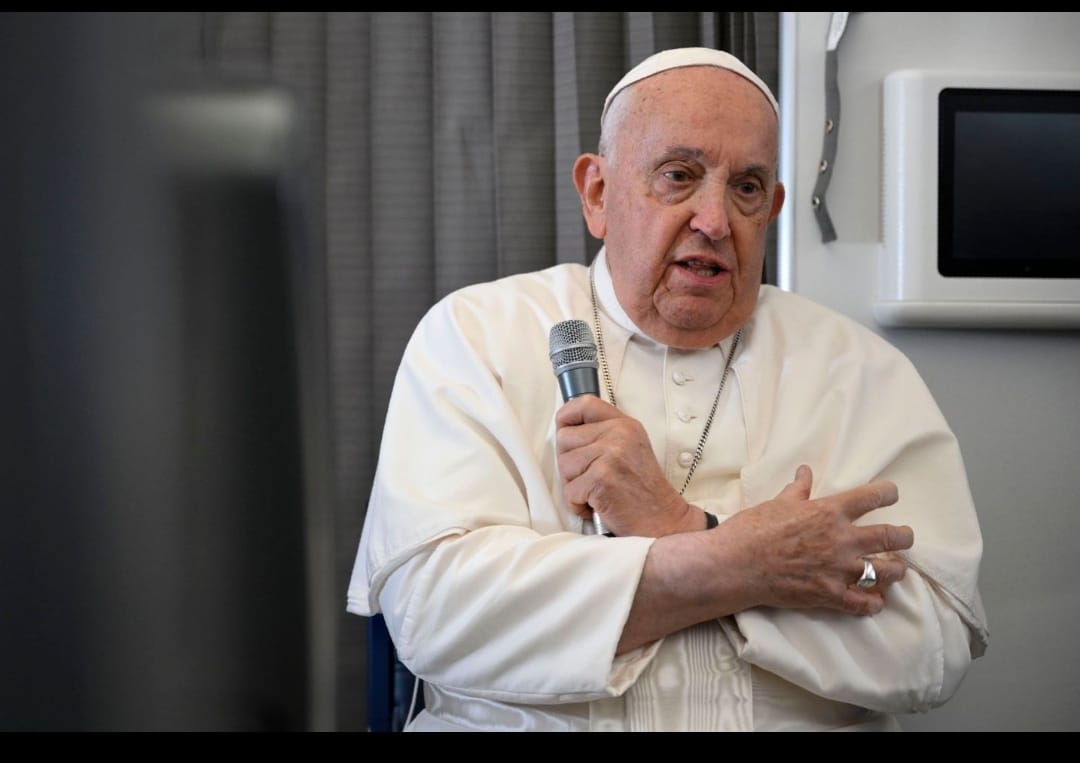
The Compassionate Pontiff: Pope Francis Dies at 88, Leaving a Mixed Legacy of Hope and Unfinished Reckoning
By George Omagbemi Sylvester
The world stands at a moral crossroads with the passing of Pope Francis at the age of 88, a man widely revered for his humility, humanity, and efforts to reshape the Catholic Church into a vessel of compassion, social justice, and mercy. Yet, even in his death, the shadows of unresolved trauma, rooted in decades of clerical abuse; cling to his papacy, threatening to tarnish a legacy that otherwise radiates light.

Born Jorge Mario Bergoglio in Buenos Aires, Argentina, in 1936, Pope Francis was the first pope from the Americas and the first Jesuit to ascend the papal throne. His election in 2013 was itself a turning point, a signal that the Church was ready for introspection and reform after decades of bureaucratic rigidity and moral decline. But while Pope Francis redefined the global perception of what a pontiff could be, his inability to decisively eradicate the rot of clerical abuse and Vatican secrecy leaves a bitter footnote to an otherwise progressive era.
A Pope of the People

Francis was, above all, a pastor of the people. He lived in a guesthouse rather than the Apostolic Palace, carried his own bag, and rejected the papal limousine for a modest Ford Focus. His simple lifestyle sent a message louder than a thousand encyclicals, that humility was not merely a virtue to be preached, but one to be lived.
He tackled issues that many in the Vatican’s hierarchy feared to touch. From calling for action on climate change in his landmark encyclical Laudato Si’, to opening doors for the divorced and remarried, and asking “Who am I to judge?” in reference to gay Catholics, Francis sought to shift the Church from a rule-bound institution to a more merciful community of believers.
Former UN Secretary-General Ban Ki-moon once said of Francis: “His voice carries moral authority because it is not political. It is prophetic.” Indeed, Francis saw the world through the eyes of the poor, the refugee, the marginalized. He called the global economic system “an economy that kills” and urged nations to remember “the cry of the earth and the cry of the poor.”
In his 2020 book Let Us Dream, Francis wrote, “This is a moment to dream big, to rethink our priorities… and to choose what matters.” That dream was not just theological, it was social, economic, environmental, and deeply human.
An Incomplete Reckoning

Yet even prophets stumble. While Pope Francis acknowledged the evils of sexual abuse within the Church, his actions often fell short of his rhetoric. He initially defended Chilean Bishop Juan Barros despite widespread allegations of covering up abuse, only to backtrack after international outrage. Though he later defrocked hundreds of priests and convened global bishops for a summit on abuse in 2019, the fundamental structures of secrecy and institutional protection remained largely intact.
Renowned historian Garry Wills once said, “The Catholic Church is the longest-standing authoritarian institution in the Western world.” Despite Francis’ reformist zeal, that institution remained resistant to full transparency.
“There is no greater tyranny,” wrote Montesquieu, “than that which is perpetrated under the shield of law and in the name of justice.” This tyranny lived in the silence of countless victims whose testimonies were long ignored, buried under ecclesiastical bureaucracy.
Even Francis’ own commissions on abuse faltered. Several prominent abuse survivors resigned, citing lack of progress and frustration at the Vatican’s unwillingness to hold bishops accountable. It is a tragic irony that a pope so committed to the poor and oppressed struggled to fully deliver justice to the most grievously wounded among his own flock.
Philosophical and Political Legacy
Despite these failings, Pope Francis reasserted the moral relevance of the Church in an era of rising authoritarianism and nihilism. He condemned populist nationalism, warned against “savage capitalism,” and confronted world leaders on their failure to uphold human dignity.
Barack Obama once called him “a living example of Jesus’ teachings,” and indeed, Francis preached with the urgency of a man who saw the world on fire.
He often quoted Dostoevsky’s The Brothers Karamazov: “The mystery of human existence lies not in just staying alive, but in finding something to live for.” For Francis, that “something” was the dignity of the human person. He reasserted the Church’s opposition to the death penalty, called for the abolition of nuclear weapons, and emphasized that migration is not a crime but a human right.
His encyclical Fratelli Tutti called for a new kind of politics: “A love capable of transcending borders is the basis of what we call social friendship.” In a world fractured by xenophobia and greed, Francis’ voice was often the lone trumpet of compassion echoing across closed borders and barbed wire fences.
Criticism from Within
Not all welcomed this new direction. Traditionalist Catholics saw him as a threat to orthodoxy. Some cardinals openly resisted his reforms, and conservative theologians accused him of creating doctrinal confusion. But Francis seemed unfazed. “Tradition is not the worship of ashes,” he once said, quoting Gustav Mahler, “but the preservation of fire.”
Perhaps it is this fire that will define his legacy. A fire for justice, mercy, and a Church more in tune with the suffering of the world than with the politics of Rome.
The Final Chapter
As news of his death spreads, reactions are flooding in. UN Secretary-General António Guterres praised him as “a tireless advocate for the poor, the vulnerable, and the planet.” German Chancellor Olaf Scholz described him as “a moral compass in a turbulent world.” In the slums of Manila, the plains of Kenya, and the refugee camps of Lebanon, candles are being lit for a pope who saw them not as burdens, but as brothers.
Yet, for the victims of clerical abuse, the candle burns differently, more like a flicker of hope never fully realized.
Francis once said, “Mercy is the very foundation of the Church’s life.” But mercy without justice, as philosopher Cornel West reminds us, is sentimentality. And justice without truth is cruelty.
The Church now faces a difficult road ahead. Will it choose a successor who deepens the reforms Francis began, or one who retreats to the safety of orthodoxy? Will it finally confront its sins not with apologies alone, but with sweeping structural change?
Pope Francis leaves behind a Church more open, more self-aware, but still grappling with its darkest sins. He was the right man for a world gasping for empathy, but not quite the hammer needed to demolish the structures of secrecy that protected predators for decades.
Still, in an era of cynicism, his belief in the power of mercy, inclusion, and human dignity stands tall.
As the philosopher Immanuel Kant once said, “Two things fill the mind with ever increasing awe: the starry heavens above me and the moral law within me.” Pope Francis reminded a watching world that amid scandal and sorrow, there remains a moral law—and it must always side with the least of these.
He has departed this world, not with the might of a monarch, but with the footprints of a shepherd. Let the next chapter of the Catholic Church be written not just with prayers, but with courage. For that is what Francis hoped for most, not sainthood, but a Church worthy of its founder.




celebrity radar - gossips
Adron Homes Celebrates Visionary Chairman, Aare Adetola Emmanuel King, at 51
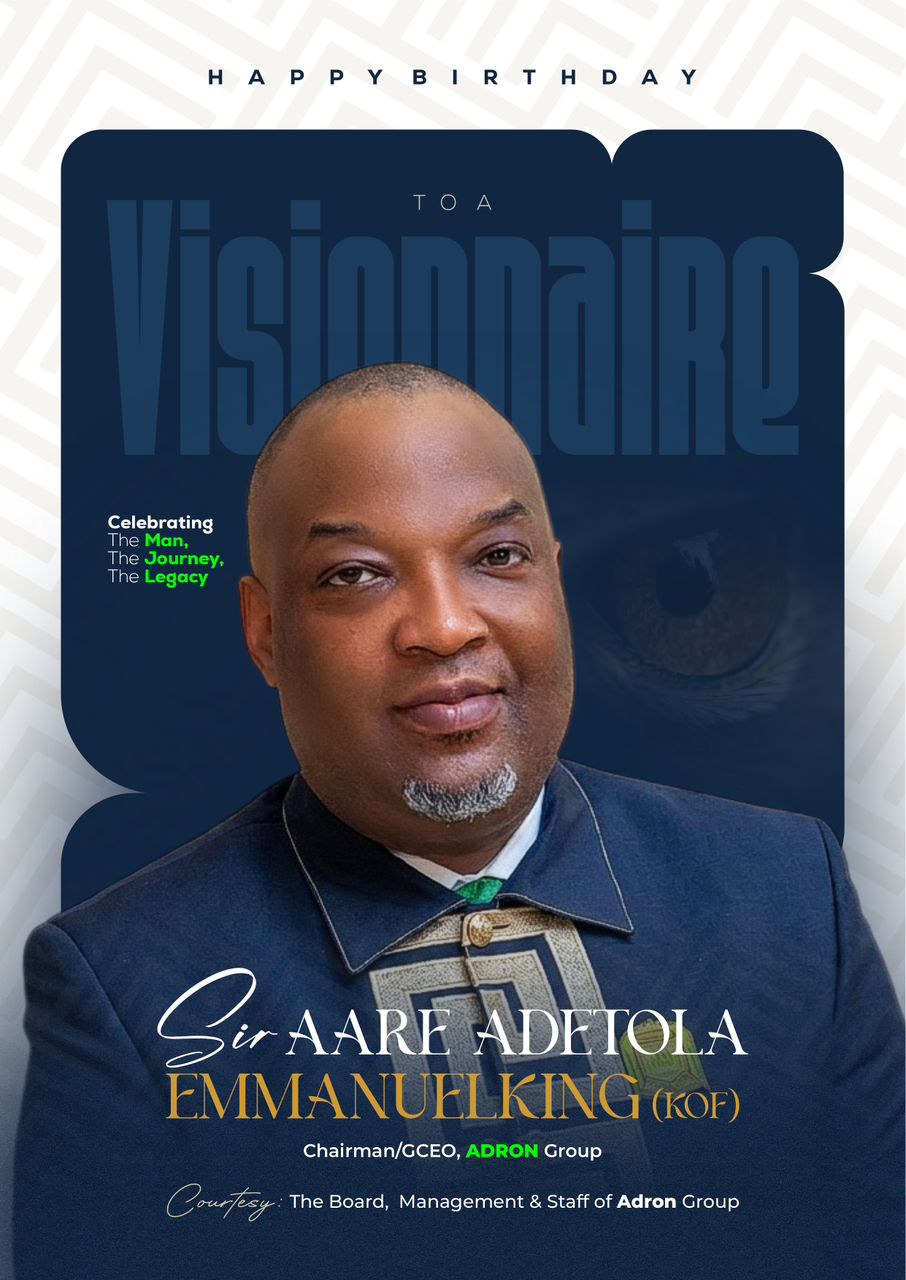
Adron Homes Celebrates Visionary Chairman, Aare Adetola Emmanuel King, at 51
The management and staff of Adron Homes and Properties Limited have joined family, friends, associates, and well-wishers across the globe to celebrate their Chairman and Chief Executive Officer, Aare Adetola EmmanuelKing, as he marks his 51st birthday.

In a statement released by the company, the milestone was described as a celebration of an exceptional leader whose vision, resilience, and entrepreneurial brilliance have not only transformed Adron Homes into a household name in Nigeria’s real estate sector but have also redefined affordable housing across the country.
Under his dynamic leadership, Adron Homes has continued to expand its footprint, delivering value-driven residential solutions while empowering thousands of Nigerians with opportunities for home ownership. His commitment to excellence, innovation, and customer satisfaction has remained the driving force behind the company’s sustained growth and industry leadership.
The statement further highlighted Aare EmmanuelKing’s passion for nation-building and community development, noting his significant contributions to job creation, youth empowerment, and the promotion of socio-economic development through real estate investments.
“As a leader, mentor, and visionary, Aare Adetola EmmanuelKing has consistently inspired a culture of excellence, integrity, and dedication within the organization. His ability to turn bold ideas into reality continues to position Adron Homes as a trailblazer in the industry,” the statement read.
The company expressed profound gratitude for his steadfast leadership and prayed for continued wisdom, strength, and sound health as he embarks on another year of impactful achievements.
As he celebrates his 51st birthday, the entire Adron Homes family proudly honours a man whose legacy continues to shape the future of real estate in Nigeria.
Happy 51st Birthday, Aare Adetola EmmanuelKing!
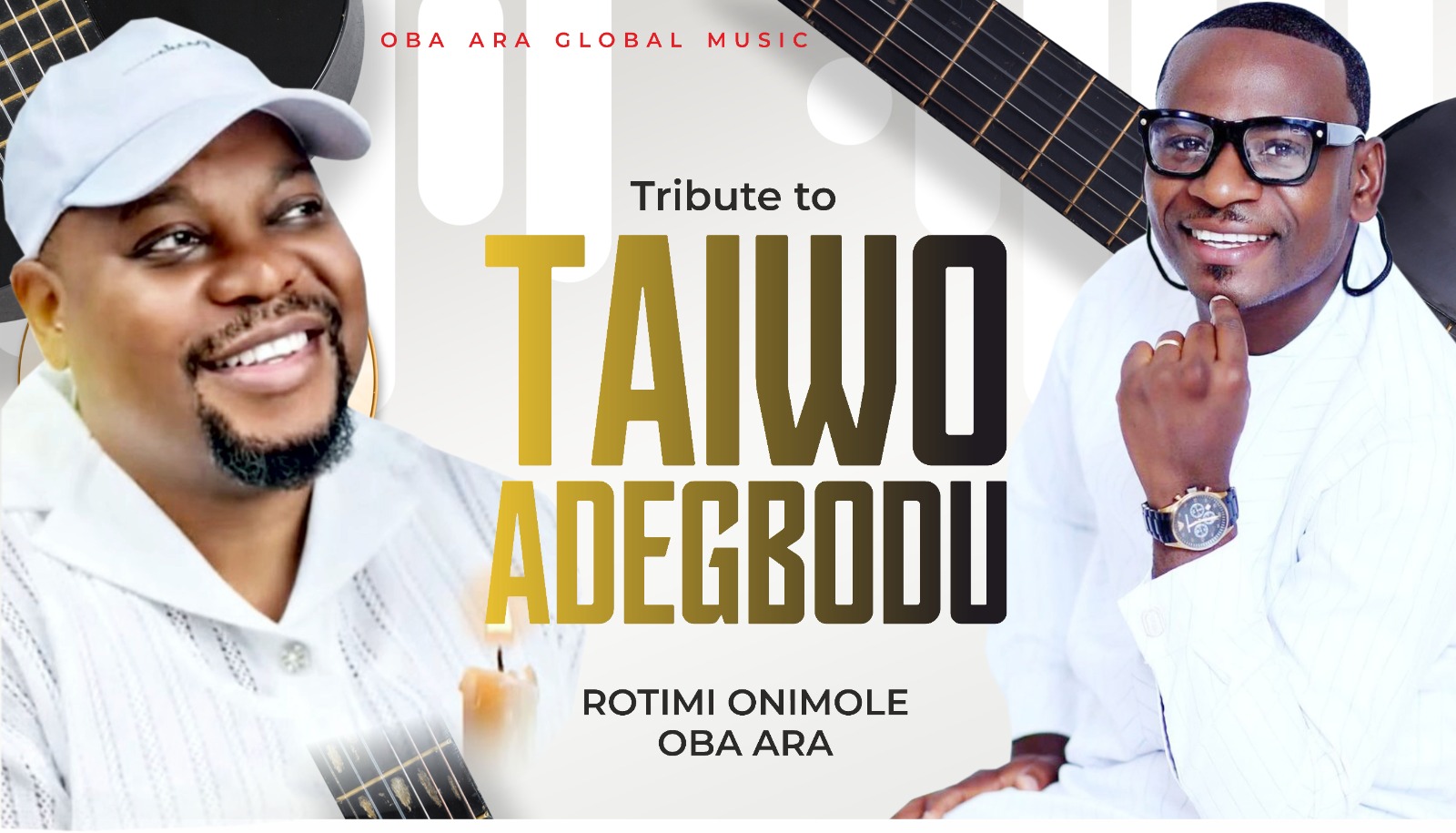
Oba Ara Releases Emotional Tribute to Late Taiwo Adegbodu
Taofik Afolabi
The gospel music community continues to grieve the painful loss of Taiwo Adegbodu, a beloved figure whose sudden departure left a deep void among fans, colleagues, and loved ones. In response to this loss, renowned gospel minister Rotimi Onimole, popularly known as Oba Ara, has released a moving tribute song that captures both the sorrow of the moment and the enduring legacy of the late singer.
Oba Ara, a proud son of Isale Eko, channels raw emotion throughout the song, using heartfelt lyrics and soul-stirring melodies to reflect on his personal connection with Taiwo Adegbodu. In the tribute, he openly expresses how deeply the news of Adegbodu’s passing shook him, describing it as a painful and unexpected loss that is difficult to come to terms with.
The song goes beyond mourning, it celebrates the life, ministry, and impact of Taiwo Adegbodu. Oba Ara highlights the late artist’s dedication to spreading the gospel through music, his inspiring voice, and the spiritual influence he had on many within and beyond Nigeria. Through powerful verses, he paints a picture of a man who lived for God and touched countless lives through his ministry.
Listeners have described the tribute as both comforting and deeply emotional, as it resonates with the collective grief of the gospel music community. It serves as a reminder that although Taiwo Adegbodu is no longer physically present, his music, message, and legacy will continue to live on.
In honoring his late colleague, Oba Ara not only pays his respects but also offers a source of healing for fans and fellow ministers, using music as a tool to process grief and celebrate a life well lived.
celebrity radar - gossips
Buratai, Fagbemi , Shagaya, Olofa, Others Eulogise Olowu Kuta’s Olori On 60th Birthday, Foundation Launch

Buratai, Fagbemi , Shagaya, Olofa, Others Eulogise Olowu Kuta’s Olori On 60th Birthday, Foundation Launch
Eminent personalities across the Nigeria stormed the TFK Event Centre, Bala Mohammed Way, Guzape, Abuja, to celebrate the 60th birthday of Olowu Kuta’s Olori, Queen Jumai Amoke and her Foundation Launch on Saturday 28, March 2026.

From former Chief of Army Staff, Lt Gen TY Buratai rtd, to the Minister of Justice and Attorney-General of the Federation, Prince Lateef Fagbemi; Olofa of Offa, HRM Oba Mufutau Gbadamosi. Even top businesswoman and socialite, Chief (Mrs) Bola Shagaya, was in attendance.


Other dignitaries were newly promoted Deputy Inspector-General of Police and former AIG Zone 2 , Lagos , Adegoke Fayoade, Major General Abdumalik, Major General Samuel Adebayo rtd (Fmr CDI);
Major General Anthony Omozoje rtd (Fmr Copp);
Alhaji Tajudeen Owoyemi (Asiwaju of Offa and CEO Radisson Hotel Nigeria;
Dr Waheed Olagunju, former managing director of Bank of Industry, Oniba of Iba, Lagos State, HRM Oba Dr Suleiman Raji ;
Justice Falola, Olu of Ile-Ogbo , Oba Adetoyese amongst many traditional rulers and captains of industry too numerous to mention.
Speaking at the occasion, the Chief Host, Olowu of Kuta, HRM Oba Dr Adekunle Oyelude Makama, CON , Tegbosun iii, who is also the husband of the celebrant commended Queen Jumai for ‘ her slender arms full of kindness’ to establish such humanitarian Foundation, ‘Amoke Children and mother in Need Foundation’ at a time Nigerians are going through economic crisis occassioned by the global meltdown.
Olowu also commended her steadfastness and love for the less privileged and downtrodden.
The monarch refrenced the task before his wife’s humanitarian gesture said her best is yet to come.
” Olori Amoke Jumai, I celebrate you. You will celebrate 70, 80, 90 and continue to shine as you continue to put a smile on people’s faces. I love you, “Olowu Kuta added.
To Lt Gen Buratai, a former army chief and former Nigerian Ambassador to Benin Republic, the reward of hard work is more work.
Buratai, who also doubles as Balogun Agba of Owu Kuta, a chieftaincy title reserved for a generalismo congratulated Queen Jumai for attaining the age of 60 in good health.
The retired army General said he’s not surprised by the turn out of eminent personalities across the country to celebrate the Olowu Kuta’s Olori because she merited it through her hospitality to all, adding that Allah the most merciful, most beneficial would accept all her act of ibadah.
The minister of Justice, Prince Fagbemi, was full of praises for Queen Jumai for deeming it fit to have a place in her heart to accommodate the needy and less privileged in ‘our society.’
Prince Fagbemi urged the guests to contribute generously to support the Foundation in order to continue to alleviate poverty and put a smile on the faces of the people.
” I congratulate you on your 60th birthday and Foundation Launch. I wish you many happy returns of the day and many more fruitful services to the country and motherland”, Prince Fagbemi added.
The celebrant, Queen Jumai who was grining from ear to ear thankfully said she was excited by the turn out and the response of the people to her foundation.
Queen Jumai, however, promised to continue to use her resources and donations received for the good of the needy and less privileged in the society.
” I want to appreciate my own Kabiesi Olofa of Offa , for his presence and im I’m using him as a point of contact to all other Kabiesis present here, the minister of justice and Attorney-General, you’re welcome, sir; Mrs Bola Shagaya, I salute your enterprise, Lt Gen Buratai, I’m grateful, sir; DIG Fayoade, Justice Falola and other dignitaries too numerous to mention, I thank you, all. To my darling husband, Kabiesi Olowu , I thank you immensely for your support. And to my family and friends, I thank you , all. E se pupo!”, she said.


-

 society7 months ago
Religion: Africa’s Oldest Weapon of Enslavement and the Forgotten Truth
-

 news4 months ago
WHO REALLY OWNS MONIEPOINT? The $290 Million Deal That Sold Nigeria’s Top Fintech to Foreign Interests
-

 society6 months ago
“You Are Never Without Help” – Pastor Gebhardt Berndt Inspires Hope Through Empower Church (Video)
-

 celebrity radar - gossips2 months ago
Dr. Chris Okafor Returns with Power and Fire of the Spirit -Mounts Grace Nation Altar with Fresh Anointing and Restoration Grace on February 1, 2026