
society
When Comfort Becomes Complicity: The Hidden Violence of Neutrality. (How moral grandstanding silences empathy and what to do about it)

When Comfort Becomes Complicity: The Hidden Violence of Neutrality. (How moral grandstanding silences empathy and what to do about it)
By George Omagbemi Sylvester | Published on SaharaWeeklyNG.com
“Sometimes when you are not the victim you turn to be a priest.” The line is brutal in its honesty. It names a human reflex we would rather deny: WHEN PAIN IS NOT OURS, WE OFTEN SERMONIZE INSTEAD OF SYMPATHIZE. We reach for tidy morality plays, not messy solidarity. We become judges in robes we stitched for ourselves; confident, distant and wrong.

This essay argues that the priestly posture (moralizing from a safe distance) does real harm. Philosophy, history and behavioral science converge on one simple fact: NEUTRALITY and MORAL GRANDSTANDING in the face of suffering enable injustice. To resist that drift, we must choose courage over commentary, action over applause and responsibility over rhetorical righteousness.

The Priestly Reflex and Its Consequences.
It is tempting to stand safely on the pavement describing the flames rather than grabbing water. Archbishop Desmond Tutu warned against this pose: “If you are neutral in situations of injustice, you have chosen the side of the oppressor.” That’s not rhetoric; it is diagnosis. Neutrality is not a vacuum, but a shelter for the powerful.
Sociology and psychology explain how we slide into the PRIESTS PULPIT. After the 1964 murder of Kitty Genovese in New YORK (long mythologized as “38 witnesses doing nothing”) scholars Bibb Latané and John Darley designed experiments (1968–1970) that established the bystander effect: As the number of onlookers grows, the likelihood of help falls. We diffuse responsibility, assume someone else will act and talk ourselves into spiritual aloofness: “This is not my place.” The original Genovese reporting was later shown to be exaggerated in parts, but the experiments remain robust: diffusion of responsibility is real and deadly. When we are not the victim, the mind reaches for distance and the distance breeds sermons.

Philosopher Hannah Arendt offered a chilling lens: the “BANALITY of EVIL.” Much evil, she argued, is not spawned by theatrical villains but by ordinary people who outsource moral judgment to convention and bureaucracy. “The sad truth,” Arendt wrote, “is that most evil is done by people who never make up their minds to be good or evil.” The priestly reflex is precisely this quiet abdication an appearance of moral clarity that hides moral laziness.
In political life, the cost is stark. Martin Luther King Jr. warned, “Injustice anywhere is a threat to justice everywhere.” The phrase is not a slogan; it is a systems insight. When we treat others’ suffering as a stage on which to display our virtue, we do not disrupt the system; we stabilize it. We offer commentary instead of consequences.
Moral Grandstanding: The Sermon as Performance.
Modern ethics has a name for the priestly reflex: moral grandstanding. Philosophers Justin Tosi and Brandon Warmke define it as using moral talk to impress others and elevate one’s status. It is the public square’s glittering homily, designed not to help the victim but to burnish the speaker. The result is predictable: OUTRAGE INFLATION, PERFORMATIVE PURITY TESTS and a CROWD that talks over those who are actually harmed.
Psychology adds more traps. Moral licensing whispers, “You’ve posted, protested or donated once, now you’ve done enough.” Empathy gap research shows our concern shrinks with distance, difference and politics. Paul Bloom, in AGAINST EMPATHY, cautions that unexamined empathy can be biased; he recommends compassion guided by reason. The point is not to feel less but to act more intelligently: to pair warm HEARTS with cool HEADS.
Economists Ernst Fehr and Simon Gächter showed that communities flourish when members are willing to bear a cost to punish WRONGDOING, even as uninvolved third parties. This “ALTRUISTIC PUNISHMENT” knits social order by signaling that injustice will meet resistance. In other words: the antidote to the priestly pose is accountable action, not decorative outrage.
Philosophy’s Demands: From Spectatorship to Stewardship.
Long before social media, Adam Smith described the “impartial spectator,” an inner witness that checks our ego and urges justice. Properly formed, this spectator does not excuse indifference; it rebukes it. Peter Singer sharpened the edge: “If it is in our power to prevent something very bad from happening, without thereby sacrificing anything morally significant, we ought to do it.” The drowning child in Singer’s famous thought experiment is not a metaphor to admire, but a command to act.
Edmund Burke is often misquoted, but his verified counsel is tougher and truer: “WHEN BAD MEN COMBINE, the GOOD must ASSOCIATE; else they will FALL one by one.” The instruction is collective. Association (organized, disciplined, sustained) is the opposite of priestly posturing. It is solidarity operationalized.
How the Priest Shows Up Today.
Victim-blaming in public discourse: We search for the victim’s mistake to absolve ourselves. Did they dress wrongly, protest poorly, speak too loudly? The “PRIEST” asks how the hurting invited their hurt.
Policy debates as morality theater: We score points; THE POOR PAY COSTS. When food, housing or migration becomes a backdrop for brand-building, real families become scenery.
Neutrality masquerading as professionalism: Institutions hide behind “PROCESS” while harm compounds. Procedure without courage is ritual; priestly incense masking the stench of neglect.
What To Do Instead: A Brief Ethics of ANTI-PRIESTHOOD.
Move first, MORALIZE LATER. When harm is clear, action precedes analysis. Call the ambulance, secure the scene, offer the seat, share the meal, transfer the funds, sign the affidavit. Discuss theory after the danger has passed.
Center those harmed. “Nothing about us without us” is more than a slogan; it is a safeguard. Design responses with, NOT FOR, the people affected.
Invest where it hurts (aA LITTLE). If help costs nothing, it usually changes nothing. TIME, MONEY, RISK and REPUTATION are CURRENCIES of real SOLIDARITY.
Build associational power. Burke was right: ORGANIZE. JOIN UNIONS, CIVIC GROUPS, NEIGHBORHOOD WATCHES, LEGAL DEFENSE FUNDS, FAITH COMMUNITIES. Lone priests deliver sermons; communities deliver outcomes.
Measure outcomes, not applause. Swap “DID I SOUND RIGHTEOUS?” for “Did we reduce suffering? Did we increase safety, freedom and dignity?”
Choose principled dissent over fashionable outrage. King again: courage is not the absence of fear but the triumph over it. When your coalition is wrong, say so. When the headline is misleading, correct it; especially if it flatters your side.
Practice disciplined compassion. Bloom’s caution matters: PAIR FEELING with FACT. Target aid where it works; test programs; correct course. COMPASSION without COMPETENCE exhausts.
The Civic Stakes.
History is merciless to spectators. Societies do not collapse in a single dramatic act; they erode by a thousand small abdications: someone else will speak; someone else will vote; someone else will resist. The priestly reflex institutionalizes those abdications. It trains a generation to curate moral identities rather than carry moral burdens.
We can do better. The first step is to retire the pulpit we drag everywhere. The second is to recover the oldest civic technology human beings possess: showing up. Aristotle wrote that we become just by doing just acts. Not by liking just posts or issuing just statements; but by DOING.
A Final Word to the “Priest” in All of Us.
You and I are not exempt. We are all, at times, the safe commentator, the tasteful neutral, the careful non-participant. Let us give that figure a new liturgy”: When a NEIGHBOR SUFFERS, show up.
When a stranger is targeted, STAND NEAR.
When a rule shields cruelty, BREAK the SILENCE and sometimes the RULE.
When your comfort depends on someone else’s risk, TRADE your COMFORT.
The work is not glamorous. It will not feel like a sermon. It will look like grocery runs, witness statements, donated hours, early votes, shared platforms and hard conversations with your own allies. It will feel small; until it doesn’t.
The line we began with remains our warning and our way out: SOMETIMES WHEN YOU ARE NOT THE VICTIM YOU TURN to be a PRIEST. The task is to turn, instead, into a neighbor. Let the record show that in our time the bystanders learned to MOVE, the neutral learned to CHOOSE and the preachers without practice learned to put their hands to the FIRE.

~ George Omagbemi Sylvester




society
Grace Nation: Harvest of Babies 2026 Records Miracle Birth and Dedication of Twins as Conference Concludes
“Guard your fruitfulness—identify and avoid distractions.”
The 2026 edition of Harvest of Babies, the flagship family liberation conference of Grace Nation Global, concluded with remarkable testimonies, including the reported safe delivery of a baby boy during the programme and the dedication of multiple “miracle babies.”
Miracle Delivery and Baby Dedications
One of the standout testimonies involved a woman whose pregnancy had gone beyond term and was reportedly scheduled for surgery. According to accounts shared during the conference, she was prayed for after being identified during one of the sessions. She later delivered a healthy baby boy without complications during the course of the event.
The conference also witnessed the dedication of several children described as long-awaited blessings, including twins after 15 years, a baby boy after 9 years, and a baby girl after 7 years. The dedications formed a major highlight of the closing moments of the programme, reinforcing the conference’s focus on fruitfulness and restoration.
Teaching on Fruitfulness
Continuing his teaching series on “Fruitfulness,” the Generational Prophet of God and Senior Pastor of Grace Nation Worldwide, Dr Chris Okafor, emphasized the importance of addressing the root causes of life’s challenges.
“If the cause of a battle is not confronted, the cycle may continue,” he said, adding that spiritual discipline—particularly prayer—remains a key tool in overcoming limitations such as barrenness, whether physical, financial, or generational.
He described prayer as a necessary channel for divine intervention, stressing that understanding one’s spiritual foundation is essential to overcoming recurring challenges.
Guarding Your Fruitfulness
Dr. Okafor also warned about distractions that may hinder progress, urging believers to remain focused on principles that sustain growth and fulfillment.
“Every kingdom operates by principles,” he noted. “If you allow distractions around you to take your focus away from those principles, you may delay your manifestation.”
He encouraged participants to be intentional about their environment, relationships, and spiritual discipline in order to maintain their breakthroughs.
What Hinders Fruitfulness?
The cleric identified curses and ignorance as major obstacles to fruitfulness. According to him, some challenges may stem from longstanding family patterns, but these can be broken through spiritual understanding and alignment.
He reiterated that blessings—particularly those pronounced through spiritual authority—have the capacity to reverse negative cycles and establish fruitfulness.
“Ignorance allows problems to persist,” he said. “But when you gain understanding and follow divine instruction, transformation begins.”
Looking Ahead
Although the 2026 Harvest of Babies conference has ended, organizers say the testimonies and experiences from the event will have a lasting impact. Many participants expressed faith that by this time next year, they will return with their own testimonies of fruitfulness.
The conference closed on a note of expectation, with attendees looking forward to future editions and continued manifestations of what they described as divine intervention. By Sunday Adeyemi [email protected]


society
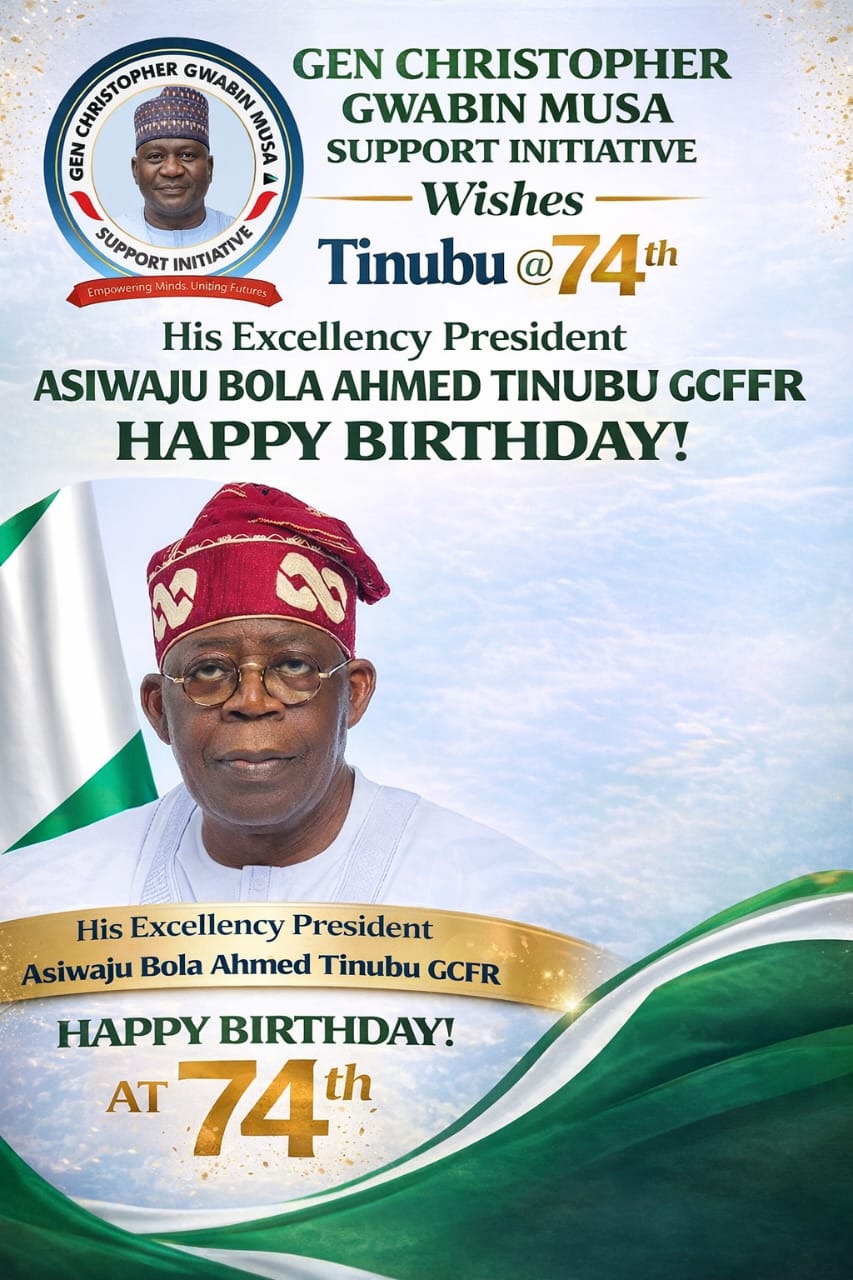
GEN CHRISTOPHER GWABIN MUSA SUPPORT INITIATIVE EXTENDS WARM BIRTHDAY FELICITATIONS TO PRESIDENT TINUBU ON 74TH BIRTHDAY
GEN CHRISTOPHER GWABIN MUSA SUPPORT INITIATIVE EXTENDS WARM BIRTHDAY FELICITATIONS TO PRESIDENT TINUBU ON 74TH BIRTHDAY
The Gen Christopher Gwabin Musa Support Initiative has extended heartfelt congratulations to His Excellency President Asiwaju Bola Ahmed Tinubu, GCFR, on the occasion of his 74th birthday.
In a statement released to the press, the Initiative conveyed warm wishes for the President’s personal well-being and for his continued leadership of the nation. The statement, signed by the Convener, Ibrahim Dahiru Danfulani, Sadaukin Garkuwan Keffi/Betara Biu, expressed hope that the coming year would bring the President “renewed strength and more wisdom in guiding the nation.”
The statement further noted that the Grand Patron of the Initiative, His Excellency Gen Christopher Gwabin Musa, OFR, Minister of Defence of the Federal Republic of Nigeria, joined in celebrating the milestone. It added, “Wishing Your Excellency continued good health, vitality, and determination as you lead the country towards greater unity and progress.”
The message underscores support for President Tinubu’s administration and its national objectives, marking the birthday as an occasion to reaffirm commitment to the nation’s unity and advancement under his stewardship.
society
Dominion City to Host Global Camp Meeting, “2 Nights of Glory” 2026 in Lagos, Enugu …Calls for Moral Renewal

*Dominion City to Host Global Camp Meeting, “2 Nights of Glory” 2026 in Lagos, Enugu
…Calls for Moral Renewal
Lagos – Dominion City has announced plans to host its annual Global Camp Meeting alongside a special “2 Nights of Glory” gathering in April 2026, with events scheduled to be held simultaneously in Lagos and Enugu.
The week-long programme is expected to draw tens of thousands of participants onsite and millions of virtual attendees from across the globe.
The Global Camp Meeting will run from Wednesday, April 1 to Monday, April 6, featuring daily sessions at 8:00 a.m. and 5:00 p.m. The “2 Nights of Glory” is slated for Friday, April 3 and Saturday, April 4 at the Golden Heart Place, Km 22 Lekki-Epe Expressway, beside Lagos Business School, Ajah, Lagos.
Organised by Dominion City, a global church focused on raising transformational leaders, the conference will centre on revival, spiritual renewal, and practical teachings. This year’s theme, “Redigging the Wells of Our Fathers,” underscores a call to return to foundational values and principles.
Speaking ahead of the event, Nobbert Onaga, President, Golden Heart Foundation and Senior Pastor, DC Lagos & Europe, emphasised the need for moral reawakening as a pathway to national transformation. He described the Church as “the pillar and foundation of truth,” noting that the conference aims to confront moral decline and restore core values within society.
“We are going back to foundational truths that established the Church. These truths will help repair societal damage and reposition the Church as a source of hope and light,” Onaga said.
Also speaking, Shola Olapade, Senior Pastor of Dominion City Headquarters, highlighted the Church’s role in addressing ethical and cultural challenges, particularly among young people. He added that the programme would go beyond spiritual teachings to include sessions on artificial intelligence, innovation, business, media, arts, and career development.
“We are equipping people not just spiritually, but with relevant 21st-century skills to thrive in today’s world,” Olapade noted.
The conference will feature teachings and ministrations from a lineup of international ministers, including Dr. David Ogbueli, Dr. Charles Ndifon, Andres Bisonni, Pastor Randy Mitchell, Apostle Ikechukwu Peter Nnajiofor, Dr. Ferdinand Nweke, Apostle Ben Hanyani Ndobe, Evangelist Dan Scott, and Dr. Chiefo Ejiofobiri.
Music ministrations will also be led by notable gospel artists such as Grace Idowu, Rhema Onuoha, Once More Six, David Nkennor, Anthony Kani, and GUC.
Organisers disclosed that over 30,000 participants are expected to attend in person, with free transportation provided from designated locations across Lagos to ease access. In addition, free medical services will be offered daily, building on previous outreaches that benefited over 1,700 people.
To ensure safety and order, more than 200 traffic marshals will be deployed in collaboration with relevant authorities.
Beyond its spiritual impact, organisers project that the event will stimulate local economic activity across hospitality, transportation, and retail sectors.
The Global Camp Meeting remains a key platform for spiritual impartation, leadership development, and societal transformation, aligning with Dominion City’s mission to equip believers to influence their communities positively.
Participation is open to the public, with registration available online for both physical and virtual attendance. //END.//
*PHOTO CAPTIONS:*
L-R: Dr. Godwin Efobi, Head, Medical Team, Dominion City Headquarters (DCHQ); Pastor Shola Olapade, Senior Pastor, DCHQ; Pastor Nobbert Onaga, President, Golden Heart Foundation and Senior Pastor, DC Lagos & Europe; Pastor Chuks Anochie, Head of Security and Traffic Control, Dominion City Headquarters (DCHQ), Camp Meeting 2026; Pastor Josh Tim Vaduchi, Head of Event & Programmes, DCHQ, during the press briefing of the forthcoming Global Camp Meeting, held the weekend of 2026 at the Dominion City Headquarters (DCHQ), Lagos.
L-R: Pastor Chuks Anochie, Head of Security and Traffic Control, Dominion City Headquarters (DCHQ), Camp Meeting 2026; Pastor Shola Olapade, Senior Pastor, DCHQ; Pastor Nobbert Onaga, President, Golden Heart Foundation and Senior Pastor, DC Lagos & Europe; Dr. Godwin Efobi, Head, Medical Team, DCHQ; and Pastor Josh Tim Vaduchi, Head of Event & Programmes, during the press briefing of the forthcoming Global Camp Meeting, held over the weekend in 2026 at the Dominion City Headquarters (DCHQ), Lagos.


-

 society6 months ago
Religion: Africa’s Oldest Weapon of Enslavement and the Forgotten Truth
-

 news4 months ago
WHO REALLY OWNS MONIEPOINT? The $290 Million Deal That Sold Nigeria’s Top Fintech to Foreign Interests
-

 society6 months ago
“You Are Never Without Help” – Pastor Gebhardt Berndt Inspires Hope Through Empower Church (Video)
-

 celebrity radar - gossips2 months ago
Dr. Chris Okafor Returns with Power and Fire of the Spirit -Mounts Grace Nation Altar with Fresh Anointing and Restoration Grace on February 1, 2026