society
The Limit Breaker London Conference: For You To Move forward, You Must First Deal with Every Evil Horns – Dr Chris Okafor
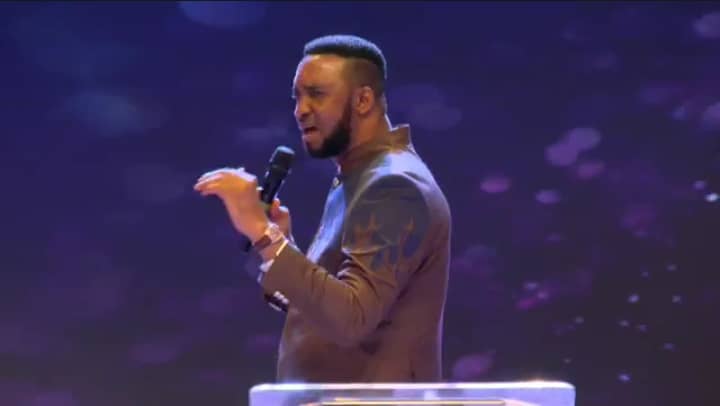
The two Major Assignments of the evil horns in the life of the People, is to Scattered the good things God had plan for them and also to keep them in Same situations and Position in Life.
Speaking at the Day 1 of The Limit Breaker Conference in London, The Global Prophet and Senior Pastor Grace Nation world-wide aka Liberation City Dr Chris Okafor said the Assignment of the evils horns is to put people in Bad Position in Life.
The Generational Prophet of God who Teaches on the Topic “Breaking The Horns of Wickedness” emphasised that the horn represents Powers, Positions and The head to mention but few, saying for something good to come or for you to fight for something good , you need the horns, Therefore you must Position yourself in the place of Prayers to dislodge the Power of every evil horns in your life.
Speaking on what to do to breakout from the Various horns of Wickedness in your family and life.
The Popular Lagos Prophet said you must be a soul winner, When you win souls into the kingdom of God, Elohim empowers you with the words bigger and stronger than all principalities,
The Man of God also highlighted that when you Provide yourself as a Kingdom investor, God empowers you to breakout from any forms of wicked Horns that the enemy has sent to keep you and your family, in conclusion the Generational Prophet of God declared that for a child of God to move forward, you must first deal with all forms of evil horn that has been keeping people in same Position for a long time in your family.
Spirit of Limitations were broken at the conference with Prophetic declarations by God servant, evils horns holding the destiny of many gives way as many were set Free from the hand of those stronger than them,
Mighty Deliverance, Miracle of all kind, Restoration from evil horns were all evidential in the life of People at the Conference, The Mighty hand of God was evidential everywhere at the meeting.
Day 2 of The Limit Breaker Conference continue on 19th August 2024 at Same Venue Dominion Center 9 The Broadway High Road, Wood Green London N22 6DS, the Time is 4pm.
Join Dr Chris Okafor at The Limit Breaker Conference London for a life changing Prophetic Encounter and Experience.
society
Revolutionizing Nigeria’s Energy Future: The Gbenga Komolafe Story
By Moses Udo
Among the constellation of Nigeria’s leadership, there are individuals whose vision and tenacity do more than just inspire people; they are representatives and architects of transformation. Engr. Gbenga Komolafe, helming the Nigerian Upstream Petroleum Regulatory Commission (NUPRC), is irrevocably one such luminary. His leadership over this critical agency has been exceptionally administrative; it is emblematic of the purposeful reform that has become one of the answers to the clarion calls within the broader framework of President Bola Ahmed Tinubu’s Renewed Hope Agenda.

Komolafe’s leadership has yielded structural innovations, an article that can be likened to a Master builder who is laying the foundation for a high skyscraper. He is constructing a new framework for Nigeria’s oil and gas industry. And for the record, he has championed non-kinetic strategies to quell crude oil theft, a feat which has remarkably reduced losses to 5,000 barrels per day, and has stabilized production at 1.7 million barrels per day. Under his Project 1 MMBOPD initiative, there is an expectation for an additional million barrels per day by December 2026. These types of gains are what cannot just be conjured from rhetoric, but only from disciplined execution by a focused leader.
However, what we can call the most compelling evidence of Komolafe’s reformative ascendancy lies in the report of N5.21 trillion mid-year revenue generated by the NUPRC in the first half of 2025 alone. To put this in a better context, this figure represents 42.7% of the record N12.2 trillion garnered in the entire year of 2024. Even against the N15 trillion target of 2025, this constitutes 34.7% already achieved in just six months. This is a sterling pace amid global oil market volatility and domestic production challenges. This monetary performance is not merely impressive; it is massive and undoubtedly transformative.
Moreover, Engineer Komolafe’s strategies have strengthened the confidence of investors and also repositioned Nigeria’s upstream sector as a reliable sector for the country’s revenue. It’s no mean feat that the nation now holds the largest gas reserves and the second-largest oil reserves in Africa; this enviable status owes much to the labor and strategic framework he has painstakingly put in place.
It is also worth noting to state that Komolafe’s tenure is equally defined by transparency, sustainability, and inclusivity. In achieving this feat, he has pioneered the Nigeria Gas Flare Commercialisation Programme (NGFCP) and the Carbon Credits Earning Framework, becoming a twin initiative that is positioned at the intersection of environmental responsibility and economic sustainability. These flagship projects are aimed at not just eliminating the challenges of gas flaring but also reducing methane emissions, encouraging carbon capture technologies, monetizing the decarbonization strategy, remaining at the vanguard of the country’s energy transition, and promoting sustainable energy practices.
In complementing these, he established the Host Community Development Trusts (HCDTs) and an Alternative Dispute Resolution Centre (ADRC), which help to create a participatory governance and further foster conflict resolution that once marred upstream operations.
Under his leadership, the upstream sector has achieved fiscal discipline through metering reforms, transparent cargo declarations, and simplified royalty frameworks as a result of his adoption of progressive regulation, which is a plan that is rooted in the Petroleum Industry Act (PIA), the 10-Year Regulatory and Corporate Strategic Plan (2023–2033), and the 2024 Regulatory Action Plan.
The Energy Policy Advancement Centre (EPAC) lauded this performance as a salient testament to strategic governance, foresight, and institutional discipline. Their Director-General, Dr. Ibrahim Musa, asserted, “NUPRC has moved beyond passive regulation to active value generation”, and he further emphasized that what sets this leadership apart “is not just the quantum of revenue but the discipline with which it is being pursued”.
Musa also praised NUPRC’s debt recovery drive, which yielded $459,226 from outstanding obligations — part of a cumulative $1.436 billion owed from crude oil lifting contracts.
He said: “Debt recovery may not attract headlines, but it is the backbone of fiscal discipline. Every dollar recovered is a step towards stabilising government finances and strengthening our economic resilience. The NUPRC’s persistence in this regard is commendable.”
But why do all these matter within President Tinubu’s Renewed Hope Agenda? At its heart, the president’s agenda seeks to restore public confidence, strengthen institutional capacity, and rejuvenate Nigeria’s struggling economy. Fortunately for Nigerians, Engr. Komolafe’s conduct encapsulates these ideals. Komolafe is not merely an agent of reform; he is an embodiment of that agenda’s promise. His work is the praxis through which Renewed Hope becomes a loved reality, and more than just a campaign slogan it used to be known for.
History praises visionaries because they alone perceive possibilities where others see only patches, and Komolafe exemplifies this through his strategic foresight in curbing theft and production stabilization within the oil and gas sector. His holistic reforms have integrated environmental imperatives, enshrined accountability within the NUPRC, and created community welfare; His ability to leverage policies and frameworks to recalibrate oil and gas governance has fostered institutional renewal; and his ability to deliver tangible gains for the federation’s revenue base has ensured fiscal prominence.
As we have found ourselves in an era where grandiloquence often eclipses genuine progress, and political ambition serves personal interest, the tenure of Eng. Gbenga Komolafe in NUPRC has stood among others as impactful, transformative, and substantive. He is not a mere bureaucrat; he is an architect of modern Nigeria’s energy future, who builds a legacy of reforms, and not rhetoric.
His contributions ripple outside the confines of the oil and gas sector, nourishing the ethos and reinforcing the Renewed Hope Agenda upon which our collective future depends. Thanks to him, the oil Industry is now much more efficient as a result of the implemented strategic reform, which drastically reduced capital and operational expenditure in oil production.
Indeed, a man of vision is not just an asset but a lodestar to his nation. In Gbenga Komolafe, we find a man of vision who is unequivocally an invaluable asset to our great nation.
Udo is a public affairs analyst writing from Glasgow, United Kingdom.
society
PMAN Backs Police Report on Kukwaba Land Dispute, Cuts Ties with Olusco
Abuja, Nigeria — The Performing Musicians Employers’ Association of Nigeria (PMAN) has endorsed the findings of the Inspector-General of Police (IGP) Monitoring Unit on alleged fraudulent activities linked to Olusco Heritage & Investment Ltd and its Managing Director, Mr. Olufemi Olumeyan, about Plot 504, Kukwaba, Abuja.
According to the police investigation, there is a prima facie case of fraud, intimidation, violence, and breach of peace arising from unauthorised dealings on the land. PMAN, the rightful title holder, said the report confirms long-standing concerns about irregular transactions and thanked the police for their professionalism.
The controversy began in 2023 when PMAN signed a joint venture agreement with Olusco. The agreement, however, was subject to the payment of a premium which Olusco never fulfilled, leaving it unenforceable. Despite this, Olusco allegedly went ahead to advertise and sell portions of the land.
PMAN said the situation worsened after Olusco requested that foreign investment funds be paid into a personal account, a move the association rejected. Later, it emerged that Olusco had struck a separate ₦350 million development deal with G & D Building & Engineering Ltd before disputes arose, leading to petitions to the police.
The Monitoring Unit also flagged the involvement of former PMAN officials, including Mr. Boniface Itodo and entertainer Mr. Zakky Azzay, who were accused of impersonating executives after their dismissal, thereby misleading the public and aggravating the crisis.
On December 7, 2024, PMAN formally terminated its arrangement with Olusco, citing breaches and risks to the public. The association has since tightened security on the site with police support. During one operation, officers dispersed trespassers, and one person sustained a minor injury while fleeing. PMAN clarified that no shots were fired, countering sensational online reports.
National President, Pretty Okafor, said PMAN’s focus is now on accountability and protecting members of the public. “Anyone who paid money to unauthorised parties should come forward. We are working with the IGP Monitoring Unit and EFCC to trace funds, identify victims, and ensure justice,” he said.
PMAN stressed that no sale or allocation on Plot 504 is valid without its written approval and urged potential buyers to exercise caution
society
Blood on the Prayer Mat: Katsina’s Unguwan Mantau Massacre Exposes a Republic That Cannot Protect Its Own
Blood on the Prayer Mat: Katsina’s Unguwan Mantau Massacre Exposes a Republic That Cannot Protect Its Own.
Written by George Omagbemi Sylvester | published by SaharaWeeklyNG.com
At dawn (an hour meant for quiet devotion) gunmen invaded the small community of Unguwan Mantau in Malumfashi Local Government Area, Katsina State and turned a mosque into a killing ground. Worshippers had gathered for morning prayers when the assailants opened fire and set homes ablaze in nearby villages. By midweek, officials confirmed that at least 50 people were dead and around 60 others abducted, a toll that is as staggering as it is shameful for a state that claims a monopoly on force.
Authorities and residents describe a grim sequence: 30 worshippers shot inside the mosque and 20 more burned to death as the attackers extended their carnage to surrounding settlements. Local legislator Aminu Ibrahim briefed the Katsina State House of Assembly on the horror, while state officials deployed security forces after the fact; too late to save the dead, too thin to deter the abductors.
Early accounts suggest the assault may have been retaliation after townspeople reportedly ambushed and killed several gunmen days earlier. That cycle (residents defending themselves in the absence of reliable protection, only to face brutal vengeance) has become a deadly pattern in northwestern Nigeria, where armed groups and “BANDITS” exploit rainy-season cover and thin state presence to RAID, BURN, KIDNAP and KILL.
Let us be clear: this is not an inevitable tragedy of geography. It is a FAILURE of GOVERNANCE, of SECURITY PLANNING, and of JUSTICE. Over the past years, the northwest and north-central regions have endured relentless attacks linked to FARMER-HERDER tensions over land and water, predation by organized criminal gangs and the broader erosion of state authority outside major urban centers. The line between “CONFLICT” and outright criminal insurgency is now razor-thin.
Political theory provides a precise yardstick for this disgrace. Over a century ago, sociologist Max Weber wrote that a state is “a human community that successfully claims the monopoly of the legitimate use of physical force within a given territory.” When citizens are gunned down in prayer while perpetrators roam and re-attack, that monopoly is shattered and with it, the state’s basic claim to legitimacy.
The late Kofi Annan fused security, rights and development into a single doctrine: “We will not enjoy development without security, we will not enjoy security without development, and we will not enjoy either without respect for human rights.” This massacre in Katsina is the brutal embodiment of that warning. Without security, farmers cannot farm; traders cannot trade; children cannot attend school and families cannot even pray in peace. Development, under such conditions, is a cruel mirage.
What Happened and Why It Matters?
THE ATTACK: Armed men stormed the Unguwan Mantau mosque during Fajr prayers and extended the assault to nearby homes. Dozens were killed; many more abducted.
POSSIBLE TRIGGER: Officials and residents say it may have been a reprisal for an earlier community ambush that killed several gunmen.
THE PATTERN: Such dawn and nighttime raids are frequent in the northwest, where armed groups exploit weak policing, limited military resources across vast rural terrain and dense foliage during the rainy season.
THE TREND: Initial reports counted 13–27 deaths; by Wednesday, the figure rose to about 50, with around 60 abducted, underscoring how quickly casualty numbers escalate as the dust settles.
This is not simply about numbers; it is about a citizen (state covenant in tatters). When communities are compelled to self-arm and mount ambushes (because formal protection is unreliable) retaliation is almost guaranteed and civilians are the softest targets. The state’s reactive deployments after massacres are emblematic of STRATEGY-BY-PRESS-RELEASE, not the PROACTIVE, INTELLIGENCE-DRIVEN SECURITY ARCHITECTURE demanded by these threats.
The Deeper Rot.
The criminal economies driving banditry (KIDNAP-FOR-RANSOM, PROTECTION RACKETS, CATTLE RUSTLING, ILLEGAL MINING CORRIDORS) thrive where the state is ABSENT, PREDATORY or CORRUPT. Meanwhile, climate stress and shrinking livelihoods intensify local disputes. But to reduce this to “AGE-OLD CLASHES” is to excuse the inexcusable. A sovereign republic cannot outsource the safety of its citizens to luck, weather or vigilante valor.
Economist Amartya Sen has argued that “development is freedom,” and freedom requires protective security; the guarantees that shield people from “unfreedoms” such as violence and fear. In Unguwan Mantau, that protective security failed catastrophically. The cardinal test of government (to keep people alive) was not met.
What Must Happen Now.
Relentless, intelligence-led pursuit of the perpetrators. Nigeria’s security agencies must treat this as a priority counter (organized-crime operation) not a one-off sweep. Establish a fusion cell covering Katsina, Kaduna, Zamfara corridors to map command structures, financiers, armories and kidnap logistics. Use signals intelligence, human sources and air-ground coordination to preempt, not merely respond. (The rainy season cover cited by officials must be factored into surveillance and patrol patterns not used as an alibi.)
Secure worship spaces and rural choke points. Pre-dawn prayers and market days are high-risk windows. Station mobile units and community-alert networks around mosques, schools and feeder roads, especially in Malumfashi LGA and adjacent hot spots. Visible deterrence is itself a lifesaver.
Ransom-proof the landscape. Every abduction that results in a quiet payout feeds the monster. Create a state-backed Victim Support & Rapid Recovery Fund tied to non-payment protocols, combined with swift asset seizures from suspected collaborators and money handlers. Follow the money. (Sahara and others report dozens abducted here; if ransoms flow, future attacks are financed before our eyes.)
Professionalize community defense, don’t romanticize it. Where auxiliary community guards exist, fold them into a regulated, trained and accountable rural constabulary under state oversight, with clear rules of engagement to minimize reprisals and human rights abuses that fuel revenge cycles. The alternative (ad hoc vigilantism) invites more massacres.
Justice that is seen and felt. Special fast-track courts for terror, mass murder and banditry, with witness protection, are essential. Publicize arrests, prosecutions and convictions. Impunity is the oxygen of repeat offenses.
Address the economic logic of violence. Expand livelihood programs along known attack corridors, integrate pastoral routes and grazing policy into land-use planning and disrupt illegal mining and gun-running networks that bankroll banditry. Security without economic chokeholds is whack-a-mole policy.
National coordination and honest metrics. Standardize incident reporting and response time audits across the northwest. Publish monthly dashboards, attacks prevented, abductees rescued, networks dismantled. What gets measured gets managed. What is hidden festers.
A Country at a Crossroads.
The killings in Unguwan Mantau join a long, painful ledger of atrocities that stain our conscience and corrode our democracy. This is not the northeast’s Boko Haram front (though its ghosts haunt us still) it is the northwest’s criminal insurgency that feasts on governance voids. The Associated Press, Reuters, Al Jazeera and Anadolu Agency document the evolution of the death toll and the abductions; the facts are uncontested, the devastation undeniable.
And yet, facts alone do not move nations; resolve does. Weber’s test (the monopoly of legitimate force) is not a seminar abstraction; it is the thin line between a republic and a ravaged territory. If Nigeria cannot guarantee that its citizens will not be butchered at prayer, then every promise of reform rings hollow.
Kofi Annan’s injunction should be plastered on the wall of every security council chamber and governor’s office: there is no development without security and no security without human rights. Secure the people; uphold the law; choke the money flows; measure honestly; punish swiftly. Anything less is complicity by incompetence.
Unguwan Mantau is not a headline. It is a warning. If we do not break the cycle (today, not tomorrow) more families will bury their dead after morning prayers and bandits will tighten their grip on the rural heartland. The state must reclaim its authority or concede that others wield it.
May the victims REST IN PEACE. May the ABDUCTED RETURN ALIVE. And may those who failed to protect them feel the full weight of accountability that a republic demands.
-
society5 months agoRamadan Relief: Matawalle Distributes Over ₦1 Billion to Support 2.5 Million Zamfara Residents
-
Politics2 months agoNigeria Is Not His Estate: Wike’s 2,000‑Hectare Scandal Must Shake Us Awake
-
society4 months agoBroken Promises and Broken Backs: The ₦70,000 Minimum Wage Law and the Betrayal of Nigerian Workers
-
society3 months agoOGUN INVESTS OVER ₦2.25 BILLION TO BOOST AQUACULTURE