
society
Throwback: Primate Ayodele’s Interview With Tribune Newspaper About Nigeria On December 31, 2023

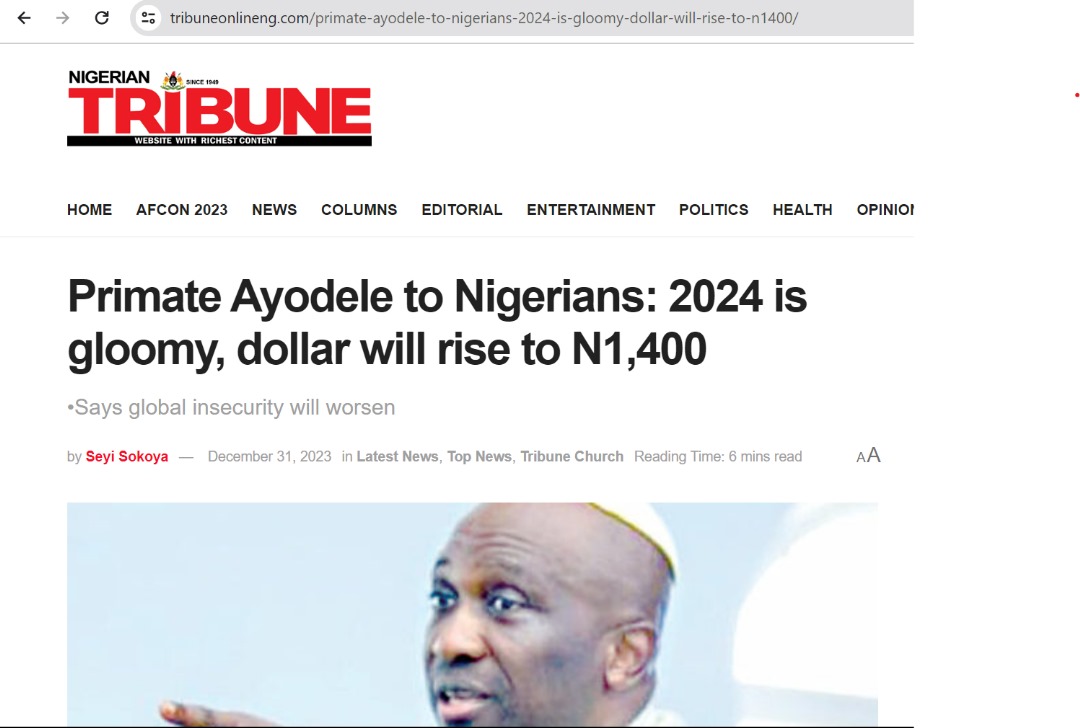
Throwback: Primate Ayodele’s Interview With Tribune Newspaper About Nigeria On December 31, 2023
In this interview, popular seer and spiritual head of Inri Evangelical Spiritual Church, Lagos, Primate Elijah Ayodele speaks on 2024 and what awaits Nigeria and the world.

The economy
NIGERIANS need to be watchful, prayerful, and constantly appeal to God. The government needs help. If the government refuses to listen to God’s warning, it is bound to get into problems. The Bola Tinubu government is out of line. When I warned that voting for an All Progressive Congress federal government would lead to calamity and storm, many people felt I was talking rubbish. With all the economic formulas that the current government is postulating, it can’t get a correct model that will help the country. The World Bank and the IMF have killed Nigeria’s economy. If President Tinubu continues to listen to them, Nigeria will die. There is still payment of fuel subsidy. Tinubu cannot play with a subsidy. The complete removal of subsidies will result in complete economic trouble. We cannot buy fuel for N100 anymore. They are lies.
I foresee that under the current realities, the cefa will be stronger than the Naira. Also, the dollar will rise to N1400 and this will shake the economy so badly that some forces are hell-bent on frustrating the Tinubu-led Federal government but they will not be successful.
The economy will be fluctuating (rising and falling} to the extent that the Central Bank of Nigeria will cry out. The opposition will take several steps to fight the present government but they will miss their strategies. Government palliative is part of the things that are ruining the economy and has not added anything good to the economic revival. I foresee the Nigerian economy will fluctuate, it will be unstable and inflation rates will rise astronomically. The economic stability will crash down to very low levels even though the Central Bank of Nigeria {CBN} and the federal government will be working to find a way forward. I have not seen anything better, for the future looks gloomy.
Do not play politics with Nigerians. The government must do what is right. Playing politics with Nigeria will destroy the country and the nation will collapse. We must be realistic if we want to balance the nation. Increment in workers’ salaries will not improve things. The Nigeria Labour Congress (NLC) is blindfolded. The President of the NLC is incompetent; he will not be able to achieve anything. He is weak; he is only making political noise. He should stop making noise.
We must stop patronizing the dollar. It is killing our country. There must be a constant power supply; we must use our mineral resources to negotiate. The ministry that is supposed to be feeding Nigeria is the Ministry of Mines. The person who is in charge must work with the CBN governor. We must improve our mechanized farming.
In 2024, the government must reduce the price of food commodities; giving out palliatives is a fraud; it is a scam. There should be food markets in various states for genuine food palliatives. The price of a bag of rice can be reduced to N20,000. We must also improve our road infrastructure. These would make Nigeria better. God still insists that Tinubu is his plan but not his purpose for Nigeria. The cost of living will become unbearable in 2024 if the government refuses to do what is needed. There will be a shortage of water. We are smiling and suffering. Prices in essential commodities will rise.
Insecurity
They cannot end insecurity in 2024. The police and other forces must be equipped. There will be another unguided missile attack that will kill civilians. When this repeats itself, people would insist that it was orchestrated. If there is an adjustment in the war against terror in Nigeria, then it will work. The government must create employment opportunities; this will help in the fight against insecurity. We must also look at the issue of state policing again. If there is food, infrastructure, and electricity, then things will pick up. A cashless policy will destroy Tinubu’s government. We must pray against religious and ethnic war in Nigeria. A prominent African president will escape a bomb attack. Let us pray that Customs officers will not be attacked. The head of the NIS might be changed. Some people will rubbish the efforts of the EFCC chairman. More insecurity in the North. Benue, Plateau, Abuja, Ondo, and Kogi will experience more insecurities.
Politics
If Obaseki doesn’t take it easy, PDP will lose in Edo. If PDP loses, Obaseki will be troubled. Ondo State’s Aiyedatiwa will be frustrated, he cannot rule Ondo State. Tinubu will take over Ondo State. Some five PDP governors will rescue the party. Fubara must not cross to APC. He must remain in PDP; he should not follow Wike. If he does, that will be the end of his political career. He should not fight against Wike. If he fights against Wike, he will not win. The Akwa Ibom state governor too must not cross to APC. If Mbah comes out to contest for the governorship election, he may destroy Soludo. Soludo must prepare himself because the APC is ready to take over the state. If care is not taken, Ganduje and Tinubu will part ways. The relationship between Tinubu and Shettima will be constrained. Some of the President’s allies will fight his wife. He must watch his health properly. Seyi Makinde must not leave PDP; if he does, he will not make it politically again. Gbajabiamila will receive a rude shock.
Nigeria will keep borrowing and it would become so burdensome that we would start to beg for relief. Giving us debt relief is another bondage because there will be conditions. There are three cabals bent on hijacking Tinubu’s government. Buhari and Tinubu will still fight. A prominent leader in Afenifere will pass away. Nigeria will break if there is no restructuring as of 2035. Nnamdi Kanu’s bail will be unconditional and it is not too certain. Samuel Ekpa must be careful so that he will not be arrested.
Infrastructure
There will be problems in the telecommunications industry. G5 has come to stay. The tax on these companies will increase and the burden of this will drive some of them away. The government has plans to establish a telecommunication company. Let us pray that we won’t witness any fire outbreak in any federal secretariat. Let us pray that no governor’s office will be set ablaze. A prominent pastor will die, same with an Islamic scholar. And ex-governor will pass on. Building collapse in Abuja is imminent; there will be a bomb scare in Abuja. I foresee the Nigeria Gas Company will be shut down as there will not be enough gas to meet the energy needs of companies and the Transmission Company of Nigeria. Let us pray so that the facilities of the Transmission Company of Nigeria will not be attacked. I foresee the Ijede Power plant, Egbin Thermal Station, Shiroro Dam, and Kanji Dam will have problems and be shut down. Let us pray so that none of the dams will become dry. I foresee that the Abuja Electricity Distribution Company Kubwa substation and the Apo substation will be shut down.
Global terrorism and insecurity
At the global level, I foresee the emergence of a new set of terrorist organizations different from HAMAS in Gaza, the Kurdistan Workers Party {PKK} in Turkey, Boko Haram in Nigeria, and Al-Shabaab in Somalia. I foresee a network of terror gangs scheming in the year 2024 to cause havoc and also plan evils towards the United States of America, the United Kingdom, the State of Israel, France, Germany, and Turkey to create a breakdown of law and order and a state of insecurity. The spirit of God revealed to me that there will be aborted or failed coups de-tat in some countries. I foresee another terrorist group that is a faction of the PKK in 2024. The Al-Shabaab terror gang, Al-Qaeda, and ISIS criminals will begin to terrorize more countries in Africa and Europe. Europe will begin to witness more frequent acts of terrorism. The spirit of God says another coalition of terrorist groups will emerge in Africa. The band of criminals will work hand in hand with the likes of AL-QAEDA and Boko Haram.
Primate Ayodele to Nigerians: 2024 is gloomy, dollar will rise to N1,400




society
GEN CHRISTOPHER GWABIN MUSA SUPPORT INITIATIVE EXTENDS WARM BIRTHDAY FELICITATIONS TO PRESIDENT TINUBU ON 74TH BIRTHDAY
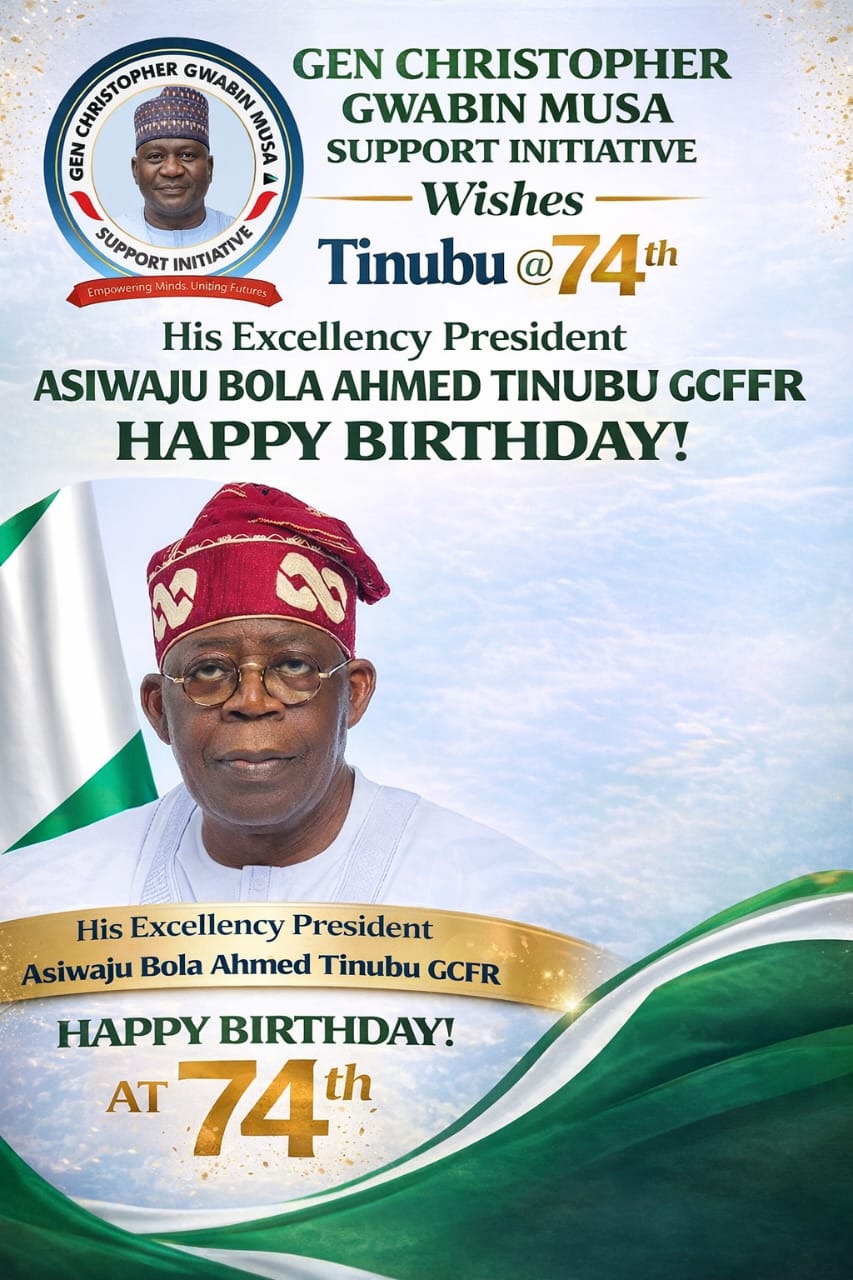
GEN CHRISTOPHER GWABIN MUSA SUPPORT INITIATIVE EXTENDS WARM BIRTHDAY FELICITATIONS TO PRESIDENT TINUBU ON 74TH BIRTHDAY
The Gen Christopher Gwabin Musa Support Initiative has extended heartfelt congratulations to His Excellency President Asiwaju Bola Ahmed Tinubu, GCFR, on the occasion of his 74th birthday.
In a statement released to the press, the Initiative conveyed warm wishes for the President’s personal well-being and for his continued leadership of the nation. The statement, signed by the Convener, Ibrahim Dahiru Danfulani, Sadaukin Garkuwan Keffi/Betara Biu, expressed hope that the coming year would bring the President “renewed strength and more wisdom in guiding the nation.”
The statement further noted that the Grand Patron of the Initiative, His Excellency Gen Christopher Gwabin Musa, OFR, Minister of Defence of the Federal Republic of Nigeria, joined in celebrating the milestone. It added, “Wishing Your Excellency continued good health, vitality, and determination as you lead the country towards greater unity and progress.”
The message underscores support for President Tinubu’s administration and its national objectives, marking the birthday as an occasion to reaffirm commitment to the nation’s unity and advancement under his stewardship.
society
Dominion City to Host Global Camp Meeting, “2 Nights of Glory” 2026 in Lagos, Enugu …Calls for Moral Renewal
*Dominion City to Host Global Camp Meeting, “2 Nights of Glory” 2026 in Lagos, Enugu
…Calls for Moral Renewal
Lagos – Dominion City has announced plans to host its annual Global Camp Meeting alongside a special “2 Nights of Glory” gathering in April 2026, with events scheduled to be held simultaneously in Lagos and Enugu.
The week-long programme is expected to draw tens of thousands of participants onsite and millions of virtual attendees from across the globe.
The Global Camp Meeting will run from Wednesday, April 1 to Monday, April 6, featuring daily sessions at 8:00 a.m. and 5:00 p.m. The “2 Nights of Glory” is slated for Friday, April 3 and Saturday, April 4 at the Golden Heart Place, Km 22 Lekki-Epe Expressway, beside Lagos Business School, Ajah, Lagos.
Organised by Dominion City, a global church focused on raising transformational leaders, the conference will centre on revival, spiritual renewal, and practical teachings. This year’s theme, “Redigging the Wells of Our Fathers,” underscores a call to return to foundational values and principles.
Speaking ahead of the event, Nobbert Onaga, President, Golden Heart Foundation and Senior Pastor, DC Lagos & Europe, emphasised the need for moral reawakening as a pathway to national transformation. He described the Church as “the pillar and foundation of truth,” noting that the conference aims to confront moral decline and restore core values within society.
“We are going back to foundational truths that established the Church. These truths will help repair societal damage and reposition the Church as a source of hope and light,” Onaga said.
Also speaking, Shola Olapade, Senior Pastor of Dominion City Headquarters, highlighted the Church’s role in addressing ethical and cultural challenges, particularly among young people. He added that the programme would go beyond spiritual teachings to include sessions on artificial intelligence, innovation, business, media, arts, and career development.
“We are equipping people not just spiritually, but with relevant 21st-century skills to thrive in today’s world,” Olapade noted.
The conference will feature teachings and ministrations from a lineup of international ministers, including Dr. David Ogbueli, Dr. Charles Ndifon, Andres Bisonni, Pastor Randy Mitchell, Apostle Ikechukwu Peter Nnajiofor, Dr. Ferdinand Nweke, Apostle Ben Hanyani Ndobe, Evangelist Dan Scott, and Dr. Chiefo Ejiofobiri.
Music ministrations will also be led by notable gospel artists such as Grace Idowu, Rhema Onuoha, Once More Six, David Nkennor, Anthony Kani, and GUC.
Organisers disclosed that over 30,000 participants are expected to attend in person, with free transportation provided from designated locations across Lagos to ease access. In addition, free medical services will be offered daily, building on previous outreaches that benefited over 1,700 people.
To ensure safety and order, more than 200 traffic marshals will be deployed in collaboration with relevant authorities.
Beyond its spiritual impact, organisers project that the event will stimulate local economic activity across hospitality, transportation, and retail sectors.
The Global Camp Meeting remains a key platform for spiritual impartation, leadership development, and societal transformation, aligning with Dominion City’s mission to equip believers to influence their communities positively.
Participation is open to the public, with registration available online for both physical and virtual attendance. //END.//
*PHOTO CAPTIONS:*
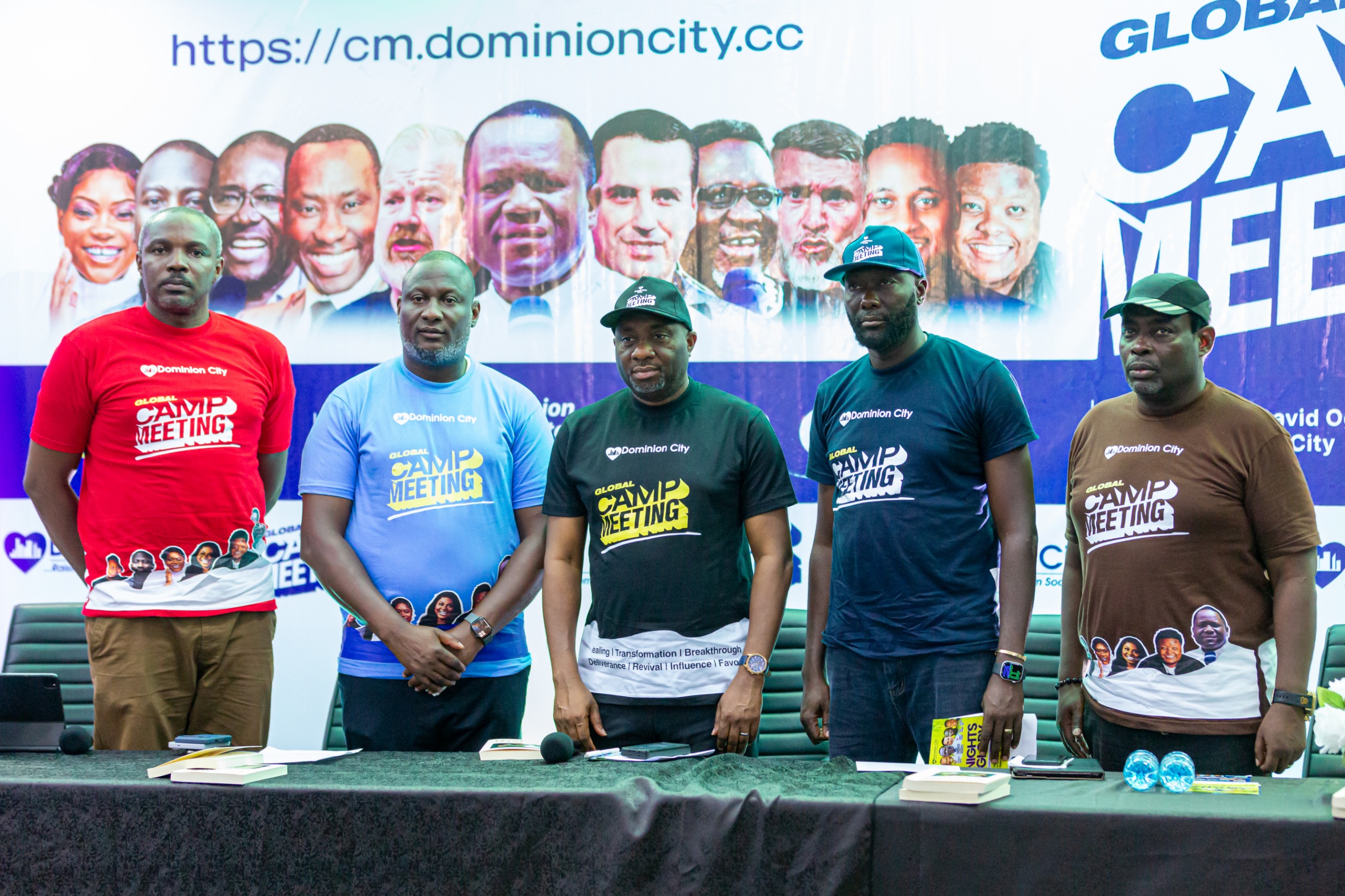
L-R: Dr. Godwin Efobi, Head, Medical Team, Dominion City Headquarters (DCHQ); Pastor Shola Olapade, Senior Pastor, DCHQ; Pastor Nobbert Onaga, President, Golden Heart Foundation and Senior Pastor, DC Lagos & Europe; Pastor Chuks Anochie, Head of Security and Traffic Control, Dominion City Headquarters (DCHQ), Camp Meeting 2026; Pastor Josh Tim Vaduchi, Head of Event & Programmes, DCHQ, during the press briefing of the forthcoming Global Camp Meeting, held the weekend of 2026 at the Dominion City Headquarters (DCHQ), Lagos.
L-R: Pastor Chuks Anochie, Head of Security and Traffic Control, Dominion City Headquarters (DCHQ), Camp Meeting 2026; Pastor Shola Olapade, Senior Pastor, DCHQ; Pastor Nobbert Onaga, President, Golden Heart Foundation and Senior Pastor, DC Lagos & Europe; Dr. Godwin Efobi, Head, Medical Team, DCHQ; and Pastor Josh Tim Vaduchi, Head of Event & Programmes, during the press briefing of the forthcoming Global Camp Meeting, held over the weekend in 2026 at the Dominion City Headquarters (DCHQ), Lagos.
society
Oloworo of Oworosoki Kingdom, Oba Babatunde Saliu, Felicitates President Bola Ahmed Tinubu at 74
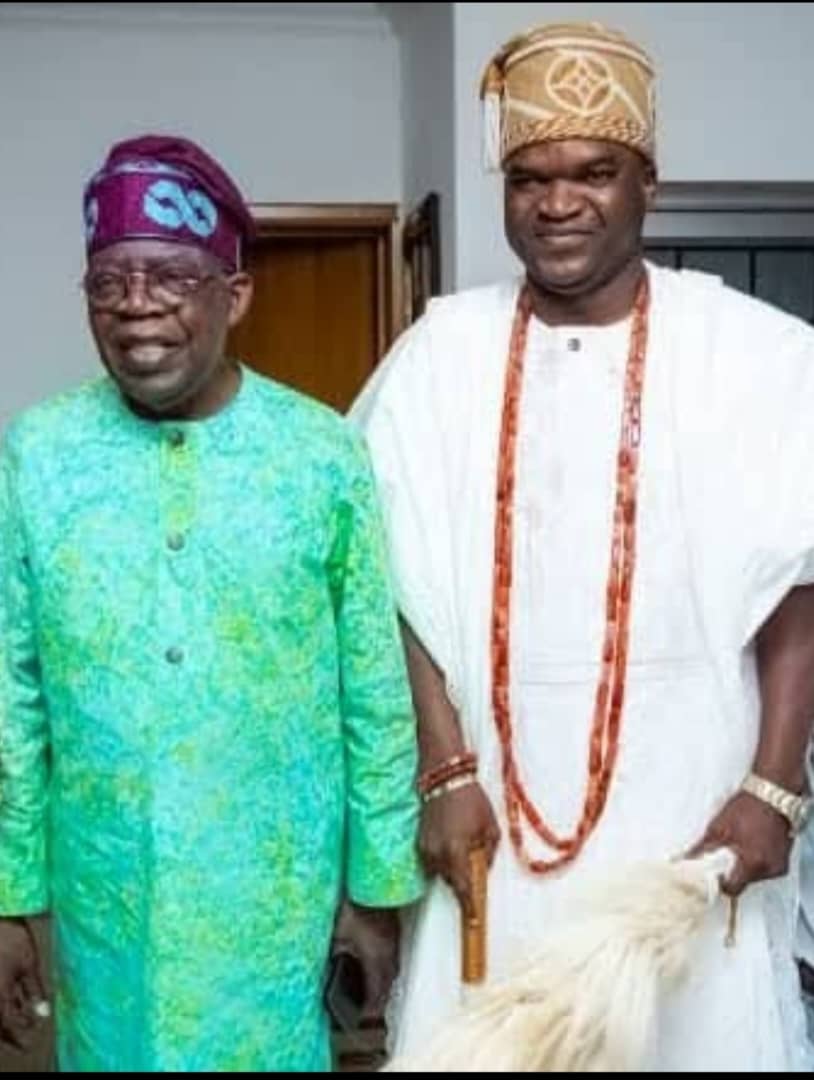
Oloworo of Oworosoki Kingdom, Oba Babatunde Saliu, Felicitates President Bola Ahmed Tinubu at 74
By Adeyemi Obadimu
The Oloworo of Oworosoki Kingdom, His Royal Majesty, Oba Babatunde Saliu, Elebo II, has extended warm felicitations to the President of the Federal Republic of Nigeria, Bola Ahmed Tinubu, GCFR, on the occasion of his 74th birthday.
In a goodwill message issued from his palace, the revered monarch described President Tinubu as a visionary statesman, a courageous reformer, and an indefatigable democrat whose lifelong commitment to nation-building continues to shape Nigeria’s progress.
Oba Babatunde Saliu praised the President’s unwavering dedication to public service, noting that his leadership has ushered in a new phase of economic reform, infrastructural renewal, and institutional strengthening across the country.
According to the monarch, the President’s Renewed Hope Agenda has begun yielding tangible relief and renewed confidence among citizens, reflecting his determination to reposition Nigeria for sustainable growth and prosperity.
“President Bola Ahmed Tinubu has demonstrated exceptional resilience, strategic foresight, and a deep love for Nigeria. His administration’s bold initiatives are laying the foundation for long-term national transformation. At 74, he remains steadfast in his resolve to build a stronger, more united, and economically vibrant nation,” the monarch stated.
Oba Babatunde further commended the President’s legacy of leadership, describing him as a bridge-builder, a mentor to many leaders, and a symbol of democratic stability. He acknowledged the President’s decades of sacrifice and contribution to the advancement of democracy in Nigeria.
On behalf of the Oworosoki Kingdom, the royal father prayed for divine wisdom, sound health, and renewed strength for the President to successfully complete the noble reforms and developmental strides he has embarked upon for the benefit of all Nigerians.
“As Your Excellency marks 74 remarkable years, we pray that Almighty God grants you long life, continued wisdom, and the fortitude to steer our great nation toward greater heights. May your days be filled with strength and grace as you continue to serve Nigeria with distinction,” Oba Babatunde Saliu added.
President Bola Ahmed Tinubu clocks 74 as a leader whose enduring influence, bold reforms, and steadfast patriotism remain central to Nigeria’s ongoing journey of national renewal.


-

 society6 months ago
Religion: Africa’s Oldest Weapon of Enslavement and the Forgotten Truth
-

 news4 months ago
WHO REALLY OWNS MONIEPOINT? The $290 Million Deal That Sold Nigeria’s Top Fintech to Foreign Interests
-

 society6 months ago
“You Are Never Without Help” – Pastor Gebhardt Berndt Inspires Hope Through Empower Church (Video)
-

 celebrity radar - gossips2 months ago
Dr. Chris Okafor Returns with Power and Fire of the Spirit -Mounts Grace Nation Altar with Fresh Anointing and Restoration Grace on February 1, 2026