society
Uniqueness, Raw Talent, Creativity distinguishes Femi Trinity among Colleagues
Uniqueness, Raw Talent, Creativity distinguishes Femi Trinity among Colleagues .
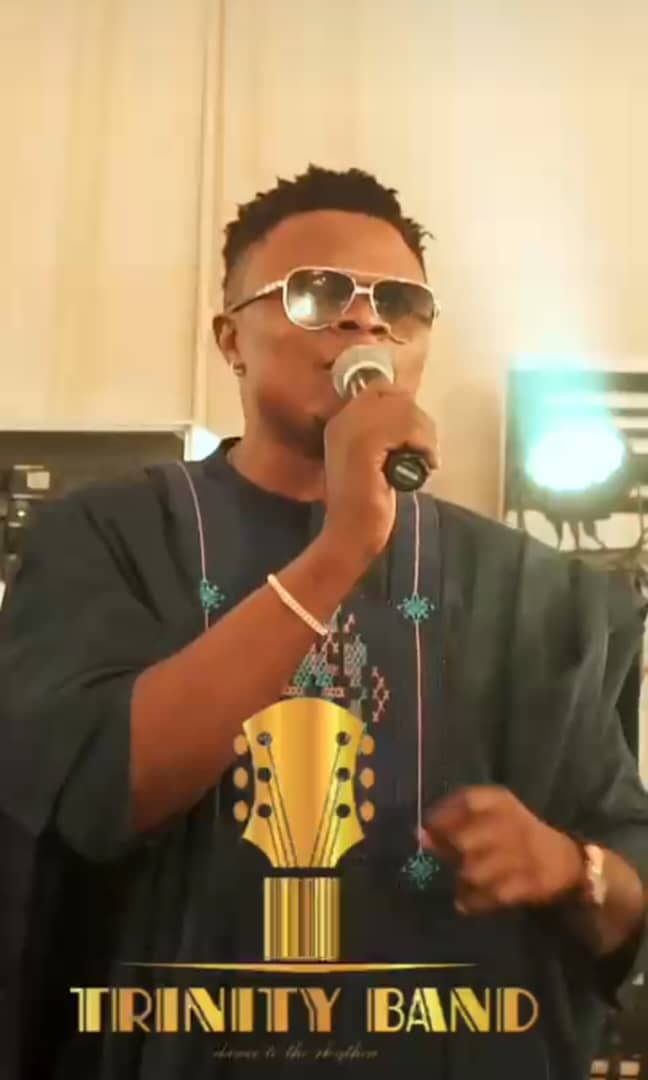
One of the famous Music Act making waves in the entertainment industry with dynamisms and ability to translate Songs into creativity is no other person than the famous Falade Oluwafemi aka Femi Trinity of Trinity Rhythmic band,
He is Good,Talented, Handsome, Creative and very humble to all his fans across the globe
He has created a niche for himself, therefore His name is now a household name in the entertainment world Particularly Fans and lovers of Live Bands.
Femi Trinity Talents to sing creative songs is beyond any ones imaginations, full of Power he has the ability to transfer any one from a stage of helplessness to a full stage of hope, his songs give hope, rethink, and melodious.
Without mincing words Femi trinity is a talent full of great unique experiences, His Christian choir background page way for him in the music industry and stands him out among his colleagues in the industry, when Femi Trinity sings, he takes full charge, releasing messages to all his fans and making sure they get the best of him at all times
The jeka a baa na owo e crooner recently shake the federal capital city of Abuja with the best of his songs along side his crew members, it was really a moment where Society meets music, it was never a dull moment,a fans who witness the show remarked
This is why I said Femi Trinity remains the best, heaven is just his starting point, he has a very big hidden Talent, when well exploited will make him a popular Music Act across the Globe,
If you want the best of Music, Femi Trinity is the talent that can give you good music for your money
Watch out for Part 2, more of Femi Trinity
society
Lt General Waidi Shaibu; an Epitome of Selflessness, Altruistic and Unalloyed leadership
Lt General Waidi Shaibu; an Epitome of Selflessness, Altruistic and Unalloyed leadership.
By Comrade Oladimeji Odeyemi.
” This initiative is also central to my “Soldier First Concept”, which seek to deliberately prioritize the welfare and living condition of our officers and soldiers. It is worth reiterating that my Soldier First Concept is premised on the understanding that operational success is directly linked to the level of care and support provided to those entrusted with the defense of our beloved nation. The President Bola Ahmed Tinubu Barracks Phase Two, therefore, stands as a practical expression of my command philosophy”. Lt General Waidi Shaibu during the flagging off of the Phase Two of the Bola Ahmed Tinubu Barracks Construction Project in Abuja.
At the inception of the President Bola Ahmed Tinubu administration, one thing was clear to all, here was an enigma and a master strategist coming to tackle a most difficult and daunting job, after our economy, the task of winning the remnant of the war against terrorism and violent crimes in the Country.
Before the Tinubu administration came into the office, the previous administration for the most part have been able to contain the issue of insecurity to their best of abilities, but politics and ethnicity mixed with religion have also been a clog in the wheel of decisively dealing with this cankerworms.
Although the reins of governance fell into Tinubu’s way through a landslide victory at the 2023 elections, the task of fighting the last batch of terror has now be given to a certain General Waidi Shaibu by his appointment as the 25th Chief of Army Staff, (COAS, Nigerian Army) in October 2025 and by extension the man upon whom the biggest responsibility yet, in recent times fell upon not only to win a most unconventional warfare against terror and violent crimes, but to organize the Nigerian Army, in organization, motivation and infrastructure, more than in the fronts fighting terror. Therefore the tasks were legion.
Changing The Military With Servant Leadership Style.
Exactly four months after, the very unassuming gentleman and a General, Shaibu can be said to have equally achieved in legionary and legendary proportions by bringing his uniqueness into changing the Nigerian Army with his purposeful servant-leader military style of leadership in which the high morale of the soldiers was brought back and trust restored between the rank and file and the commanding officers.
Today, there is no organized terror attacks of the kind we used to see, only isolated soft-target attacks and ambushes as the capacity of Boko Haram, ISWAP, bandits and other enablers of violent crimes have practically been decimated and reduced to nothingness.
How Was General Shaibu Able To Do This?
There are a number of significant difficulties for today’s military – the global war on terrorism, weapons system acquisitions and personnel drawdowns have been a hindrance with Nigeria denied access to sophisticated weapons in the past and some past administration, mismanaging and embezzling of funds meant for weapons procurement.
The focus of this article is on one strategic component of the exemplary leadership of General Waidi Shaibu, who in spite of some odds, and international support and morale of our troops was still able to shape the Nigerian Army significantly as to make it functional, professional and a worthy army, a pride to the noble profession of the military, recognized all over the world for bringing violent crimes to its knees. And in just such a short time too.
Effectiveness Of General Shaibu’s Leadership.
As earlier stated, Shaibu’s servant leadership has been the major turning point in making the huge difference, from the period of his appointment, to date.
The Army’s definition of leadership is the process of influencing people by providing purpose, direction and motivation while operating to accomplish the mission and improving the organization.
Therefore an army leader is required to inspire and influence people to accomplish their goals.
General Shaibu simply put himself in the place of his soldiers, feeling their pain as his pain, knowing their needs as his needs — He wasn’t the boss who stayed to far from his troops, he lived among them.
Shaibu is a leader who motivates people both inside and outside the army to help them pursue their goals, focus on their thinking, and shape decisions for the better of the army.
General Waidi Shaibu took his unique leadership style to the world, appearing on the world stage in Liberia, when he reaffirmed Nigeria’s enduring leadership in regional peace and security, declaring that Liberia’s current stability was a direct result of Nigeria’s delibrate intervention , African solidarity and military sacrifices. In his speech at the Barclay Training Center, Monrovia, Liberia, where he was the Special Guest of Honor at the event marking the 69th Armed Forces Day Anniversary of the Armed Forces of Liberia. Here he was at the international stage strengthening not only the Nigerian Army but deepening Nigeria’s democracy by telling the whole world his resolve to exterminate terror as well as defend Nigeria’s democracy, a deep resolve to which he has played an exemplary role.
Such is the kind of servant leader that Shaibu is, his loyalty to Nigeria and to President Bola Ahmed Tinubu, never in doubt. He’s a soldier’s soldier.
Loyalty As Shaibu’s Watchword.
In leadership loyalty, although a vital ingredient, can only be acquired by those who are innately and inherently loyal. In the army, loyalty is perhaps more than just a need, it is a pillar upon which the military structure rests.
But Shaibu to date, has left no one in doubt where his loyalty lies, to the country, and to the President and the Commander in Chief.
In all the six zones of our dear country, the Army under General Shaibu has stayed true to the indivisibility of the country. Our country is safer today because of the unique leadership style, loyal and selfless service provided by the Chief of Army Staff.
Shaibu’s philosophy seems to echo the very words of the great military strategist, Napoleon Bonaparte, “as long as there is the self-determination to do what is best for the nation, every other consideration is secondary”.
These are the type of characteristics he said the army under him aims to instill in each solider, and to all intents and purposes, General Waidi Shaibu has done all of these.
Lesson From Having A Leader Like General Shaibu.
Being an exemplary leader in the army requires having mental strength. There is a common misconception that people who are physically strong are the only ones who make great leaders. But again, we have seen in the ever smiling gentle General that his greatest strength lies in his mental faculty and capabilities.
We have also seen in the example of Shaibu, a good leader needs to be mentally strong and able to make firm and sound minded decisions.
Fighting terrorism is more of intelligence gathering and counter-espionage, more of a game of wits than bare braggadio, when the enemy you are fighting is not the conventional Army and may even be lurking in the market place, mosques, churches, where civilians reside. Perhaps, this is where Shaibu in four months have won.
Mahatma Gandhi was an exceptional leader in that he was able to satisfy the basic psychological needs of his followers. Ghandi, a small frail man whom was soft spoken and practiced resolute leadership style, is a prime example of dexterity in leadership. He was able to move thousands of people to action in India and at the same time inspired the entire globe with his non-violent methods.
General Shaibu, with his soft spoken, almost shy nature, has been able to gain the confidence of his men, that today, under his leadership, the Nigerian Army is the pride of our dear Nation.
Today, we salute this exemplary leader, consummate soldier and meritorious Chief of Army Staff who came when his country needed him most and has continued to serve humanity and has impacted positively on this generation. His name in the annals of history, we are very sure of worthy, most irreproachable place in which he will be remembered for his selfless services rendered to motherland, saving Nigeria from being consumed by violent crimes and from political destabilization. A certain General Waidi Shaibu has continued to stand firmly behind the country and behind his President.
Comrade Oladimeji Odeyemi, an entrepreneur and an opinion moulder contributed this article from Ibadan, Oyo State.
society
Senate’s Electoral Reform Bill Risks Opening Door to Voting Errors, NBA’s Ubani Warns
By George Omagbemi Sylvester | Published by SaharaWeeklyNG
“As harmonization talks continue in Abuja, legal experts and civil society leaders warn that ambiguities in the Senate’s draft amendment could undermine electronic result transmission and weaken public confidence ahead of the 2027 general elections.”
Abuja, Nigeria – The ongoing controversy over the Electoral Act 2022 (Repeal & Enactment) Amendment Bill, 2026 has erupted into one of the most consequential political flashpoints in Nigeria’s democratic journey ahead of the 2027 general elections. At the centre of the storm is the Senate’s version of the bill, which critics (including Monday Ubani, SAN, Chairman of the Nigerian Bar Association (NBA) Electoral Reform Committee) say leaves open critical loopholes that could invite systematic electoral errors and manipulation.
On Saturday, Ubani raised pointed concerns during a televised interview on Arise Television, arguing that the Senate’s draft, as passed on second reading, “leaves room for electoral error”. He explained that electronic result transmission and result transfer processes in the bill still rely on manual collation at collation centres, leaving the possibility for discrepancies between what voters see at the polling unit and what is declared later.
“The people have witnessed a situation where a different result will be declared at the collation centre, different from what happened at the polling unit,” Ubani said. “The Senate proposed bill leaves room for electoral error and there are concerns about communication failures that can be illegally taken advantage of.”
The uproar stems from the Senate’s decision not to include language that mandates real‑time electronic transmission of election results from polling units with a reform widely championed by civil society, legal experts, opposition parties and advocacy groups. Instead, the Senate retained a provision that allows the Independent National Electoral Commission (INEC) discretion in determining the mode of results transfer, similar to what existed under the Electoral Act 2022.
For decades, Nigeria’s elections have been plagued by allegations of manipulation and result tampering, particularly during the transportation and collation of results away from polling units. In the 2023 general elections, electronic tools like the INEC Result Viewing Portal (IReV) were deployed to upload results online, allowing citizens to view them in real time. However, the Supreme Court later ruled that such electronic transmission lacked a statutory basis, since the Electoral Act did not expressly mandate its use.
This legal lacuna has invigorated reform advocates to push for legislative clarity. As one election law expert told TheCable in an in‑depth legal analysis, “the absence of ‘real‑time’ language, the undefined communication failure exception, and the designation of manual results as primary when technology allegedly fails transform what should be a strong transparency mechanism into a discretionary system vulnerable to abuse.”
Yet, rather than enshrining real‑time electronic transmission as a legal requirement, the Senate retained the existing discretionary framework, prompting outrage. Civil society organisation #FixPolitics Africa argued that this amounts to a “brazen betrayal of electoral reform and the rule of law,” stating that ambiguities in the bill erode public trust and risk hollowing out Nigeria’s democracy.
Prominent voices have weighed into the debate. Former Minister of Education and activist Oby Ezekwesili warned that the Senate’s approach amounts to “playing with fire” ahead of elections that Nigerians hope will be more credible than past cycles. Critics argue that removing mandatory electronic transmission and retaining discretionary language hands back power to old practices that have facilitated manipulation.
On the political front, the Peoples Democratic Party (PDP) condemned the Senate’s decision as “most shameful and unfortunate,” stressing that the majority of Nigerians want electoral sanctity bolstered through electronic safeguards. The party’s statement argued that without clear legal requirements, result manipulation remains possible.
Yet Senate leaders have downplayed the criticism. Senate President Godswill Akpabio stressed that the process is not complete, noting that the Senate will reconvene to approve the Votes and Proceedings of its sessions before the final text is settled. He cautioned against premature judgments, characterising public outrage as misguided given that legislative harmonisation with the House of Representatives is still underway.
Senators like Ireti Kingibe have also sought to reassure the public. Kingibe, a member of the Senate Committee on Electoral Matters, said the core reforms (including electronic transmission) remain part of the discussions and will be clarified in a harmonised version of the bill.
As a harmonisation committee meets to reconcile the Senate and House versions, the stakes could scarcely be higher. If the differences are not resolved clearly and transparently, the final Electoral Act may lack the very reforms most Nigerians believe are necessary to restore confidence in the electoral process.
Legal scholar Dr. Emeka Umeagbalasi, writing in a recent analysis, captured the moment perfectly: “Nigerians invested in technology and raised expectations about transparency, but the legal framework must now match that investment and failing to enshrine real‑time transmission risks a repeat of the very irregularities reformers sought to eliminate.”
The 2027 elections loom large on the calendar. With trust in democratic institutions fragile and public impatience with political elite promises at an all‑time high, the final form of Nigeria’s electoral law may prove as decisive as any campaign rhetoric or political rally. The tension between tradition and technology, discretion and certainty, could well determine whether the next general elections are a triumph of democracy or another missed opportunity.
society
Bishop Chidi Anthony Appointed National President of CPFN Stakeholders Forum at 8th Bi-ennial Convention, Ibadan 2026
Ibadan, Oyo State – The Christian Police Fellowship of Nigeria (CPFN) has appointed Bishop Chidi Anthony as the National President of CPFN Stakeholders Forum, following his outstanding contributions to ministry, global evangelism, and humanitarian impact.
The appointment was made at the 8th Bi-ennial National Convention of CPFN, held from February 11-13, 2026, at Men of Issacar Vision Ministry, Olororo-Ojo, Ibadan, Oyo State. The convention was themed “Christian Police as Repairer of the Breach” (Isaiah 58:12).
Bishop Anthony, General Overseer of Kings in Christ International Ministries and National President of the Pentecostal Ministers Forum (PMF), expressed gratitude for the opportunity, saying, “When I received the letter… I was not surprised, so pleased with the letter, because this is the reason why God called me.”
He emphasized his commitment to promoting CPFN’s good image and changing public perception of the police, stating, “I have to protect the good image of CPFN… When a police man does a little mistake, you find out it will go viral, but when a police man does something good, you find out, it will not go viral and the people are seeing it that the police are bad.”
Bishop Anthony praised AIG Emmanuel Adegbola Aina’s performance as CPFN National Coordinator and expressed admiration for CPFN founder, retired AIG Michael O. Daniel, saying, “I was surprised that with his age, he still came and participated actively at the convention… great evidence of his passion of things of God.”
To CPFN members, Bishop Anthony offered encouragement: “My encouragement to them is that they should not relax, it is not easy when you are into Christ… our reward is over there in heaven.”
The 8th Bi-ennial Convention marked a turning point for CPFN, ushering in renewed vision, stronger leadership, and deeper spiritual commitment. With Bishop Chidi Anthony at the helm, CPFN looks forward to greater impact in spreading the gospel, fostering integrity, and building a police force anchored in faith and service to humanity.
-
celebrity radar - gossips6 months agoWhy Babangida’s Hilltop Home Became Nigeria’s Political “Mecca”
-
society6 months agoPower is a Loan, Not a Possession: The Sacred Duty of Planting People
-
news6 months agoTHE APPOINTMENT OF WASIU AYINDE BY THE FEDERAL GOVERNMENT AS AN AMBASSADOR SOUNDS EMBARRASSING
-
Business6 months agoBatsumi Travel CEO Lisa Sebogodi Wins Prestigious Africa Travel 100 Women Award