
Politics
US Republican debate: Who were the winners and losers?

US Republican debate: Who were the winners and losers?
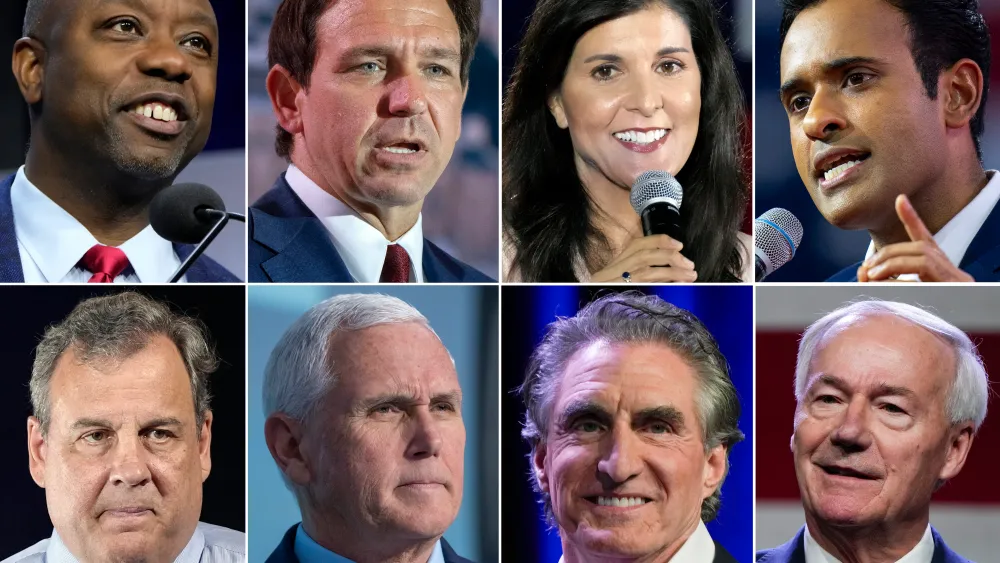
REPUBLICAN DEBATE– Interestingly, the first Republican presidential debate was a rowdy affair that saw the eight candidates leap headlong into heated exchanges.
There were some who thought it would be boring without Donald Trump – the ultimate showman – but that was decidedly not the case. The former president may have been the life of the party during primary debates back in 2016, but the eight rivals who travelled to Wisconsin proved they could bring some excitement without his help.

Some candidates stood out from the pack, however – and some seemed to languish on the sidelines.
With Donald Trump skipping the first 2024 Republican presidential primary debate, eight of his primary rivals – most of them men wearing ties similar to the bright red one regularly worn by the former president – brawled for second-place status Wednesday night.
Vivek Ramaswamy, the 38-year-old entrepreneur and first-time candidate, was alongside Florida Gov. Ron DeSantis in the center of the stage – and he was the central figure for much of the night. Ramaswamy brawled with former Vice President Mike Pence over his experience, former South Carolina Gov. Nikki Haley over foreign policy, former New Jersey Gov. Chris Christie over Trump, and more.
And because he has positioned himself as a defender of Trump, Ramaswamy was, at times, a stand-in for the former president, who momentarily ceded the stage Wednesday night but will take it back Thursday when he turns himself in at the Fulton County jail in Georgia as he faces election subversion charges.

Taking shots at Ramaswamy
With Trump absent from Wednesday’s debate, the target of most of the debate participants was not DeSantis or South Carolina Sen. Tim Scott or any candidate who has ever held elected office. It was political newcomer Ramaswamy. The first jab at the Ohio entrepreneur came from Pence: “Vivek, you recently said a president can’t do everything. Well, I’ve got news for you, Vivek. I’ve been in the hallway. I’ve been in the West Wing. The president of the United States has to confront every crisis facing America.”
That spurred a heated back-and-forth and light name-calling between the two candidates. Later, in the first bit of the debate, former New Jersey Gov. Chris Christie compared Ramaswamy’s answers to something cranked out by ChatGPT. Christie then capitalized on Ramaswamy rhetorically asking what a little-known guy with a funny name was doing on the debate stage by pointing out that the quip sounded awfully like Barack Obama’s old stump line about him being “a skinny kid with a funny name who believes that America has a place for him.”
At another point, Pence went after Ramaswamy when the entrepreneur said, “We are in the middle of a national identity crisis.” The former vice president replied, “We don’t have an identity crisis, Vivek. We are not looking for a new national identity.”
Pence also contrasted his own resume with Ramaswamy’s: “Well, I’ve got news for you, Vivek. I’ve been in the hallway and the West Wing. A president of the United States has to confront every crisis facing America.”
DeSantis doesn’t stand out
DeSantis set the expectation that he would be the focal point of Wednesday’s debate. He was anything but.
He certainly didn’t speak the most. Though his campaign suggested his Republican opponents would have their “knives out” for DeSantis, he wasn’t on the receiving end of many attacks. And at a key moment – when the candidates were asked to raise their hands if they would support Trump if he is convicted in a court of law – DeSantis peeked around the stage to see how everyone else had responded before he half-heartedly put up his right palm.
DeSantis, who earned the center-stage spot, appeared content to exit Milwaukee without risking his second-place standing in the polls. But he also did little to erase the impression, confirmed by polling, that he is closer to the rest of the pack than in a tier with Trump or in one of his own.
When he spoke, DeSantis largely leaned on rehearsed lines familiar to anyone who has heard him speak in recent months. Just as he does on the campaign trail, he opened the debate by declaring “Our country is in decline” and “We need to send Joe Biden back to his basement.” He joked about Hunter Biden’s paintings – a regular punchline when he visits early nominating states. He said under a DeSantis administration, people who cross into the United States illegally would end up “stone cold dead,” a promise he has repeated for weeks.
At times, moderators attempted to move DeSantis off his practiced remarks. When DeSantis touted his record on crime by declaring it was at a 50-year low in Florida, Fox’s Brett Baier interjected that crime was up in Miami. DeSantis clarified: “Well, statewide.” Asked if he would support a federal six-week abortion ban, DeSantis talked about his electoral victory in Florida. Pressed to give an answer, he replied as he has for weeks, by refusing to rule it out or get behind it.
DeSantis attempted to shed his reputation as a cold and stiff debater by forcefully speaking directly to Americans at home, often pointing directly at the camera, and by sharing anecdotes from an abortion survivor and a mother whose son died from fentanyl poisoning. He shared his biography – thrice mentioning his military service and talking repeatedly about his young family – an acknowledgment that voters may not yet know his story beyond the cultural clashes and COVID-19 policies that have made him a Republican star.
Christie’s failed Attack Dog moment
If there was one candidate who was expected to emerge from Wednesday night with a knock-out punch of a moment, it was Christie. Nearly eight years ago, the former governor embarrassed Marco Rubio during the final debate before the New Hampshire primary by pointing out the Florida senator’s habit of repeating lines. While Rubio won more votes than Christie in the Granite State – coming in fifth to Christie’s sixth – the senator struggled to shed a reputation for being robotic.
Christie seemed ready to give Ramaswamy the same treatment. But while Christie’s “ChatGPT” line was reminiscent of his past debate performance, he failed to trip up the Ohio businessman. Instead, Ramaswamy went on to attack him over his criticism of Trump.
Asked if he would support the former president if he’s convicted of a crime, Christie said the party needs to stop “normalizing this conduct,” drawing boos from the crowd.
“Your claim that Donald Trump is motivated by vengeance and grievance would be a lot more credible if your entire campaign were not based in vengeance and grievance against one man,” Ramaswamy said.
Ahead of the debate, Doug Mayer, a senior adviser to the Christie campaign, told CNN the former New Jersey governor would turn anyone who defended Trump into Trump. But Christie’s attempt to attack the former president’s top defender onstage was met with more vitriol from the crowd.
“You make me laugh,” Christie said before the sound of boos drowned him out. The optics didn’t help: Fox News showed a split screen of Christie standing silently as Ramaswamy grinned until the moderators asked the crowd to let him finish.
Drawing distinctions over abortion
Some candidates supported a 15-week federal abortion ban. Some said they were against efforts to pass a nationwide ban. And no one clearly stated they would sign a six-week federal abortion ban – even if they’d approved such laws as governors.
More than a year after the Supreme Court overturned Roe v. Wade, abortion policy is still a tricky issue for Republican candidates caught between the need to demonstrate their anti-abortion bona fides and address the realities of the political landscape, where voters have rejected stringent abortion restrictions and the candidates who backed them.
At one end of the spectrum stood Haley, who sparred with Pence over the possibility of passing a federal ban. Haley called on the other candidates to “be honest” with the American people about the low odds of getting 60 senators to overcome a filibuster and approve a federal abortion ban. She instead pushed for consensus on issues such as encouraging adoption and allowing doctors and nurses with moral objections to the procedure the right not to perform them.
“Consensus is the opposite of leadership,” Pence said in response. But even Pence wasn’t willing to go further than endorsing a 15-week federal abortion ban, the cutoff offered in a bill South Carolina Sen. Lindsey Graham introduced last year.
“A 15-week ban is an idea whose time has come,” Pence said. Scott also backed the 15-week ban onstage.
Two candidates who have signed a six-week abortion ban into law – DeSantis and North Dakota Gov. Doug Burgum – stopped short of saying they would do the same nationally. Burgum said his opposition to a national ban stems from his support for the 10th Amendment. DeSantis asked if he would sign a federal six-week ban, and simply said he would “stand on the side of life.”
“I understand Wisconsin will do it differently than Texas,” DeSantis said. “But I will support the cause of life as governor and as president.”
DeSantis tries, but fails, to duck the January 6 question after being pressed by Pence
When moderators asked DeSantis whether Pence was right to reject Trump’s pressure campaign to overturn the 2020 presidential election, the Florida governor attempted to dodge – ignoring what he’d been asked and complaining about the “weaponization” of the federal government.
But Pence dug in, putting DeSantis on the spot.
“The American people deserve to know whether everyone on this stage agrees that I kept my oath to the Constitution that day. There’s no more important duty, so answer the question,” he said.
“Mike did his duty. I’ve got no beef with him,” DeSantis said, attempting to quickly move on.
The moment illustrated how cautious the Florida governor is of alienating Trump’s base.
Christie, though, mocked DeSantis’ answer, calling it “a pre-canned speech.”
He said Pence “deserves not grudging credit; he deserves our thanks as Americans.”
Haley leans towards the general election
Haley, the former South Carolina governor and US ambassador to the United Nations under Trump, brought onto the stage Wednesday a message that was geared more directly for a general electorate than those of her rivals.
What’s less clear is whether she did enough to impress Republican voters to get there.
Haley balked at a federal abortion ban, saying the reality of the Senate’s 60-vote threshold to break the filibuster and the need for a House majority means “consensus” is necessary on the issue. She also said contraception should be available to all women.
She was one of the few candidates to acknowledge that climate change is real.
She was the first to criticize Trump by name, pointing to rising spending during his presidency. She praised Pence’s actions on January 6, 2021, despite Trump’s pressure on the former vice president to seek to overturn the 2020 election result. Haley also called her former boss the “most disliked politician in America.”
“We cannot win a general election that way,” she said.
And she hammered Ramaswamy during an exchange over Russia, as Haley defended the United States’ support for Ukraine.
“You have no foreign policy experience, and it shows,” she said during one of the night’s most animated exchanges.
Scott sticks to Mr. Nice Guy’s routine
The plan for Scott going into the debate was to stick with his “kill ‘em with kindness” attitude. For the first part of the debate, he did that. The problem was that the approach kept him out of most of the exchanges. While the other candidates were debating and skirmishing over abortion, Ukraine or whether Trump should be pardoned, Scott wasn’t really in it. He did try and insert himself with warnings about the “weaponization” of the federal government and crime in America. But all of his comments and arguments faded into the background as candidates piled on Ramaswamy or Christie praised Pence for his actions on January 6, 2021.
When Scott did get a chance to weigh in on the southern border, illegal immigration and fentanyl, he offered a long answer about how important and easy it would be to finish Trump’s border wall.
“As the next president of the United States, I will make that border wall complete,” Scott said, extending each word in that concluding sentence. He paused for applause. There was none.
Ahead of the debate, Republican strategists argued that this was the approach Scott wanted to take because it’s his authentic self. The question now is if the South Carolina senator will stick with it going forward.




*Renewed Hope Ambassadors Step Into the Next Phase
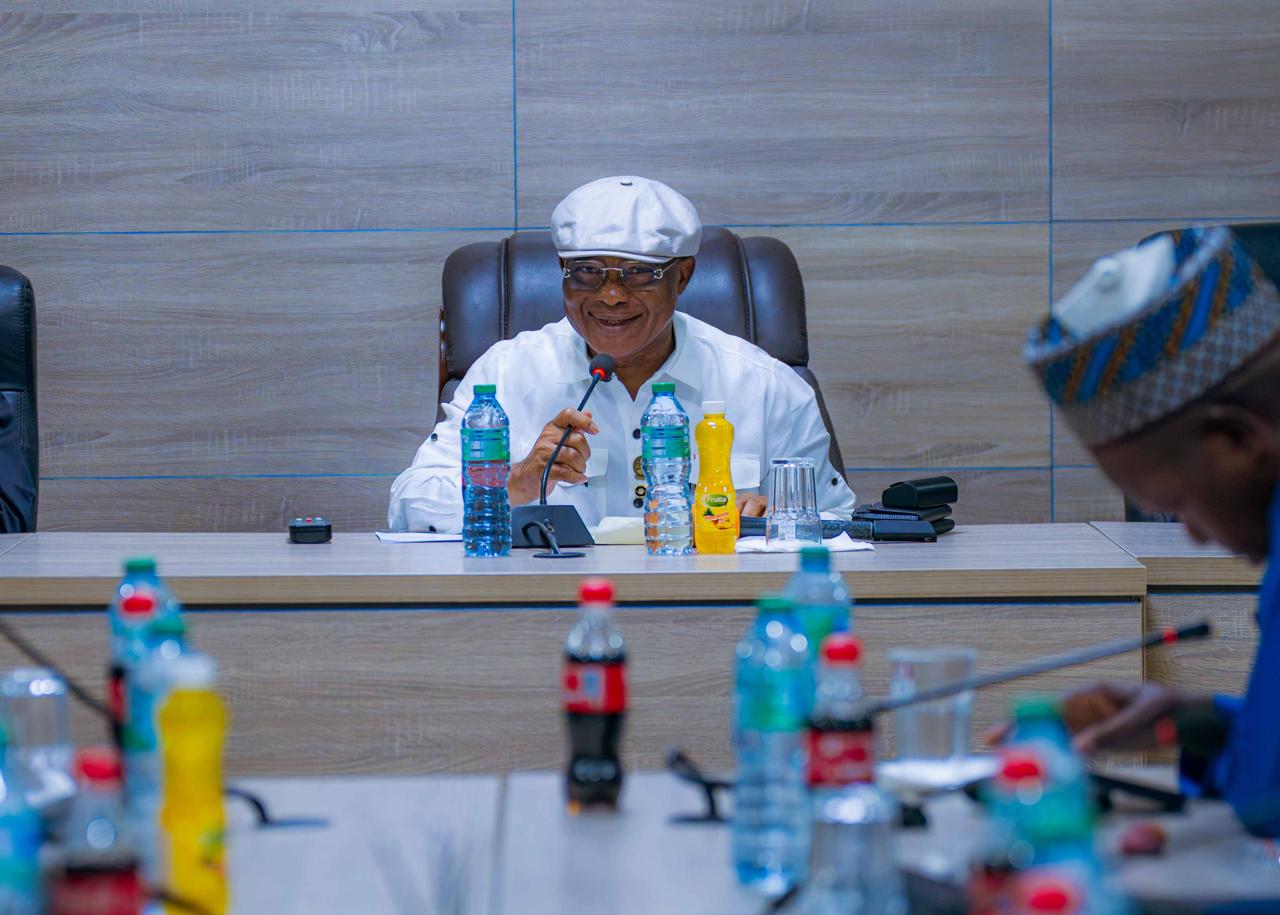
Fresh from the successful APC 2026 National Convention, the Renewed Hope Ambassadors National, Zonal, and State leadership gathered in Abuja over the weekend, for its fourth strategic meeting, setting the tone for nationwide grassroots activation ahead of 2027.
Chaired by Governor Hope Uzodinma (Imo State) the Director General and National Coordinator of the Renewed Hope Ambassadors, alongside Deputy Director-General, Governor Uba Sani of Kaduna State, and Governor Inuwa Yahaya of Gombe State as Secretary, the session reinforced one clear direction: One Party. One Message. One Mobilization whilst also laying out a strategic roadmap for the activation of the network across all communities in Nigeria.
Backed by the strength of 31 APC-led states, the Renewed Hope Agenda is taking Bola Ahmed Tinubu’s message of progress and reform to every corner of Nigeria.
From bold economic restructuring to initiatives like NELFUND, the increase in the national minimum wage from ₦30,000 to ₦70,000, and strategic investments in critical sectors, including PNiCGI, the mission remains clear: helping Nigerians understand both the purpose and the progress of the Renewed Hope vision.
This is coordination at scale. This is grassroots engagement with purpose. This is the next phase of Renewed Hope with One Party, One Message, and One Mobilisation framework
#RenewedHopeAmbassadors #APC #WeAreAPC


Governor Bago Inaugurates APC Digital Media Sub-Committee Ahead of National Convention.
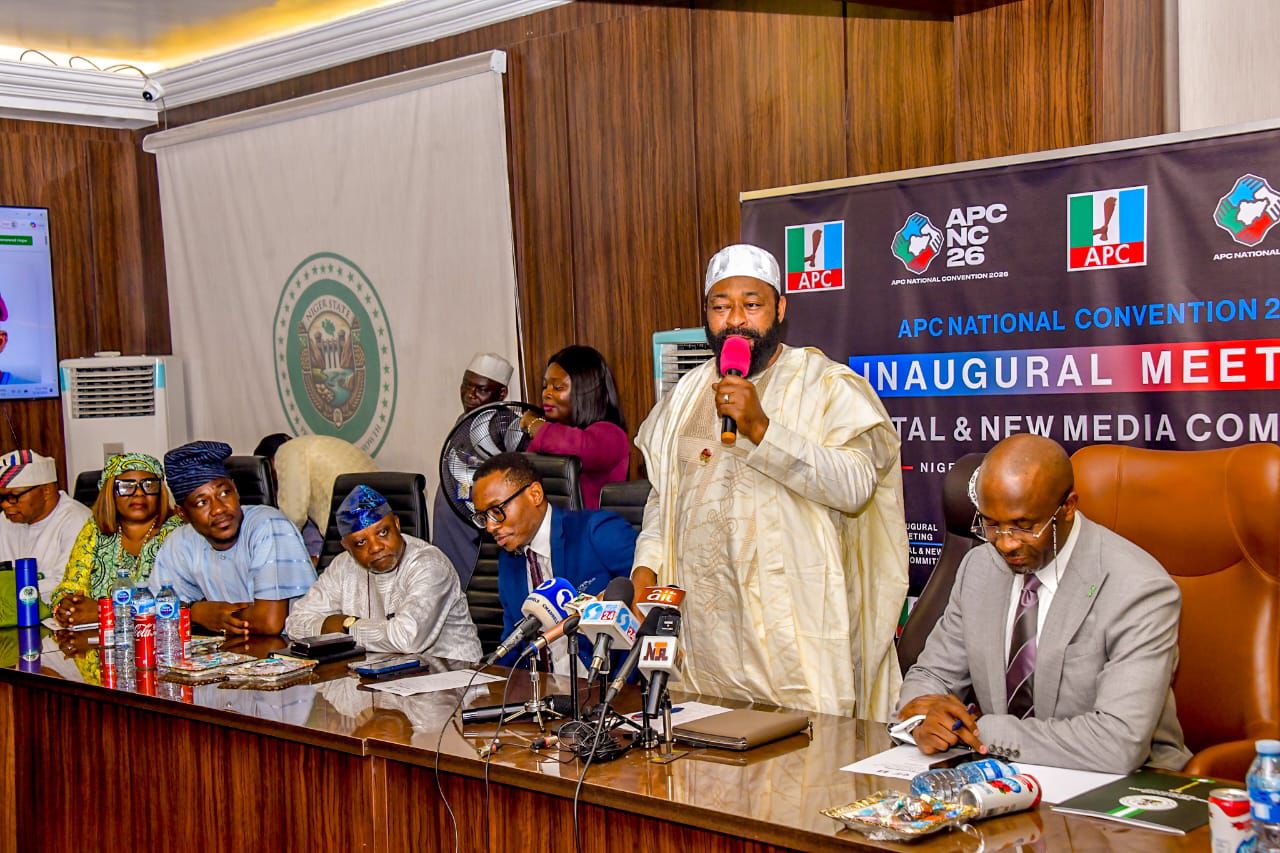
Governor Umaru Bago has inaugurated the Digital Media Sub-Committee for the forthcoming National Convention of the All Progressives Congress (APC), scheduled to hold on March 27 and 28, 2026 in Abuja.
Chairing the sub-committee, Governor Bago tasked members with the responsibility of effectively communicating the party’s manifesto to the public.
He emphasized the need to leverage social media platforms to highlight the achievements and ongoing efforts of President Bola Ahmed Tinubu, noting that communication gaps have posed challenges that must now be decisively addressed.
The Co-Chair of the sub-committee, Hon. Benjamin Kalu, Deputy Speaker of the House of Representatives, echoed the Governor’s position, urging members to project the activities of both the party and the government to a broader audience.
He called for a deliberate and coordinated effort to showcase the party’s achievements and policy direction, stressing the importance of shaping a compelling and consistent narrative across all digital platforms.
Delivering a presentation to the committee, Otega Ogra, SSA to the President on New Media, who serves as Secretary of the sub-committee, outlined strategic focus areas to guide the team’s operations.
His presentation highlighted communication priorities and actionable steps to achieve the committee’s mandate and strengthen the party’s digital engagement.


VP Shettima Set to Lead Delegation to Zamfara as Governor Dauda Lawal Formally Joins APC
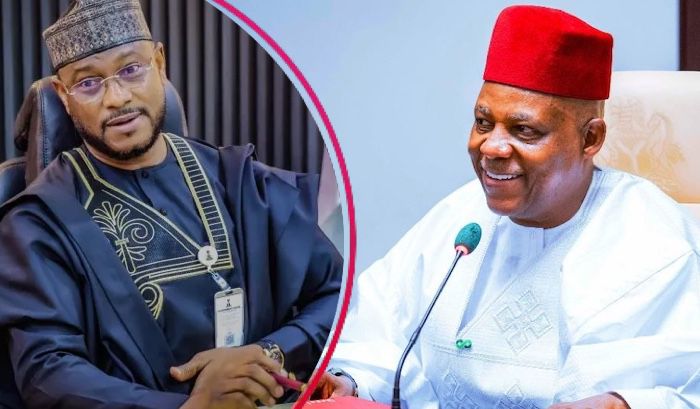
The Zamfara State chapter of the All Progressives Congress (APC) has finalized plans to receive Vice President Kashim Shettima for the formal defection and reception of Governor Dauda Lawal into the ruling party, scheduled to take place on Tuesday.
State APC Chairman, Tukur Danfulani Maikatako, disclosed this during a high-level stakeholders’ meeting held in Gusau, the state capital. He noted that the Vice President would be joined by the party’s national leadership to mark what he described as a landmark political realignment in the state.
Maikatako expressed the party’s excitement over Governor Lawal’s return, recalling that Zamfara had historically been an APC stronghold and that the Governor was previously a bona fide member of the party before his earlier exit.
“We all know that Zamfara has long been one of the APC’s stronghold states, where the defected Governor was once a bona fide member. Now that he has decided to return home, having been satisfied that the APC remains his second choice after the one he left for obvious reasons,” Maikatako stated.
The Chairman called on all party faithful across the 147 wards in the state’s 14 local government areas to turn out en masse to honour the Vice President’s visit. He emphasized that the event was strategically positioned to bolster the party’s popularity and strengthen its structures ahead of the 2027 general elections.
In a strong appeal for unity, Maikatako urged members to set aside all factional tendencies, stressing that the APC remained one political family with shared goals, particularly the ambition to make Zamfara and Nigeria great again.
Echoing similar sentiments, a former state APC Chairman, Lawal M. Liman, appealed to members to cascade the message to their wards and local government areas. He reinforced the need for cohesion, noting that the party’s collective strength would be critical to achieving success in future elections.

All eyes are now on Gusau as the ruling party prepares for a high-profile political gathering expected to further consolidate its influence in Zamfara State.


-

 society6 months ago
Religion: Africa’s Oldest Weapon of Enslavement and the Forgotten Truth
-

 news4 months ago
WHO REALLY OWNS MONIEPOINT? The $290 Million Deal That Sold Nigeria’s Top Fintech to Foreign Interests
-

 society6 months ago
“You Are Never Without Help” – Pastor Gebhardt Berndt Inspires Hope Through Empower Church (Video)
-

 celebrity radar - gossips2 months ago
Dr. Chris Okafor Returns with Power and Fire of the Spirit -Mounts Grace Nation Altar with Fresh Anointing and Restoration Grace on February 1, 2026