
society
When You Accept, You Win: The Untold Secret to Inner Peace


When You Accept, You Win: The Untold Secret to Inner Peace.
By George Omagbemi Sylvester | Published by SaharaWeeklyNG.com
“Life is not about being better than someone else; it is about being better than you used to be.” ~ Wayne Dyer
Life is not a straight road; it twists and turns, stumbles and rises and often punches us in the gut when we least expect it. No one, not even the most privileged or the most pious, is promised constant happiness. In fact, to assume that life will always go your way is a dangerous illusion. The truth is that life can never guarantee happiness, but it does offer us the power to endure, grow and most importantly ACCEPT.

This acceptance is not weakness; it is power. It is the key to peace of mind in an unpredictable world. When we understand that there are things beyond our control (other people’s success, the circumstances of our birth, time, death, betrayal, loss, missed opportunities) and we choose to stop wrestling them, we begin to live freely. Acceptance does not mean surrender; it means clarity. It is the admission that some battles are not worth your mental health, your joy, or your future.
The Myth of Constant Happiness. We live in an age where social media sells the illusion that everyone else is doing better than us; smiling on yachts, attending million-dollar weddings, buying new homes, posing with luxury cars, launching billion-dollar start-ups. The pressure to “KEEP UP” can make people lose their sense of reality. Now here’s the truth: no one is happy all the time and nobody’s life is as perfect as it looks online.

According to a 2023 global study by Ipsos, over 45% of people worldwide reported feeling stress and anxiety daily, despite apparent success or wealth. The World Health Organization also confirmed that depression remains the leading cause of disability globally. What does this tell us? THAT HAPPINESS is not GUARANTEED by SUCCESS, MONEY or even LOVE. It is FOUND in MINDSET.
Acceptance is Freedom. When you accept that not everything will go your way, you eliminate unnecessary suffering. You accept that you are ahead of alot of people, but others are far ahead of you and that’s okay. Life isn’t a race; it’s a personal journey. Just like the MOON and the SUN, we all SHINE at different TIMES.
In the words of American author Mark Manson: “The desire for more positive experience is itself a negative experience. And, paradoxically, the acceptance of one’s negative experience is itself a positive experience.”
Acceptance allows you to breathe, think clearly and reset your focus on what you can control. It helps you detach from toxic comparison and walk your unique path with confidence.
COMPARISON is a THIEF. One of the worst habits modern society encourages is the constant COMPARISON of lives, COMPARISON kills JOY. It leads to DEPRESSION, ENVY, RESENTMENT and HOPELESSNESS.
Harvard University’s 75-Year Study on Adult Development (which remains one of the longest-running studies in the world) concluded that people who focused on personal growth and meaningful relationships were far more fulfilled than those who chased social status and compared their lives to others. In simpler terms, you will never be at peace if you constantly measure yourself against someone else.
Control What You Can. Accept What You Can’t.
You didn’t choose your birthplace, the color of your skin, your parents or your early financial background. Some people are born into WEALTH, others into WAR. Some get an early start in life, others crawl into progress through PAIN and FIRE. It is what it is, but here’s what you do control: your MINDSET, your DISCIPLINE, your REACTION, your WORK-ETHIC and your BELIEF-IN-YOURSELF. That is enough.
Billionaire entrepreneur Jack Ma, once rejected by 30 jobs and told he was “NOT GOOD ENOUGH,” said: “You should learn to smile when you fail, knowing that every setback is temporary. What you cannot change, you must learn to rise above.”
Real Growth Begins at ACCEPTANCE. Let us not confuse “ACCEPTANCE” with “RESIGNATION.” Acceptance is understanding the terrain; resilience is deciding to walk the terrain anyway. Once you accept that life isn’t fair, you become stronger. You stop waiting for a perfect opportunity and start building your own. You stop blaming others and start creating solutions.Every mature mind eventually comes to this realization: you are not entitled to an easy life. Life owes you nothing (not success, not justice, not love), but you owe yourself peace, sanity and purpose.
Balance Ambition with Grace. Being ambitious is great, it moves the world forward. Ambition without acceptance becomes poison. It turns into greed, restlessness and desperation. The healthiest ambition is the one balanced with the grace to accept when the timing IS NOT right or when life throws you curveballs.
Michelle Obama, in her memoir Becoming, stated: “Your story is what you have, what you will always have. It is something to own.”
Own your story. Whether you are behind, ahead or stuck in the middle, it is still your journey. You can not photocopy another person’s destiny.
You are Not Late, You are on Your Path. It is said that Colonel Sanders founded KFC at the age of 65 and Morgan Freeman got his breakout role at 52. Meanwhile, Mark Zuckerberg became a billionaire at 23. Different seasons, different timeliness, same potential for impact. Stop panicking. Life is not a ONE-SIZE-FITS-ALL program. What matters is what you do with what you have, where you are. That is the path to real fulfillment.
Inner Peace is the Real Flex. What is more powerful than owning cars or properties? Inner peace. The ability to sleep at night without anxiety, bitterness or fear. The ability to laugh freely, love purely and live fully. Peace of mind is the luxury too many rich people DO NOT have.
In the words of spiritual teacher Eckhart Tolle: “Accept — then act. Whatever the present moment contains, accept it as if you had chosen it.”
This mindset changes everything. It creates emotional intelligence, mental stability and spiritual strength. You become less reactive, more intentional and more grateful.
The Bottom Line: Acceptance Is the Beginning of Power. This is not a call to give up. This is a call to wake up. To see life as it truly is; flawed, unpredictable, yet full of potential. To stop trying to control the wind and instead adjust your sails. To stop chasing shadows and start embracing the light within you. Let go of the illusion of constant happiness. Life will bruise you, humble you, test you. It will also shape you, teach you and (if you let it) transform you. The moment you accept that you are ahead of some and behind others, that life is both suffering and beauty, you find peace; and from peace, you find power.
“Happiness can exist only in acceptance.” ~ George Orwell

Written by George Omagbemi Sylvester
Published by SaharaWeeklyNG.com




FOPCHEN Seeks Wider Engagement As Court Defers Hearing
OTA, OGUN STATE — The High Court of Ogun State, Ota Division, on Thursday resumed hearing in the ongoing matter involving cultural and societal concerns, before adjourning proceedings till Thursday, July 2, 2026, for continuation of hearing.
At the resumed sitting on May 28, 2026, counsel representing the various parties revisited key issues in the case and made further submissions before the court.
The matter, which has continued to generate public interest across different sectors, again drew attention from legal observers and stakeholders who described the case as one with significant implications for societal values, cultural identity and constitutional interpretation.
Speaking after the proceedings, the Foundation for the Protection of Cultural Heritage in Nigeria, popularly known as FOPCHEN, renewed its appeal for dialogue and constructive engagement among Nigerians, stressing that sensitive cultural and moral issues should not be left entirely within the confines of the courtroom.
According to the group, broader conversations involving traditional institutions, civil society organisations, religious leaders and policy stakeholders remain necessary in addressing issues relating to national values and social responsibility.
Legal analysts at the court premises noted that arguments being canvassed by parties in the suit could shape future legal interpretations surrounding cultural and moral questions in the country.
Following submissions by counsel, the presiding judge adjourned the matter till Thursday, July 2, 2026, to enable parties further prepare and respond to issues raised during the hearing.
The development has continued to spark reactions among observers, with many Nigerians closely monitoring the proceedings ahead of the next hearing date.

US-Based Society Lady, Fehintola-Brat Extends Eid-El-Kabir Greetings To Muslims
United States based fahionista of class, Chief (Mrs) Ayoola Fehintola-Brat has extended a warm greetings to Muslim faithful all over the world on the occasion of the 2026 Eid-El-Kabir celebration.
Fehintola-Brat who is the Balogun Egbe Obaneye Obinrin Akile Ijebu, and the Yeye Asofin of Idenaland in her message to Journalists urged Muslim to continually uphold the enduring values of sacrifice, obedience, faith, and compassion, which are central to the significance of Eid-El-Kabir festival.
A quiet philantropist whose humanitarian services has won her several laurels urged Muslims to use the spiritual occasion to pray for the peace co-existence of Nigerians regardless of religious, social and political leanings stressing that the oneness of the country should not be underplay.
In a related development, she expressed her felicitations to all sons and daughters of Ijebuland on the forthcoming Ojude Oba 2026 celebration, tasking age-groups otherwise known as Regbregbe to be more proactive in giving back to their immediate communities.
According to her, the beauty of the age-groups in Ijebuland is the need to contribute immensely to the development of the land in no small means. “This we will continue to achieve with God on our side”, she concluded.
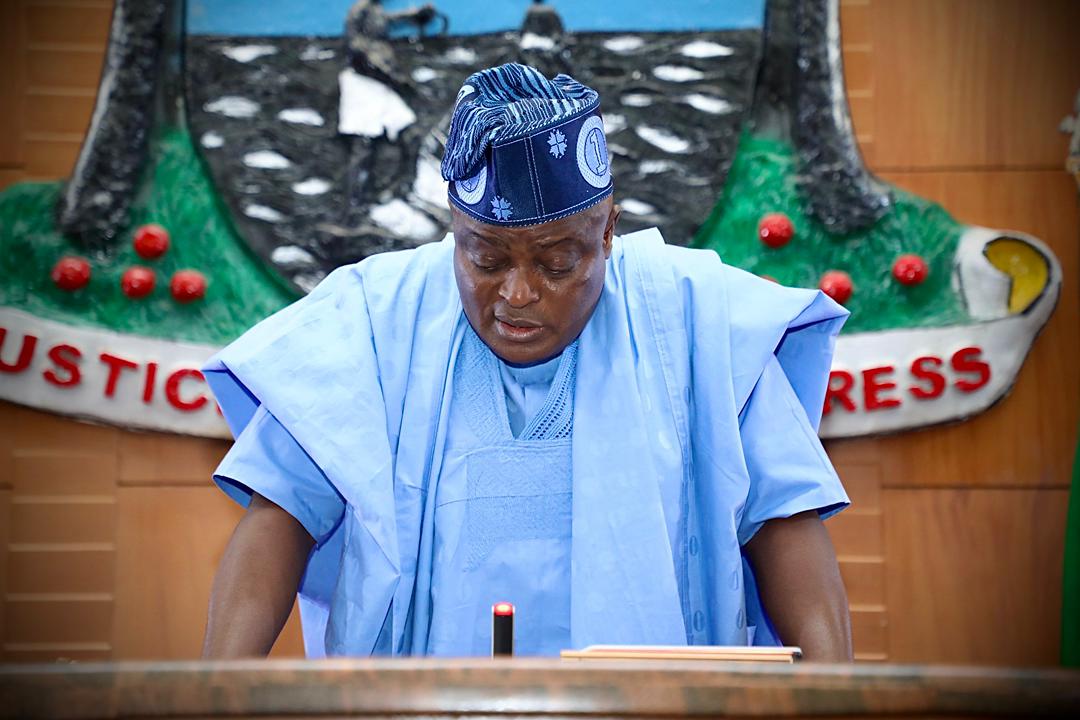
Sallah: Obasa Felicitates Muslim Ummah, Commends Nigerians for APC Primaries Turnout
The Speaker of the Lagos State House of Assembly, Rt. Hon. Mudashiru Obasa has extended warm felicitations to Muslims in Lagos State and across Nigeria on the occasion of Eid al-Adha.
In a statement released by his Chief Press Secretary, Mr. Dave Agboola, Obasa described the festival as a season of sacrifice, reflection, and gratitude, urging the faithful to continue to uphold the values of peace, unity, and love that strengthen the nation.
He noted that the celebration of Eid al-Adha is not only a spiritual milestone but also a reminder of the importance of togetherness and collective responsibility in building a stronger society.
He, likewise, emphasized that the festival provides an opportunity for Nigerians to renew their commitment to national progress and to support leadership that prioritizes development and prosperity.
Obasa, however, commended Nigerians, particularly members of the All Progressives Congress (APC), for their massive turnout during the recently concluded party primaries. He described the participation as a clear demonstration of the people’s confidence in the government of President Bola Ahmed Tinubu and their belief in the administration’s vision for a greater Nigeria.
“The APC primaries have shown the resilience of our democracy and the confidence Nigerians have in the leadership of President Bola Ahmed Tinubu and the Renewed Hope Agenda. This is a strong message that our people are ready to continue supporting policies that will drive growth and prosperity,” Obasa stated.
The Speaker further encouraged Muslims to celebrate responsibly, stressing that the joy of Eid should be accompanied by prayers for the continued peace and progress of Lagos State and Nigeria.
“As you celebrate with family and loved ones, may this season bring joy, peace, and prosperity to your homes. Let us remain united in our resolve to build a stronger nation,” he added.
On behalf of the Lagos State House of Assembly, Obasa wished all Muslims a happy and fulfilling Eid al-Adha celebration.


- Société Nationale des Pétroles du Congo (SNPC) Chief Ominga to Speak at African Energy Week (AEW) 2026 as Congo Accelerates Gas Expansion May 29, 2026
- South Africa: Deputy President Mashatile arrives in India for a Working Visit May 29, 2026
- Seychelles: President Visits Key Development Sites on Coetivy Island May 29, 2026
- Accelerating regional action to advance mental health care in Africa May 29, 2026
- President of the Republic of Seychelles Meets Young La Digue Talent Ahead of London Showcase May 29, 2026
- United Nations Economic Commission for Africa (ECA) launches regional initiative to accelerate women’s digital entrepreneurship across four African countries May 29, 2026
- Ethiopia: International community must act to safeguard press freedom ahead of national election May 29, 2026
- CORRECTION: Annual Meetings 2026 (AM2026): African Development Bank (AfDB) 2025 Trade Finance Report Highlights Resilience of African Financial Institutions After Covid-19 May 29, 2026
- Why Big Tech Could Become Nigeria’s New Gas Partner May 29, 2026
- African Energy Chamber (AEC)-Venezuela Alliance Accelerates Pathways into South-South Energy Expansion May 29, 2026
- Société Nationale des Pétroles du Congo (SNPC) Chief Ominga to Speak at African Energy Week (AEW) 2026 as Congo Accelerates Gas Expansion May 29, 2026
- South Africa: Deputy President Mashatile arrives in India for a Working Visit May 29, 2026
- Seychelles: President Visits Key Development Sites on Coetivy Island May 29, 2026
- Accelerating regional action to advance mental health care in Africa May 29, 2026
- President of the Republic of Seychelles Meets Young La Digue Talent Ahead of London Showcase May 29, 2026
- United Nations Economic Commission for Africa (ECA) launches regional initiative to accelerate women’s digital entrepreneurship across four African countries May 29, 2026
- Ethiopia: International community must act to safeguard press freedom ahead of national election May 29, 2026
-

 news6 months ago
WHO REALLY OWNS MONIEPOINT? The $290 Million Deal That Sold Nigeria’s Top Fintech to Foreign Interests
-

 society4 weeks ago
SOCIAL MEDIA IS NOT A BATTLEFIELD COMMAND – WHY THE NIGERIAN ARMY’S ACTION AGAINST JUSTICE CRACK IS A NATIONAL SECURITY IMPERATIVE
-

 celebrity radar - gossips4 months ago
Dr. Chris Okafor Returns with Power and Fire of the Spirit -Mounts Grace Nation Altar with Fresh Anointing and Restoration Grace on February 1, 2026
-

 celebrity radar - gossips6 months ago
Prophet Kingsley Aitafo Releases 2026 Prophecy: ‘Nigeria Will Rise, but the World Must Prepare for Turbulence’