
celebrity radar - gossips
Why Dare Zaka Is The Go-To Cinematographer for Nigeria’s Top Music Artists


*Why Dare Zaka Is The Go-To Cinematographer for Nigeria’s Top Music Artists
In Nigeria’s vibrant Fuji music scene, the visual element has become just as important as the music itself. As the genre continues to evolve and reach wider audiences, the demand for captivating music videos that tell a story and highlight the culture is at an all-time high. In this context, one name consistently rises above the rest—Dare Zaka. Renowned for his keen eye, professionalism, and ability to translate sound into visuals, Dare Zaka is now the go-to cinematographer for almost 90% of A-list Fuji artists. Here’s why he’s their top choice.
While Dare Zaka has made a name for himself by working with a wide range of artists, he is particularly renowned for his contributions to the Fuji music genre. His versatility and creative vision make him an appealing choice for various music styles, ensuring that his skills are sought after across the Nigerian music landscape.
A Master of Visual Storytelling
Dare Zaka is not just a cameraman; he’s a storyteller. His ability to weave narratives through visuals has made him the go-to cinematographer for some of the biggest names in the Fuji music industry, including K1 De Ultimate, Pasuma, Malaika, Remi Aluko, Taiye Currency, and many others. Zaka has a knack for capturing the energy and essence of Fuji music while maintaining an engaging storyline, a quality that endears him to both artists and fans.
One A-list artist, who recently collaborated with Zaka on a video project, mentioned in a casual conversation, “Zaka understands Fuji. He knows the soul of the music, and that’s why he can bring out the best in our videos. It’s like he’s one of us.”
A Deep Understanding of Fuji Culture
Fuji is not just a genre; it’s a culture steeped in tradition, storytelling, and communal vibes. Understanding the nuances of Fuji music and its cultural significance is crucial, and this is where Dare Zaka excels. He knows that Fuji isn’t just about the beats or lyrics—it’s about the expressions, the gestures, and the emotions. His videos are often rich in cultural references, from traditional attire to the symbolic locations chosen for shoots.
Zaka’s deep-rooted connection to Fuji allows him to portray it authentically, which is why A-list artists in the genre trust him with their projects. As Taiye Currency once remarked, “Working with Dare Zaka is like having a director who has lived your story. He knows how to translate our lyrics into visuals in a way that the audience understands.”
A Proven Track Record of Success
Shooting videos for artists like K1 De Ultimate and Pasuma is no small feat. Dare Zaka’s reputation is built on delivering quality and maintaining consistency. His work speaks for itself, with music videos that often rack up millions of views and help elevate Fuji artists to a broader audience. It’s not just about the visuals—Zaka’s videos add value to the music, making them memorable experiences for fans.
Remi Aluko’s manager once noted in an interview, “Zaka doesn’t just shoot; he creates. Every time we get the final cut, it’s like he’s captured exactly what the music is trying to say.”
Commitment to Innovation
Despite working within a genre known for its traditional roots, Dare Zaka isn’t afraid to innovate. He skillfully blends traditional Fuji elements with modern visual techniques, ensuring that his work feels both authentic and contemporary. This innovative approach is what has kept him relevant in an industry that’s constantly evolving.
In one of his latest projects with Malaika, Zaka introduced drone shots to capture a massive street performance, showcasing the size and energy of the crowd in a way that was previously unexplored in Fuji music videos. This blend of traditional energy with modern techniques exemplifies his forward-thinking approach.
A Collaborative Spirit with a Professional Edge
Dare Zaka’s ability to collaborate effectively with Fuji artists is another reason why he’s the choice of the top names. He approaches each project not just as a job but as a creative journey shared with the artist. He listens, respects their ideas, and merges his vision with theirs to create something unique.
Pasuma’s longtime assistant shared, “Dare is professional but also very easy to work with. He respects the artist’s vision and brings his expertise to enhance it. It’s always a smooth process working with him.”
Why Dare Zaka is The Choice of Fuji Artistes
It’s clear that Dare Zaka isn’t just any cinematographer. He’s a visionary who has carved out a unique place for himself in the Fuji industry through a combination of skill, cultural understanding, and professionalism. His ability to capture the soul of Fuji music while continuously innovating and collaborating seamlessly with top artists has made him indispensable.
For Fuji artists looking to elevate their music and connect more deeply with their audience, Dare Zaka remains the top choice. In an industry where visuals play a crucial role in conveying the heart of the music, Zaka’s work ensures that the culture of Fuji is not only preserved but celebrated in new and captivating ways.
As Fuji music continues to expand beyond traditional boundaries, Dare Zaka will undoubtedly remain at the forefront, shaping the future of how this rich genre is seen and experienced.




celebrity radar - gossips
Accolades to Empress Genevieve Wining as she Celebrate birthday in Grand style

Accolades to Empress Genevieve Wining as she Celebrate birthday in Grand style
Emmanuel Clement
Vilnius, Lithuania – The Grand Hotel Vilnius will host a grand birthday celebration in honor of Her Majesty The Empress Genevieve Wining of the United Kingdom of Atlantis (UKA) on April 4th, 2026.
The four-day event promises to be an extravagant affair, marking the special birthday of Empress Genevieve Wining. The celebration will take place at the prestigious Grand Hotel Vilnius, Lithuania, renowned for its luxurious ambiance and exceptional service.

According to the event flyer, the birthday celebration will be a spectacular occasion, fitting for an empress. Guests can expect an elegant setting adorned with golden accents, sparkling champagne, and festive decorations, creating a regal atmosphere befitting the occasion.
The Empress Genevieve Wining of UKA is expected to grace the event, which will include various festivities and celebrations in her honor. The occasion aims to bring together dignitaries, followers, and guests to commemorate the empress’s birthday with grandeur and joy.
For media inquiries, accreditation, or further information about the birthday celebration of The Empress Genevieve Wining of UKA, please contact the event organizers.
Courtesy of His Excellency Emperor Prof. Solomon Wining. UKA

Today, Dr. Chris Okafor turns a year older
~By Sunday Adeyemi
It is widely acknowledged that the exceptional Dr. Chris Okafor, a man of great character, always celebrates his birthday on April 4th, and in recognition of this occasion, I am inspired to write this special tribute to honor him.
Today marks a momentous occasion as we commemorate the birthday anniversary of Dr. Chris Okafor, a rare gem, a perfect gentleman, and the revered founder of Grace Nation Church, aka Liberation City.
Without reservation, this versatile and dependable Oracle foundry has consistently proven itself worthy of the accolades bestowed upon it on this notable anniversary.
Let it be reiterated that Dr. Chris Okafor is a leader known for his generosity and commitment to humanity’s welfare and advancement. The special gifts donated recently to widows and widowers within and outside the church are a testament to his exceptional leadership.
Your reputation as an outstanding and authentic man of God is evident in your exceptional goodwill and philanthropic endeavors.
Your dedication and perseverance have yielded impressive results, and numerous people, including myself, are justifiably proud of the remarkable work you are doing.
You have consistently exemplified outstanding leadership in the Christian community, demonstrating the profound impact of your role as a gift from God to humanity. I firmly believe this to be true.
Here’s to a year of productivity, success, and happiness. Congratulations and warm wishes on your birthday, sir.
Sunday Adeyemi
Your Son
celebrity radar - gossips
Adron Homes Celebrates Visionary Chairman, Aare Adetola Emmanuel King, at 51
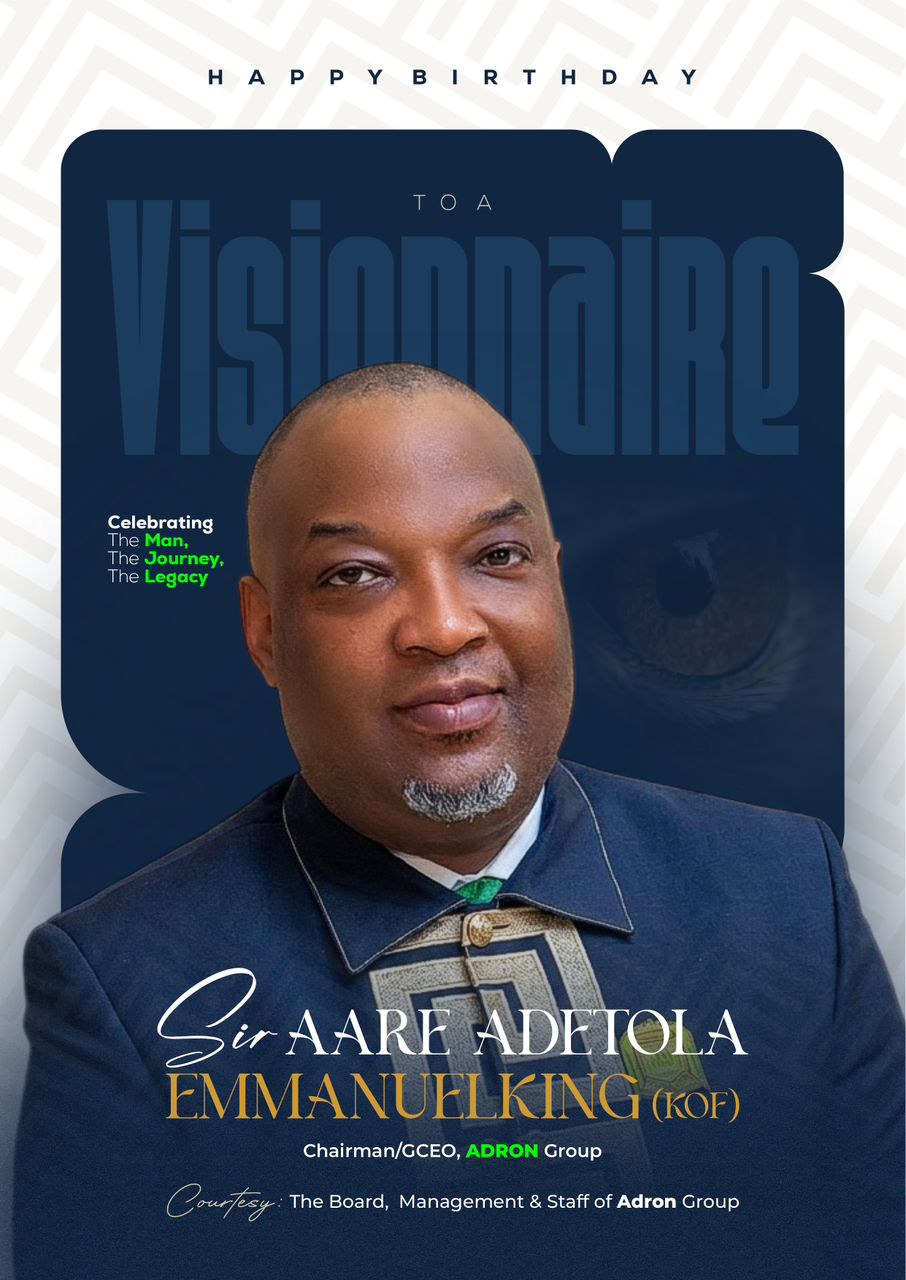
Adron Homes Celebrates Visionary Chairman, Aare Adetola Emmanuel King, at 51
The management and staff of Adron Homes and Properties Limited have joined family, friends, associates, and well-wishers across the globe to celebrate their Chairman and Chief Executive Officer, Aare Adetola EmmanuelKing, as he marks his 51st birthday.

In a statement released by the company, the milestone was described as a celebration of an exceptional leader whose vision, resilience, and entrepreneurial brilliance have not only transformed Adron Homes into a household name in Nigeria’s real estate sector but have also redefined affordable housing across the country.
Under his dynamic leadership, Adron Homes has continued to expand its footprint, delivering value-driven residential solutions while empowering thousands of Nigerians with opportunities for home ownership. His commitment to excellence, innovation, and customer satisfaction has remained the driving force behind the company’s sustained growth and industry leadership.
The statement further highlighted Aare EmmanuelKing’s passion for nation-building and community development, noting his significant contributions to job creation, youth empowerment, and the promotion of socio-economic development through real estate investments.
“As a leader, mentor, and visionary, Aare Adetola EmmanuelKing has consistently inspired a culture of excellence, integrity, and dedication within the organization. His ability to turn bold ideas into reality continues to position Adron Homes as a trailblazer in the industry,” the statement read.
The company expressed profound gratitude for his steadfast leadership and prayed for continued wisdom, strength, and sound health as he embarks on another year of impactful achievements.
As he celebrates his 51st birthday, the entire Adron Homes family proudly honours a man whose legacy continues to shape the future of real estate in Nigeria.
Happy 51st Birthday, Aare Adetola EmmanuelKing!


-

 society7 months ago
Religion: Africa’s Oldest Weapon of Enslavement and the Forgotten Truth
-

 news4 months ago
WHO REALLY OWNS MONIEPOINT? The $290 Million Deal That Sold Nigeria’s Top Fintech to Foreign Interests
-

 society6 months ago
“You Are Never Without Help” – Pastor Gebhardt Berndt Inspires Hope Through Empower Church (Video)
-

 celebrity radar - gossips2 months ago
Dr. Chris Okafor Returns with Power and Fire of the Spirit -Mounts Grace Nation Altar with Fresh Anointing and Restoration Grace on February 1, 2026