
Business
FIRST BANK: STILL STANDING GIDIGBA 125 YEARS AFTER


F
BY ALEX OTTI
This week marks the celebration of the 125th anniversary of the existence of the First Bank franchise in Nigeria. This stands the bank out as one of the earliest institutions established in West Africa, and obviously, one of the handful still in existence today.
The bank began as the Bank of British West Africa (BBWA) in 1894 and quickly began playing the role of the Central Bank of British West Africa in the absence of a regulator at those medieval times in the sub region. The bank witnessed the amalgamation of the Northern and Southern protectorates and the eventual independence of Nigeria in 1960. It was founded by Alfred Lewis Jones, a shipping magnate who imported silver currency into West Africa through Elder Dempster shipping company also owned by him.
In 1957, the bank changed its name to Bank of West Africa (BWA). Sequel to Nigeria’s independence in 1960, the bank began to extend more credit to indigenous Nigerians as most of its credit facilities were hitherto concentrated on foreigners living in the erstwhile colony.
Standard Bank acquired the Bank of West Africa in 1966 and changed its name to Standard Bank of West Africa. In 1969, Standard Bank of West Africa incorporated its Nigerian operations and its name had to change once again, this time to Standard Bank of Nigeria Ltd (SBN). In 1971, SBN listed its shares on the Nigerian Stock Exchange and placed 13% of its share capital with Nigerian investors. Following the implementation of the indigenisation policy of the then military government soon after the civil war, Standard Chartered Bank reduced its stake in SBN to 38%. This action led to another change in name to First Bank of Nigeria in 1979 as Standard Chartered Bank insisted that since it had lost majority control, the bank should no longer bear its name since by the action, it had failed to be its full fledged subsidiary.
This marked a watershed in the history of the bank as more Nigerians were appointed to the board and it began to look and operate more like a Nigerian bank. The bank had subsequently moved from a limited liability company to a publicly quoted company and back to a limited liability company which it presently is. The latest status is in compliance with changes in the regulatory environment in 2012 that required that the group operates as a holding company, with the bank as one of its subsidiaries or spin off other operations not related to banking. That marked the birth of FBN Holdings which presently has the bank and non bank subsidiaries as part of the group.
In 1982, First Bank opened a branch in London and converted same to a full fledged subsidiary, FBN Bank (UK) in 2002. Two years later, in 2004, a representative office in Johannesburg, South Africa, debuted. At the moment, First Bank has subsidiaries or representative offices in France, China, Democratic Republic of Congo, Gambia, Sierra Leone, Ghana, Guinea and Senegal. At the last count, First Bank had presence across 10 countries in three continents. It operates from over 750 locations and employs close to 22,000 people. Its has over N3.3trillion in total assets. It also boasts over N2.5trillion in Customer deposits with a tidy 19% Capital Adequacy Ratio (CAR). The bank has over 1.3m shareholders and over 14million customers.
Before going further, I must, in the full disclosure tradition of this column, declare that I joined First Bank as an Assistant General Manager on April 1, 2001 and left 10 years after, having risen to the position of Executive Director in 2011. I joined as part of the transformation team of the bank set up following a decision to institute comprehensive reforms in the bank. The project, titled, “Century 2, the New Frontier” effected a total change in the way things were done in the bank. Readers will realize, in the course of this essay, that a major part of the resilience and longevity of the bank has to do with its ability to keep pace with changes, not just in the banking ecosystem, but the global environment.
It is pertinent to note that so many institutions and companies disappear after only a few years of existence and therefore, there must be some distinguishing characteristics that have made First Bank, not only to survive but to excel in the last one decade and a quarter. I will attempt to share my own thoughts on this, which would definitely not be exhaustive.
One thing that stands the bank out is that everything it does is woven around strategy. In my days at the institution, and I believe it should still be the same now, the bank will start a year with long board and management strategy sessions. These comprise long and short term strategies. The long term strategies normally have a horizon of 5 years while the short term ones are normally between one and three years. I am sure some people, particularly in other environments, will argue that 5-year strategies would be at best described as medium term, but the truth is that in the Nigerian market, 5 years is even too long given how rapidly things change here!
Organizations succeed and fail on strategy. The profound saying that when you fail to plan, you plan to fail fits in perfectly here. It is also said that when you are not certain about where you are going, any road takes you there. Having a clear strategy is one thing, achieving flawless execution is another. I am aware of organisations that are very long on plans and short on implementation. On this, you must give it to First Bank as it is also very good on monitoring and measurement. It is a known fact that what doesn’t get measured, hardly gets done. So, to execute, you must have measurement tools and put in place, a system that not only rewards good performance but also poor performance. I can still remember our strategy sessions as we joined in 2011, where the then CEO, Mr. Bernard Longe reeled out the Big Hairy Audacious Goal (BHAG) of “being twice as large as the second largest bank in Nigeria by a defined future date”. Yes, the bank may not have achieved that goal within the timeframe, but it did have a goal and it did work towards that goal. It is in strategy that you define who you want to be, who you want to serve, how you want to serve them and what distinguishes you from the “guy down the road”. Once you have those agreed, the tools and the people must also be addressed. I have seen situations where management disbands a strategy put in place by the organisation only to replace it with a weak strategy or none at all and in consequence end up as lunch for competition.
First Bank is noted for its very strong corporate governance regime. I believe this is at the heart of the longevity of the bank. In our days and I believe it is the same till today, there are things you simply could not do irrespective of who you were. Just like any organsation, the bank had a soul, meaning the key board members who called the shots. But every decision had to go through a process. Having survived over a long period of time, most things were documented and rules were strictly adhered to. I recall that even loan applications from viable businesses of shareholders of the bank must not only be disclosed, but must go through rigorous processes before they were approved. And with the Risk Management function under very experienced professionals with the brilliant Sanusi Lamido Sanusi, who was later to become CEO of the bank and six months later, the CBN Governor and currently the Emir of Kano, you couldn’t go round the process. By the way, it will not be out of place to mention that I was appointed an Executive Director the same day, September 4, 2005 with HRH Sanusi who had joined from UBA. Others appointed same day with us were Oladele Oyelola, Remi Babalola who went on to become Minister of State For Finance, and Mrs Bola Adesola, the current CEO of Standard Chartered Bank. We joined the only surviving executive director from the regime before ours, Mr. John Aboh, who is the current Chairman of Ecobank Nigeria and the then CEO of the bank, Mr. Jacobs Moyo Ajekigbe.
As we were appointed, we were handed over a merger and acquisition deal, (some called it outright takeover bid) with another bank with footprints in some other African countries. The deal looked good on the surface, but some of us saw danger in the whole transaction as proposed. We struggled with that transaction for close to two years before resting it. Even though there was very strong support for the deal from some influential shareholders, management thought it was not going to create value for First Bank and therefore had to let it die a natural death. Yours truly had argued then that based on “back of the envelope analysis”, over 60% of mergers and acquisition destroy shareholder value. This my held position was to be corroborated by the Harvard Business Review Report in 2015 which stated that between 70% and 90% of mergers and acquisition destroy shareholder value and in fact fail. The reasons for failure are fully documented in the literature. One is glad that we still have the foremost Nigerian bank with us today celebrating its 125 years anniversary as some of us are persuaded that the situation would not have been the same if that deal went through. On this note, permit me to acknowledge the resilience of Mr. Jacobs Moyo Ajekigbe who showed strength of character as the buck naturally stopped on his table.
One of the lessons to learn from the First Bank story is its ability to adapt to changing situations in the environment. For an organisation to adapt, it must understand the environment and be able to read changes and sometimes predict them, even before they happen. The reality is that human beings will normally gravitate around their comfort zones and oftentimes, become very resistant to change. It is only an organisation that constantly interrogates the status quo that will be able to adapt to changes or even lead the change itself. In our time, we realized that we had what our Human Capital Management department referred to an “aging workforce”. Like Clinton would say about Senator Dole, “we did not have a problem with their age, but with the age of their ideas”. The bank started a workforce renewal strategy which saw to the entry of young people with fresh ideas who could relate to the youthful population who were basically in control of the “new money”.
To attract them, one needed people that not only looked like them but also reasoned like them. An age band was approved by management for different levels in the staff cadre. This tilted the average age of staff down significantly. Younger people were selected to replace those retiring on account of age. Technology was massively deployed as part of strategy. Service delivery, which was measured by external consultants, spiked in the positive direction. The bank was able to compete with smaller and younger banks, giving them a run for their money.
The brand equity is an important part of any organisation, more so a bank. First Bank benefited so much from its brand. Because some banks had come and gone and bank failures has not ceased even at this moment, the bank benefitted from its longevity. Some people joke about dead people’s money being warehoused in the bank. Besides, what the brand represents is also the conscious effort at tweaking the brand to be in tune with modernity, of course without doing away with the reassuring effect of the ‘elephant’. I remember with nostalgia, the first strategy session we attended in Gateway Hotel, Otta in 2001, a new colleague, had proposed that the bank should do away with the elephant as the animal is not known to be smart, fast and efficient. We were all shocked at the response he got. Virtually everyone, except those of them that were new, charged at him, in the manner of the elephant he wanted removed. That was the last time he made that kind of suggestion. It was considered a heresy to remove the elephant. The rest of the people that mustered courage to speak about the elephant talked about how to make it nimble, how to face it forward rather than backwards, how to get the elephant to raise one of its legs and generally how it would reflect efficiency in strength.
Finally, I have always maintained that an organisation cannot be better than its people.
First Bank has built a culture of employing very sound and good people. The recruitment process is excellent and gives little or no room for manipulation. The reward system ensures that the best people stay and misfits are gradually eased out. The compensation system remains competitive from what I hear and positions at the top are tenured such that the CEO and Executive Directors must retire after a maximum of two tenures of 3 years each. This policy makes it difficult for people to sit tight at those levels and also keeps the top open for deserving younger people to aspire. It is my sincere hope and belief that these time-honoured traditions of First Bank endure.
Let me therefore join millions of Nigerians to congratulate First Bank on this 125th Anniversary celebration and wish the Board, Management, Staff, Shareholders and Customers well. Of course, I pray for the continued sense of camaraderie that exists among the ex-staff of First Bank





Fidelity Bank grows gross earnings by 38% to N434.95b in Q1
Fidelity Bank Plc recorded 37.9 per cent growth in gross earnings to N434.95 billion in first quarter 2026 as the international commercial bank continued to expand its core banking market share.
Interim report and accounts of Fidelity Bank for the three months ended March 31, 2026 released at the Nigerian Exchange (NGX) showed that gross earnings rose from N315.42 billion in first quarter 20025 to N434.95 billion in first quarter 2026, representing an increase of 37.9 per cent.
The top-line performance was driven by impressive growth in the bank’s core business operations with interest incomes rising by 22.8 per cent to N314.48 billion in first quarter 2026 as against N256.10 billion in first quarter 2025.
With net interest income at N180.97 billion, the bank closed the period with profit before tax of N92.48 billion. After taxes, net profit stood at N74.47 billion for the three-month period. Earnings per share remained high at N5.69, underlining the capacity of the bank to reward its shareholders.
The balance sheet of the bank also emerged stronger. Total assets crossed the N11 trillion mark to N11.35 trillion by March 2026 compared with N10.46 trillion recorded in December 2025. Customers’ deposits increased from N6.89 trillion to N7.38 trillion. Total equity rode on the back of earnings growth to a 27.5 per cent increase from N1.09 trillion in December 2025 to N1.39 trillion by March 2026.
The first quarter 2026 results further consolidated the strong earnings outlook of the bank, which had successfully completed its recapitalisation amidst impressive earnings performance in 2025.
Fidelity Bank had recorded double-digit growths in interest and non-interest incomes as well as key balance sheet items during the year ended December 31, 2025.
The audited report showed that gross earnings rose from N1.04 trillion in 2024 to N1.52 trillion in 2025, an increase of 45.6 per cent. Interest and similar incomes had grown by 38.7 per cent from N803.1 billion in 2024 to N1.11 trillion in 2025. Fees and commission incomes also rose by 44.7 per cent from N78.4 billion to N113.4 billion. The bank recorded net profit after tax of N242.4 billion in 2025.
The bank’s balance sheet emerged stronger with total assets rising by 18.6 per cent to N10.46 trillion in 2025 as against N8.82 trillion in 2024. Customer deposits increased by 16.1 per cent from N5.94 trillion to N6.89 trillion, reflecting continued franchise strength and an improved funding profile. Net loans and advances meanwhile declined by 2.4 per cent to N4.28 trillion in 2025 as against N4.39 trillion in 2024, attributable to customers paying down on their mature obligations.
The bank had in 2025 strengthened its capital position, with eligible capital rising to N561 billion, above the regulatory minimum of N500 billion for banks with international authorisation. In addition, capital adequacy had remained robust, with Capital Adequacy Ratio of 30.94 per cent by December 2025 as against 23.47 per cent by December 2024.
Managing Director, Fidelity Bank Plc, Dr. Nneka Onyeali-Ikpe, said the first quarter 2026 results reinforced the bank’s strong and resilient business model.
She noted that with the remarkable success of its recapitalisation programme and continuing expansion, Fidelity Bank has entered a new era of growth and impressive returns.
“We are on a stronger footing and confident that we will set new growth records that are reflective of our legacy and the future we are working on,” Onyeali-Ikpe said.
Business
Dangote Refinery Ends Nigeria’s Era of Fuel Import Dependence, Boosts GDP, FX Earnings — EIU
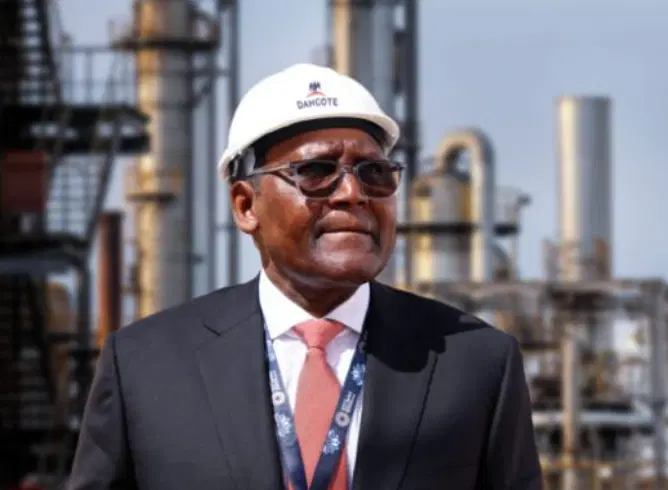
Dangote Refinery Ends Nigeria’s Era of Fuel Import Dependence, Boosts GDP, FX Earnings — EIU
The operational ramp up of the 650,000 barrels per day Dangote Petroleum Refinery & Petrochemicals is fundamentally reshaping Nigeria’s downstream oil sector, significantly reducing the country’s dependence on imported refined petroleum products and strengthening its external position, according to the Economist Intelligence Unit (EIU).
In its latest assessment on Nigeria’s fuel market and regulatory environment, the EIU said the refinery has already transformed a sector that was previously characterised by heavy reliance on imported fuel despite Nigeria being Africa’s largest crude oil producer. The report noted that the refinery met nearly 80 per cent of domestic petrol demand in April and produced enough volumes to satisfy local consumption requirements as operations approached full capacity.
The EIU described Nigeria’s downstream petroleum sector before the refinery as “long dysfunctional”, noting that the country had remained almost entirely dependent on costly imported fuel while producing nearly 1.5 million barrels of crude oil daily.
According to the report, the emergence of the refinery has reduced import dependence, improved domestic fuel availability and strengthened Nigeria’s balance of payments position through lower import demand and rising exports of refined petroleum products.
“The gradual ramp up of the 650,000 barrel/day Dangote refinery since May 2023 has transformed Nigeria’s long dysfunctional downstream sector,” the report stated. “The country’s main refineries, all state owned, had been inoperative for years and Nigeria was almost entirely reliant on costly imported fuel.”
The research and analysis division of The Economist Group, London added that the refinery’s attainment of full operational capacity and its planned expansion would further support Nigeria’s economic growth and foreign exchange earnings over the medium term.
“Meanwhile, the attainment of full capacity at, and an increase in exports from, the Dangote refinery will support real GDP growth and foreign exchange earnings in 2026 and 2027 and beyond, as a planned doubling of the plant’s output comes on stream around the end of the decade,” it added.
Industry analysts said the refinery is increasingly positioning Nigeria as an emerging refining and export hub, altering energy trade flows across Africa and reducing the vulnerability associated with fuel import dependence.
The EIU noted that the refinery’s expansion has coincided with major reforms in Nigeria’s downstream sector, including the removal of fuel subsidies and the introduction of market driven pricing mechanisms.
The report, however, said the transition from a state dominated fuel import structure to large scale domestic refining has triggered resistance from interests linked to the old import regime.
The latest tensions emerged following the decision by the Nigerian Midstream and Downstream Petroleum Regulatory Authority to relax restrictions on petrol imports despite the refinery’s growing capacity to meet domestic demand.
Dangote Industries subsequently initiated legal action, arguing that continued import approvals undermine domestic refining investments and conflict with the objectives of the Petroleum Industry Act, which seeks to encourage local refining capacity and reduce import dependence.
Analysts noted that the availability of large-scale domestic refining capacity has improved Nigeria’s energy security and reduced exposure to external supply shocks and foreign exchange volatility.
The Centre for the Promotion of Private Enterprise also cautioned against unrestrained importation of petroleum products, warning that such a policy could weaken Nigeria’s industrialisation drive and discourage investments in domestic refining.
Chief Executive Officer of CPPE, Muda Yusuf, said continued dependence on imported fuel had historically contributed to pressure on foreign reserves, exchange rate instability and fiscal leakages.
The refinery’s growing impact is also being reflected in Nigeria’s broader macroeconomic indicators. Earlier this month, S&P Global Ratings cited increased domestic refining capacity and rising hydrocarbon exports among the major factors supporting Nigeria’s sovereign credit rating upgrade – the first in 14 years.
Beyond Nigeria, analysts said the refinery is increasingly being viewed as a strategic industrial asset for Africa, where many countries remain heavily dependent on imported fuel despite rising demand for transportation, manufacturing, and power generation.
Business
BREAKING: Court Dismisses $19.6 Million Claim Against NNPCL — Rules Contract Scope Cannot Be Changed Orally

BREAKING: Court Dismisses $19.6 Million Claim Against NNPCL — Rules Contract Scope Cannot Be Changed Orally
In a landmark ruling on Friday, May 22, 2026, the Federal Capital Territory High Court in Abuja threw out a $19.6 million lawsuit filed by Alternate Dimensions Ventures Ltd against the Nigerian National Petroleum Company Limited (NNPCL), affirming a key legal principle: a written contract cannot be expanded through oral agreements or conduct.
Alternate Dimensions had sought $19,600,000 in professional fees, claiming the scope of its Direct Sale, Direct Purchase (DSDP e-pro) contract with NNPCL was orally expanded. Represented by counsel Patrick Peter, the firm argued it was entitled to the revised sum for services rendered under the alleged new terms.
But NNPCL, through its lawyer Ituah Imhanze of KENNA LP, pushed back sharply, arguing that parties are bound exclusively by the clear terms of their written agreement. Imhanze contended that without any written amendment, the claim was legally unsound, and the court agreed.
Delivering judgment, Justice Hamza Mu’azu upheld NNPCL’s defense, stating that the contract was unambiguous and that no evidence was adduced during the trial, which supported the alleged scope expansion. The court further found that NNPCL fully complied with all contractual terms and committed no breach.
Dismissing the suit as meritless, Justice Mu’azu reinforced the doctrine of sanctity of contract: any amendment to a written agreement must be express, unequivocal, and documented, not implied or verbal.
The ruling spares NNPCL from the S19.6 million claim and also a floodgate of similar potential liabilities.


- Deputy (Dep.) Finance Minister Courts Investors to Transform Ghana’s rice Economy June 4, 2026
- Mobile health services in Kenya reduce the risk of stillbirths June 4, 2026
- JustMarkets Research Highlights Global Growth Divergence as a Key Market Driver June 4, 2026
- African Development Bank Group approves $125 million investment in African Trade and Investment Development Insurance (ATIDI) to expand risk insurance capacity in Africa June 4, 2026
- Congo Energy & Investment Forum 2027 to Position Brazzaville as a Hub for Global Energy Deal-Making June 4, 2026
- Africa Skills Hub (ASH) Transitions to ASH Africa as it Marks 10 Years of Impact June 4, 2026
- When women farm better, Eswatini eats better June 3, 2026
- Togo Hosts the 8th Annual Forum of National Volunteer Agencies in the Economic Community of West African States (ECOWAS) Region June 3, 2026
- Indigenous Peoples gravely vulnerable to Ebola epidemic, warn United Nations (UN) independent experts June 3, 2026
- Meeting between Parliamentary Vice-Minister ONISHI and His Excellency (H.E.) Mr. Cosgrow, Principal Minister and Minister for Agriculture, Fisheries and Blue Economy of Seychelles June 3, 2026
- Deputy (Dep.) Finance Minister Courts Investors to Transform Ghana’s rice Economy June 4, 2026
- Mobile health services in Kenya reduce the risk of stillbirths June 4, 2026
- JustMarkets Research Highlights Global Growth Divergence as a Key Market Driver June 4, 2026
- African Development Bank Group approves $125 million investment in African Trade and Investment Development Insurance (ATIDI) to expand risk insurance capacity in Africa June 4, 2026
- Congo Energy & Investment Forum 2027 to Position Brazzaville as a Hub for Global Energy Deal-Making June 4, 2026
- Africa Skills Hub (ASH) Transitions to ASH Africa as it Marks 10 Years of Impact June 4, 2026
- When women farm better, Eswatini eats better June 3, 2026
-

 news6 months ago
WHO REALLY OWNS MONIEPOINT? The $290 Million Deal That Sold Nigeria’s Top Fintech to Foreign Interests
-

 society1 month ago
SOCIAL MEDIA IS NOT A BATTLEFIELD COMMAND – WHY THE NIGERIAN ARMY’S ACTION AGAINST JUSTICE CRACK IS A NATIONAL SECURITY IMPERATIVE
-

 celebrity radar - gossips4 months ago
Dr. Chris Okafor Returns with Power and Fire of the Spirit -Mounts Grace Nation Altar with Fresh Anointing and Restoration Grace on February 1, 2026
-

 celebrity radar - gossips6 months ago
Prophet Kingsley Aitafo Releases 2026 Prophecy: ‘Nigeria Will Rise, but the World Must Prepare for Turbulence’
You must be logged in to post a comment Login
You must log in to post a comment.