
society
Governor Umo Eno’s Strategic Investment Insights: A Global Economic Model for Akwa Ibom’s Growth By MefLyN AnwanA

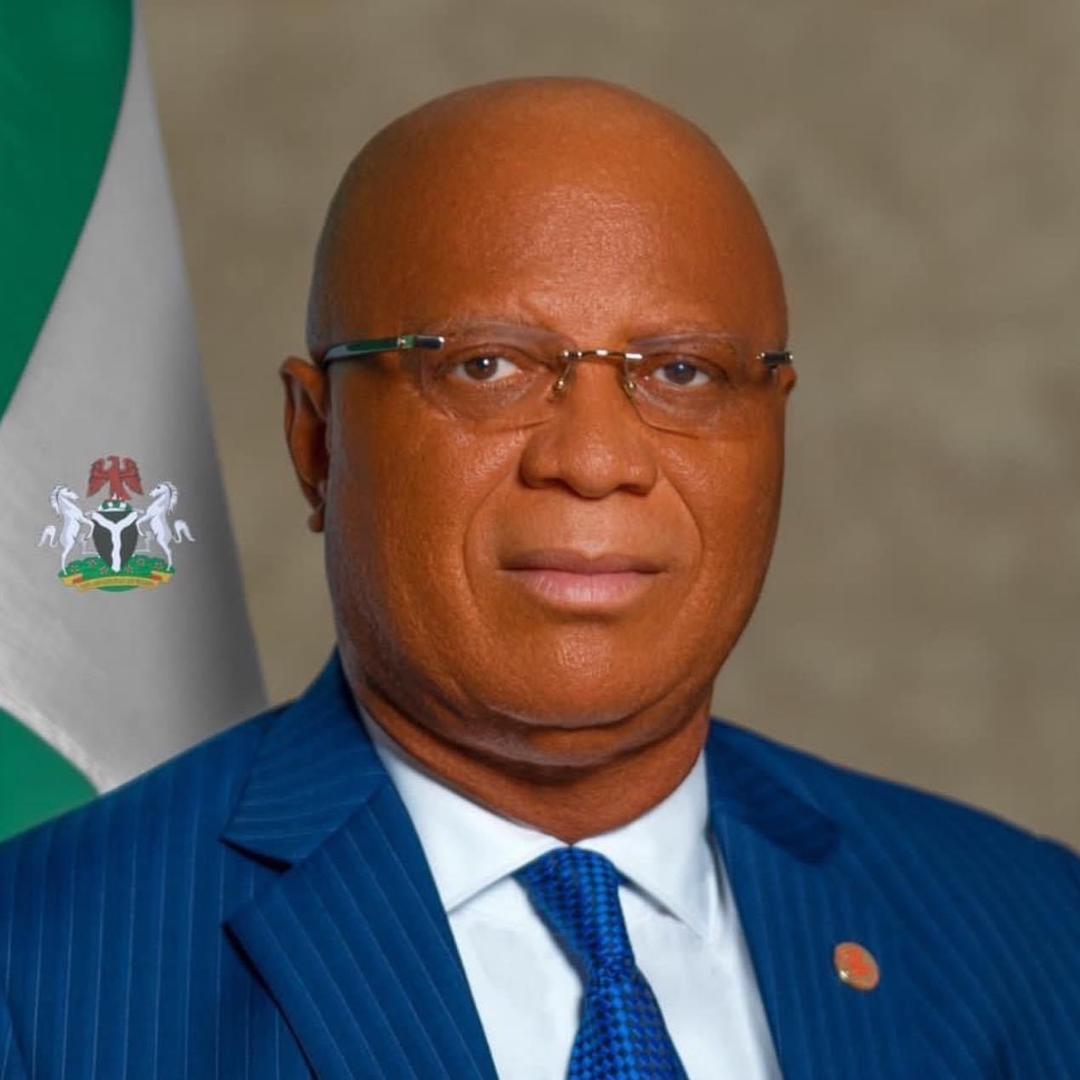
Governor Umo Eno’s Strategic Investment Insights: A Global Economic Model for Akwa Ibom’s Growth
By MefLyN AnwanA
The Governor Umo Eno led administration is clearly focused on practical, forward-thinking solutions to enhance the prosperity of Akwa Ibom State and its people.
Interestingly, the Governor has so far empowered 800 entrepreneurs via the EAP Programme designed to incubate and accelerate 5,000 entrepreneurs at IBOM-LED insuring youth and women development, driving rural development, Housing solutions and social development, empowering farmers with the Back to Farm initiative and also raising the bar in education ,health care and security, while building a skilled workforce ready to tackle future challenges at the Dakkada Skills Acquisition Centre,(DASAC) plus investments in massive road infrastructure across the state and lots more . Therefore, the Governor Umo Eno led administration is committed to uplifting Akwa Ibom through basic reforms and strategic investments.
In the arena of international investment, developed nations have consistently exhibited a robust approach tailored towards sustainable growth and strategic diversification. For Akwa Ibom, understanding and embracing these strategies will catalyze economic development and infrastructural advancement.
Many developed countries, through sovereign wealth funds and state-backed investments, prioritize sectors with long-term growth potential and economic resilience. For instance, the Qatar Investment Authority (QIA) has channeled over 400billion dollars in over 40 countries of the world in the area of finance, media, energy, and real estate.
By aligning with these sectors, Qatar ensures a steady revenue stream and economic stability. Also, a prime area is that of Infrastructure and Real Estate Investments which plays a pivotal role in fostering economic growth. QIA’s substantial investments in European landmarks such as the Shard skyscraper and the Savoy Hotel in the UK, has not only provided high returns but also boosted tourism and created jobs. Akwa Ibom’s strategic investment drive with its strategic location and developmental potential is relatively enhancing its attractiveness to international investors and tourists by directing investments into key infrastructural projects like the Ibom Towers.
Again, Diversification and Risk Mitigation concepts come to light where diversifying investments across sectors and geographies becomes the bane. Developed nations mitigate economic risks and enhance portfolio resilience.
Qatar’s expansive investments, ranging from the automotive sector in Germany to luxury fashion in Italy, illustrates the importance of not putting all economic eggs in one basket. Of course it would be risky putting all eggs in one basket, hence the need to think outside the box and diversity. This will reap bountiful harvest in the future. Akwa Ibom State Government’s approach of exploring diversified investment opportunities within Nigeria and across the globe, therefore reduces dependency on a single economic driver.
Over the years, Akwa Ibom has been blessed with forward thinking leaders who hitherto saw the need to launch out on capital projects. These laudable projects were initially misunderstood and the same defiant mentality was deployed in talking down on those lofty investments. Some of these capital projects include, the Victor Attah International Airport, Ibom Air, Maintenance Repair and Overhaul, MRO facility, 21 storey smart building, the Godswill Akpabio International Stadium, the 20,000 capacity amphitheatre at the Unity Park, the Ibom Hotel & Golf Course, at Nwaniba , Uruan, Four Points by Sheraton in Ikot Ekpene, airport road dualization project, Kings Flour Mill, Ibom Power Plant, and several others.
The benefits of these projects are relative in the trajectory of the development course of Akwa Ibom. Therefore, the Ibom Tower project and others would contribute to the state revenue bearing recurrent expenditure and Current economic realities . It is like a father who has three or four children and desires to send them to study abroad, it is only wise that with lofty aspirations envisaged in the blueprint of Akwa Ibom State we start now to invest in the future.
Various developed nations have over the years exemplified the effectiveness of strategic investments in driving economic growth and diversification. Countries such as Germany, Japan, and South Korea have leveraged targeted investments in technology, education, and infrastructure to foster sustainable growth. For instance, Germany’s investment in green technology and renewable energy has not only bolstered its economy but also positioned it as a global leader in environmental sustainability. Japan’s focus on innovation and quality education tion has underpinned its rapid technological advancements and economic resilience. Similarly, South Korea’s strategic investments in the electronics and automotive industries have transformed it from a war-torn country to an industrial powerhouse within a few decades.
Following these precedents, it is clear that Governor Umo Eno’s administration in Akwa Ibom State aims to drive action on successful strategies to promote economic diversification and long-term prosperity. By prioritizing key sectors such as agriculture, manufacturing, tourism, and digital technology, the administration is laying the foundation for a more resilient and balanced economy. These forward-thinking initiatives are not merely about short-term gains but are focused on creating an enabling environment that fosters innovation, attracts foreign investment, and improves the overall quality of life for the citizens.
For instance, strategic investments in education and vocational training programs aim to equip the youth with relevant skills, thereby creating a knowledgeable workforce that can drive industrial growth. Infrastructure development, including expansions in road networks, power supply, and digital connectivity, is designed to enhance business operations and attract local and international investors.
Furthermore, investments in healthcare and social services address critical societal needs, ensuring a healthy and productive population capable of sustaining economic activities. By drawing lessons from the successes of developed nations, Governor Umo Eno’s approach encapsulates a holistic and sustainable pathway towards economic development, positioning Akwa Ibom State as a key player in the regional and global economy.
A case for Public-Private Partnerships is in focus as Successful investment strategies often involve collaboration between public entities and private corporations. Germany and the UK have leveraged such partnerships to drive innovation and sectoral growth. For Akwa Ibom, fostering public-private partnerships is a framework to unlock new funding avenues, spur technological advancements, and enhance operational efficiencies across various sectors, including healthcare, education, and energy. Without a shadow of doubt, in order to attain enhanced economic resilience it is important to Diversify investments to provide a buffer against economic downturns. With a portfolio spread across various high-potential sectors, Akwa Ibom can achieve more sustainable growth, withstand global market fluctuations, and safeguard its economic interests. Another outlook that gives us a perspective is the Increased Foreign Direct Investment (FDII) , in aligning with global investment strategies, Akwa Ibom becomes a more attractive destination for foreign investors. Transparent policies, strategic investment choices, and robust infrastructural development thereby creating a conducive environment for FDI, further accelerating regional growth.
As Akwa Ibom charts a path towards economic prosperity, the strategies deployed by developed nations offer valuable lessons. This pathway of strategic investments, diversification of economic portfolio and public-private partnerships by the Governor Umo Eno Led Administration will definitely unlock Akwa Ibom’s true economic potential and establish the State as a formidable player in the global economic landscape.
MefLyN Anwana is the Aide to Governor Umo Eno on Entrepreneurial Development.








Love on Display: Katie Price and Lee Put On a Public Show of Affection
By George Omagbemi Sylvester | Published by SaharaWeeklyNG
British media personality Katie Price is once again at the center of tabloid and public attention after being photographed poolside with her new husband, Lee, in a display of affection that quickly circulated across entertainment platforms. The images, reportedly taken during a recent leisure outing at a private resort location in the United Kingdom, show the couple embracing and kissing beside a swimming pool, with Lee prominently displaying a tattoo tribute dedicated to Price.
The photographs, which surfaced in mid-February 2026 through British tabloid outlets, depict the couple appearing relaxed and affectionate. Lee, whose full name has been reported in sections of the UK press but who largely maintains a lower public profile compared to his wife, lifted his arm to reveal a visible tattoo said to be in honor of Price and a gesture widely interpreted as a public affirmation of their relationship.
What happened was straightforward but symbolically charged: a public display of affection between newlyweds, amplified by Price’s longstanding celebrity status. Where it happened (poolside at what sources describe as a private holiday setting) underscores the blending of personal life and public spectacle that has long defined Price’s media journey. During a recent February getaway placed it squarely within ongoing tabloid interest surrounding her latest marriage. Price, 47 and her new husband Lee, whose visible tribute tattoo became the focal point of the moment.
Celebrity culture scholars argue that public figures such as Price operate within a media ecosystem where visibility sustains relevance. “Modern celebrity is performative intimacy,” explains Professor Graeme Turner, a media and cultural studies scholar known for his work on celebrity culture. “Public displays of affection are not merely private acts; they are communicative gestures that reinforce brand identity and narrative continuity.” In Price’s case, her romantic relationships have long been interwoven with her public persona.
Price first rose to prominence in the late 1990s under the glamour model moniker “Jordan,” before transitioning into reality television, publishing and business ventures. Her personal life (including previous marriages and high-profile relationships) has frequently generated headlines in the British press. This latest marriage continues that pattern of intense scrutiny.
The tattoo tribute displayed by Lee is particularly significant in celebrity symbolism. Body art dedicated to a partner is often perceived as a declaration of permanence. Dr. Chris Rojek, emeritus professor of sociology and an authority on fame and public identity, has observed that “celebrity relationships are sustained as much through symbolic reinforcement as through private commitment. Visible tokens (rings, tattoos, coordinated appearances) function as public assurances.” In this case, the tattoo serves not merely as personal expression but as a visual narrative device in an already highly mediated relationship.
How the moment unfolded (casually but conspicuously) reflects the dynamics of contemporary celebrity coverage. Photographs were reportedly captured either by paparazzi stationed nearby or shared through controlled media access, a common practice in the British entertainment industry. Within hours, the images were republished by multiple outlets, accompanied by commentary on Price’s relationship history and ongoing legal and financial challenges, issues that have previously placed her under intense public scrutiny.
Despite recurring controversy throughout her career, Price remains a resilient media figure. Communications analyst Mark Borkowski has previously remarked in interviews that “Katie Price understands publicity better than most. Whether by design or instinct, she maintains a feedback loop with the press that keeps her culturally visible.” The poolside photographs appear to fit squarely within that established pattern of managed exposure and reactive media amplification.
Critically, there is no indication of misconduct, public disturbance or controversy tied directly to the poolside display itself. It was, by all verified accounts, a consensual and celebratory expression of affection between married adults. The wider attention it has generated speaks less to the act and more to the individuals involved; particularly Price’s enduring position within British popular culture.
For global audiences, the episode illustrates a broader truth about contemporary fame: private milestones often become public commodities. The marriage of Katie Price and Lee (and the symbolic tattoo that now marks it) has become another chapter in a life lived persistently under the camera’s gaze.
As celebrity culture continues to blur boundaries between intimacy and publicity, moments like this poolside embrace are no longer trivial snapshots. They are narrative events, reinforcing identity, commitment and brand continuity in equal measure.
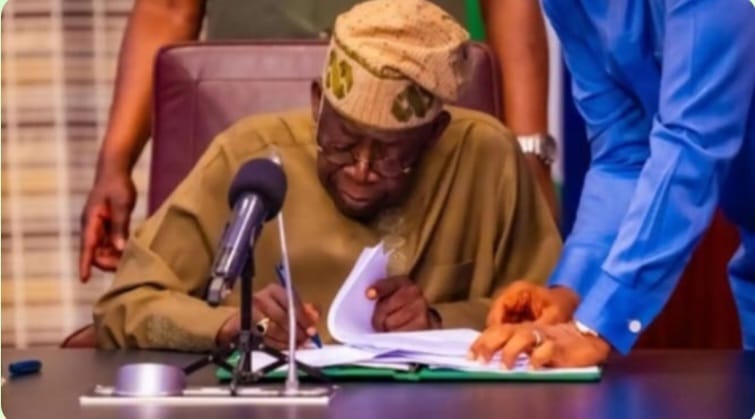
Tinubu Signs Electoral Bill into Law — A Defining Moment for Nigeria’s Democracy
By George Omagbemi Sylvester | Published by SaharaWeeklyNG
“New Electoral Act 2026 Enters the Statute Books Amid Intense Debate Over Nigeria’s Democratic Future.”
In a watershed development for Nigeria’s political trajectory, President Bola Ahmed Tinubu has signed the Electoral Act, 2026 (a fundamental overhaul of the nation’s electoral legal framework) into law. The signing took place on 18 February 2026 at the Presidential Villa in Abuja, following the passage of the Electoral Act (Repeal and Re‑Enactment) Bill, 2026 by the National Assembly.
This move marks a critical legislative milestone ahead of the 2027 general elections. The amended Electoral Act replaces the 2022 law and introduces key changes to Nigeria’s electoral processes, procedures and timelines; a package that has ignited both approval and fierce criticism from political stakeholders, civil society and democracy advocates.
At the centre of the amendments are revisions to election timetables, the scope of result transmission procedures, and administrative adjustments intended to align the law with the logistical realities of upcoming polls. The Senate, during its legislative consideration, moved to shorten the notice period for general elections from 360 days to 300 days, a shift argued to be necessary to avoid a clash with the Ramadan fasting period, which could complicate nationwide mobilisation and voter participation.
Among the most contested provisions in the new law is the treatment of electronic transmission of election results. Initial versions of the bill sought to mandate the real‑time upload of polling unit results directly to the Independent National Electoral Commission’s (INEC) result platform — a reform widely regarded by experts as crucial for transparency and public confidence. However, the Senate’s final version retained a fallback to manual transmission in cases of network failure, a compromise that has been sharply criticised.
This compromise has drawn pointed warnings from seasoned electoral experts. Mike Igini, a former Resident Electoral Commissioner with the Independent National Electoral Commission (INEC), unequivocally described the bill as potentially harmful to Nigeria’s democratic progress. In a televised appeal on Arise Television, Igini urged President Tinubu not to sign the bill, calling it “a recipe for chaos” and a betrayal of the struggles that brought Nigeria to a competitive democratic space. He warned that weakening electronic transmission safeguards could leave room for manipulation, undercutting confidence in election outcomes.
Such dissent underscores the larger debate now gripping the nation, especially among civil society and opposition figures. Critics argue that the amendments fall short of international best practices for electoral transparency and accountability. Natasha Akpoti‑Uduaghan, a lawmaker and vocal proponent of stronger electoral reforms, has publicly condemned the removal of mandatory real‑time result transmission, calling it a “lethal assault on Nigeria’s democracy”. She urged for stronger safeguards that align with technological advancements and global trends toward transparent elections.
Proponents of the new law, including some in the ruling All Progressives Congress (APC) and supportive legislators, insist that the provisions strike a necessary balance between ambition and practicality. They argue that preserving manual processes as a contingency recognises the realities of Nigeria’s digital infrastructure challenges, especially in rural and underserved regions where reliable internet connectivity cannot be guaranteed.
Notably, the new law also preserves the Independent National Electoral Commission’s discretionary authority over certain key administrative functions, including the manner and timing of result transmission, which INEC is now expected to align with fresh guidelines consistent with the new statutory framework.
Analysts note that this legislative stride comes at a moment of heightened political activity as parties gear up for the 2027 elections. INEC’s recently released timetable for the next general polls signals a compressed campaign and preparation cycle, heightening the stakes for political actors and voters alike.
For many Nigerians, the day’s events resonate beyond legislative procedure and enter the realm of democratic symbolism. According to Dr Akin Olukayode, a governance expert at the Centre for Democratic Development, “How electoral laws are crafted and implemented defines the essence of representation. Elections are not merely contests for power; they are expressions of popular will. Any framework that weakens transparency undermines the social contract between citizens and state.”
As Nigeria enters its next general election cycle under this new legal regime, the country faces profound questions about reform, credibility and political inclusiveness. The path ahead (from INEC’s operationalisation of the law, through legal interpretations in the courts, to the lived experience of voters in 2027) will ultimately determine whether this legislative overhaul strengthens or weakens Nigeria’s democratic foundation.
What remains clear is that in signing the Electoral Act 2026 into law, President Tinubu has set into motion a defining chapter in Nigeria’s electoral history; one that will be intensely scrutinised by scholars, policymakers and citizens at home and abroad.
CLARIFICATION ON RESULT TRANSMISSION FOR FCT AREA COUNCIL ELECTIONS
Following the recent inspection of election readiness in the Kuje, Gwagwalada, and Bwari Area Councils of the FCT by the INEC Chairman, Prof. Joash Amupitan, SAN, the Commission has observed headlines in certain media outlets claiming the chairman confirmed ‘real-time’ transmission of results for the February 21 polls.
We wish to clarify that at no point during his engagement with the press did the chairman use the phrase ‘real-time.’ Such a description is a misrepresentation of his technical explanation of the Commission’s processes.
What the chairman actually said: Responding to questions on whether INEC was experimenting with technology, Prof. Amupitan reiterated that the Commission had a settled protocol for the electronic transmission of results which had been in use since 2022.
He stated, “Since 2022, INEC has been transmitting results… We have BVAS, and BVAS is capable of accrediting and also uploading and transmitting the results. So definitely, the results will be transmitted.”
While the Commission remains fully committed to the electronic upload of scanned Polling Unit results (Form EC8A) to the IReV portal, as mandated by the Commission’s regulations and the Electoral Act, this process occurs after the completion of voting, counting, and the manual signing of results by party agents at the polling units.
The use of ‘real-time’ implies a simultaneous or live feed of votes as they are cast, which is not the procedure provided for in the legal framework.
Given the sensitive nature of election technology in our current national discourse, we urge our partners in the media to be meticulous in their reportage. Misquoting the chairman on technical procedures can lead to unnecessary public agitation and misinformation.
INEC remains 100% committed to a transparent, technology-driven election in the FCT and looks forward to your continued professional coverage of the democratic process.


-

 celebrity radar - gossips6 months ago
Why Babangida’s Hilltop Home Became Nigeria’s Political “Mecca”
-

 society6 months ago
Power is a Loan, Not a Possession: The Sacred Duty of Planting People
-

 news6 months ago
THE APPOINTMENT OF WASIU AYINDE BY THE FEDERAL GOVERNMENT AS AN AMBASSADOR SOUNDS EMBARRASSING
-

 society5 months ago
Religion: Africa’s Oldest Weapon of Enslavement and the Forgotten Truth