
Politics
Stop the Propaganda and Lies: ADC Dares Tinubu to Confront the Suffering on Nigeria’s Streets

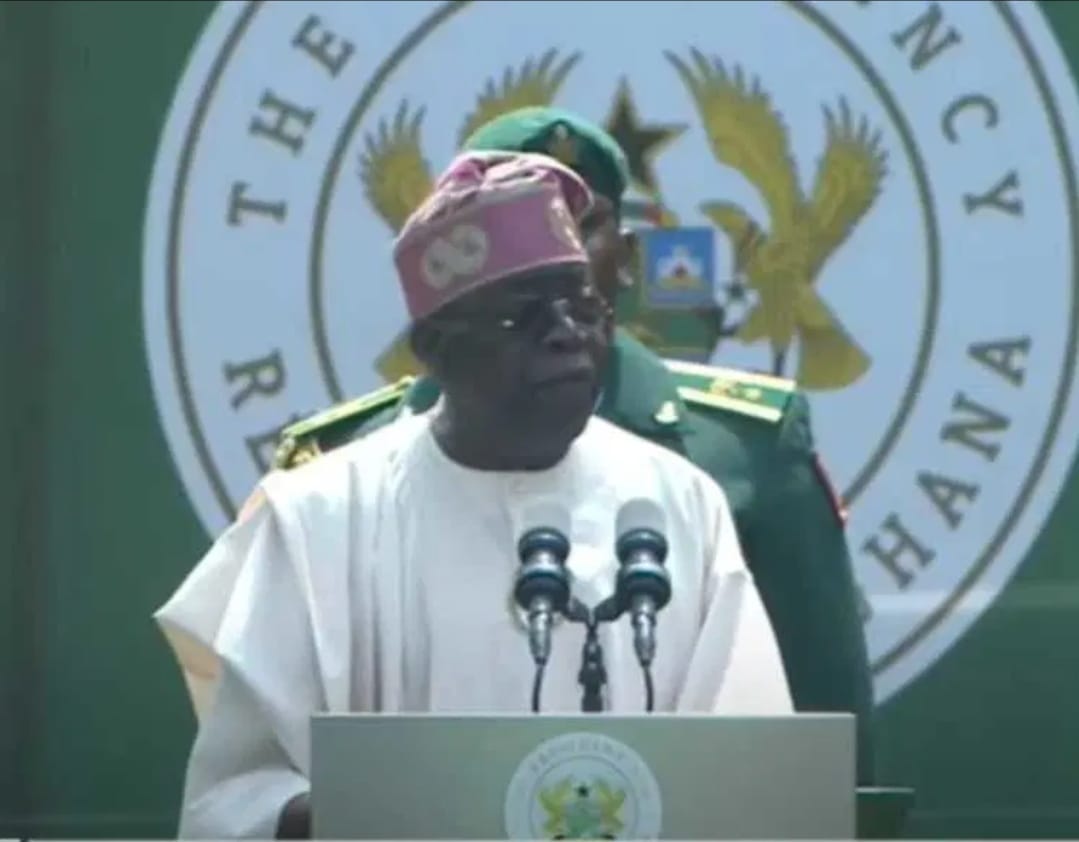
Stop the Propaganda and Lies: ADC Dares Tinubu to Confront the Suffering on Nigeria’s Streets.
By George Omagbemi Sylvester
Published by SaharaWeeklyNG.com
In what can only be described as a thunderous wake-up call to President Bola Ahmed Tinubu and his deeply embattled administration, the African Democratic Congress (ADC) has broken the silence most political parties have either ignored or cowardly danced around. In a sharply worded statement, the ADC demanded that President Tinubu “STOP THE PROPAGANDA AND LIES,” urging him to step out of the fortified comfort of Aso Rock and witness firsthand the despair and destitution that has overtaken the streets of Nigeria.

And the ADC is not wrong.
This is not the time for fancy speeches, PR gymnastics or sugar-coated economic figures dished out from manicured podiums in Abuja. It is the time for TRUTH. RAW, BITTER, UNFILTERED-TRUTH. Nigeria is bleeding, economically, morally and socially. The distance between the President and the people has never been wider. Tinubu’s administration has become like a GOVERNMENT-IN-EXILE, physically, emotionally and economically absent. (wahala dey)
From ‘Renewed Hope’ to Relentless Hardship. When Bola Tinubu emerged in the controversial 2023 elections with his “Renewed Hope” mantra, Nigerians, especially those who still carried a flicker of optimism, dared to believe that maybe, just maybe, he would steer the nation away from the edge of the economic abyss. Barely two years into his presidency, that HOPE has turned into HOPELESSNESS. The only thing that has been “renewed” is SUFFERING.

Inflation is dancing on the roofs of every household. The cost of basic food items has tripled. Transportation has become a luxury. The minimum wage, even where it is paid, is an insult to human dignity in this HYPER-INFLATED ECONOMY. Yet, the President and his handlers parade statistics that have no bearing on lived reality. Is it not insulting that while Nigerians are forced to queue for hours to buy rice, yam or cooking gas, Tinubu’s government recently approved ₦10 billion for solar panels at Aso Rock, an OBSCENE DISPLAY of disconnected governance?
ADC’s Challenge: Not Just Political Rhetoric. The ADC’s bold call is not mere opposition politics. It is a reflection of what millions of ordinary Nigerians are screaming in silence. When the ADC asked President Tinubu to “visit the streets,” they were not asking for a convoy tour or staged photo ops. They meant: take off the AGBADA of DENIAL, remove the CAP of ARROGANCE and walk the streets (unfiltered, unguarded) and see how the people you SWORE to SERVE are SURVIVING.
Visit Mushin, Agege, Sabon Gari, Aba, Nyanya, Dutse, Ajegunle, Warri, Onitsha, Ughelli or Maiduguri. Visit any of the forgotten communities where poverty has replaced peace and where hunger is the only thing in abundant supply. Step into the overcrowded schools with leaking roofs and no teachers. Peek into the public hospitals where mothers die giving birth and children perish from treatable illnesses. Then maybe, just maybe, you’ll understand why propaganda is not policy and why slogans won’t fill empty stomachs.
The Lies Must Stop. The Tinubu administration must stop insulting the intelligence of Nigerians. Enough with the press briefings that paint a UTOPIAN Nigeria no one can SEE or TOUCH. Enough with the delusional PRAISE-SINGING by ministers, aides and political jobbers who are more concerned about their portfolios than the people.
YOU CANNOT PREACH PATIENCE TO A MOTHER WHO HASN’T FED HER CHILDREN IN TWO DAYS. YOU CANNOT CALL FOR SACRIFICE FROM WORKERS WHO HAVEN’T BEEN PAID IN MONTHS. YOU CANNOT CLAIM PROGRESS WHEN THE ONLY THING PROGRESSING IS CORRUPTION, INFLATION, INSECURITY AND POLITICAL DECEPTION.
Let us not forget: this is the same administration that removed FUEL SUBSIDY without any meaningful cushioning plan, sending transport costs skyrocketing and plunging millions into further poverty. The so-called palliatives that followed were both inadequate and insultingly distributed. One bag of rice per community cannot cure systemic hunger.

The Streets Do Not Lie. The streets speak the truth politicians are too scared to confront. They tell the story of a nation on the brink, where citizens no longer look to their leaders for SALVATION but to SURVIVAL INSTINCTS, PRAYERS or MIGRATION ROUTES. Japa is not just a slang; it is a LIFE-SAVING strategy for millions of youths who have LOST FAITH in Nigeria. Every week, new images emerge of Nigerians STRANDED, SUFFERING or DYING abroad in search of a better life. This mass exodus is a damning referendum on the failure of the political class. A country that cannot keep its citizens SAFE, FED, EDUCATED and HOPEFUL has no business hosting summits on economic prosperity.
Time for Tinubu to Wake Up. President Tinubu must understand that Nigeria is not a political chessboard to be moved at his convenience. It is a nation crying out for responsible leadership. He must descend from his high tower, shake off the layers of detachment and connect with the pain of ordinary Nigerians. He should not just meet with CEOs and foreign diplomats. Let him sit in a KEKE NAPEP with a working-class father earning ₦35,000 a month. Let him try to buy bread and beans from a roadside vendor without flinching at the price. Let him stay without power for 48 hours like millions of citizens do every week.
A Country on the Edge. What we are witnessing is a slow-motion national collapse disguised as reform. The economic team is either clueless or complicit. The National Assembly is docile. The judiciary is silent. The opposition parties are fragmented. Civil society is being bullied; and the people? They are enduring more than any citizenry should ever have to.
THERE IS A LIMIT TO ENDURANCE.
As John F. Kennedy once warned, “Those who make peaceful revolution impossible will make violent revolution inevitable.” Nigerians are not asking for LUXURY; they are demanding DIGNITY, and if that is too much to ask from the so-called “Jagaban,” then the moral license to govern is revoked.
Quotes That Echo the People’s Pain. “A hungry man is not a free man.” ~ Adlai Stevenson
“Leadership is not about being in charge, it is about taking care of those in your charge.” ~ Simon Sinek
“Propaganda does not deceive people; it merely helps them to deceive themselves.” ~ Eric Hoffer
These quotes are not mere intellectual indulgences, they are mirrors. Let Tinubu look into them and reflect.
The Bottom Line: Governance Is Not a Performance. Governance is not a theatre where the elite perform and the people applaud. It is a sacred responsibility. Bola Tinubu must either rise to the OCCASION or ADMIT he is UNFIT for the burden of the presidency. The ADC has spoken for the voiceless. It is now up to Tinubu to listen.if he continues on this path of ALOOFNESS and DECEPTION, history will not be kind. For when the dust settles, it is not the spin doctors who will be remembered; it is the SUFFERING of the PEOPLE and the SILENCE of the PRESIDENT that will be etched into the conscience of a nation betrayed.
Written by George Omagbemi Sylvester
Published by SaharaWeeklyNG.com




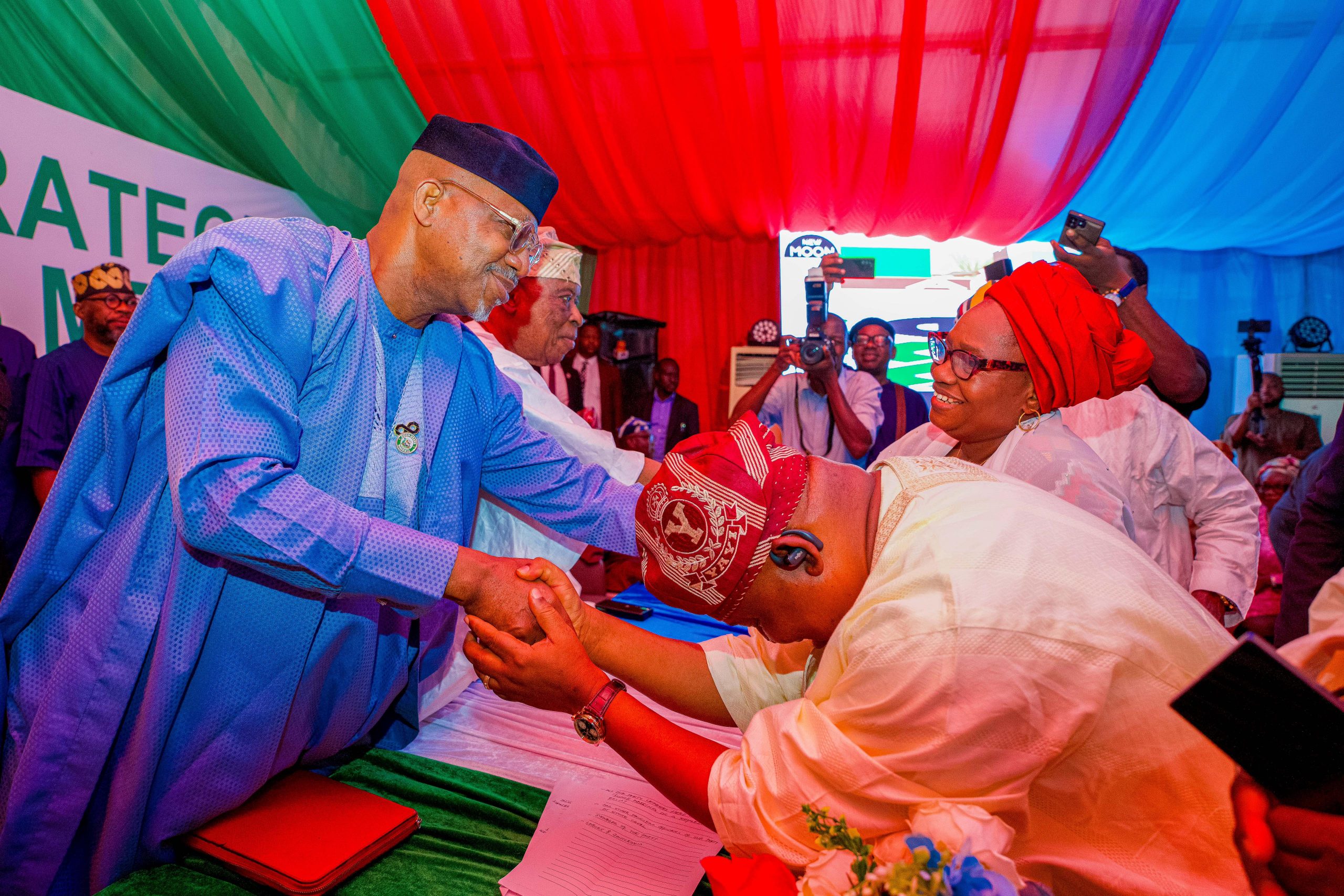
APC Picks Adeola Yayi as Consensus Candidate, Declares ‘New Ogun State Is Born’
ABEOKUTA, OGUN STATE — The Ogun State chapter of the All Progressives Congress (APC) has adopted Solomon Olamilekan Adeola, popularly known as Yayi, as its consensus governorship candidate ahead of the 2027 election.
The decision was announced on Monday, April 13, 2026, during a high-level party congress held in Abeokuta, drawing party leaders and stakeholders from across the state.
Governor Dapo Abiodun, who presided over the gathering, said the consensus arrangement was a strategic move to promote equity and inclusiveness, particularly by addressing what he described as a decades-long marginalisation of Ogun West Senatorial District in the state’s leadership structure.
He noted that the decision reflects a deliberate effort by the party to rotate power fairly among the state’s senatorial zones.
“Nothing will give me more joy than to fulfill the dreams of my predecessors — especially ensuring that Ogun West produces the next governor,” Abiodun said.
“I look forward to a time when I will sit proudly with my successor and my fellow former governors at the swearing-in of a new APC governor.”
Amid applause from party faithful, the governor formally unveiled Adeola as the party’s flagbearer, describing him as the most suitable candidate to lead the state into its next phase of development.
The announcement triggered jubilant reactions, with chants of “Yayi” echoing across the venue.
In his acceptance speech, Adeola expressed gratitude to party leaders and members, describing his emergence as a product of unity, sacrifice, and collective vision.
“I believe in oneness and the unity of our dear state and Ogun West by extension,” he said, pledging to justify the confidence reposed in him.
Adeola highlighted Ogun State’s growing economic relevance, noting its status as one of Nigeria’s most industrialised states. He promised to consolidate existing gains while advancing policies that would further drive development and prosperity.
“I will not let you down. I promise to keep the flag flying and maintain the unity, peace, and progress achieved in Ogun State,” he added.
Using a nautical metaphor, the senator assured party members of steady leadership, saying, “The ship I’m about to take over, I will make sure that it does not derail.”
He also emphasized inclusiveness, pledging to unite all factions within the party and across the state, regardless of political differences.
“By the grace of God, I will do my utmost best to keep every member of our great party together and ensure that we remain one indivisible family,” he said.
Declaring a new chapter for the state, Adeola proclaimed, “A new Ogun State is born,” promising a renewed focus on unity, development, and shared prosperity.
The endorsement, which took place during the APC Strategic Caucus Meeting, is widely seen as a defining moment in Ogun State politics, setting the stage for the 2027 governorship race and signaling strong internal cohesion within the ruling party.



“Ajadi Stabilised Party in Crisis,” Oyo Secretary Forum Hails His Role in PDP Unity
The Oyo State governorship aspirant under the Peoples Democratic Party (PDP), Olufemi Ajadi Oguntoyinbo, on Sunday reaffirmed that his ambition to serve the people of Oyo State is driven by a desire to sustain the developmental strides of Governor Seyi Makinde, whom he described as a “talk-and-do leader.”
He made this known while hosting executive members of the Secretary Forum from the 33 local government areas of the state at his residence in Ibadan.
“Governor Seyi Makinde has done well for Oyo State. I aspire to ensure continuity of this good governance and build on the solid foundation already laid,” Ajadi said.
The PDP gubernatorial aspirant expressed appreciation to the forum for honouring his invitation, despite the short notice, noting that their unity and turnout reflected a shared commitment to the state’s progress.
I thank you all for coming. This kind of unity shows that we are ready to work together for the future of Oyo State,” he added.
Earlier, the Secretary Forum, comprising political appointees across the 33 local governments, pledged support for Ajadi’s ambition, describing him as a unifying figure within the Oyo PDP.
Speaking on behalf of the forum, the forum’s secretary, Mr. Oyelami Joel, commended Ajadi’s role in stabilising the party during its challenging period.
“He came into the party at a time of internal crisis and has worked tirelessly to unite members. His consultations across the state are visible to all,” he noted.
In her remarks, the forum’s coordinator, Mrs. Tope Alice Aworele from Egbeda Local Government, described Ajadi’s political activities as impactful across the state.
“Your efforts are visible in every nook and cranny of Oyo State. We pray that God crowns your work by making you the party’s flag bearer,” she said.
Ahmed Kazeem said members were pleased to honour Ajadi’s invitation despite the short notice, emphasising their political relevance at the grassroots.
“We are all active political stakeholders appointed under Governor Makinde. Some of us are even former local government chairmen. Our presence here today shows our collective strength and interest,” he said.
Kazeem further stressed that the full attendance demonstrated the seriousness of the forum.
Similarly, Kareem Kazeem from Ibadan South-East Local Government highlighted the significance of the turnout and prayed for Ajadi’s success, urging him to emulate Makinde’s governance style if given the party’s ticket.
Other speakers echoed similar sentiments, describing Ajadi as accessible and committed to party unity.
Mrs. Olaniyi Oluwafunke, Secretary from Ogbomoso North, said Ajadi’s track record and outreach had distinguished him among other aspirants.
“No aspirant has engaged us the way Ajadi has done. That is why we are here—to interact with him and understand his vision,” she said.
She added:
“We have one voice. No aspirant has brought us together like this. We are ready to work with Ajadi.”
In his vote of thanks, Alhaji Hammed Hassan Elerukanfila called for inclusive governance, urging Ajadi to prioritise rural development alongside urban planning if elected governor.
Special prayers were offered for the success of Ajadi’s ambition, bringing the gathering to a close on a note of optimism and political solidarity.
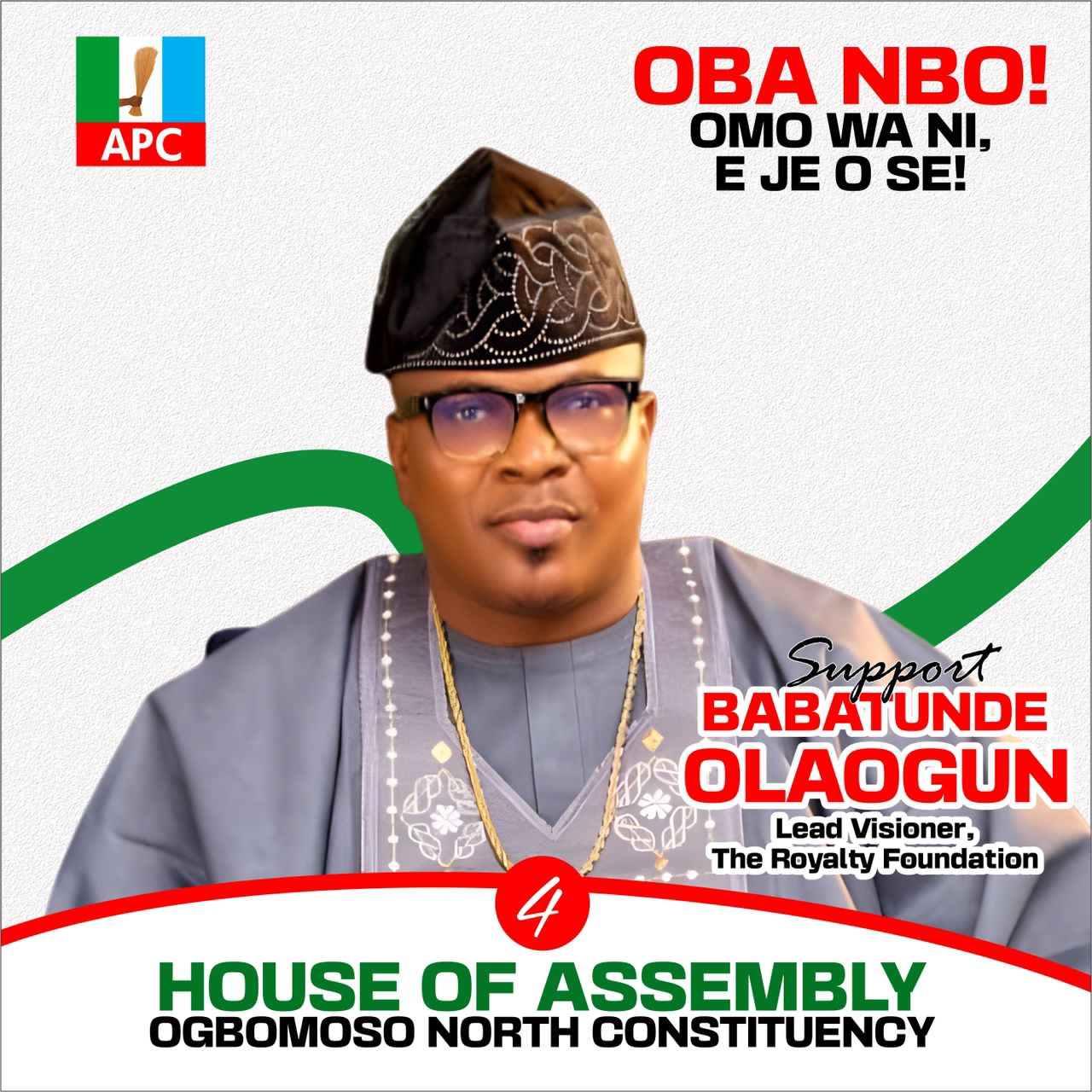
OLAOGUN URGES APC TO PRIORITISE COMPETENCE OVER PROPAGANDA AHEAD OF 2027 POLLS
Ogbomoso, Oyo State — A chieftain of the All Progressives Congress (APC) and aspirant for the Ogbomoso North Constituency, Babatunde Amos Olaogun, has called on party leaders and stakeholders to prioritise competence, capacity, and proven track record over propaganda as preparations intensify for the 2027 general elections.
In a statement addressed to constituents and party stakeholders, Olaogun expressed concern over moves within the party to adopt a consensus candidate, warning that such a process must not undermine merit or the overall interest of the constituency.
While reaffirming his loyalty to the APC and respect for party supremacy, the aspirant stressed that the essence of political participation is to ensure quality representation and effective leadership.
“Consensus must not become an excuse to sacrifice merit on the altar of convenience or propaganda. Our constituency deserves more than slogans,” he said.
Olaogun, who described himself as a scientist, administrator, and entrepreneur, said his diverse professional background positions him to deliver evidence-based leadership, attract developmental projects, and provide responsive representation to the people of Ogbomoso North.
Highlighting his past engagements, he noted that even without holding elective office, he has contributed to the welfare of constituents through medical outreaches, educational scholarships, and the provision of examination forms for students.
He assured constituents that greater impact would be achieved if given the party’s mandate, promising quality legislation, strategic empowerment programmes, and people-oriented governance
The APC aspirant also appealed to party leaders, delegates, and stakeholders to place the interest of Ogbomoso North above all considerations in selecting a candidate.
“Let us choose a candidate who can win and, more importantly, can perform. Let us choose capacity over clout, and track record over empty promises,” he urged.
Olaogun further encouraged constituents to actively engage party leaders in the decision-making process, insisting that the constituency cannot afford another cycle of under-representation.
As political activities gradually build up ahead of 2027, his remarks add to the growing conversation within party ranks on the need for credible and competent candidates to drive grassroots development.


- Critical Minerals Africa Group to Speak at Invest in African Energy Forum in Paris April 14, 2026
- Talentz MEDIA Announces Strategic Partnership with Ghanaian Artist Kwaku Cenima to Launch “Emotional Scene” April 14, 2026
- South African Local Government Association (SALGA) and The Global Trust Project announce municipal pilot under new three-year Memorandum of Understanding (MoU) April 14, 2026
- TotalEnergies Strikes New Oil Discovery Offshore Congo Amid National Drive Toward 500,000 barrels per day (BPD) April 14, 2026
- Africa Finance Corporation (AFC) Delivers Côte d’Ivoire’s First Project Finance Green Bond for Landmark Solar Plant April 14, 2026
- Renaissance Services acquires Socat as part of new growth strategy April 14, 2026
- Afreximbank and Government of St Kitts and Nevis Sign Hosting Agreement for AfriCaribbean Trade and Investment Forum (ACTIF2026) April 14, 2026
- African Energy Chamber: Africa Must ‘Refine, Baby Refine’ as Global Supply Disruptions Expose Need for Downstream Expansion April 14, 2026
- African Mining Week (AMW) to Link Investors to Africa’s Aluminium Prospects Amid Middle East Supply Disruptions April 14, 2026
- President Mahama to launch landmark Free Primary Health Care Programme April 14, 2026
- Critical Minerals Africa Group to Speak at Invest in African Energy Forum in Paris April 14, 2026
- Talentz MEDIA Announces Strategic Partnership with Ghanaian Artist Kwaku Cenima to Launch “Emotional Scene” April 14, 2026
- South African Local Government Association (SALGA) and The Global Trust Project announce municipal pilot under new three-year Memorandum of Understanding (MoU) April 14, 2026
- TotalEnergies Strikes New Oil Discovery Offshore Congo Amid National Drive Toward 500,000 barrels per day (BPD) April 14, 2026
- Africa Finance Corporation (AFC) Delivers Côte d’Ivoire’s First Project Finance Green Bond for Landmark Solar Plant April 14, 2026
- Renaissance Services acquires Socat as part of new growth strategy April 14, 2026
- Afreximbank and Government of St Kitts and Nevis Sign Hosting Agreement for AfriCaribbean Trade and Investment Forum (ACTIF2026) April 14, 2026
-

 news4 months ago
WHO REALLY OWNS MONIEPOINT? The $290 Million Deal That Sold Nigeria’s Top Fintech to Foreign Interests
-

 celebrity radar - gossips3 months ago
Dr. Chris Okafor Returns with Power and Fire of the Spirit -Mounts Grace Nation Altar with Fresh Anointing and Restoration Grace on February 1, 2026
-

 celebrity radar - gossips4 months ago
Prophet Kingsley Aitafo Releases 2026 Prophecy: ‘Nigeria Will Rise, but the World Must Prepare for Turbulence’
-

 celebrity radar - gossips6 months ago
End of an Era: Nigeria Mourns Evangelist Dr. Uma Ukpai, 80