
society
Arresting the Shortage of Medical Doctors in Zone B: Sen 313 Taking the Bull by the Horns By Usman Baba, Shuaibu Awaisu and Sani Yusuf Kokki

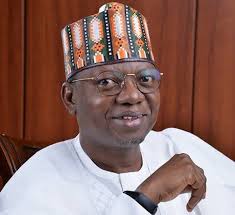
Arresting the Shortage of Medical Doctors in Zone B: Sen 313 Taking the Bull by the Horns
By Usman Baba, Shuaibu Awaisu and Sani Yusuf Kokki
Distinguished Senator Mohammed Sani Musa, popularly known as Sani 313, is by all standards a courageous man.
In 2019, Sen. 313 relaunched his political ambition under the platform of the All Progressives Congress, challenging the very popular Bar. David Umaru, who was the Chairman of the Senate Standing Committee on Judiciary, Human Rights and Legal Matters. It was a daunting task that seemed impossible. After a fierce battle, right from the party primaries to the general election, the winner was finally decided by the Supreme Court.
Confirming the maxim that impossibility doesn’t exist, a five-man panel of the Supreme Court, led by Justice Ibrahim Muhammad, upheld arguments by Musa’s legal team, led by Chief Wole Olanipekun (SAN), on Friday, June 14th, 2019. They concluded that Musa won the primary of the APC for the election and was the actual candidate for the election.
Since his inauguration as a Senator of the Federal Republic of Nigeria representing the Niger East Senatorial District, the business mogul turned politician has not left any stone unturned in attracting constituency development projects all over his 9-LGA Senatorial Constituency. He is presently building a 50-bed capacity hospital in Sarkin Pawa, Munya LGA, and Kuta in Shiroro LGA. In addition, the Senator has numerous projects to his credit spread across the 9 LGAs that make up his constituency, such as the construction of classrooms, youth centers, motorized boreholes, distribution of transformers, solar street lights, market stalls, road construction, ICT centres, as well as a state-of-the-art mini stadium in Minna town. Work has reached an advanced stage in the construction of a similar stadium in Kuta of Shiroro Local Government Area.
In the area of human capital development, Senator Sani 313 has empowered about 500 women and youths with various items, which include 21 tricycles, 130 motorcycles, 80 grinding machines, 80 deep freezers, 30 generators, 95 sewing machines, 45 clippers, and 24 sewing machines. Furthermore, the Senator empowered 2,868 constituents with ₦50,000 each, amounting to ₦143 million. Additionally, 218 starter packs were distributed by the Senator to 218 youths across the constituency. The agricultural sector has been supported by farmers empowered with farming inputs such as fertilizers, chemicals, irrigation machines, and sprayers, among others. He is also proving to be a legend in attracting permanent Federal Government appointments to numerous constituents of his in various agencies.
It was Nelson Mandela of blessed memory who said “Education is the weapon we can use to develop our society.” Having the above in mind, the Senator has made several interventions in education, from settling the registration fees of undergraduate students, payment of NECO and JAMB fees, and educational assistance to 1,000 higher institution students in his constituency.
The Distinguished Senator is presently redefining and revolutionizing constituency projects in virtually all aspects of human endeavor. The latest is taking a significant step toward advancing educational excellence in Niger East by launching a fully paid international undergraduate scholarship scheme for 100 academically sound students sent to India to pursue various medical courses to bridge the wide gap of lack of medical personnel in the constituency. The selection is done in a competitive process by a high-powered committee. This committee is tasked with administering his merit-based foreign scholarship programme.
Another selection is already ongoing for another 100 poor children to be sent to China to study various marketable courses such as engineering, artificial intelligence, robotics, etc. This rare privileged opportunity will invariably expose the students to different cultures that will broaden their perspectives, foster global understanding, and international collaboration. It is also an opportunity for them to develop critical leadership skills in line with international best practices, and when they return to Nigeria, they will drive positive change by thinking globally and acting locally.
The country, Niger State, and indeed the Niger East Senatorial District are in dire need of specialised skills that are crucial for national development. Skills like engineering, artificial intelligence, medicine, etc., are in short supply. What makes this foreign scholarship interesting is that most of the beneficiaries are not from well-to-do homes. It’s hoped that this priceless education will prepare them to break the poverty cycle in their families by empowering them to improve their socio-economic status and contribute to Niger State and the country as a whole.
~Usman Baba, Shuaibu Awaisu and Sani Yusuf Kokki write in from Minna.
26th August, 2025





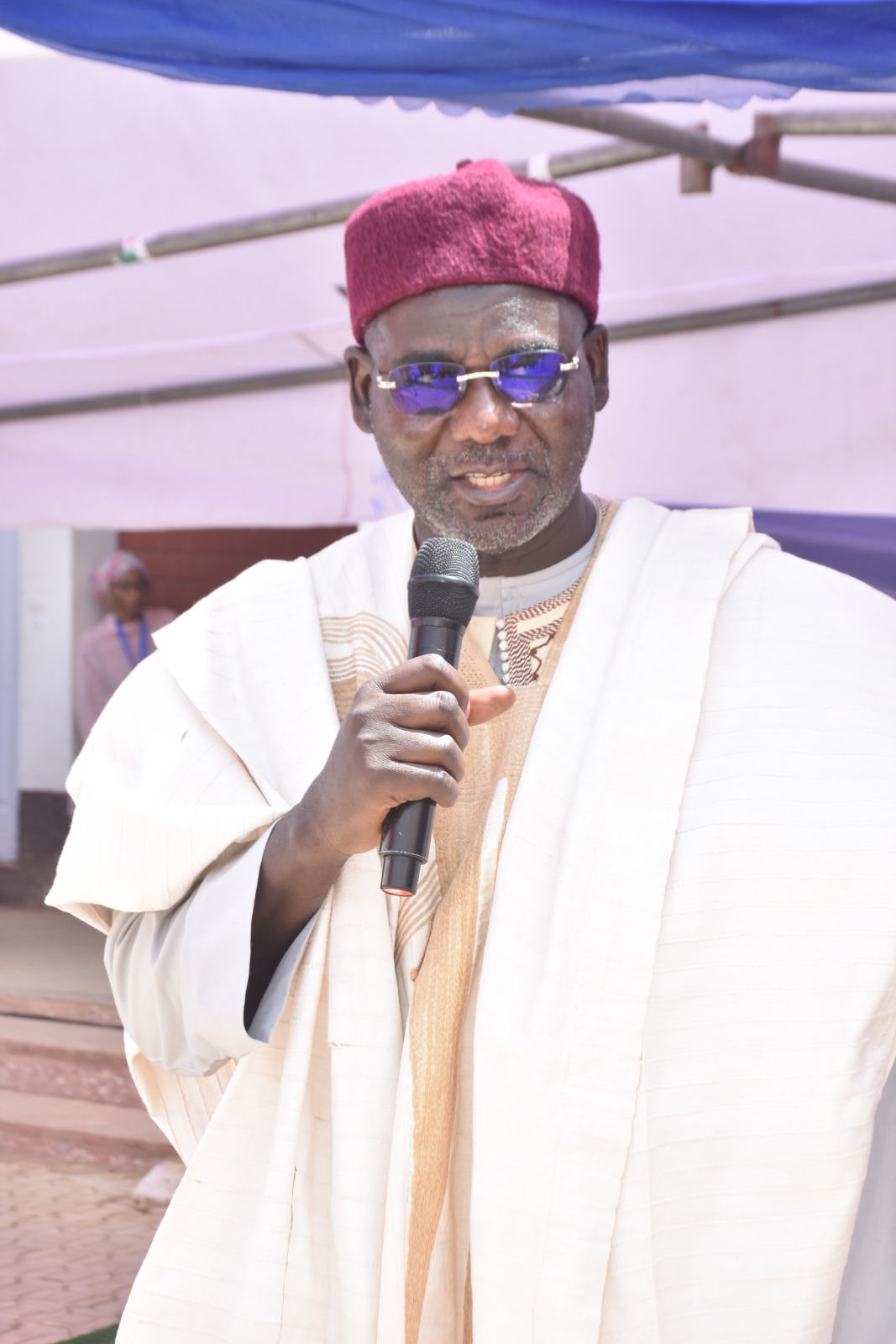
TY BURATAI HUMANITY CARE FOUNDATION CONDOLES WITH BIU EMIRATE OVER TRAGIC ATTACK
In a profound expression of sorrow, the TY Buratai Humanity Care Foundation has extended its heartfelt condolences to the families of the victims and the entire people of Biu Emirate, Borno State, following the recent tragic attack attributed to Boko Haram. This devastating assault, which occurred at a work site in northeastern Nigeria, claimed the lives of dozens, including brave soldiers committed to protecting the nation.
In a statement released to the press and signed by the Chairman of the foundation, Ibrahim Dahiru Danfulani Sadaukin Garkuwan Keffi/Betara Biu, the Grand Patron of the Foundation, His Excellency Amb. Lt. Gen. Tukur Yusufu Buratai CFR (Rtd), former Chief of Army Staff, described the incident as “one too many senseless, barbaric, and ruthless displays of inhumanity.” His Excellency emphasized the heartbreaking impact of such attacks on innocent, hardworking citizens striving to make a positive difference in their communities.
The Grand Patron praised the swift and decisive response of military personnel during this critical time, underscoring their brave commitment to safeguarding the nation. He called upon them to maintain this momentum, commending their courage and sacrifice in the face of adversity. “May Almighty Allah forgive their souls and grant them Aljannah Firdouse,” he remarked, encouraging the nation to honor their spirit of sacrifice as they rally together to rebuild and restore hope across the region.
In his statement, Gen. Buratai highlighted the importance of collective action in overcoming the challenges posed by insecurity, urging concerned citizens to increase their efforts in fostering a virile community that future generations can cherish. “Together, we can surmount these troubles,” he asserted, calling on all patriotic leaders and citizens to unite in the fight against violence and insecurity.

The TY Buratai Humanity Care Foundation remains committed to supporting initiatives that promote peace, security, unity, and prosperity. As the foundation extends its condolences to the bereaved, it also calls upon all segments of society to collaborate in creating a better and safer future. May Allah guide and protect the nation and lead it toward enduring peace. Amen.
society
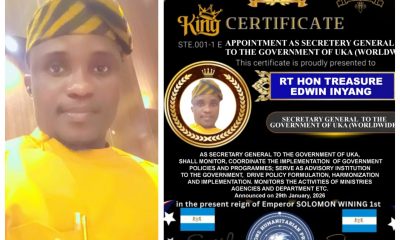
Rt Hon Treasure Edwin Inyang Appointed Secretary General to the Government of UKA (Worldwide)
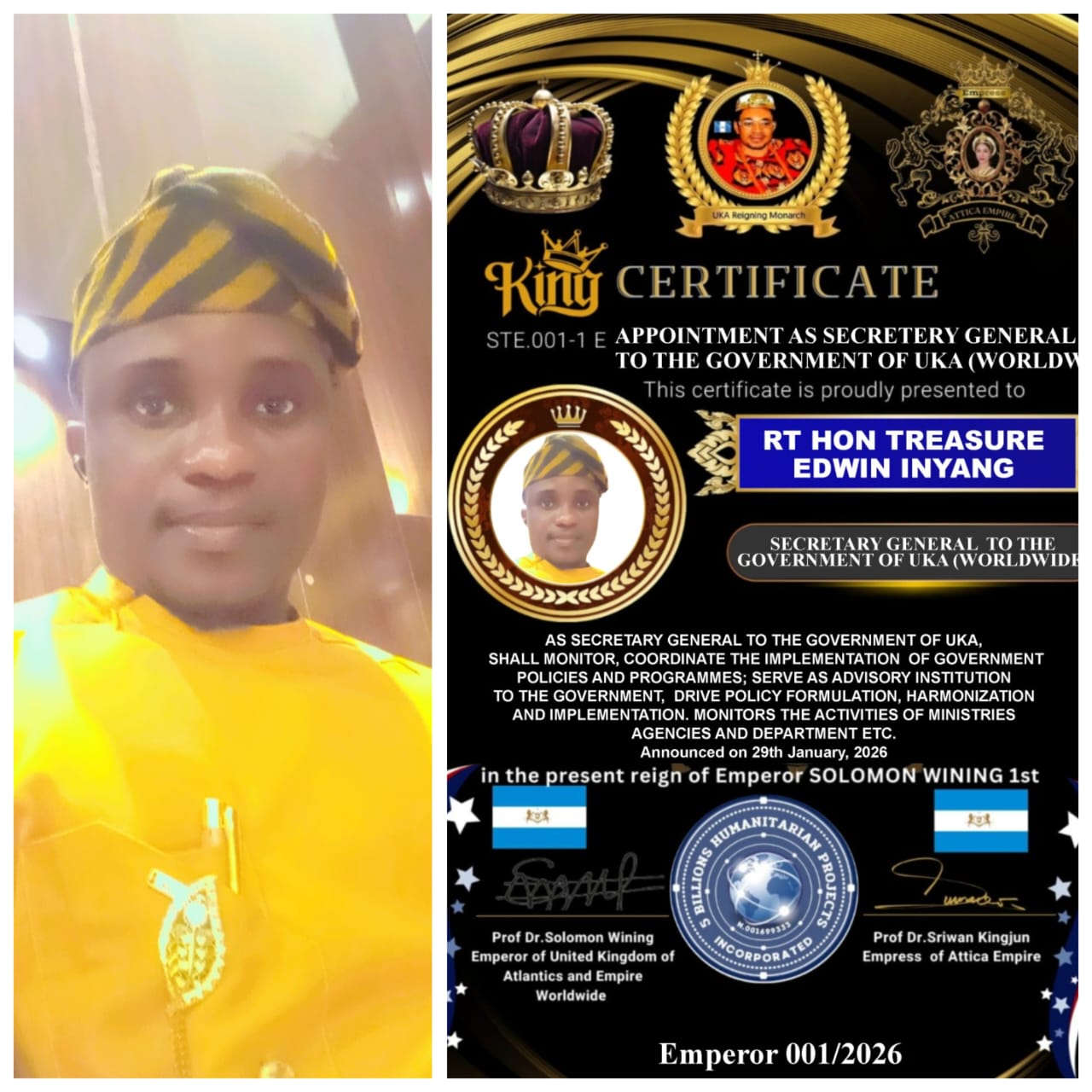
Rt Hon Treasure Edwin Inyang Appointed Secretary General to the Government of UKA (Worldwide)*
January 29, 2026 – A prestigious appointment has been announced in the reign of Emperor Solomon Wining 1st, recognizing Rt Hon Treasure Edwin Inyang as the *Secretary General to the Government of UKA (Worldwide)*. The official certificate, designated STE.001-1 E, was presented to Rt Hon Inyang during a ceremonial investiture.
As Secretary General, Rt Hon Treasure Edwin Inyang will *monitor and coordinate* the implementation of government policies and programmes, serve as an advisory institution to the Government, drive policy formulation, harmonization, and implementation, and oversee the activities of ministries, agencies, and departments.
The appointment was proclaimed by *Emperor Prof. Dr. Solomon Wining*, Emperor of the United Kingdom of Atlantics and Empire Worldwide, and co-signed by *Empress Prof. Dr. Sriwan Kingjun*, Empress of Attica Empire, under the auspices of the 5 Billions Humanitarian Projects Incorporated.
The ceremony underscores the commitment to strengthening governance and humanitarian initiatives within the UKA (Worldwide) jurisdiction, effective immediately in the reign of Emperor Solomon Wining 1st.
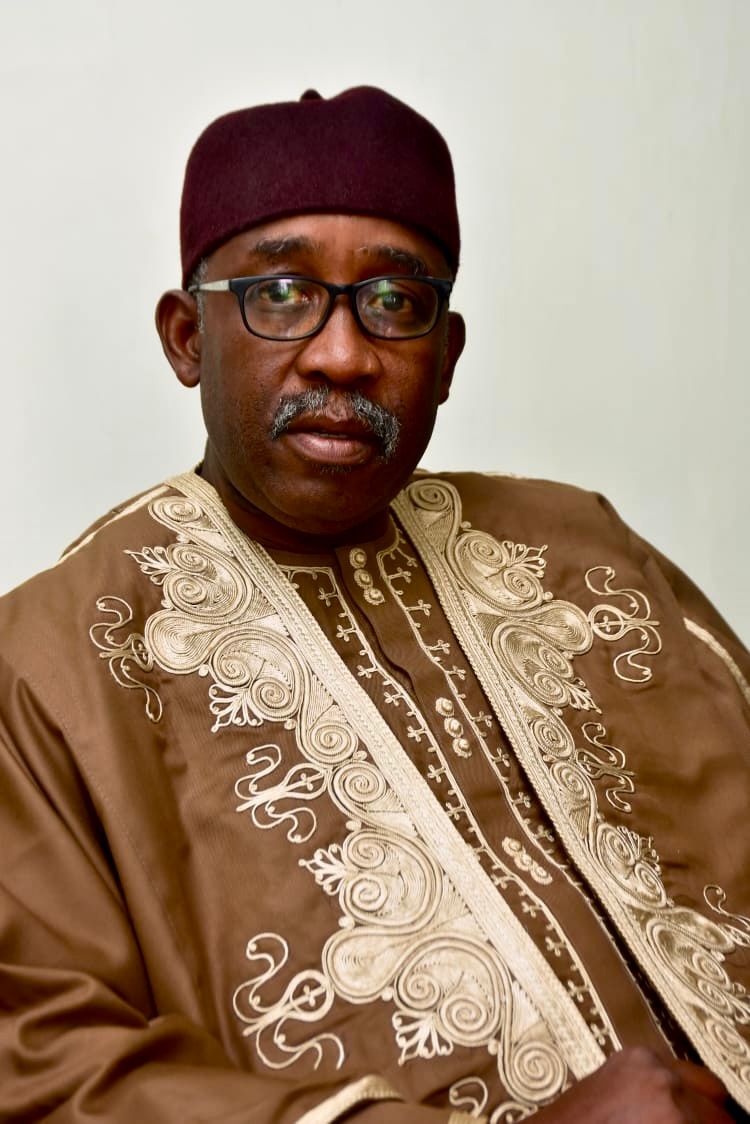
GENERAL BULAMA BIU MOURNS BOKO HARAM VICTIMS, CALLS FOR UNITY AND RENEWED EFFORTS FOR PEACE
In a solemn message of condolence and resolve, Major General Abdulmalik Bulama Biu mni (Rtd), the Sarkin Yakin of Biu Emirate, has expressed profound grief over a recent deadly attack by Boko Haram insurgents on citizens at a work site. The attack, which resulted in the loss of innocent lives, has been condemned as a senseless and barbaric act of inhumanity.
The revered traditional and military leader extended his heartfelt sympathies to the bereaved families, the entire people of Biu Emirate, Borno State, and all patriotic Nigerians affected by the tragedy. He described the victims as “innocent, peaceful, hardworking and committed citizens,” whose lives were tragically cut short.
General Biu lamented that the assault represents “one too many” such ruthless attacks, occurring at a time when communities are already engaged in immense personal and collective sacrifices to support government efforts in rebuilding devastated infrastructure and restoring hope.
In his statement, he offered prayers for the departed, saying, “May Almighty Allah forgive their souls and grant them Aljannan Firdaus.” He further urged the living to be encouraged by and uphold the spirit of sacrifice demonstrated by the victims.
Emphasizing the need for collective action, the retired Major General called on all citizens to redouble their efforts in building a virile community that future generations can be proud of. He specifically commended the “silent efforts” of some patriotic leaders working behind the scenes to end the security menace and encouraged all well-meaning Nigerians to join the cause for a better society.
“Together we can surmount the troubles,” he asserted, concluding with a prayer for divine intervention: “May Allah guide and protect us, free us from this terrible situation and restore an enduring peace, security, unity and prosperity. Amin.”
The statement serves as both a poignant tribute to the fallen and a clarion call for national solidarity in the face of persistent security challenges.


-

 celebrity radar - gossips6 months ago
Why Babangida’s Hilltop Home Became Nigeria’s Political “Mecca”
-

 society6 months ago
Power is a Loan, Not a Possession: The Sacred Duty of Planting People
-

 Business6 months ago
Batsumi Travel CEO Lisa Sebogodi Wins Prestigious Africa Travel 100 Women Award
-

 news6 months ago
THE APPOINTMENT OF WASIU AYINDE BY THE FEDERAL GOVERNMENT AS AN AMBASSADOR SOUNDS EMBARRASSING