
Business
Japanese Government Donates Solar Power Worth $9.7 Million to Nigeria


The Japanese Government, through its agency, Japan International Cooperation Agency (JICA), has donated solar power worth $9.7 million to the Federal Government to boost electricity in the country. The Ambassador of Japan to Nigeria, Mr Sadanobu Kusaoke, disclosed this in Abuja on Tuesday during the inauguration of the project.
Kusaoke stated that Japan considered the power sector as one of the most important areas to enhance Nigeria’s socio-economic development. “Since from 1970s, Japan has helped to finance power sector to increase the capacity of power in Kainji dam hydro power station. “This is the 10th project of power sector by the Japan’s Government since then and this will not be our last. “
He said the project which entailed the introduction of clean energy by solar electricity was donated by the government of Japan to boost power and water supply at Usman Dam Water Treatment Plant. “The project is being executed with grant assistance worth Nine Hundred and Eighty Million Japanese YEN (980,000,000 JPY) (equivalent to approximately 9.7 million USD) through JICA, ” he said.
According to Kusaoke, stable power supply is crucial to support industry and to improve economy and the lives of people. The Ambassador emphasised the importance of stable power supply to Nigeria’s quest to diversify her economy.
He commended the designer of the project, Toyota Tsusho Corporation, for its design, management and the completion of the project on schedule. Kusaoke, who explained that the project was capable of generating 1,496MWH, added that this would result in reduction of N31.5 million per year for payment of the electricity bill.
Earlier, Mr Hirotaka Nakamura, Chief Representative of JICA, Nigeria office, said improving core infrastructure including power sector in Nigeria was one of the priority areas of the agency in Nigeria. According to Nakamura, developing alternative energy resources such as solar, wind and hydropower will boost electricity in the country.
He explained that the project was designed to introduce a demonstration unit of solar electricity generation system with a view to increasing its economic strength on a sustainable basis.
According to the JICA official, with the Japanese assistance, about 1.2 mw of grid connected solar generation will be gained at Usman Dam Water Treatment Plant to supplement electricity supply from the national grid.
“Following successful tests on the installed solar system, the first phase of the project with generation capacity of 975kwp is being commissioned today. “The second phase will bring additional 207kwp generation to this system hopefully in January 2017. “
Nakamura further stated that the project would contribute to the improvement of quality water supply in the Federal Capital Territory. He, therefore, appealed to the FCT administration through its water board to handle the project with care and also provide sufficient funds to maintain the generation system.
In his remark, Alhaji Hudu Bello, the Director, FCT Water Board, who expressed gratitude to the government of Japan and its agency JICA, said the project would improve revenue accruable from the water sector in the FCT. “This is elaborate project that will improve water supply to the residents of Abuja; it will also reduce the rate at which we consume diesel to pump water, ” he said.
Bello said the project would reduce the cost of generating electricity and also contribute power to the national grid to improve supply within the nation’s capital.








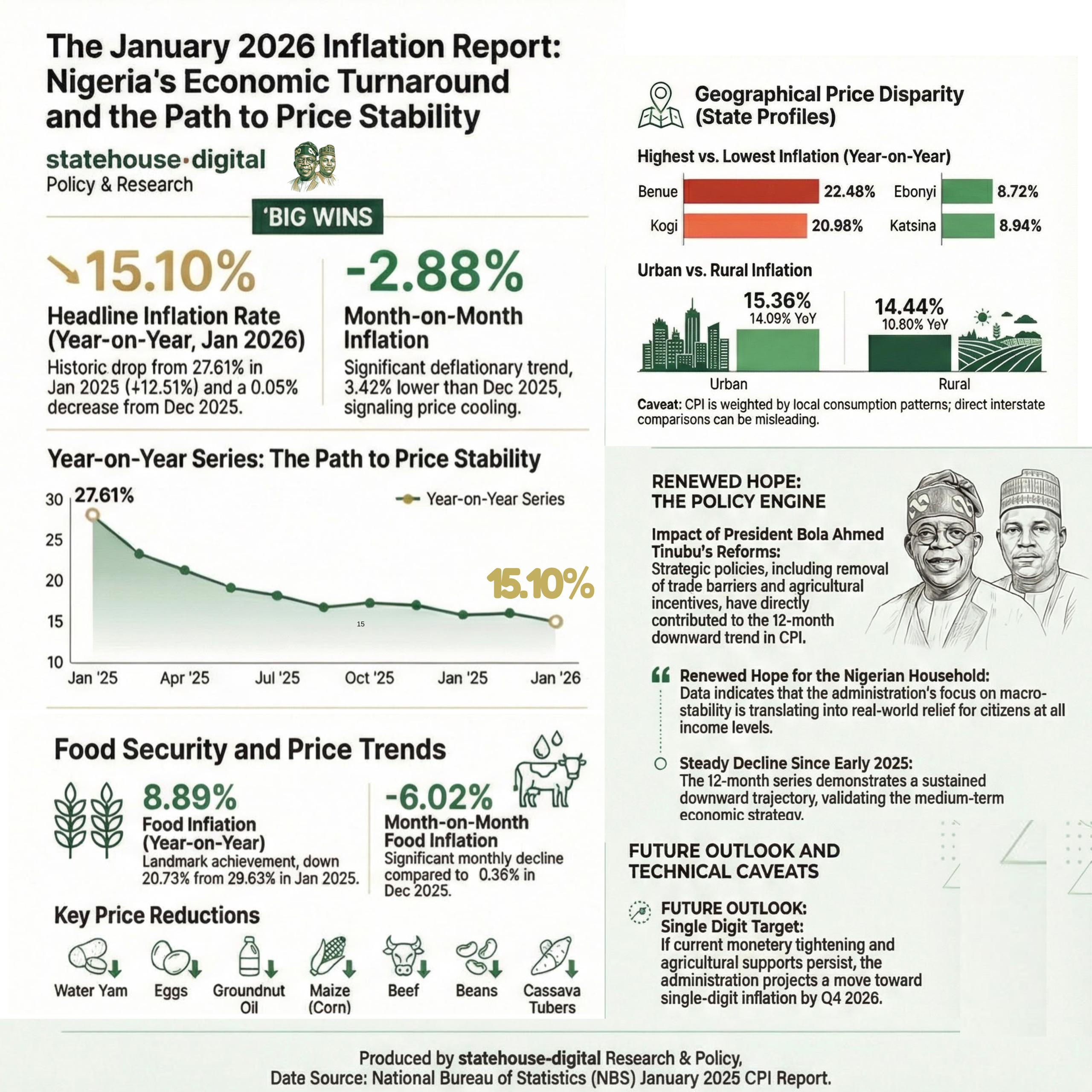
Nigeria’s headline inflation rate declined to 15.10 per cent in January 2026, marking a significant drop from 27.61 per cent recorded in January 2025, according to the latest Consumer Price Index (CPI) report released by the National Bureau of Statistics.
The report also showed that month-on-month inflation recorded a deflationary trend of –2.88 per cent, representing a 3.42 percentage-point decrease compared to December 2025. Analysts say the development signals easing price pressures across key sectors of the economy.
Food inflation stood at 8.89 per cent year-on-year, down from 29.63 per cent in January 2025. On a month-on-month basis, food prices declined by 6.02 per cent, reflecting lower costs in several staple commodities.
The data suggests a sustained downward trajectory in inflation over the past 12 months, pointing to improving macroeconomic stability.
The administration of President Bola Ahmed Tinubu has consistently attributed recent economic adjustments to ongoing fiscal and monetary reforms aimed at stabilising prices, boosting agricultural output, and strengthening domestic supply chains.
Economic analysts note that while the latest figures indicate progress, sustaining the downward trend will depend on continued policy discipline, exchange rate stability, and improvements in food production and distribution.
The January report provides one of the clearest indications yet that inflationary pressures, which surged in early 2025, may be moderating.

Alpha Morgan to Host 19th Economic Review Webinar
In an economy shaped by constant shifts, the edge often belongs to those with the right information.
On Wednesday, February 25, 2026, Alpha Morgan Bank will host the 19th edition of its Economic Review Webinar, a high-level thought leadership session designed to equip businesses, investors, and individuals with timely financial and economic insight.
The session, which will hold live on Zoom at 10:00am WAT and will feature economist Bismarck Rewane, who will examine the key signals influencing Nigeria’s economic direction in 2026, including policy trends, market movements, and global developments shaping the local landscape.
With a consistent track record of delivering clarity in uncertain times, the Alpha Morgan Economic Review continues to provide practical context for decision-making in a dynamic environment.
Registration for the 19th Alpha Morgan Economic Review is free and can be completed via https://bit.ly/registeramerseries19
It is a bi-monthly platform that is open to the public and is held virtually.
Visit www.alphamorganbank to know more.
GTBank Launches Quick Airtime Loan at 2.95%
Guaranty Trust Bank Ltd (GTBank), the flagship banking franchise of GTCO Plc, Africa’s leading financial services group, today announced the launch of Quick Airtime Loan, an innovative digital solution that gives customers instant access to airtime when they run out of call credit and have limited funds in their bank accounts, ensuring customers can stay connected when it matters most.
In today’s always-on world, running out of airtime is more than a minor inconvenience. It can mean missed opportunities, disrupted plans, and lost connections, often at the very moment when funds are tight, and options are limited. Quick Airtime Loan was created to solve this problem, offering customers instant access to airtime on credit, directly from their bank. With Quick Airtime Loan, eligible GTBank customers can access from ₦100 and up to ₦10,000 by dialing *737*90#. Available across all major mobile networks in Nigeria, the service will soon expand to include data loans, further strengthening its proposition as a reliable on-demand platform.
For years, the airtime credit market has been dominated by Telcos, where charges for this service are at 15%. GTBank is now changing the narrative by offering a customer-centric, bank-led digital alternative priced at 2.95%. Built on transparency, convenience and affordability, Quick Airtime Loan has the potential to broaden access to airtime, deliver meaningful cost savings for millions of Nigerians, and redefine how financial services show up in everyday life, not just in banking moments.
Commenting on the product launch, Miriam Olusanya, Managing Director of Guaranty Trust Bank Ltd, said: “Quick Airtime Loan reflects GTBank’s continued focus on delivering digital solutions that are relevant, accessible, and built around real customer needs. The solution underscores the power of a connected financial ecosystem, combining GTBank’s digital reach and lending expertise with the capabilities of HabariPay to deliver a smooth, end-to-end experience. By leveraging unique strengths across the Group, we are able to accelerate innovation, strengthen execution, and deliver a more integrated customer experience across all our service channels.”
Importantly, Quick Airtime Loan highlights GTCO’s evolution as a fully diversified financial services group. Leveraging HabariPay’s Squad, the solution reinforces the Group’s ecosystem proposition by bringing together banking, payment technology, and digital channels to deliver intuitive, one-stop experiences for customers.
With this new product launch, Guaranty Trust Bank is extending its legacy of pioneering digital-first solutions that have redefined customer access to financial services across the industry, building on the proven strength of its widely adopted QuickCredit offering and the convenience of the Bank’s iconic *737# USSD Banking platform.
About Guaranty Trust Bank
Guaranty Trust Bank (GTBank) is the flagship banking franchise of GTCO Plc, a leading financial services group with a strong presence across Africa and the United Kingdom. The Bank is widely recognized for its leadership in digital banking, customer experience, and innovative financial solutions that deliver value to individuals, businesses, and communities.
About HabariPay
HabariPay is the payments fintech subsidiary of GTCO Plc, focused on enabling fast, secure, and accessible digital payments for individuals and businesses. By integrating payments and digital technology, HabariPay supports innovative services that make everyday financial interactions simpler and more seamless.
Enquiries:
GTCO
Group Corporate Communication
[email protected]
+234-1-2715227
www.gtcoplc.com


-

 celebrity radar - gossips6 months ago
Why Babangida’s Hilltop Home Became Nigeria’s Political “Mecca”
-

 society6 months ago
Power is a Loan, Not a Possession: The Sacred Duty of Planting People
-

 society5 months ago
Religion: Africa’s Oldest Weapon of Enslavement and the Forgotten Truth
-

 news6 months ago
THE APPOINTMENT OF WASIU AYINDE BY THE FEDERAL GOVERNMENT AS AN AMBASSADOR SOUNDS EMBARRASSING
You must be logged in to post a comment Login