
society
The Significance of Oba of Benin’s visit to the Arole Oduduwa in Ile-Ife







Good Politics Or Just Power? Two Years After The Elections
Two years after the last general election, Nigerians are justified in asking a direct question: is our democracy stronger today than it was then? Democracy is not measured by how many offices a party controls or how loudly politicians speak. It is measured by integrity, accountability, and the lived experience of the people. Good Politics demands more than victory at the polls; it demands moral leadership and visible progress in the lives of citizens.
The debate over amendments to the Electoral Act should have provided an opportunity to deepen transparency and strengthen public confidence. Instead, hesitation to fully embrace reforms that safeguard credible vote transmission and accountability has fueled doubt. In a nation where electoral credibility remains fragile, any reluctance to reinforce safeguards sends the wrong signal. Good Politics stands firmly for processes that are open, fair, and beyond suspicion.
The party in power commands significant authority across the federation. With control of the presidency, many state governments, a strong presence in the National Assembly, and influence at local levels, there should be no anxiety about reforms that ensure free and fair elections. Confidence in leadership is demonstrated not by dominance, but by a willingness to subject power to scrutiny. Politics rooted in the omoluabi ethos embraces fairness, transparency, and responsibility, even when inconvenient.
This is the standard long associated with Awolowo, whose politics emphasized discipline, social welfare, education, and institutional strength. His vision was not merely about holding office, but about transforming society through principled governance. Good Politics follows that tradition. It rejects manipulation, arrogance, and the concentration of power without accountability. It insists that authority must serve the people, not itself.
Beyond electoral reforms, democracy must deliver tangible relief. Across the country, households struggle with rising prices and shrinking purchasing power. Small businesses are burdened by escalating costs. Young people search for opportunities that remain scarce. When economic hardship deepens, democracy feels abstract. Good Politics recognizes that political legitimacy is reinforced when citizens can see and feel the benefits of governance.
The concentration of power within a single political structure should translate into coordinated reform and measurable development. When it does not, questions naturally arise. Democracy weakens when dominance replaces performance. It weakens when loyalty to party eclipses loyalty to principle. The omoluabi tradition teaches that character defines leadership. Without character, authority becomes hollow.
A healthy democracy requires credible elections and compassionate governance. It requires leaders who understand that politics is a moral enterprise. Two years into this administration, many Nigerians remain uncertain about the direction of both our democratic processes and their daily welfare. If democracy is to endure, it must reflect Good Politics: fairness in competition, integrity in conduct, and compassion in governance. Anything less falls short of the standard that our history and our values demand.

GEN CHRISTOPHER GWABIN MUSA SUPPORT INITIATIVE COMMENDS STATE-FEDERAL COLLABORATION IN ZAMFARA
The Gen Christopher Gwabin Musa Support Initiative (GCGMSI) has commended the Zamfara State Government for its decisive contribution to security operations through the donation of newly acquired armoured personnel carriers (APCs), surveillance drones, and other critical operational equipment to troops and security agencies in the state.
This commendation was contained in a statement signed by the Convener of the GCGMSI, Ibrahim Dahiru Danfulani, Sadaukin Garkuwan Keffi/Betara Biu, and made available to the press.
The equipment was formally commissioned on Wednesday, February 18, by the Grand Patron of the GCGMSI and Minister of Defence, General Christopher Gwabin Musa, OFR (rtd.), in a ceremony at the Government House, Gusau. The event was attended by senior military officers, heads of security agencies, and top officials of the Zamfara State Government.
The GCGMSI, in its statement, hailed the donation as a “transformative and timely intervention” that aligns perfectly with its core objective of advocating for and supporting tangible measures that enhance the operational capacity and welfare of Nigeria’s security forces. The Initiative praised Governor Dauda Lawal’s administration for moving beyond rhetoric to actionable, material support, describing the move as a “blueprint for state-level collaboration in national security.”
“The provision of these assets by the Zamfara State Government is a testament to visionary leadership and a profound commitment to the peace and stability of its people,” the GCGMSI statement read. “It represents the exact kind of synergistic partnership between state and federal authorities that the GCGMSI champions. This initiative will significantly close operational gaps, boost the confidence of our gallant troops, and send a strong message to criminal elements.”
Speaking at the commissioning, General Musa emphasized that sustained collaboration is indispensable in confronting the nation’s evolving security challenges. He specifically commended Governor Lawal for his proactive support.
“Governor Dauda Lawal has demonstrated exemplary leadership and an unwavering dedication to the security of Zamfara State,” the Defence Minister stated. “The provision of these armoured vehicles, surveillance drones, and other operational equipment will undoubtedly boost the morale and operational effectiveness of our troops and other security agencies on the ground. This is a commendable effort that should be emulated by others.”
The newly commissioned assets, which include multiple APCs and advanced surveillance drones, are expected to dramatically enhance the mobility, protection, intelligence-gathering, and rapid response capabilities of security forces, particularly in the state’s remote and difficult terrains where anti-banditry operations are ongoing.
In his remarks, Governor Lawal reiterated his administration’s steadfast commitment to being a reliable partner in the security architecture. He urged security agencies to deploy the new resources responsibly and effectively to safeguard lives and property.
The Federal Government, through the Ministry of Defence, reaffirmed its commitment to continuing and deepening such partnerships with state governments across the nation to strengthen coordination and resource allocation in the collective fight against insecurity.
The GCGMSI concluded its statement by urging other state governments to take a cue from Zamfara’s “bold and pragmatic” approach, affirming that such concrete support is vital for achieving lasting peace and security across Nigeria.
society
Governor Dauda Lawal Commissions 25 Armoured Personnel Carriers, Aerial Surveillance Drones to Combat Insecurity
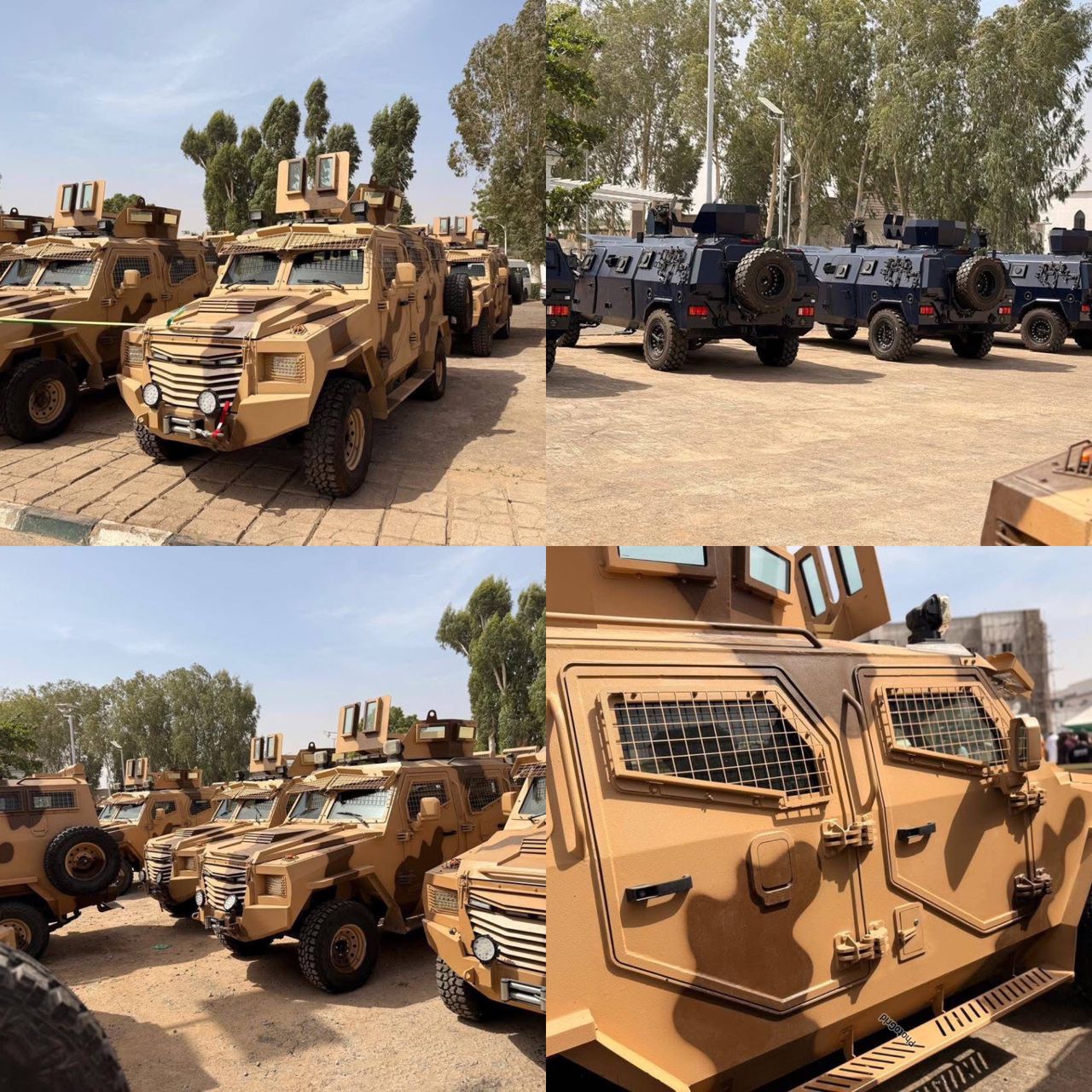
Governor Dauda Lawal Commissions 25 Armoured Personnel Carriers, Aerial Surveillance Drones to Combat Insecurity
In a major boost to the fight against banditry and insecurity in Zamfara State and the North-West Zone, Zamfara State Governor, His Excellency, Dr Dauda Lawal, on Wednesday commissioned 25 new Armoured Personnel Carriers (APCs) and sets of surveillance drones for the military and other security agencies operating in the state.
The event, which took place in Gusau, was part of the state government’s ongoing effort to provide structured logistical support to frontline security forces and combat insurgency, banditry, and protect lives and properties. Speaking at the commissioning and handover, Governor Lawal emphasised that the new assets are intended to enhance troop protection during high-risk deployments and improve rapid response capabilities in remote communities, ensuring tactical battle and overhead surveillance for victory.
“We have provided over 600 specialised motorcycles, 150 Hilux vehicles, and 20 Buffalo vehicles to our security forces. These 25 highly sophisticated APCs being commissioned today are therefore part of a broader reform to improve response to security threats. The APC’s significantly improves troop protection during deployments into high-risk areas. They reduce vulnerability during patrols, support convoy security along major routes, and strengthen rapid response capability when distress calls arise from remote communities.” the Governor stated.
Governor Lawal explained that the security challenges of recent years had disrupted farming, limited trade, and undermined public confidence across the state. He noted that his administration’s “Rescue Mission” agenda has focused on moving from fragmented responses to structured reforms, including the establishment of a Zamfara State Security Trust Fund and the operationalisation of Community Protection Guards to improve grassroots intelligence.
The Governor specifically highlighted the importance of integrating modern technology into security operations. He noted that the newly acquired drones would expand aerial surveillance, improve situational awareness, and support better coordination between command centres and troops in the field.
“Real-time information strengthens decision-making and reduces operational blind spots,” he added.
Governor Lawal however acknowledged the critical role of the Federal Government under President Bola Ahmed Tinubu, noting that recent federal budgets have allocated over three trillion naira to defence, a commitment he said strengthens subnational stabilisation efforts.
He urged the military commanders and personnel receiving the equipment to ensure disciplined maintenance and intelligence-guided deployment. “Enhancing your safety enhances the safety of our communities,” he told the troops.
Governor Lawal also told the people of Zamfara that; his administration remains resolute in restoring enduring security and peace across every Local Government Area. “We will sustain preventive measures, strengthen patrol architecture in rural corridors, deepen inter-state intelligence collaboration across the North-West, and maintain fiscal prudence in security expenditure. Stabilisation will continue through structured planning, lawful enforcement, and institutional reform.”
The Governor also linked the security investment to economic recovery, stressing that stability in rural areas is essential for agricultural productivity, market activity, and food security.
The event was attended by the Honourable Minister of Defence, General Christopher Musa (Rtd.), who formally commissioned the assets for operational service. Governor Lawal reaffirmed his administration’s resolve to sustain preventive measures and inter-state security collaboration until lasting peace is restored across all Local Government Areas in Zamfara.


-

 celebrity radar - gossips6 months ago
Why Babangida’s Hilltop Home Became Nigeria’s Political “Mecca”
-

 society6 months ago
Power is a Loan, Not a Possession: The Sacred Duty of Planting People
-

 society5 months ago
Religion: Africa’s Oldest Weapon of Enslavement and the Forgotten Truth
-

 news6 months ago
THE APPOINTMENT OF WASIU AYINDE BY THE FEDERAL GOVERNMENT AS AN AMBASSADOR SOUNDS EMBARRASSING
You must be logged in to post a comment Login