Connect with us

society

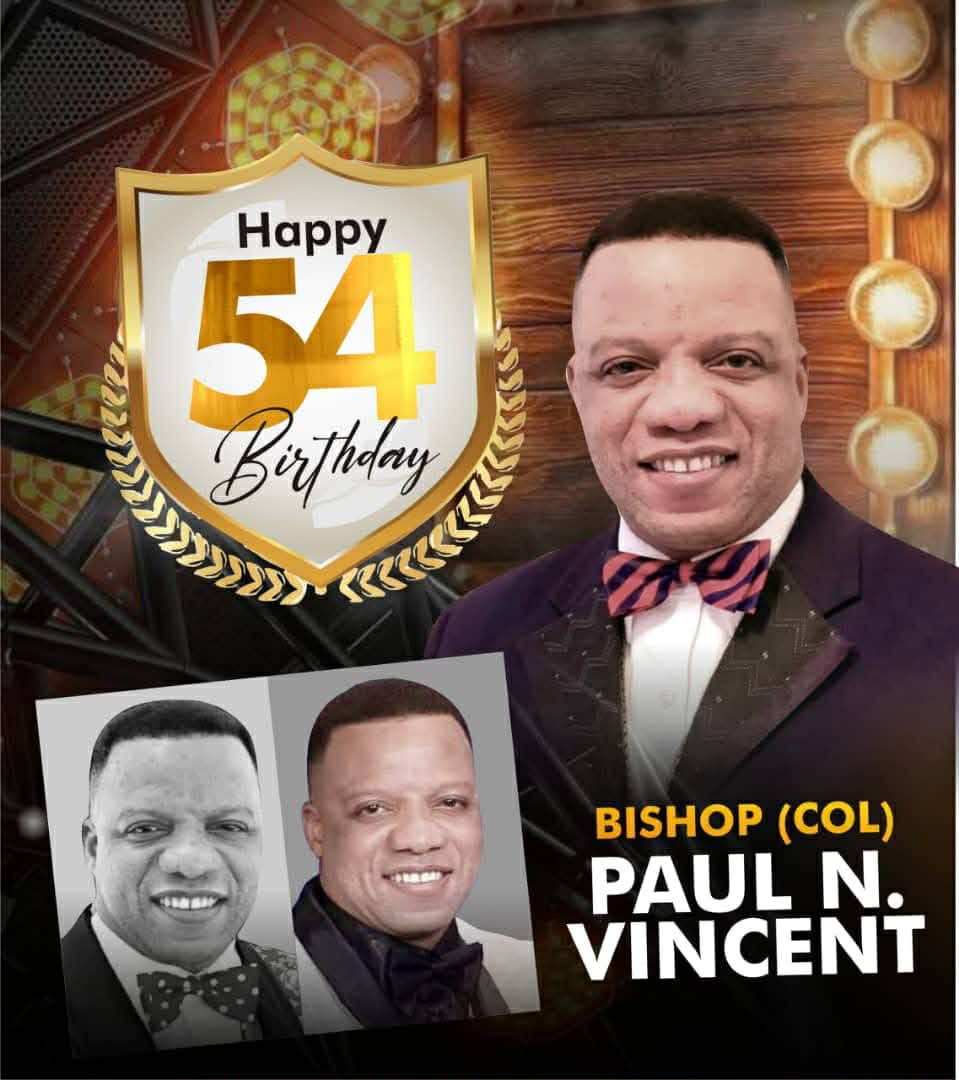
_A Legacy of Unstoppable Hope: Bishop (Col) Paul N. Vincent Celebrates Birthday & 3 Years of PWTN & Magazine Expanding Faith & Influence

Published

on

_A Legacy of Unstoppable Hope: Bishop (Col) Paul N. Vincent Celebrates Birthday & 3 Years of PWTN & Magazine Expanding Faith & Influence”_


Today, we joyfully commemorate the birthday of a visionary leader, Texas US based Bishop (Col) Paul N. Vincent, the President and CEO of Persistent Work TV Network (PWTN), & Publisher, Persistence Works Magazine. A Minister of the Gospel, Preacher, Broadcaster, Publisher & Prolific Author of 20 Books. He also serves as Military Chaplain in the US. Army Reserve.


As a life long learner, he’s earned 4 Master’s degrees: M.A. (Leadership) & Master of Divinity (M.Div.) both from Liberty University, Lynchburg VA; M.A. Professional Communication, from University of San Francisco, CA; & Executive Master’s in Public Administration from Golden Gate University, San Francisco, CA & soon completing his Ph.D in Communication.


This birthday is a moment to reflect on his extraordinary life, remarkable leadership, and the profound impact he’s had on countless lives.

_A Legacy of Unstoppable Hope: Bishop (Col) Paul N. Vincent Celebrates Birthday & 3 Years of PWTN & Magazine Expanding Faith & Influence

Bishop (Col) Paul N. Vincent is more than a title holder; he’s a beacon of hope, a symbol of acceleration, and a champion of excellence. His dedication to serving humanity, without bounds or bias, has earned him widespread respect and admiration. With a career marked by remarkable achievements and a heart full of compassion, he has touched the lives of many, empowering them to reach their full potential.


Persistence Work TV Network recently celebrated 3 years of wide TV Network coverage streaming on 20 different platforms.


Bishop (Col) Paul N. Vincent is also the host of “Global Politics” under Persistence Work TV Network, focusing on various nations and states, offering solutions from the Christian view.


As he celebrates another milestone of 54 Years, we celebrate not just a leader, but a mentor, a guide, and a friend to many. His legacy continues to inspire, uplift many. He is a beacon of acceleration, excellence, and hope_ touching lives globally.


We pray that the Almighty remains his strength, guiding him with wisdom and empowering him to achieve greater heights. Married to his lovely wife, Rev. Edith, and a daughter, Sharon Chidera Paul.


May this year bring you boundless joy, continued faithfulness, and the fulfillment of every noble desire. Here’s to many more years of leading with grace, impacting lives, and shining brightly.


 

https://online.flippingbook.com/view/630891965/

society

We Know Them and We Call Them”,  Why Bayo Onanuga’s Admission on Terrorists Should Shake Nigeria to Its Core

Published

on

We Know Them and We Call Them”,  Why Bayo Onanuga’s Admission on Terrorists Should Shake Nigeria to Its Core


By Dr. Ope Banwo, Mayor Of Fadeyi, and Founder Naija Lives Matter

A few days ago, like many Nigerians, I sat in disbelief watching Presidential spokesman Bayo Onanuga on national television.

In trying to defend the Federal Government’s handling of terrorism and banditry, he casually dropped a set of statements that, if taken at face value, amount to a public confession of close rapport between our government and the terrorists bleeding this country.

For years, Nigerians have suspected that people in power know far more about these killers than they are willing to admit. But suspicion is one thing. Hearing it confirmed from the mouth of the President’s chief media aide is another matter entirely.

I want us to calmly walk through what Mr. Onanuga has told us – and then discuss what we must do with this explosive information.

When Your “House Manager” Admits He Knows the Robbers

Let me put it in simple, everyday terms. It is one thing to suspect that your store manager and gate men know the identity and location of the burglars who keep robbing you at night. It is a different thing entirely to hear your house manager say publicly: “Yes, I know who they are. I have their phone numbers. I know where they live. In fact, I just called them yesterday and told them to return some of the goods they stole – and they obeyed me.”

That is what Onanuga effectively did on national television He spoke not as a random commentator, but as the official spokesperson of the President of the Federal Republic of Nigeria. We are therefore entitled – in fact, obligated – to treat his words as an insider admission, not mere gossip.

Four Disturbing Facts We Now Know About Our Govt And Terrorists

From his own account, we can now say four things have been confirmed beyond speculation:

1. The President and the DSS know the bandits by name.

Onanuga said clearly that they were called directly. You do not call “unknown gunmen.” You call people whose identities you know.

2. Our President and the security agencies have the direct phone numbers of these bandit leaders.
Not just vague intelligence. Direct lines. This means these killers are reachable at will by the highest office in the land.

3. The bandits take instructions from the President and the DSS.
Onanuga boasted that all the President had to do was order them to release all 38 kidnapped children and they complied – unconditionally, without even asking for recharge-card money. That means these are not just faceless terrorists; they are people who, according to the spokesman, can be commanded by our government.

4. Government knows where they live and where they hold their victims.
Onanuga explained that the reason these terrorists have not been taken out is to avoid “collateral damage.” You cannot be weighing collateral damage if you do not know their exact location – and the location of the hostages.

These are not my allegations. These are Onanuga’s admissions, broadcast to the world.

So the real issue is no longer, “Does our government know who is killing us?” The real issue is: Now that the government’s own spokesman has confirmed this level of familiarity with the terrorists, what are we, as citizens, going to do?

Welcome to Muguland – Unless We Refuse That Identity

In my books and shows, I jokingly created a fictional country called Muguland – a place where citizens are routinely played for fools.

After Mr. Onanuga’s confession, I am forced to ask: Is Muguland still fiction, or is this now our official reality?
If our highest officials know:
• who the terrorists are,
• how to call them,
• where they live,
• and can even give them instructions…
…then continue to preside over endless massacres, mass abductions and village burnings, what does that make the rest of us who keep quiet?

As a self-confessed “Mugu” myself – I even play Judge Mugu in my courtroom show – let me propose four urgent responses we must demand as a nation.

Four Things Nigerians Must Demand Now

1. Place Bayo Onanuga Under Oath as a Key Witness
The first thing any serious country would do is to treat Onanuga as a material witness in the ongoing ruination of our country.
By his own account, he knows the four essential elements investigators need to crack any case:
1. Who the perpetrators are;
2. How to contact them;
3. Where to find them;
4. The fact that they act on instructions from the very government that claims to be hunting them.

He must be invited – under oath – before an appropriate judicial or legislative body to explain, in precise detail, the nature of this relationship and how it has been used (or not used) to end terrorism.

We did not manufacture his statement. He said it. History – and the blood of innocent Nigerians – will not accept silence.

2. A Full-Scale Senate Investigation Into Government–Terrorist Links
The National Assembly, and especially the Senate under Godswill Akpabio, can no longer pretend ignorance. There must be an immediate, bipartisan investigation into:
• the nature of contacts between government officials and terrorist leaders;
• the history of negotiations, phone calls and back-channel deals;
• the reasons these relationships have not translated into the dismantling of these networks.
If we can set up committees over fuel queues and social media posts, surely we can set up one over open admissions of government rapport with murderers.

3. Public Hearings With Onanuga and the Security Chiefs

The Senate should also convene public hearings with:
• Bayo Onanuga,
• the National Security Adviser,
• the heads of DSS, Police and the Armed Forces.

Under oath, Nigerians deserve to hear:
• Why the terrorist leaders they know and can call remain at large;
• Why mass kidnappings keep occurring despite this supposed access;
• Why rescue operations and prosecutions remain half-hearted or opaque.
If you know the killers, speak to the killers, and know where the killers sleep, yet you cannot protect your citizens, something fundamental is broken.

4. Put the Presidency on Notice – Do the Job or Face the “I-Word”
Finally, the Senate must quietly but firmly put the Executive on notice.
If the President and his security chiefs now acknowledge – through their spokesman – that they possess all the information any serious leader needs to crush this menace, yet fail to act, then the Constitution offers only two honest options:
• Do your job, or
• Be prepared to face the “I-word” – impeachment – in line with the law.

Nobody is above accountability. Not even a man as politically formidable as Asiwaju Bola Ahmed Tinubu. The lives of Nigerians are not campaign souvenirs.

Why We Must Still Speak, Even If Nothing Changes

Some will say, “Ope, nothing will happen. Why stress yourself?” They may be right, in the short term. Terrorism in Nigeria did not start with this administration, and it may not end with it. But leadership is always current, not historical. The man who holds the office today bears the responsibility today.

If, as is widely whispered, the President is afraid of the so-called “military cabal” or other entrenched interests, then he should say so openly. Let the nation rally behind him to confront them. Until then, we must insist that he man up and do the job he swore to do.

I am under no illusion that one article or one broadcast will magically change our security architecture. But we must leave a record.
• Prof. Awojobi’s one-man protests did not topple military regimes, but history remembers that he stood.
• Chief Gani Fawehinmi did not eradicate injustice, but history remembers that he fought.
• Fela did not end corruption, but history remembers that he refused to be silent.

The real question is: What will history record about you and me? That we kept quiet… or that we at least tried?

Every Voice Counts – Including Yours
This is not just my fight. I am calling on those with even bigger platforms than mine – pastors, imams, influencers, columnists, retired generals, traditional rulers – to speak clearly about this dangerous normalisation of fraternising with terrorists.

Maybe it changes nothing. Maybe, as has happened in other nations, a chorus of courageous voices eventually shifts the tide. We will never know if we stay silent.

One of our literary icons once warned that “the man dies in all who keep silent in the face of tyranny.” We cannot allow the man – or woman – inside us to die because we are afraid of losing access, contracts or appointments.

You do not have to own a TV show to speak up:
• Post your thoughts on your Facebook or X page.
• Tell your small Instagram audience that you are not okay with this.
• Ask your representatives hard questions.
• Write your own short note and send it to your church, mosque or community WhatsApp group.

Little drops of truth can still become an ocean of pressure. The Clock Has Started

As for me, my name is Ope Banwo. Some call me The Rottweiler, and against all good advice from those who love me, I cannot and will not let this matter go.
From the moment Bayo Onanuga opened his mouth and gifted us this confession, the clock officially started against this government.

It is one thing for Nigerians to rely on rumours, fake news and conspiracy theories about “unknown sponsors” of terror. It is another thing entirely when a senior official of the government tells us on live television that:
• they know the people killing us,
• they speak to them,
• they can command them,
• and yet, somehow, the killing continues.

We made this mistake before. President Goodluck Jonathan once admitted publicly that those sponsoring terrorism were in his own government. We did not demand names, we did not insist on resignations or prosecutions. Instead, we went out to protest fuel subsidy removal while the terror web thickened.
Now history is repeating itself.

A high official has again told us, in plain language, that government knows and engages the terrorists. The question is no longer whether he spoke.
The question is: “What will we, as citizens, do with this confession?:’

Will we pretend we did not hear it, while we start fighting over who will win the 2027 elections? Or will we, at the very least, refuse to be silent Mugus in a country that keeps treating our lives as expendable? For my part, I have chosen. I will keep speaking, writing, and demanding answers – not because I am certain it will work, but because I refuse to be counted among those who kept quiet.

The clock is ticking.

Dr Ope Banwo
Mayor Of Fadeyi
Chairman, Naija Lives Matter

Continue Reading

society

A River of Ashes: The April 2011 Massacres in Southern Kaduna

Published

on

A River of Ashes: The April 2011 Massacres in Southern Kaduna.

By George Omagbemi Sylvester | Published by saharaweeklyng.com


…How post-election fury became a human catastrophe and why JUSTICE is still owed.

April 2011 was supposed to be a triumph for Nigerian democracy. After years of flawed polls, the country held elections that international observers called markedly improved. Instead, the weeks that followed left a stain that has not been washed away, a convulsion of communal and sectarian violence in northern Nigeria that spread into the middle-belt and devastated communities in southern Kaduna, where entire neighborhoods were RAZED, hundreds were BUTCHERED, and tens of thousands were DRIVEN from their homes. The images that emerged (burned churches and mosques, bodies hacked with machetes, children and the elderly fleeing with nothing) were not merely the BYPRODUCTS of chaotic rioting. They were the predictable outcome of decades of impunity, political manipulation of identity and a security apparatus that too often looked the other way.

What happened in Kaduna in mid-April 2011 was part of a larger outbreak of violence across at least a dozen northern states, triggered by the announcement of the presidential result on 17 April. Supporters of the main opposition candidate protested, demonstrations degenerated into riots and those riots quickly hardened into sectarian killings. HUMAN RIGHTS WATCH documented that more than 800 people were killed in the three-day surge of violence across northern Nigeria and that relief agencies estimated more than 65,000 were displaced. In Kaduna State (already a flashpoint because its north–south religious and ethnic geography is sharply divided) the death toll and destruction were particularly brutal. Saharaweeklyng.com reported that in towns and villages in southern Kaduna (including Zonkwa, Matsirga and Kafanchan) hundreds died and whole neighborhoods resembled war zones.

These were not random acts of criminality. Sahara reports testimony collected by field researchers described coordinated mobs, targeted attacks on civilians perceived to belong to the “OTHER” religion or region and systematic arson. In many of the WORST-HITS southern Kaduna communities, Muslim civilians reported being rounded up and slaughtered; in Kaduna city, Christians accused mobs of hunting and killing Muslim motorists and churches and mosques burned alike. HUMAN RIGHTS WATCH documented testimony of mobs pursuing students, hacking them to death and of security forces whose intervention (when it came) was often belated or implicated in abuses of its own. The brutality was intimate and personal: victims were hacked, burned, raped and left where they fell.

Numbers alone cannot fully convey the human tragedy, but they help defeat denial. Various datasets and investigations give overlapping pictures: Sahara’s survey of the violence tallied hundreds dead in Kaduna alone; the Armed Conflict Location & Event Data Project (ACLED), as compiled in 2011 summaries, recorded scores of violent incidents in Kaduna culminating in hundreds of fatalities. Local religious and community leaders produced differing tallies (a testimony to the chaos and the politicization of casualty counts) but all point in the same grim direction: Southern Kaduna was devastated.

WHY DID THIS HAPPEN? Scholarly analysis and policy reports converge on three drivers. First, electoral politics in Nigeria frequently mobilizes ethnic and religious identity, converting local grievances into mass violence when national stakes feel existential; the April vote exposed and inflamed those fissures. Second, there is a deeply entrenched culture of impunity: past commissions of inquiry, even when established, rarely led to prosecutions, which incentivized recurrence. Third, structural issues, such as land disputes, competition over grazing routes, demographic anxieties and weak or compromised policing, which provided fertile ground for violent escalation. Henrik Angerbrandt and other researchers who have studied the 2011 violence argue the national electoral contest interwove with local disputes so that national outcomes became a pretext for local bloodletting.

Human rights organizations and analysts did not mince words. “The April elections were heralded as among the fairest in Nigeria’s history, but they also were among the bloodiest,” said Corinne Dufka of Human Rights Watch — a damning verdict that cut across any celebratory narrative about electoral reform. Observers and NGOs called for transparent, impartial investigations and criminal prosecutions; they warned that without accountability, the cycle would repeat. The International Crisis Group and other policy bodies made similar calls, insisting that electoral integrity without JUSTICE would prove hollow.

So what followed the bloodletting in southern Kaduna? Commissions were set up and inquiries promised; dozens were arrested in some jurisdictions; but prosecutions were scant and convictions rarer still. The pattern of inquiries that soothe public anger but deliver little judicial closure was reinforced communal suspicions. Survivors and community leaders in southern Kaduna repeatedly charged that the state response was inadequate, sometimes slow, sometimes complicit. Years after 2011, the scars persisted: displaced communities, lost livelihoods, disrupted schooling and a festering sense of injustice.

Many in the region and beyond have since labeled the killings and the ensuing pattern of attacks against indigenous southern Kaduna communities as ETHNIC CLEANSING or even GENOCIDE. Such labels are legally and politically weighty; they should not be tossed about lightly. The historical record shows that mass, targeted attacks did occur and that patterns of displacement and land takeover followed. Whether those patterns meet the strict legal definition of GENOCIDE requires judicial processes and forensic investigations that Nigeria has so far not conducted to international standards. What is indisputable is that communities experienced sustained campaigns of lethal violence and that the state’s failure to secure JUSTICE created a vacuum exploited by perpetrators.

The lessons of April 2011 (and of the tragic aftermath in southern Kaduna) must be learned honestly. First, electoral reforms must be paired with robust, transparent mechanisms for accountability. Second, security sector reform is not optional: police and military must be trained, deployed and held accountable to protect civilians impartially. Third, reconciliation must be concrete: reparations, the safe return of displaced persons, restoration of livelihoods and COMMUNITY-LED TRUTH-TELLING initiatives are prerequisites for durable peace. Finally, international and domestic actors must support and monitor any investigations so that JUSTICE is more than a promise. These are not merely TECHNICAL PRESCRIPTIONS; they are MORAL IMPERATIVES.

To the families who lost fathers, mothers, children and neighbors in southern Kaduna, words of condolence without action are hollow. To the state and its institutions, the April 2011 carnage was a test — one they have yet to pass. Corinne Dufka’s admonition in 2011 still rings true: democratic gains from the elections must be preserved by bringing “those who orchestrated these horrific crimes” to JUSTICE. That demand should now be a national obsession. Nigeria’s stability, the dignity of its citizens and the credibility of its democracy depend on it.

George Omagbemi Sylvester is a journalist and commentator focused on human rights and governance in West Africa. This piece is published by saharaweeklyng.com


A River of Ashes: The April 2011 Massacres in Southern Kaduna.
By George Omagbemi Sylvester | Published by saharaweeklyng.com

Continue Reading

society

Published

on

Primate Ayodele Never Said Seyi Makinde Would Become President’’ – Media Aide Clarifies*

*How Primate Ayodele Accurately Foretold Coup In Guinea-Bissau Few Weeks Ago (VIDEO)


If there is anyone who still doubts Primate Elijah Ayodele after the unexpected coup that rocked Guinea-Bissau on Wednesday, it simply means such a person has personal issues, not just with the prophet but with God himself.

Military officers in Guinea-Bissau have taken control of the government, suspended the country’s electoral process and declared they will be in control “until further notice”.

On Monday, President Umaro Embaló, who is seeking re-election, and Fernando Dias, his main opponent, both declared victory in the country’s election even though the electoral commission had not released official results.

However, later on Wednesday, Embaló told Jeune Afrique that he was arrested at around 1 pm in his office at the presidential palace.

The coup leaders issued a communique, claiming the “High Military Command for the Restoration of National Security and Public Order” was reacting to a destabilisation plot “put in place by certain national politicians with the participation of [a] well-known drug baron,” according to the Africa Report.

This coup development happened as though Primate Ayodele wrote the script, which is just being followed by the perpetrators because he was too accurate with his prophetic warning regarding the development.

The prophet first mentioned it earlier this month in a warning to the president of the country, letting him know that the presidential election can trigger a military action if care isn’t taken. He specifically warned the president to ensure that he accepts the outcome of the election, even if he loses, because the country is in a military action.

These were his words:

“In Guinea-Bissau, there is going to be an election, but if there is a coalition and the president tries to rig the election, the country will turn to fire. There will be anarchy, and the impossible coup can be possible. To the president, if you lose this election, just leave. Don’t force yourself because you will fail”.

https://vt.tiktok.com/ZSfueMmhJ/

Apart from this, which he said during a live service in his church, Primate Ayodel, on November 11, in a series of prophecies to some African nations, mentioned that in Guinea-Bissau, there will be a military action.

He specifically warned that the president will not be reckoned with and that the president must be ready to do anything to stabilise the country because there will be a crisis.

These were his words:

“Guinea-Bissau: The country isn’t yet settled, there is still a crisis in the nation because they are going to be fighting seriously. The president will not be reckoned with, and the military will carry out another action. The president must be ready to do anything to stabilise the country because I see a crisis in Guinea.”

https://theeagleonline.com.ng/primate-ayodele-releases-prophecies-on-african-countries-6/

These prophecies are exactly a direct representation of the coup situation in Guinea-Bissau, and it’s mysterious that a man whose church is domiciled in Nigeria could accurately reveal what would happen in a far-away country like that; certainly, it’s God speaking through his vessel.

However, this isn’t the first time Primate Ayodele would be sharing such a prophecy that would have a striking fulfilment as this; he is renowned for being the only prophet to have foretold the coups in Niger, Mali, Guinea, Burkina Faso, to mention but a few.

He was also the only prophet to foretell the crisis in Madagascar that saw the president exiting the nation, the surprising election outcome in Botswana, Seychelles, and some nations that have held elections this year.

Also, the crisis between the president of Senegal, Bassirou Diomaye Faye and the prime minister, Ousmane Sonko, which no one expected, was prophesied by Primate Ayodele immediately after the election, on which he also foretold the outcome.

Likewise, the death of Raila Odinga, the opposition leader in Kenya, was foretold by Primate Ayodele in his new year prophecies for 2025, released in December 2024.

There are several mysterious prophecies Primate Ayodele has shared, and the one on Guinea-Bissau has successfully added to the list.

Continue Reading

Cover Of The Week

Trending