
Business
A Nation on Its Knees: How Nigeria Crumbled Before Our Eyes

A Nation on Its Knees: How Nigeria Crumbled Before Our Eyes.
By George Omagbemi Sylvester | saharaweeklyng.com
“Wake up Nigeria, we can not reclaim our throne when we are deep asleep on the job.”
NIGERIA (the land of vast potential, resplendent hope and a future once imagined so bright) has fallen into a quagmire of broken promises, shattered expectations and systemic decay. Once touted as Africa’s rising star, we now endure a reality of no reliable electricity, crumbling road networks, failing governance, a free-falling naira, insecurity and poverty levels that soar to new heights. In short: how can we reclaim the title of Giant of Africa when the foundations have collapsed?
What went wrong?
1. GOVERNANCE FAILURE.
At the heart of Nigeria’s decline lies the collapse of governance. A scholarly review noted that “despite being Africa’s largest economy, Nigeria faces governance deficits that hinder sustainable development and economic growth.” According to the same study, Nigeria’s power generation stagnated at 5,500 MW in 2023 while demand soared to around 30,000 MW. When governance fails to deliver the basics (power, rule of law, infrastructure) hope dies.

The former President of the NBA, Olisa Agbakoba SAN, warned that Nigeria can only reach a ₦500 trillion economy with “robust legal and institutional frameworks.”
We have the institutions on paper; what is lacking is integrity, capacity and political will.
2. ECONOMIC MISMANAGEMENT & OVER-RELIANCE ON OIL.
Nigeria’s economic malaise is not for lack of resources. The country is rich – in people, in land, in energy. Yet the so-called “RESOURCE CURSE” is very real. As one recent article summarised: “This study identifies political and administrative corruption, as well as low productivity, as key structural barriers to economic transformation.”
Our economy has remained overly dependent on oil, IMPORT-HEAVY and SHOCK-PRONE.
According to International Monetary Fund (IMF): “Between 2014 and 2023, real per capita GDP declined on average by 0.7 percent annually. In 2023 the poverty rate stood at 42 percent.” The naira crash, inflation and debt burden all result from decades of mis-prioritisation.

3. INFRASTRUCTURE COLLAPSE & SERVICE DELIVERY FAILURE.
How can farms prosper when there’s no road to bring produce to market? How can factories thrive when electricity is erratic and cost of doing business is punitive? Infrastructure is the backbone of growth and Nigeria’s backbone is broken. From dilapidated classrooms to degraded hospitals, with no street lights, neglected parks and streets, the promise of public service delivery lies in ruins. Education, for example, receives about 6 to 7 percent of the annual budget, far below UNESCO’s recommended minimum of 15 percent.
When schools are crumbling, teachers demoralised, classes crowded, the future shrinks. Health systems are overstretched; security infrastructure inadequate. In one study, “Effect of insecurity, no-one farms, output falls.”
4. SECURITY CRISIS & SOCIAL DISINTEGRATION.

You cannot build or grow in fear. Yet Nigeria’s security situation has deteriorated dramatically, insurgency in the North East, banditry in the North West, separatist violence in the South East, kidnappings and terror everywhere. The GOVERNANCE-INFRASTRUCTURE-SECURITY complex has collapsed. One article points to a “growing issue of terrorism financing” and noted that “137 out of 261 borders in the North-East and North-West remain unguarded.”
When citizens fear for their lives, investors stay away, agriculture shrinks and social capital bleeds away.
5. CURRENCY COLLAPSE, POVERTY SURGE & PUBLIC DESPAIR.
The currency is the barometer of trust in an economy. The fall of the naira, hyper-inflation, food insecurity, these are not merely economic metrics but human tragedies. In 2025, almost 129 million Nigerians were reported to live under the national poverty line; around 60 percent of the population.
And still we speak of “GIANTS”. A bigger statistical GDP does not mean new schools, new roads or new hope. As one expert warned after rebasing, the economy looked bigger, though it was “not more productive, nor more industrialised.”
Money is meaningless when schools are empty, clinics dilapidated and the streets unsafe.

HOW DID WE GET HERE?
The path to crisis is rarely sudden; it is built by years of neglect, bad decisions and compounding error.
After independence, Nigeria soared and hoping to be the model of African success. Oil money flooded in.
Instead of investing in infrastructure, diversification and human capital, elites chased rents, the institutions stagnated, corruption spread and oil-money dependency took root.
The roads were not built, the power plants were not completed, the schools were not upgraded. Governance became transactional. The public service, a career; accountability, optional.
Every crisis was met with bandaid (fuel subsidies, borrowed money, unsustainable spending) while the foundational work languished.
The economy remained fragile, when oil dropped, the rest of the system creaked. Export diversification (agriculture, manufacturing, services) was ignored or mis-managed.
Meanwhile security deteriorated: as poverty increased, marginalised youths turned to crime; state legitimacy waned; local grievances ballooned.
Now we arrive at a paradox, Nigeria has the youth, the land, the potential, but none of the trust, institutionality or infrastructure to harness it.
WHO CAN RESCUE US?
Rescue is not coming from outside. It must come from US (the citizens, the activists, the business owners, the churches, the societies) and the leadership we force to act.
POLITICAL LEADERSHIP WITH BACKBONE.
We need leaders who view their roles not as patrons, but as trustees. Leaders willing to discipline themselves, reduce wasteful governance costs and invest in the citizens. The NBA’s Agbakoba admonished that without “robust legal and institutional frameworks” Nigeria cannot achieve greatness.
A leader with moral authority, vision, discipline and one who prioritises the long game over short-term gain.
INSTITUTIONAL OVERHAUL & GOVERNANCE REFORM.
Formal institutions exist; what they lack is strength. We must build accountability systems, independent judiciary, transparent procurement, strong sub-national governments. As one article stressed: “Nigeria must prioritise transparency, accountability and inclusivity to foster national stability and prosperity.”
Real reform will destroy the rent-seekers and empower the productive.
INFRASTRUCTURE INVESTMENT & HUMAN CAPITAL.

The giant awakens when his spine is rebuilt. Roads. Schools. Hospitals. Electricity. Parks. Mines. Farms. This is not charity; it is investment in the future. According to the IMF, Nigeria’s “real reforms can help Nigeria realize its potential as an African and global economic powerhouse.”
We can not wait for foreign capital; we must mobilise domestic capital, diaspora remittances, public-private partnerships and ensure the results reach the ground.
ECONOMIC DIVERSIFICATION & PRODUCTIVITY CULTURE.
Oil is not the future. Nigeria’s future lies in agriculture, manufacturing, ICT, service exports, renewable energy. We must shift from monoculture to multi-pillar productivity. A deeper study pointed out how “unproductivity stems from poor resource usage and lack of diversification.”
When we make something, we manufacture value, we employ our Youth, we transform from consumers to producers.
CIVIC AWAKENING & DEMAND-DRIVEN ACCOUNTABILITY.
No one will do it for us. Citizens must rise. Vote consciously. Demand accountability. Monitor budgets. Report looters. Build local associations. The Reddit-commentary is blunt:
“Nigerians are pretenders. They know they are a reflection of what their leaders represent.”
Indeed, the giant cannot stand while the people sleep. Civic duty is no longer optional, but imperative.
The Way Foward.
The path forward is clear, but the will is weak. Nigeria can be the Giant of Africa again, but not by default. It will require decisive action, brutal honesty, structural reforms and collective courage. We must stop treating crisis as normal. We must stop rationalising failure. We must demand better.
The blazing truth is this, the country that fails to govern its internal house cannot govern itself; the country that cannot provide roads, schools, electricity and security cannot dream of greatness. We are capable. We have the people. The land. The future.
Now we must muster the will. For without will, even the greatest of nations will shrink. Nigeria, it is time to wake up. Your giant is asleep and your future depends on whether you rise and shake the dust from his shoulders.
Published on saharaweeklyng.com. Author: George Omagbemi Sylvester.




Business
Alpha Morgan Bank Reinforces Commitment to Education at Redeemer’s University Business School Commissioning
Alpha Morgan Bank Reinforces Commitment to Education at Redeemer’s University Business School Commissioning
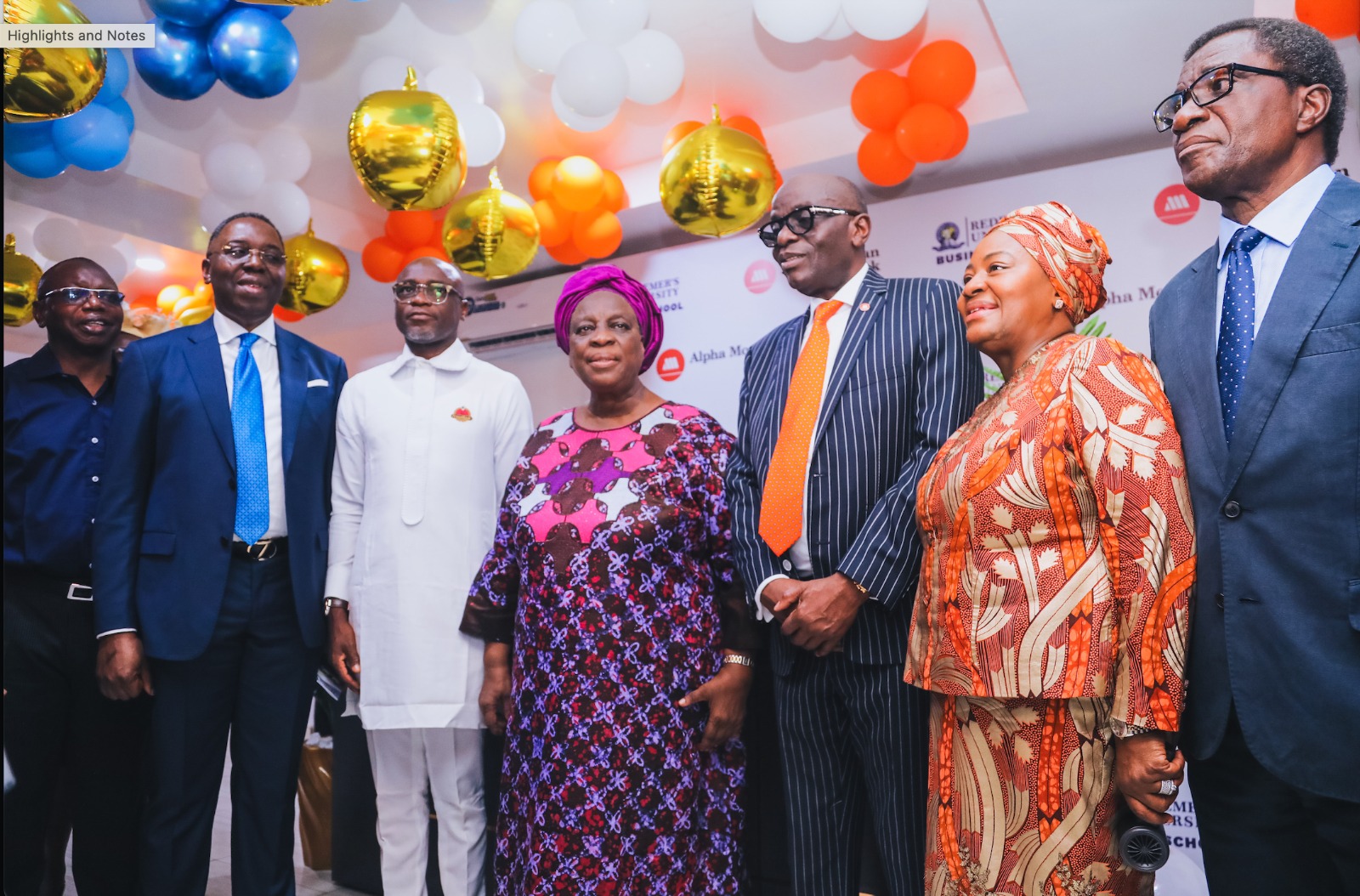
Alpha Morgan Bank has reaffirmed its commitment to education and institutional development through its support for the commissioning of the Redeemer’s University Business School.
The Business School was officially inaugurated by Pastor (Mrs.) Folu Adeboye, at the commissioning ceremony attended by distinguished guests including Her Excellency, Mrs. Bola Obasanjo; the Pro-Chancellor and Chairman, Governing Council of Redeemers University, Professor Oluwatoyin Ogundipe; the Vice Chancellor, Professor Shadrach Olufemi Akindele; and other notable dignitaries.
Speaking at the event, the Managing Director of Alpha Morgan Bank reiterated the Bank’s commitment to supporting institutions that drive intellectual growth and national development.
As part of its broader focus on knowledge sharing and thought leadership, Alpha Morgan Bank will host its Economic Review Webinar in May 2026, bringing together experts to share insights on key economic trends and opportunities.
The Bank’s involvement reflects its continued dedication to empowering institutions and shaping the future of business and leadership in Nigeria.
Read more about Alpha Morgan Bank on www.alphamorganbank.com
PHOTO
L-R: Prof. Shadrach Olufemi Akindele, Vice Chancellor, Redeemers University, Engr. Eloka Eje, Dr Perez Araka, Pastor (Mrs) Folu Adeboye, Mother-In-Israel, The Redeemed Christian Church of God, Mr Ade Buraimo, MD/CEO Alpha Morgan Bank, Dr (Mrs) Oluwatomi Somefun, Dr. Simeon Ifere, at the inauguration of the Redeemer’s University Business School, Redemption City, Ogun State on Thursday 2nd April, 2026
Tinubu Aide Rebuts Rufai Oseni Over ₦3.3tn Power Debt Deal
Business
Aare Adetola Emmanuelking Welcomes President Tinubu to Gateway International Airport Commissioning in Iperu-Remo
Aare Adetola Emmanuelking Welcomes President Tinubu to Gateway International Airport Commissioning in Iperu-Remo
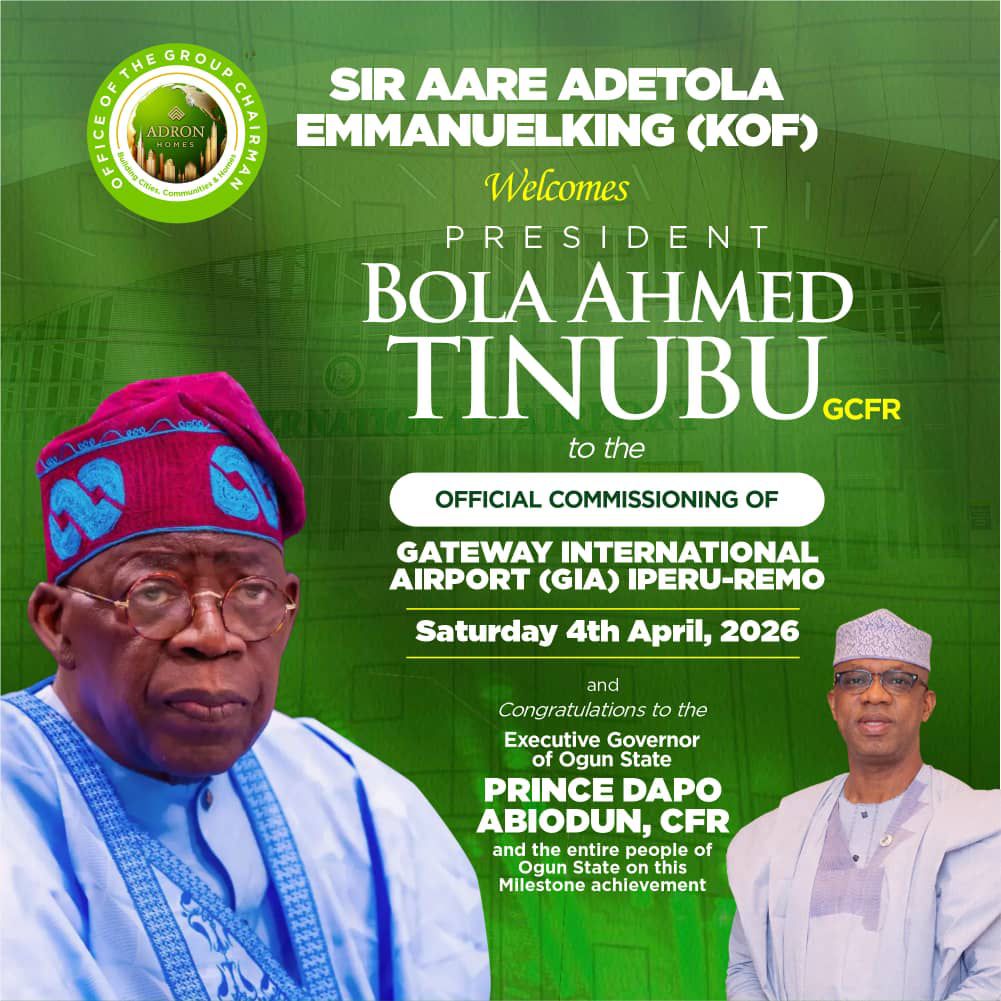
In a momentous occasion that underscores the rapid infrastructural advancement of Ogun State, renowned real estate mogul and philanthropist, Aare Adetola Emmanuelking, warmly received the President of the Federal Republic of Nigeria, Bola Ahmed Tinubu, at the official commissioning of the Gateway International Airport, located in Iperu-Remo.
The landmark event, held under the visionary leadership of the Ogun State Governor, Dapo Abiodun, marks a significant stride in the state’s economic transformation agenda, positioning Ogun as a key hub for aviation, commerce, and investment in Nigeria.
Aare Emmanuelking, who is also the Chairman/CEO of Adron Homes and Properties, commended the Ogun State Government for its foresight and commitment to infrastructural excellence. He described the airport project as a “game-changer” that will not only boost connectivity but also stimulate real estate growth, tourism, and industrial expansion across the region.
Speaking during the commissioning, President Tinubu lauded Governor Abiodun’s administration for delivering a world-class facility that aligns with the Federal Government’s Renewed Hope Agenda, emphasizing the importance of strategic infrastructure in driving national development.
The Gateway International Airport is expected to serve as a critical gateway for investors and travelers, further enhancing Ogun State’s reputation as one of Nigeria’s most business-friendly environments.
The presence of top dignitaries, industry leaders, and stakeholders at the event underscores the project’s significance and its anticipated impact on the state’s socio-economic landscape and beyond.


- Seychelles Strengthens Human Rights Reporting through National Workshop April 8, 2026
- ABB’s Application Configurator brings speed and precision to grid-feeding protection system design April 7, 2026
- Can Equatorial Guinea Reposition as West Africa’s Gas Hub? April 7, 2026
- Afreximbank Partners with African Energy Week 2026 to Drive Africa-Led Energy Deals April 7, 2026
- Merck Foundation Marks ‘World Health Day’ 2026 – Transforming Patient Care in Africa and Beyond through 2600+ Scholarships for Healthcare Providers From 52 Countries April 7, 2026
- Morocco Gas Plan Reset Could Open Door to New Investment Models April 7, 2026
- African Petroleum Producers Organization (APPO) Secretary General Joins Angola Oil & Gas (AOG) 2026 as African Energy Bank Eyes June 2026 Debut April 7, 2026
- Ghanaian Biomedical Specialist Receives International Award April 7, 2026
- Grey Connects the Africa-Canada Money Corridor With Instant Transfers via Interac April 7, 2026
- Nigeria’s Oil Revival in Focus as Petroleum Minister Lokpobiri Joins Paris Energy Forum April 7, 2026
- Seychelles Strengthens Human Rights Reporting through National Workshop April 8, 2026
- ABB’s Application Configurator brings speed and precision to grid-feeding protection system design April 7, 2026
- Can Equatorial Guinea Reposition as West Africa’s Gas Hub? April 7, 2026
- Afreximbank Partners with African Energy Week 2026 to Drive Africa-Led Energy Deals April 7, 2026
- Merck Foundation Marks ‘World Health Day’ 2026 – Transforming Patient Care in Africa and Beyond through 2600+ Scholarships for Healthcare Providers From 52 Countries April 7, 2026
- Morocco Gas Plan Reset Could Open Door to New Investment Models April 7, 2026
- African Petroleum Producers Organization (APPO) Secretary General Joins Angola Oil & Gas (AOG) 2026 as African Energy Bank Eyes June 2026 Debut April 7, 2026
-

 news4 months ago
WHO REALLY OWNS MONIEPOINT? The $290 Million Deal That Sold Nigeria’s Top Fintech to Foreign Interests
-

 society7 months ago
“You Are Never Without Help” – Pastor Gebhardt Berndt Inspires Hope Through Empower Church (Video)
-

 celebrity radar - gossips2 months ago
Dr. Chris Okafor Returns with Power and Fire of the Spirit -Mounts Grace Nation Altar with Fresh Anointing and Restoration Grace on February 1, 2026
-

 celebrity radar - gossips4 months ago
Prophet Kingsley Aitafo Releases 2026 Prophecy: ‘Nigeria Will Rise, but the World Must Prepare for Turbulence’