
celebrity radar - gossips
Africa Akinwunmi Adesina (AFDB): Any conspiracy from the Western Block? By Jimoh Ibrahim OFR, CFR

Please wait a minute; it is about corporate governance! Yes, in a simple bank matter, and what is more, as Wolfensohn will say, corporate governance is about promoting corporate fairness, transparency, and accountability. Every day we keep struggling on which of the rules of ethics or governance will secure corporate sustainability and profitability. The strategy is unending from its trajectory from the 1776 Adam Smith “it is not from the benevolence of the butcher, the brewer, or the baker that we expect our dinner, but from their regard to their own self -interest. We address ourselves, not to their humanity but to their self-love, and never talk to them of our own necessity but of their advantages” In 1932 we were inodiated with the corporate governance of Berle and Means, which centered on the separation of ownership from the control that produces a condition where the interest of the owner and ultimate manager may, and often do diverge. Or desire to maximized shareholders’ value. And, could this be the desire of the Western block interest in AFDB? We are no longer in the 1980 days of mergers and acquisitions. Or, Junk Bonds and poison pills no one is interested in selling her shares in AFDB. (at least I do know that the Nigeria shares is not for sale!) it may be that the 1900 rise of institutional investors is the thinking of Donald Trump on corporate governance as a businessman. The challenge with an institutional investor is the high cost of monitoring and the free-rider problem, liquidity versus dialogue, who own the institutional investor share, and who is the ultimate beneficiary of the shares in the end? Or the challenge of the company versus index investing, effective market hypothesis, portfolio diversification. Will individual action make a difference concerning AFDB ethical issues? Or a case of rationale apathy or outright apathy ignorance, and what is the active oversight of the US going to add any value to AFDB? We left those issues to the events of the 1990s. A new challenge to corporate governance in the 2000s was the case of activism, and Hedge Funds and Private equity—the 2010 issues of pooled Funds and stewardship cannot be wholly left out since trust is of a challenge. In 2020 we are not even sure what response to corporate governance will be with COVID 19. The problems of managing corporations from home include presenting an integrated fiduciary relationship between the management and the Board at a time when the Directors can be held responsible for the management’s actions, and defense of I did not do what the management did can no longer stand! Liberalism has a way of making everyone wealthy from the absolute gain advantage through collective action. The assurances of collective resources to pursue share gains so is the West, NATO, and North America Free Trade Agreement (NAFTA). It is against such authoritarian regimes that liberalism thinks, liberals will not go into war against one another, and the principle of collectivism and collaboration is in the best interest of economic harmony. Yes, the democratic peace theory and the campaign for the establishment of the liberal domestic democratic Government worldwide. The US will not buy Nigeria oil, yet we are hoping for wealth creation among two liberals with absolute gains and collective interest. The US may cross the border to control Nigeria’s investment in AFDB and wishing to remove the Nigerian elected president in a bank in which Nigeria has the highest interest. Is the relative gains principle of liberalism in international units strengthen US interest against Nigeria? The US aims at spreading liberal democracy that widening the zone of peace inhabited by world democratic states. Yet, the US is questioning the Nigerian appointment and praxis of a Nigerian bank president in a bank in which Nigeria has the highest shares! What is more of a nonsensical or absurd idea or talk of a President of AFDB asking to explain why he employed a female staff? He favors the highest shareholder, why his personal team is known to him before resuming to work, what he has to say about a staff that proceeded on medical leave on health ground after the bank physician-approved a health leave for him. What a nonsense. And notwithstanding the clearance from the Board room, a ‘powerful’ shareholder wants independent probe of the nonsense allegations! In global governance, the US can violate global governance principles without question; all she needs to say is that she is doing so on a humanitarian grant! Adesina, a Human being need not have an altruistic feeling so conceived the US. If he invites a colleague who both of them made first class in the university to work with him, then the US must trump up a limited war at least for a start. The US power as a hegemon cannot be challenged. (yet international society is anarchic in the sense that there is no central Government) At least without the UN resolution, the US invaded Iraq for violation of the UN directives for ten years. Where did the US get the authority to invade Iraq? Never worry, it is all about providing stability as hegemon to the new world, (But the US does not give central Government for the global society) Who invade Panama in the face of article 2 (4) and (7) of the UN chapter? It all in the protection of global governance principles. (maybe.) In Nigeria, out of the list of liberal states? Alexander Dumas ‘all for one and one for all’ now comes to the unwillingness of other western nations to protect Nigeria in the face of the US launch of the attack on Nigeria as one significant investment in Africa’s continent. Where did we go wrong! The US indeed must be a powerful country battling so many issues at the same time. From the challenges of power shift, the WHO imbroglio, the debt crises, outdating infrastructure, and more importantly, COVID 19 and now to Femi Adesina query to explain why he employed Nigerians and allow a sick director to go on leave at AFDB. Also, less I forget why he employed his personal staff like the chief of staff from people he already knows!! There is no specific allegation on fraud yet. The US is about launching a limited war in AFDB. Again, will the war be not, however, absolute? If what is left from the remains of liberalism is anything relevant from the battle of COVID19 to Africa Development Bank (AFDB), then America will soon remember Winston Churchill golden worlds ‘to jaw jaw is always better than to war war! At least after the upcoming August re-election of Akinwunmi Adesina. Yes, liberalism is all about collaboration, collectivism, and interdependence. It is all about the harmony of interest. No one will forget too soon that liberalism is a normative theory that has its own phenomenon of what ought to be rather than what it is. And, it is not contending the fact that there are specific regulations in respect of what is in the procedural setting of AFDB rather than what it ought to be. The processes and procedures of the African Development Bank are not for reforms (at least for now).
The US should be applying the procedure after the change, not using what ought to be as Yasick for today’s judgment. For unjust orders are inherently unstable because they invite rebellion by the people they oppress. We say that liberal theory is often prescriptive, recommending specific policy for just order not in the content of what is established to be known to us as AFDB rules of ethics coded and written praxis.




celebrity radar - gossips
Adron Homes Celebrates Visionary Chairman, Aare Adetola Emmanuel King, at 51
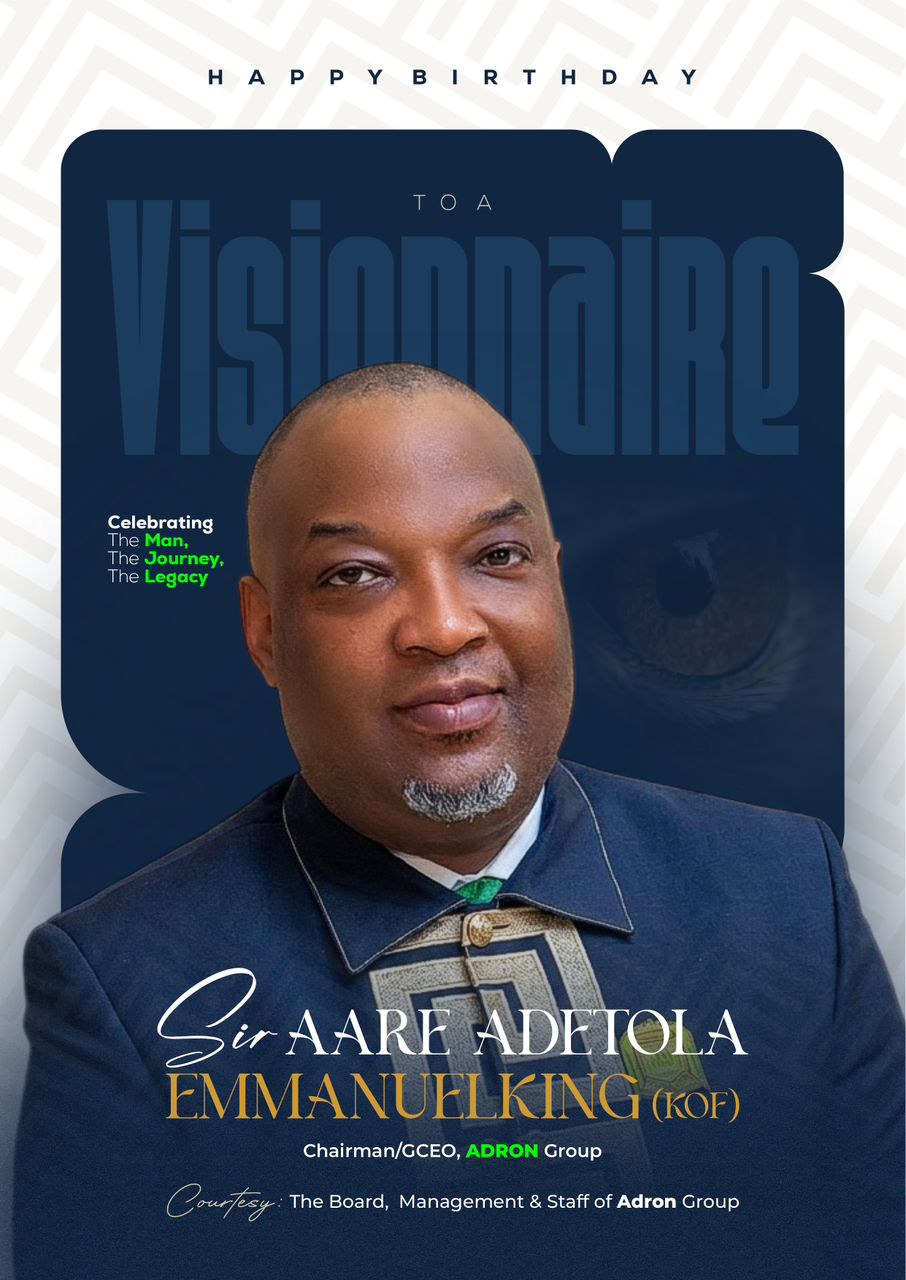
Adron Homes Celebrates Visionary Chairman, Aare Adetola Emmanuel King, at 51
The management and staff of Adron Homes and Properties Limited have joined family, friends, associates, and well-wishers across the globe to celebrate their Chairman and Chief Executive Officer, Aare Adetola EmmanuelKing, as he marks his 51st birthday.

In a statement released by the company, the milestone was described as a celebration of an exceptional leader whose vision, resilience, and entrepreneurial brilliance have not only transformed Adron Homes into a household name in Nigeria’s real estate sector but have also redefined affordable housing across the country.
Under his dynamic leadership, Adron Homes has continued to expand its footprint, delivering value-driven residential solutions while empowering thousands of Nigerians with opportunities for home ownership. His commitment to excellence, innovation, and customer satisfaction has remained the driving force behind the company’s sustained growth and industry leadership.
The statement further highlighted Aare EmmanuelKing’s passion for nation-building and community development, noting his significant contributions to job creation, youth empowerment, and the promotion of socio-economic development through real estate investments.
“As a leader, mentor, and visionary, Aare Adetola EmmanuelKing has consistently inspired a culture of excellence, integrity, and dedication within the organization. His ability to turn bold ideas into reality continues to position Adron Homes as a trailblazer in the industry,” the statement read.
The company expressed profound gratitude for his steadfast leadership and prayed for continued wisdom, strength, and sound health as he embarks on another year of impactful achievements.
As he celebrates his 51st birthday, the entire Adron Homes family proudly honours a man whose legacy continues to shape the future of real estate in Nigeria.
Happy 51st Birthday, Aare Adetola EmmanuelKing!
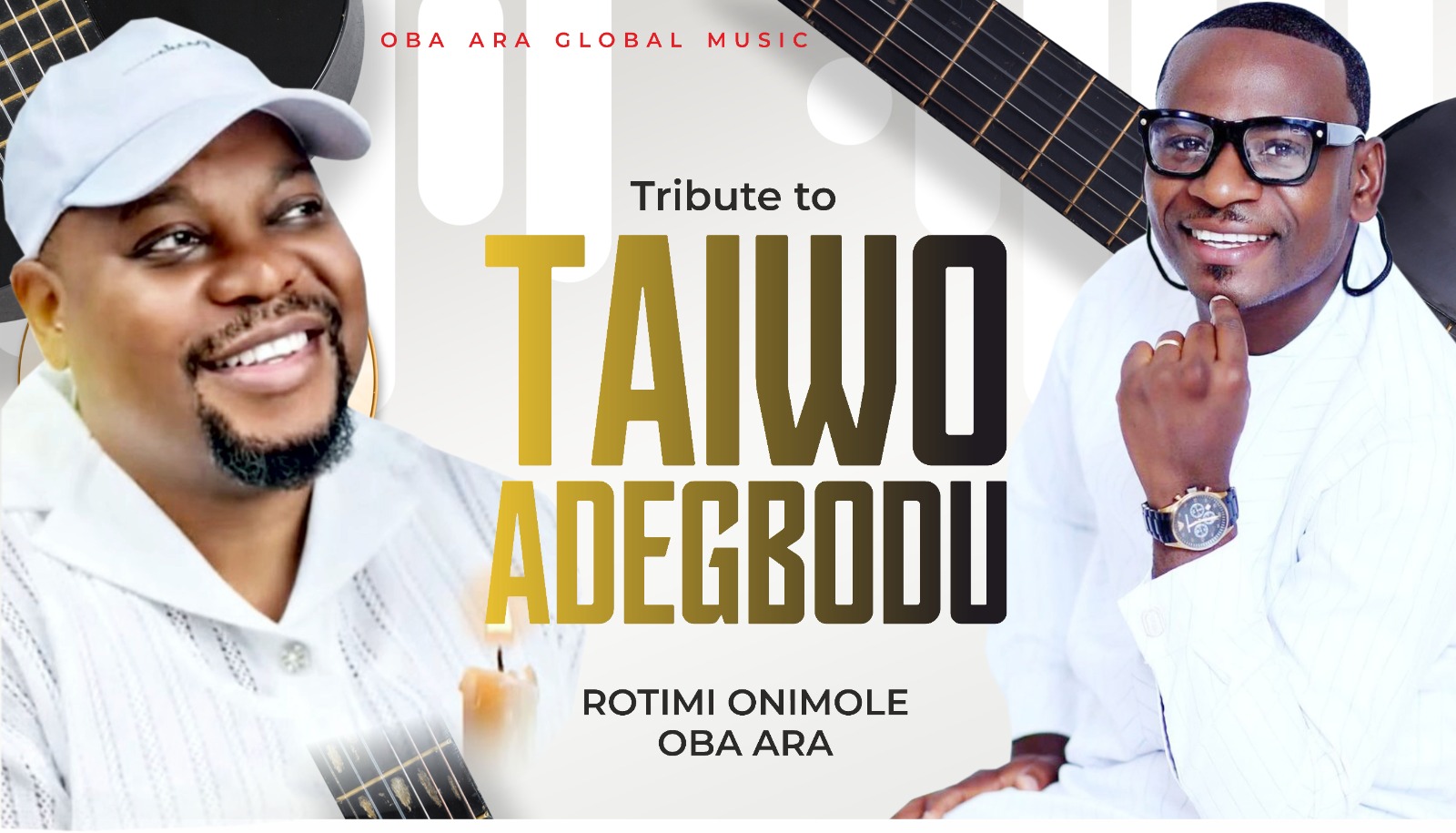
Oba Ara Releases Emotional Tribute to Late Taiwo Adegbodu
Taofik Afolabi
The gospel music community continues to grieve the painful loss of Taiwo Adegbodu, a beloved figure whose sudden departure left a deep void among fans, colleagues, and loved ones. In response to this loss, renowned gospel minister Rotimi Onimole, popularly known as Oba Ara, has released a moving tribute song that captures both the sorrow of the moment and the enduring legacy of the late singer.
Oba Ara, a proud son of Isale Eko, channels raw emotion throughout the song, using heartfelt lyrics and soul-stirring melodies to reflect on his personal connection with Taiwo Adegbodu. In the tribute, he openly expresses how deeply the news of Adegbodu’s passing shook him, describing it as a painful and unexpected loss that is difficult to come to terms with.
The song goes beyond mourning, it celebrates the life, ministry, and impact of Taiwo Adegbodu. Oba Ara highlights the late artist’s dedication to spreading the gospel through music, his inspiring voice, and the spiritual influence he had on many within and beyond Nigeria. Through powerful verses, he paints a picture of a man who lived for God and touched countless lives through his ministry.
Listeners have described the tribute as both comforting and deeply emotional, as it resonates with the collective grief of the gospel music community. It serves as a reminder that although Taiwo Adegbodu is no longer physically present, his music, message, and legacy will continue to live on.
In honoring his late colleague, Oba Ara not only pays his respects but also offers a source of healing for fans and fellow ministers, using music as a tool to process grief and celebrate a life well lived.
celebrity radar - gossips
Buratai, Fagbemi , Shagaya, Olofa, Others Eulogise Olowu Kuta’s Olori On 60th Birthday, Foundation Launch

Buratai, Fagbemi , Shagaya, Olofa, Others Eulogise Olowu Kuta’s Olori On 60th Birthday, Foundation Launch
Eminent personalities across the Nigeria stormed the TFK Event Centre, Bala Mohammed Way, Guzape, Abuja, to celebrate the 60th birthday of Olowu Kuta’s Olori, Queen Jumai Amoke and her Foundation Launch on Saturday 28, March 2026.

From former Chief of Army Staff, Lt Gen TY Buratai rtd, to the Minister of Justice and Attorney-General of the Federation, Prince Lateef Fagbemi; Olofa of Offa, HRM Oba Mufutau Gbadamosi. Even top businesswoman and socialite, Chief (Mrs) Bola Shagaya, was in attendance.


Other dignitaries were newly promoted Deputy Inspector-General of Police and former AIG Zone 2 , Lagos , Adegoke Fayoade, Major General Abdumalik, Major General Samuel Adebayo rtd (Fmr CDI);
Major General Anthony Omozoje rtd (Fmr Copp);
Alhaji Tajudeen Owoyemi (Asiwaju of Offa and CEO Radisson Hotel Nigeria;
Dr Waheed Olagunju, former managing director of Bank of Industry, Oniba of Iba, Lagos State, HRM Oba Dr Suleiman Raji ;
Justice Falola, Olu of Ile-Ogbo , Oba Adetoyese amongst many traditional rulers and captains of industry too numerous to mention.
Speaking at the occasion, the Chief Host, Olowu of Kuta, HRM Oba Dr Adekunle Oyelude Makama, CON , Tegbosun iii, who is also the husband of the celebrant commended Queen Jumai for ‘ her slender arms full of kindness’ to establish such humanitarian Foundation, ‘Amoke Children and mother in Need Foundation’ at a time Nigerians are going through economic crisis occassioned by the global meltdown.
Olowu also commended her steadfastness and love for the less privileged and downtrodden.
The monarch refrenced the task before his wife’s humanitarian gesture said her best is yet to come.
” Olori Amoke Jumai, I celebrate you. You will celebrate 70, 80, 90 and continue to shine as you continue to put a smile on people’s faces. I love you, “Olowu Kuta added.
To Lt Gen Buratai, a former army chief and former Nigerian Ambassador to Benin Republic, the reward of hard work is more work.
Buratai, who also doubles as Balogun Agba of Owu Kuta, a chieftaincy title reserved for a generalismo congratulated Queen Jumai for attaining the age of 60 in good health.
The retired army General said he’s not surprised by the turn out of eminent personalities across the country to celebrate the Olowu Kuta’s Olori because she merited it through her hospitality to all, adding that Allah the most merciful, most beneficial would accept all her act of ibadah.
The minister of Justice, Prince Fagbemi, was full of praises for Queen Jumai for deeming it fit to have a place in her heart to accommodate the needy and less privileged in ‘our society.’
Prince Fagbemi urged the guests to contribute generously to support the Foundation in order to continue to alleviate poverty and put a smile on the faces of the people.
” I congratulate you on your 60th birthday and Foundation Launch. I wish you many happy returns of the day and many more fruitful services to the country and motherland”, Prince Fagbemi added.
The celebrant, Queen Jumai who was grining from ear to ear thankfully said she was excited by the turn out and the response of the people to her foundation.
Queen Jumai, however, promised to continue to use her resources and donations received for the good of the needy and less privileged in the society.
” I want to appreciate my own Kabiesi Olofa of Offa , for his presence and im I’m using him as a point of contact to all other Kabiesis present here, the minister of justice and Attorney-General, you’re welcome, sir; Mrs Bola Shagaya, I salute your enterprise, Lt Gen Buratai, I’m grateful, sir; DIG Fayoade, Justice Falola and other dignitaries too numerous to mention, I thank you, all. To my darling husband, Kabiesi Olowu , I thank you immensely for your support. And to my family and friends, I thank you , all. E se pupo!”, she said.


-

 society7 months ago
Religion: Africa’s Oldest Weapon of Enslavement and the Forgotten Truth
-

 news4 months ago
WHO REALLY OWNS MONIEPOINT? The $290 Million Deal That Sold Nigeria’s Top Fintech to Foreign Interests
-

 society6 months ago
“You Are Never Without Help” – Pastor Gebhardt Berndt Inspires Hope Through Empower Church (Video)
-

 celebrity radar - gossips2 months ago
Dr. Chris Okafor Returns with Power and Fire of the Spirit -Mounts Grace Nation Altar with Fresh Anointing and Restoration Grace on February 1, 2026