
celebrity radar - gossips
BODE GEORGE THE UNREPENTANT CON ARTIST BY KAREEM ADEDUNTAN

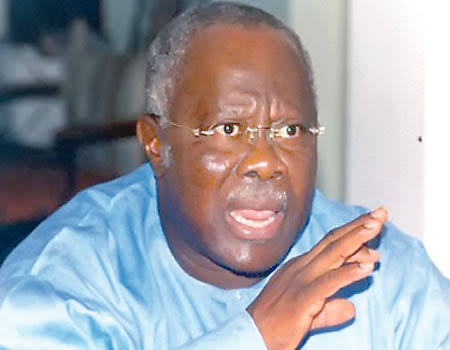
Events of the past few weeks have been tumultuous. Unfortunate things have happened. Lives have been lost. Property damaged. Essential institutions such as the police force and army are under justifiable scrutiny. Protests call for needed reform. Taking advantage of the situation, less noble actors have pressed forward, either to steal the hard-earned property of others or to prosecute selfish political objectives not germane to the protests at hand.
Even with many people taking undue license to press cases that would otherwise be tossed from the court of public opinion, one would think certain people would keep their mouths shut and hide their pens even during this period. Bode George is one such person. In commenting on the protests and trying to fault Bola Tinubu for every human imperfection ranging from the original sin in the Garden of Eden to the cost of tomatoes in the local market, George is either one of the world’s most bulbous hypocrites or the victim of the worst bout of amnesia ever recorded in the journals of medical science. In that this gruff, indelicate man well remembers the sound of his own name and responds to the ruffle of fresh naira with the pounce of a hungry jackal, one may fairly assume that his particular diathesis points more to the former moral decrepitude than to any medical infirmity that might affect his memory.
In his recent article published by NEW DAWN entitled “Lagos State THE Anger, The Rage”, Bode George huffs and puffs in contrived indignation at recent events in Lagos. He misrepresents himself as a storm for change and justice. He is nothing of the sort. For all of his blowing and the grand noise he thinks himself to make, he barely manufactures an audible moment. He is but a rickety, broken tea kettle trying futilely with all its waning might to bring a tiny pot of water to boil.
Try as it might, the rickety kettle is unstable and cannot hold itself upright. In the end, the only noteworthy sound it can muster is the sound of its falling to the floor after toppling from the counter top.
Inept as he is loquacious, the former naval commander, once again, has proven that he cannot successfully navigate a toy boat from one end of a bathtub to the other. He would make a wreck of even this simple assignment. Everything he has touched ends up being worse off, if not in complete ruins, than when he first happened upon it. His coming into a room is a cause for sorrow and his exit a cue for celebration. The man is an albatross around his own neck.
Yet, he had the audacity to write that all conscientious men must stand with the righteous at this hour and the he had “chosen to identify with the voiceless…” It seems that George discovered morality a bit late in the game of life and over a decade after the time when even a fiber of morality on his part would have amounted to something. George squeals about the deaths and destruction that have occurred in Lagos and then lays the trouble at the foot of one man who happens to be his political nemesis. Such as assignment of guilt by George is based on political convenience and con games rather than fact. George says Tinubu has questions to answer about the incident at Lekki but he offers no proof as to why Tinubu should be on the spot.
If George were really interested in justice, how come he did not jump at his master Obasanjo when the latter was commander in chief? As commander in chief, Obasanjo presided over the slaughter of several hundreds and perhaps thousands of unarmed innocent men, women and children in separate incidents in Zaki Biam and Odi. In each case, people were burned alive in their homes or dragged away and butchered. George voiced no indignation at these large massacres although they cost a hundred fold more lives than even all the precious lives lost everywhere in Lagos, not just Lekki during this period. Unjust death anywhere is a tragedy and must be condemned. But George’s background tells us that he is not crying because he cares about those who died or were wounded during events in Lagos but because the moment conveniently serves his political interest.
If he had morality, he would have chastised Obasanjo for killing innocent women and children and ransacking whole towns. Instead, George kept publicly quiet while in private endorsing the carnage set down by his boss who would eventually reveal himself to be a turncoat friend and master who would shuffled George off to prison. George talks of people being brought before the ICC in the Hague for what has happened in Lagos. His lawyer should advise him to be circumspect. Should some diligent human rights attorney take a good look at his role in the Obasanjo government and his endorsement of the confirmed large-scale massacres at Zaki Biam and Odi, that lawyer might take a very keen interest in Mr. George. George would surely quake in his boots upon finding on his doorstep one morning a mysterious brochure saying that he just won an all-expenses paid holiday to the Hague.
George is infamous for his meanness of personality and mercenary outlook toward policy – give him an official position and he will do any number of ugly things to keep it. In his writing, he called himself a elder statesman. However, one cannot award that title to oneself. It must be earned not unilaterally expropriated lest it be taken away by those who can rightly bestow it. George is no more a statesman than a mosquito is an eagle.
George claims Lagos to be an awful place yet he still lives here even after vowing to move away forever should the APC win the 2019 election. George will not move because, deep in his heart, he knows Lagos is the best that Nigeria has. It is the best not because of anything George did. It is the best despite George for he tried to thwart every major constructive initiative the state’s progressive governors have attempted since 1999.
George has the nerve to lament about the poor state of infrastructure and blame Tinubu and others. George drips with a double dose of highly toxic hypocrisy here. George well knows he encouraged Obasanjo to illegally withhold Lagos state funds when Tinubu was governor. George did this because he was afraid Tinubu would gain political support if allowed access to those funds to do projects in the state. Thus, George cared nothing that his antics might hurt Lagosians. He is captained by the perverse logic that rules all people who crave public office but are inherently unfit for the roles they seek. He believes the best way for him to gain the support of the people is to make them suffer. This is the way his mind worked then and the manner it malfunctions now. He is more interested in inveigling support than in duly enhancing the public welfare.
As governor, Tinubu brought power generator barges to Lagos to provide 300MW of power to the state and give residents and businesses more, cheaper power. What did George do? He did not applaud the initiative as a boon for Lagosians. He connived with Obasanjo to stop this. Again, he decided that he would rather see Lagosians suffer than Tinubu succeed at doing something new and needed for the people
Like he did in the past, George today is happy about the events that have befallen Lagos. He only feigns concern. He now is possessed of that cruel happiness that specially effects the mean at heart. They are only truly happy when misfortune comes to others. George now gloats the evildoer’s gloat and dances the wicked man’s dance. He is in this deformed way because he knows he cannot gain political traction by outperforming anyone. He cannot win by doing something positive because there is essentially noting positive in him. He is a bundle of negative impulses and actions. Thus, his only avenue of political pleasure and success is to tear down that which others have built. George is a breaker not maker of things.
His career has been monstrous. As military governor in Ondo, he was known to be corrupt to the utmost. He plundered the state’s treasury describing himself, by way of explanation, as a ‘Lagos Boy’ – giving the state a bad name. There was no part of the state treasure his sticky hand did not explore. As NPA chairman, he allowed the port to deteriorate. He is thus partly responsible for the economic bottleneck that is the port and all the harm and higher costs it brings to us. Worse, he was caught artificially segmenting large contracts into smaller ones so as to bypass procurement requirements and oversight. In this manner, he bilked the nation much like he did Ondo state as its governor. If nothing else, one can say that as a thief he has shown remarkable consistency if a coarseness of approach that always seems to get him caught.
As an operative of the PDP in Lagos and the SW, he has been the APC’s best friend for the division and antipathy he foments within his own party makes him one of the APC’s top recruiters.
Last, there is not a truly original thought that ever came from him. Toward the end of his piece, he asserts that the Lekki toll gate should be closed. George is a day late like most plagiarizers are. Tinubu made a similar recommendation the day before. George would not have made his copycat gesture but for having read Tinubu’s earlier statement.
Like the thief he is, George steals someone’s idea then foments hate against the other man for having had the idea first.
George is not a leader, a statesman or a visionary. His is a criminal mind and a cold hearted and an amoral personality. Bode, don’t forget there are still people old enough to remember where you are truly from.
At the end of the statement, George signs off “CON.” For most people that would mean Commander of the Niger. Yet, to get the perfect description of him, one must simply use this word before writing the word “artist” who can’t even identify the grave of his father in Ogun State… WHAT A “LAGOSIAN”.




celebrity radar - gossips
Adron Homes Celebrates Visionary Chairman, Aare Adetola Emmanuel King, at 51
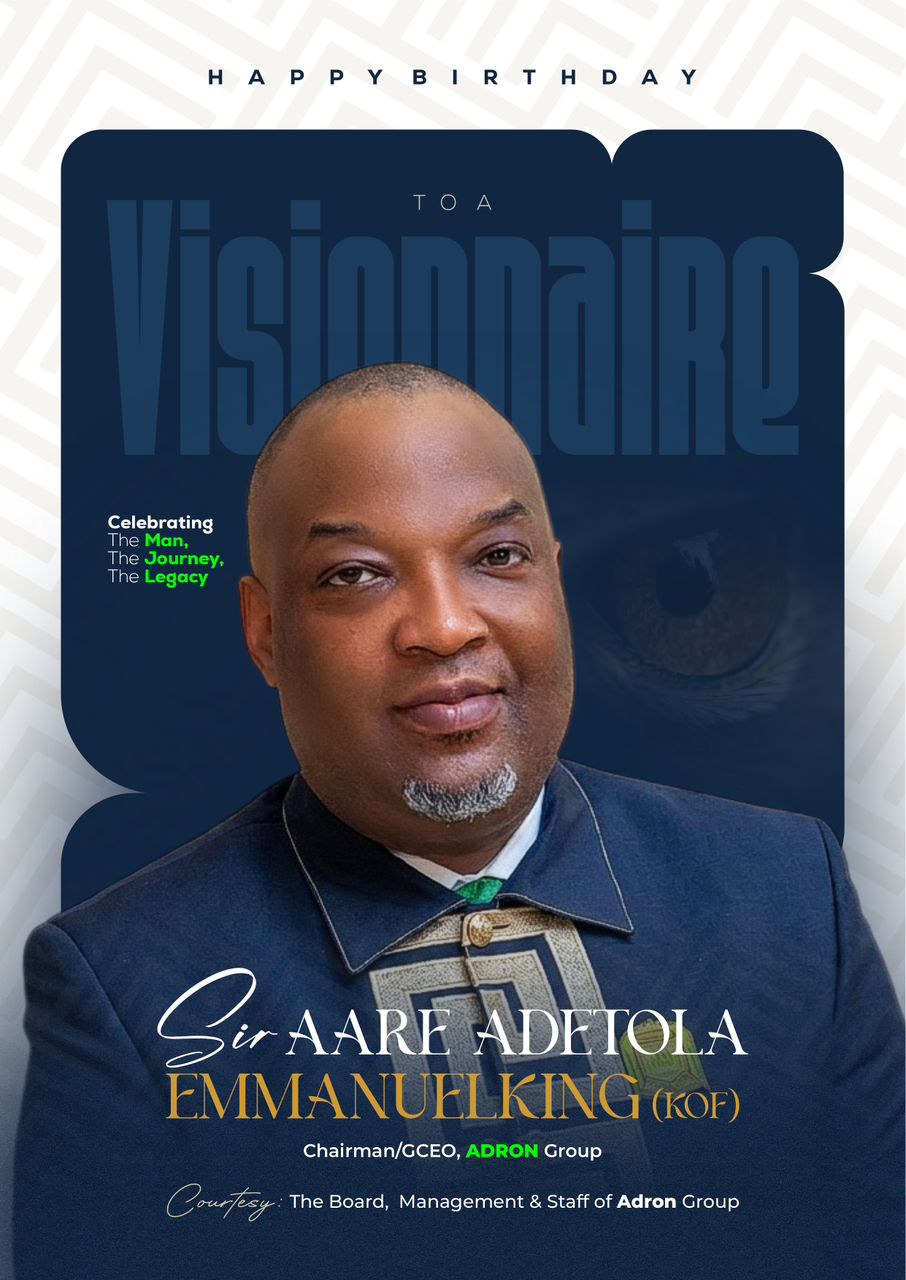
Adron Homes Celebrates Visionary Chairman, Aare Adetola Emmanuel King, at 51
The management and staff of Adron Homes and Properties Limited have joined family, friends, associates, and well-wishers across the globe to celebrate their Chairman and Chief Executive Officer, Aare Adetola EmmanuelKing, as he marks his 51st birthday.

In a statement released by the company, the milestone was described as a celebration of an exceptional leader whose vision, resilience, and entrepreneurial brilliance have not only transformed Adron Homes into a household name in Nigeria’s real estate sector but have also redefined affordable housing across the country.
Under his dynamic leadership, Adron Homes has continued to expand its footprint, delivering value-driven residential solutions while empowering thousands of Nigerians with opportunities for home ownership. His commitment to excellence, innovation, and customer satisfaction has remained the driving force behind the company’s sustained growth and industry leadership.
The statement further highlighted Aare EmmanuelKing’s passion for nation-building and community development, noting his significant contributions to job creation, youth empowerment, and the promotion of socio-economic development through real estate investments.
“As a leader, mentor, and visionary, Aare Adetola EmmanuelKing has consistently inspired a culture of excellence, integrity, and dedication within the organization. His ability to turn bold ideas into reality continues to position Adron Homes as a trailblazer in the industry,” the statement read.
The company expressed profound gratitude for his steadfast leadership and prayed for continued wisdom, strength, and sound health as he embarks on another year of impactful achievements.
As he celebrates his 51st birthday, the entire Adron Homes family proudly honours a man whose legacy continues to shape the future of real estate in Nigeria.
Happy 51st Birthday, Aare Adetola EmmanuelKing!
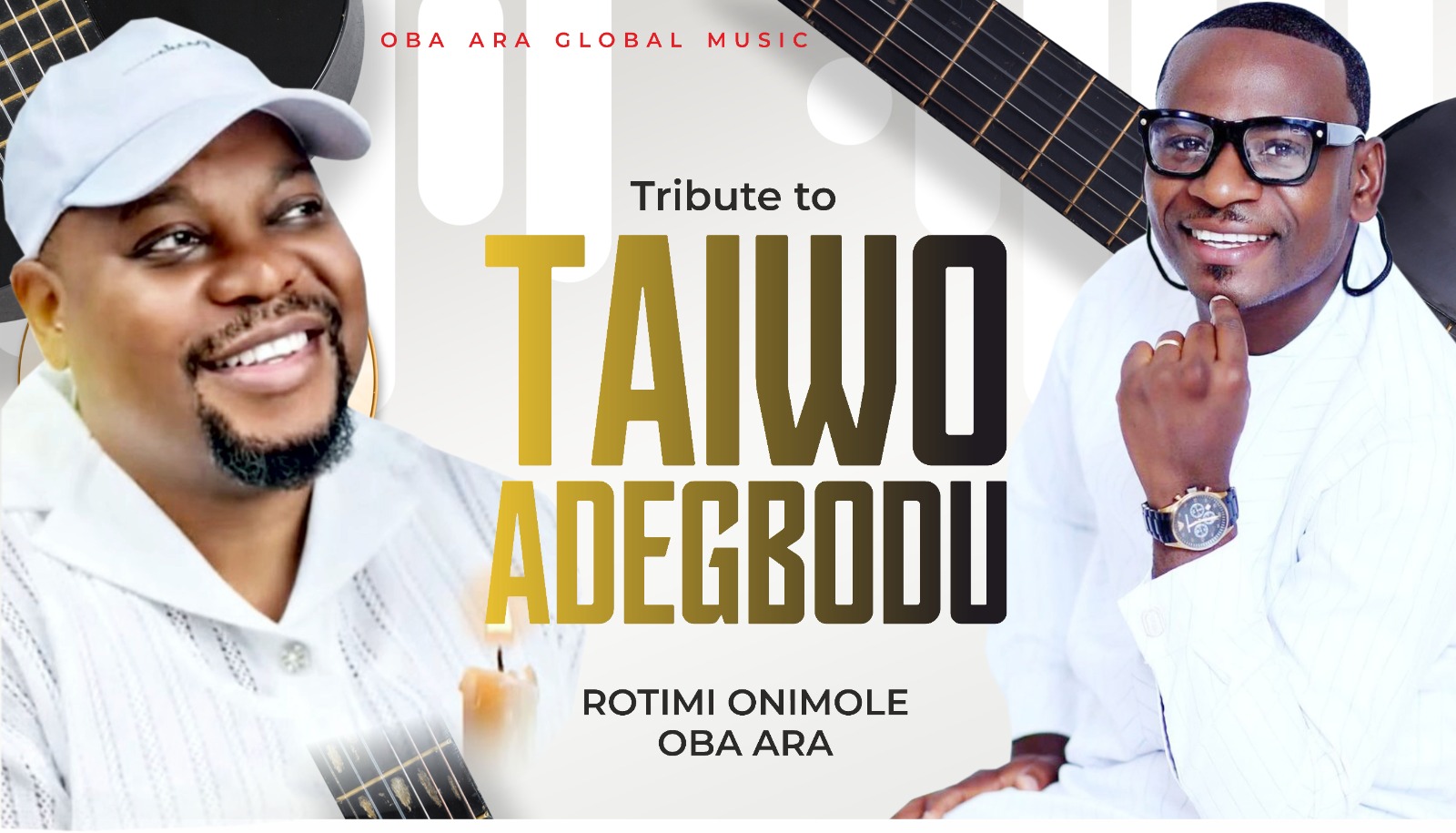
Oba Ara Releases Emotional Tribute to Late Taiwo Adegbodu
Taofik Afolabi
The gospel music community continues to grieve the painful loss of Taiwo Adegbodu, a beloved figure whose sudden departure left a deep void among fans, colleagues, and loved ones. In response to this loss, renowned gospel minister Rotimi Onimole, popularly known as Oba Ara, has released a moving tribute song that captures both the sorrow of the moment and the enduring legacy of the late singer.
Oba Ara, a proud son of Isale Eko, channels raw emotion throughout the song, using heartfelt lyrics and soul-stirring melodies to reflect on his personal connection with Taiwo Adegbodu. In the tribute, he openly expresses how deeply the news of Adegbodu’s passing shook him, describing it as a painful and unexpected loss that is difficult to come to terms with.
The song goes beyond mourning, it celebrates the life, ministry, and impact of Taiwo Adegbodu. Oba Ara highlights the late artist’s dedication to spreading the gospel through music, his inspiring voice, and the spiritual influence he had on many within and beyond Nigeria. Through powerful verses, he paints a picture of a man who lived for God and touched countless lives through his ministry.
Listeners have described the tribute as both comforting and deeply emotional, as it resonates with the collective grief of the gospel music community. It serves as a reminder that although Taiwo Adegbodu is no longer physically present, his music, message, and legacy will continue to live on.
In honoring his late colleague, Oba Ara not only pays his respects but also offers a source of healing for fans and fellow ministers, using music as a tool to process grief and celebrate a life well lived.
celebrity radar - gossips
Buratai, Fagbemi , Shagaya, Olofa, Others Eulogise Olowu Kuta’s Olori On 60th Birthday, Foundation Launch
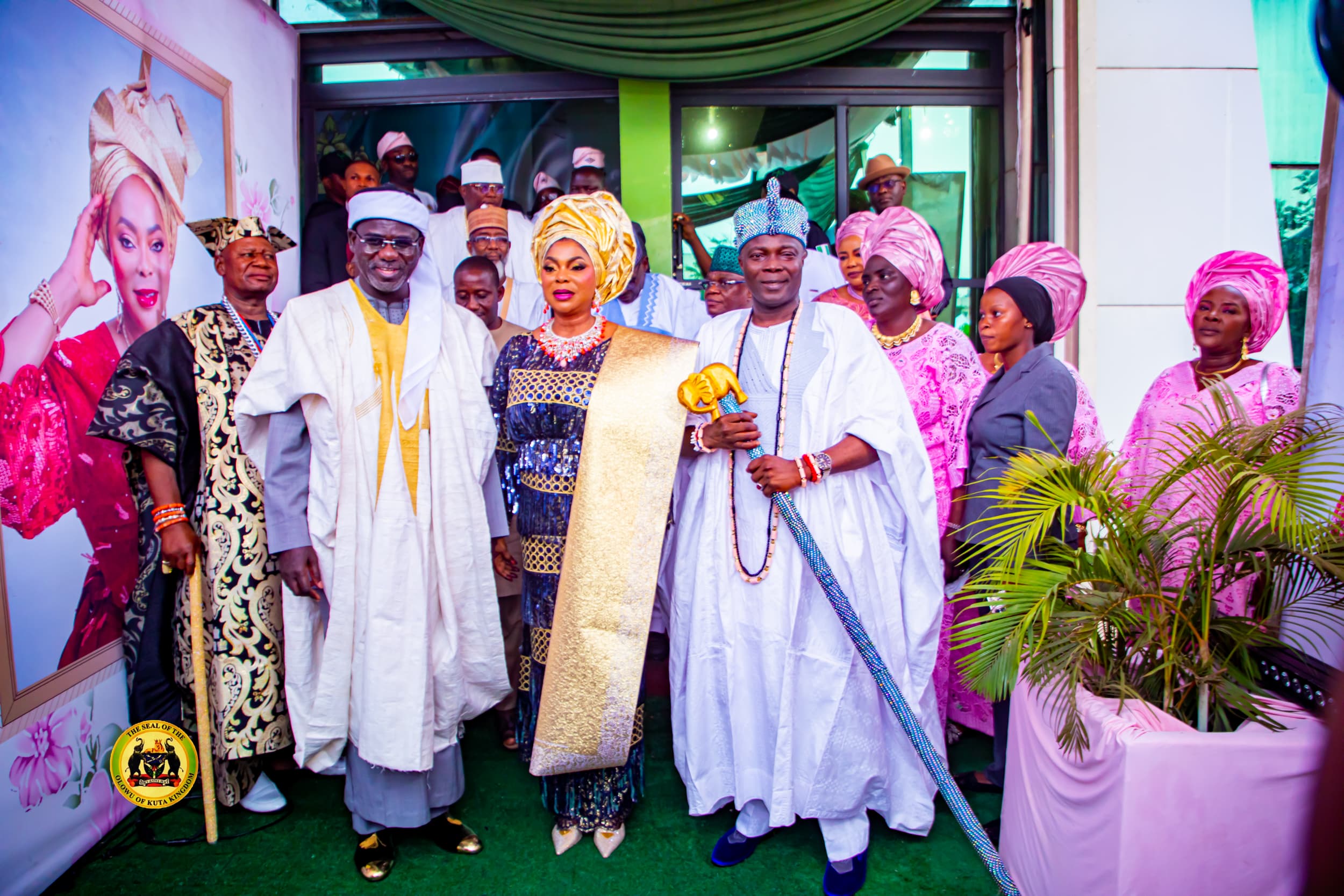
Buratai, Fagbemi , Shagaya, Olofa, Others Eulogise Olowu Kuta’s Olori On 60th Birthday, Foundation Launch
Eminent personalities across the Nigeria stormed the TFK Event Centre, Bala Mohammed Way, Guzape, Abuja, to celebrate the 60th birthday of Olowu Kuta’s Olori, Queen Jumai Amoke and her Foundation Launch on Saturday 28, March 2026.

From former Chief of Army Staff, Lt Gen TY Buratai rtd, to the Minister of Justice and Attorney-General of the Federation, Prince Lateef Fagbemi; Olofa of Offa, HRM Oba Mufutau Gbadamosi. Even top businesswoman and socialite, Chief (Mrs) Bola Shagaya, was in attendance.


Other dignitaries were newly promoted Deputy Inspector-General of Police and former AIG Zone 2 , Lagos , Adegoke Fayoade, Major General Abdumalik, Major General Samuel Adebayo rtd (Fmr CDI);
Major General Anthony Omozoje rtd (Fmr Copp);
Alhaji Tajudeen Owoyemi (Asiwaju of Offa and CEO Radisson Hotel Nigeria;
Dr Waheed Olagunju, former managing director of Bank of Industry, Oniba of Iba, Lagos State, HRM Oba Dr Suleiman Raji ;
Justice Falola, Olu of Ile-Ogbo , Oba Adetoyese amongst many traditional rulers and captains of industry too numerous to mention.
Speaking at the occasion, the Chief Host, Olowu of Kuta, HRM Oba Dr Adekunle Oyelude Makama, CON , Tegbosun iii, who is also the husband of the celebrant commended Queen Jumai for ‘ her slender arms full of kindness’ to establish such humanitarian Foundation, ‘Amoke Children and mother in Need Foundation’ at a time Nigerians are going through economic crisis occassioned by the global meltdown.
Olowu also commended her steadfastness and love for the less privileged and downtrodden.
The monarch refrenced the task before his wife’s humanitarian gesture said her best is yet to come.
” Olori Amoke Jumai, I celebrate you. You will celebrate 70, 80, 90 and continue to shine as you continue to put a smile on people’s faces. I love you, “Olowu Kuta added.
To Lt Gen Buratai, a former army chief and former Nigerian Ambassador to Benin Republic, the reward of hard work is more work.
Buratai, who also doubles as Balogun Agba of Owu Kuta, a chieftaincy title reserved for a generalismo congratulated Queen Jumai for attaining the age of 60 in good health.
The retired army General said he’s not surprised by the turn out of eminent personalities across the country to celebrate the Olowu Kuta’s Olori because she merited it through her hospitality to all, adding that Allah the most merciful, most beneficial would accept all her act of ibadah.
The minister of Justice, Prince Fagbemi, was full of praises for Queen Jumai for deeming it fit to have a place in her heart to accommodate the needy and less privileged in ‘our society.’
Prince Fagbemi urged the guests to contribute generously to support the Foundation in order to continue to alleviate poverty and put a smile on the faces of the people.
” I congratulate you on your 60th birthday and Foundation Launch. I wish you many happy returns of the day and many more fruitful services to the country and motherland”, Prince Fagbemi added.
The celebrant, Queen Jumai who was grining from ear to ear thankfully said she was excited by the turn out and the response of the people to her foundation.
Queen Jumai, however, promised to continue to use her resources and donations received for the good of the needy and less privileged in the society.
” I want to appreciate my own Kabiesi Olofa of Offa , for his presence and im I’m using him as a point of contact to all other Kabiesis present here, the minister of justice and Attorney-General, you’re welcome, sir; Mrs Bola Shagaya, I salute your enterprise, Lt Gen Buratai, I’m grateful, sir; DIG Fayoade, Justice Falola and other dignitaries too numerous to mention, I thank you, all. To my darling husband, Kabiesi Olowu , I thank you immensely for your support. And to my family and friends, I thank you , all. E se pupo!”, she said.


-

 society7 months ago
Religion: Africa’s Oldest Weapon of Enslavement and the Forgotten Truth
-

 news4 months ago
WHO REALLY OWNS MONIEPOINT? The $290 Million Deal That Sold Nigeria’s Top Fintech to Foreign Interests
-

 society6 months ago
“You Are Never Without Help” – Pastor Gebhardt Berndt Inspires Hope Through Empower Church (Video)
-

 celebrity radar - gossips2 months ago
Dr. Chris Okafor Returns with Power and Fire of the Spirit -Mounts Grace Nation Altar with Fresh Anointing and Restoration Grace on February 1, 2026