
Business
DANGOTE PETROLEUM REFINERY TO BEGIN DISTRIBUTION OF PMS AND DIESEL NATIONWIDE

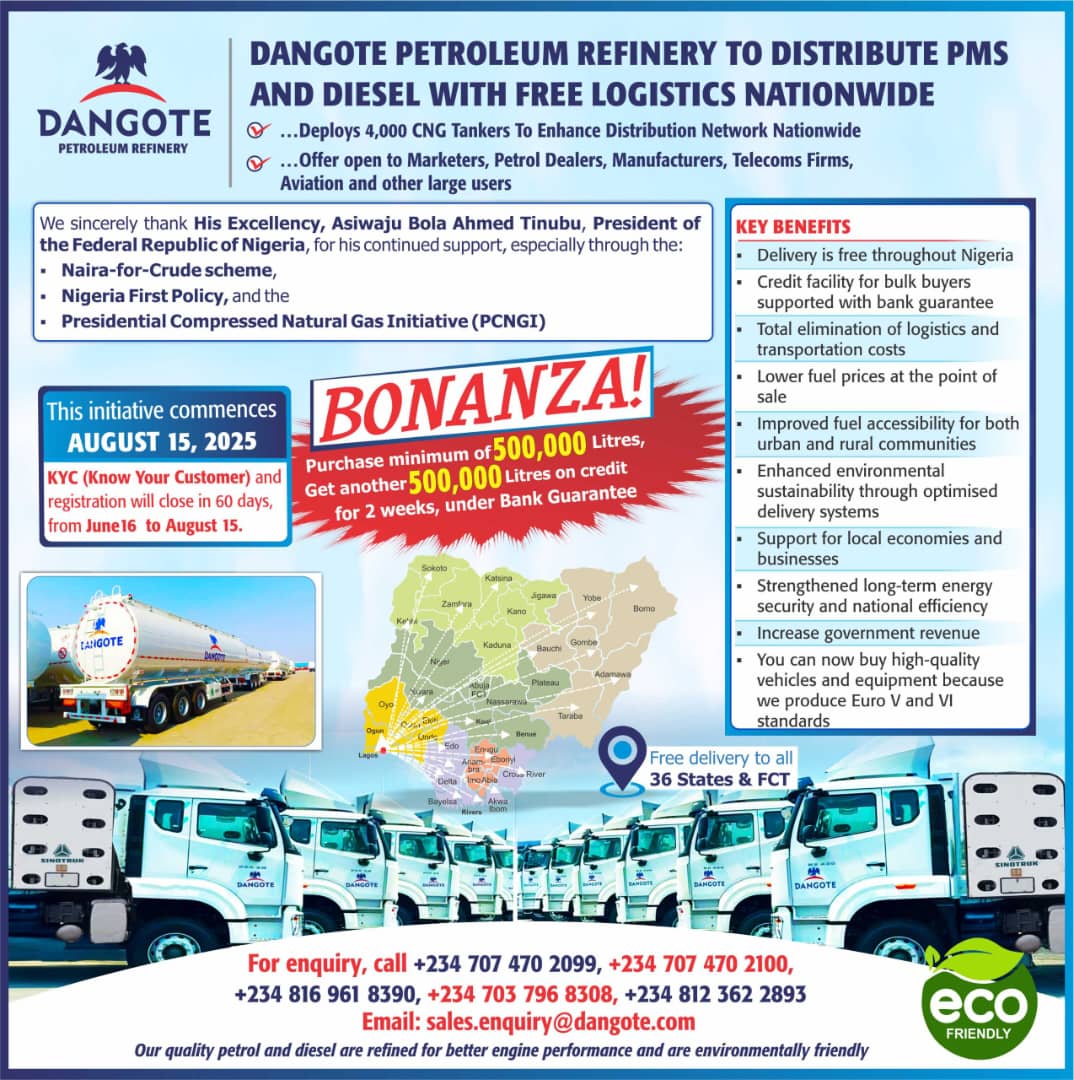
…Deploys 4,000 CNG Tankers To Enhance Distribution Network Nationwide*
*…Offer open to Marketers, Petrol Dealers, Manufacturers, Telecoms Firms, Aviation and other large users*
Dangote Petroleum Refinery is pleased to announce the commencement of a significant national initiative designed to transform Nigeria’s fuel distribution landscape. Effective 15th of August 2025, the Refinery will begin the distribution of Premium Motor Spirit (PMS) and diesel to marketers, petrol dealers, manufacturers, telecoms firms, aviation, and other large users across the country, with free logistics to boost distribution network.
To ensure smooth take-off of this scheme, Dangote Refinery has invested in the procurement of 4,000 brand-new Compressed Natural Gas (CNG)-powered tankers. This phase of the programme will continue over an extended timeframe. The refinery is also investing in Compressed Natural Gas (CNG) stations, commonly referred to as daughter booster stations, supported by a fleet of over 100 CNG tankers across the country to ensure seamless product distribution.
This strategic programme is part of our broader commitment to eliminating logistics costs, enhancing energy efficiency, promoting sustainability and supporting Nigeria’s economic development. It affirms our dedication to improving the availability and affordability of fuel, in support of broader efforts to strengthen the economy and improve the well-being of all Nigerians.
Under this initiative, all petrol stations purchasing PMS and diesel from the Dangote Petroleum Refinery will benefit from this enhanced logistics support. Key sectors such as manufacturing, telecommunications, and others will also gain from this transformative initiative, as reduced fuel costs will contribute to lower production costs, reduced inflation, and foster economic growth. Players in these key sectors and others can purchase directly from the Dangote Petroleum Refinery.
In addition, the refinery will offer a credit facility to those purchasing a minimum of 500,000 litres—allowing them to obtain an additional 500,000 litres on credit for two weeks, under bank guarantee.
This pioneering effort marks a major milestone in our vision to revolutionise Nigeria’s energy sector. Dangote Refinery is dedicated to ensuring that no place is left behind. Our goal is to provide equitable access to affordable fuel for all Nigerians, regardless of location, making energy more accessible and sustainable for everyone, wherever they may be.
It is expected to revitalise previously inactive petrol stations, thereby driving job creation, stimulating small and medium-sized enterprises (SMEs), increasing government revenue, improving fuel access in rural and underserved communities, and strengthening investor confidence in Nigeria’s downstream petroleum sector.
This initiative is inline with the Renewed Hope Agenda of His Excellency, President Bola Ahmed Tinubu, reflecting our shared commitment to economic progress, stability, and inclusive development. We sincerely thank the Federal Government for its continued support, especially through the Naira-for-Crude scheme, which has helped stabilise fuel supply amid global price volatility. It marks a major revolution in the midstream and downstream sectors and stands as a key example of President Bola Tinubu’s bold and reformative economic policies.
We invite marketers, petrol dealers, manufacturers, telecom companies, and all key stakeholders to embrace this landmark initiative. The registration process, including Know Your Customer (KYC) verification, will take place from 16 June to 15 August, spanning a total of 60 days. For enquiries, please call +234 707 470 2099, +234 707 470 2100, +234 816 961 8390, +234 703 796 8308, +234 812 362 2893. Email: Email: [email protected].
Dangote Petroleum Refinery remains a proud partner in this national journey— a truly Nigerian company of global standards, dedicated to the well-being of all Nigerians.





THE GREAT WALL OF LIQUIDITY: Inside Nigeria’s N4.65 Trillion Banking Paradox
By Blaise Udunze | Investigative Desk
ABUJA — On the surface, the numbers scream triumph. The vaults are overflowing. Following a grueling recapitalization marathon initiated in March 2024, Nigeria’s banking sector has emerged with a staggering N4.65 trillion in fresh capital.
The Central Bank of Nigeria (CBN) is taking a victory lap. Balance sheets are bolstered, capital adequacy ratios are soaring, and foreign investors are once again eyeing Nigerian tickers with interest. But beneath the polished marble floors of the nation’s financial towers, a more haunting question is being whispered: Has the banking sector become a fortress that keeps the real economy out?
The $1 Trillion Mirage
The logic of Governor Olayemi Cardoso’s reform is textbook: stronger banks equal a stronger economy. Yet, Nigeria remains a land of “financialization without productivity.” While the banking sector is sophisticated and profitable, the industrial heart of the nation is flatlining.
The data reveals a stark, structural disconnect:
Private Sector Credit: Stands at a measly 17% of GDP, trailing far behind the sub-Saharan average.
The SME Desert: Small and Medium Enterprises (SMEs) provide 80% of jobs and 50% of GDP, yet they receive barely 1% of total bank lending.
The “Safe” Trap: Instead of funding factories or agro-processing, banks are retreating into the “safety” of government securities and treasury instruments—profiting from the state’s debt while the entrepreneur starves.
Locked Out: The SME Struggle
For the average Nigerian manufacturer, the N4.65 trillion might as well be on the moon. Banks cite “perceived risk” and “lack of collateral” as reasons to keep the vault doors shut.
”Stability alone is not a meal,” says one industry analyst. “The real test isn’t a strong balance sheet; it’s whether that balance sheet allows a young entrepreneur in Kano or a farmer in Benue to scale. Right now, the capital is circulating inside the system, but it isn’t leaking out to the streets.”
The Stability vs. Growth Tightrope
There is a growing fear among economic watchers that the CBN’s obsession with “stability” and “risk-based supervision” is inadvertently strangling growth. By tightening the screws to prevent another banking collapse, regulators may be rewarding risk aversion.
When banks are forced to be “too safe,” they stop being engines of development and start behaving like high-end pawn shops.
The Structural Imbalance at a Glance:
| Sector | Contribution to GDP | Share of Bank Credit |
| :— | :— | :— |
| SMEs | ~50% | < 1% |
| Agriculture | ~25% | Marginal |
| Government/Trade | Minimal | Dominant |
A Defining Moment or a Missed Opportunity?
The N4.65 trillion is a starting gun, not a finish line. To prevent this capital from becoming stagnant, experts argue for a radical shift in the “rules of the game”:
Differentiated Capital Requirements: Rewarding banks that lend to high-impact sectors like manufacturing.
Credit Guarantees: De-risking SME loans to make them as attractive as government bonds.
The “Consumer” Metric: Measuring banking success not by profit margins, but by customer outcomes and job creation.
The Verdict
Nigeria’s banking sector has never been stronger, but the Nigerian economy has rarely felt more fragile. If the N4.65 trillion remains locked behind a wall of risk aversion and short-term profit-seeking, the recapitalization will be remembered as a brilliant financial exercise—and a catastrophic economic failure.
The vault is full. Now, who has the key?

Precision and Heritage: How Fifi Stitches Is Rewriting African Fashion Narratives
A Nigerian-born designer is gradually carving out a cross-continental footprint in contemporary fashion, blending African textile heritage with British technical discipline.
Esther Fiyinfoluwa Adeosun, Founder and Creative Director of Fifi Stitches, is gaining recognition for structured womenswear and bridal couture that reinterprets traditional fabrics through architectural tailoring and precision construction.
Born in Ibadan, Oyo State, Adeosun’s fashion journey began at home, seated beside her mother’s sewing machine. What started as childhood curiosity, sometimes jamming the machine just to understand its mechanics—evolved into a disciplined design practice now operating between Nigeria and the United Kingdom.
During an interview with journalists the fifi Stitches once mentioned “I was fascinated by how flat fabric could transform into something structured and meaningful”.
In her Story , early designs made for her family, though imperfectly finished, were worn with pride—an encouragement that laid the foundation for her professional confidence.
Today, Fifi Stitches is recognised for sculpted bodices, controlled tailoring, corsetry construction, and the contemporary reinterpretation of Ankara, Aso Oke, and Adire textiles.
The brand challenges the long-held perception that African fabrics belong solely in ceremonial contexts, instead positioning them within global luxury and modern design spaces.
Adeosun’s training reflects this dual perspective. She studied Fashion Design and Entrepreneurship at the Institute for Entrepreneurship and Development Studies, Obafemi Awolowo University, and earned a Diploma in Fashion Design through Alison Online.
In the UK, she undertook industry-focused technical training with Fashion-Enter Ltd and gained fashion business exposure through Fashion Capital UK.
Her technical expertise spans pattern drafting, draping, garment technology, structured tailoring, corsetry, and bespoke fittings—skills she describes as central to credibility in fashion. “Precision builds trust,” she says. “A designer must understand construction as deeply as creativity.”
Fifi Stitches has showcased collections at the Suffolk Fashion Show, Liverpool Fashion Show – FB Fashion Ball, Red Carpet Fashion Event in London, and through editorial features in London Runway Magazine.
The brand has also received coverage in The Guardian Nigeria and Vanguard Allure, expanding its visibility across markets.
Beyond couture, Adeosun integrates community impact into her practice.
She has facilitated garment construction workshops, draping sessions, and introductory training programmes for women and emerging creatives, promoting fashion as both artistic expression and vocational empowerment.
Fifi Stcithes Boss operates between Nigeria and the UK, in order to continue to shape her brand identity.
According to her “Nigeria provides cultural richness and expressive textile traditions, while the UK offers structured production systems, sustainability conversations, and institutional frameworks”.
Looking ahead, Adeosun said she plan to establish a fully structured fashion house spanning Africa and the UK, develop scalable production partnerships, launch capsule collections, and expand independent editorial visibility.
Her broader ambition is clear: to position African textile craftsmanship within global contemporary design conversations—through structure, discipline, and technical excellence.
GTCO Launches “Take on Squad” Hackathon 3.0, Opens Call for Applications
Guaranty Trust Holding Company Plc (“GTCO” or the “Group”) has announced the launch of “Take on Squad” Hackathon 3.0, reaffirming its commitment to fostering innovation, empowering talent, and supporting the development of technology-driven solutions that address real-world challenges across Africa.
Now in its third edition, the Hackathon brings together developers, designers and entrepreneurs across Nigeria in a collaborative environment to build practical solutions across key sectors including financial services, healthcare, commerce and digital inclusion. Under the theme “Smart Systems: The Intelligent Economy,” participants are challenged to design and build intelligent, data-driven solutions that transform how communities engage with money.
Applications are now open, and interested teams can find full guidelines and registration details on the official portal at https://squadco.com/hackathon.
Speaking on the initiative, Eduophon Japhet, Managing Director of HabariPay, stated: “Today’s dynamic, digitally driven world demands continuous innovation, which is shaping how economies grow, how businesses scale, and how societies evolve. Through “Take on Squad” Hackathon, we are deliberately investing in the ideas and talent that will define the future. Our objective is not simply to encourage innovation, but to enable its translation into scalable solutions that deliver real and measurable impact. This reflects GTCO’s role as a financial services platform that connects capital, capability, and creativity to drive sustainable progress.”
The social coding event remains a cornerstone of HabariPay’s mission to foster creativity and problem-solving among emerging tech talents. Competing teams will leverage Squad’s advanced APIs to create scalable digital tools that address everyday challenges faced by businesses and individuals.
Through initiatives such as this, GTCO continues to position itself at the intersection of finance, technology and enterprise, actively shaping the future of digital transformation in Africa.
About HabariPay
HabariPay Ltd is the fintech subsidiary of Guaranty Trust Holding Company Plc (GTCO), one of the largest financial services institutions in Africa with direct and indirect investments in a network of operating entities located in 10 countries across Africa and the United Kingdom.
Licensed by the Central Bank of Nigeria (CBN), our goal is to support SMEs, micro merchants, large corporations and other fintechs (Tech Stars) with the tools they need to thrive in an evolving digital economy and expand beyond their current market reach. HabariPay’s solutions include Squad, a full-scale digital payments toolkit to make in-person and online payments simpler, HabariPay Storefront, an e-commerce website to facilitate online purchases, Value-Added Services to help merchants access cost-effective and flexible airtime and data bundles to run their businesses, as well as a switching infrastructure that enables tech-focused businesses to optimise cost and make transactions more efficient.
HabariPay’s contributions to Accelerating Digital Acceptance in Africa have not gone unnoticed–it received Mastercard’s Innovative Mobile Payment Solution Award at TIA 2022 for its innovative payment solution, SquadPOS.
About Squad
Squad is a complete digital payments solution that is reliable, secure, and affordable, making receiving in-person and online payments simpler and convenient.
Thousands of merchants currently leverage Squad’s payment solutions for their daily business operations. Squad’s current products and service offerings include SquadPOS, Squad Payment Links, Squad Virtual Accounts, USSD, and E-Commerce Storefront.
Find out more at www.squadco.com.


-

 society7 months ago
Religion: Africa’s Oldest Weapon of Enslavement and the Forgotten Truth
-

 news4 months ago
WHO REALLY OWNS MONIEPOINT? The $290 Million Deal That Sold Nigeria’s Top Fintech to Foreign Interests
-

 society6 months ago
“You Are Never Without Help” – Pastor Gebhardt Berndt Inspires Hope Through Empower Church (Video)
-

 celebrity radar - gossips2 months ago
Dr. Chris Okafor Returns with Power and Fire of the Spirit -Mounts Grace Nation Altar with Fresh Anointing and Restoration Grace on February 1, 2026