
celebrity radar - gossips
Drama As Woman On Wheelchair Blocks & Attempts Suicide In Front Of Buhari’s Convoy



President Buhari was in Edo state, 6th September to join the grand finale of APC gubernatorial hopeful Godwin Obaseki’s campaign train, but what many people are not aware of is the drama that allegedly played out shortly before the president’s convoy appeared close to the House of Assembly complex by Airport road Juncture in Benin, Edo state capital.
An eyewitness, Chijioke Anyacho narrates how a disabled woman on a wheel chair attempted suicide when she ambushed the President’s convoy, lamenting her poor living conditions.
Read the disturbing account below
Today I witnessed a woman on wheelchair attempt the unimaginable………running into the president’s convoy.
There was heavy military presence in King Square early this morning as president Buhari was coming to join the Grand finale of Godwin Obaseki’s campaign for the September 10th gubernatorial elections in Edo State. Soon they started redirecting vehicles and in a matter of minutes Ring Road was locked down…….no vehicular movement around the Square aside Police patrol vans.
I was beside the state house of assembly by Airport road Juncture, the only side without any military presence……just a hand full of unarmed policemen and civil defense.
Soon two Hilux Jeep with a ROAD CLOSED sign painted on top was coming with speed and the security personels immediately ordered everyone to move to the walk way and not cross the road.
In less than 60 seconds, the president’s convoy starts appearing from the curved corner of Airport road, they were not on the usual neck breaking speed that is the custom of Nigerian political class.
It was slow enough for you to get a good look of every single vehicle in the convoy yet fast enough for you not to be able to catch up with it in a race.
As the convoy gets close to the house of assembly complex, this woman on wheelchair appears from no where and starts wheeling herself right across the road.
The Jeep in front stops immediately……. I was expecting some armed security men to jump out and teach the woman a lesson for daring to ambush the president but they actually stopped for the woman on wheelchair to cross!!
I was dumbfounded.
It is suicidal to attempt crossing the road when a Nigerian politician is passing.
When the jeep stopped for the woman to cross, the woman stopped too…and it those splits seconds the driver of the Jeep seemed indecisive. Angry looking Mopol soon jumped downed from one of the Hilux van and charged toward the Jeep in from (sic) to know why it stopped suddenly, same time a policeman dashed for the woman on the wheelchair and pulled her back.
All these happened in less than 2 minutes.
It was when the woman grabbed the uniform of the policeman by the collar refusing to let go and shouting “una know as i take dey eat…I no dey fit buy food again…Buhari no go pass..make una leave me make i die”
It was then what just happened struck me.
She was held back till the president’s convoy passed.
I don’t know if i should call it desperation or bravery, honestly i don’t know which……….but I think some Nigerians are becoming more daring. The economy is pushing people to the walls.
I am sure the president will never get to hear that a woman on wheelchair attempted suicide on his convoy in Benin city.
It was right in front of me that it happened.




celebrity radar - gossips
Accolades to Empress Genevieve Wining as she Celebrate birthday in Grand style

Accolades to Empress Genevieve Wining as she Celebrate birthday in Grand style
Emmanuel Clement
Vilnius, Lithuania – The Grand Hotel Vilnius will host a grand birthday celebration in honor of Her Majesty The Empress Genevieve Wining of the United Kingdom of Atlantis (UKA) on April 4th, 2026.
The four-day event promises to be an extravagant affair, marking the special birthday of Empress Genevieve Wining. The celebration will take place at the prestigious Grand Hotel Vilnius, Lithuania, renowned for its luxurious ambiance and exceptional service.

According to the event flyer, the birthday celebration will be a spectacular occasion, fitting for an empress. Guests can expect an elegant setting adorned with golden accents, sparkling champagne, and festive decorations, creating a regal atmosphere befitting the occasion.
The Empress Genevieve Wining of UKA is expected to grace the event, which will include various festivities and celebrations in her honor. The occasion aims to bring together dignitaries, followers, and guests to commemorate the empress’s birthday with grandeur and joy.
For media inquiries, accreditation, or further information about the birthday celebration of The Empress Genevieve Wining of UKA, please contact the event organizers.
Courtesy of His Excellency Emperor Prof. Solomon Wining. UKA

Today, Dr. Chris Okafor turns a year older
~By Sunday Adeyemi
It is widely acknowledged that the exceptional Dr. Chris Okafor, a man of great character, always celebrates his birthday on April 4th, and in recognition of this occasion, I am inspired to write this special tribute to honor him.
Today marks a momentous occasion as we commemorate the birthday anniversary of Dr. Chris Okafor, a rare gem, a perfect gentleman, and the revered founder of Grace Nation Church, aka Liberation City.
Without reservation, this versatile and dependable Oracle foundry has consistently proven itself worthy of the accolades bestowed upon it on this notable anniversary.
Let it be reiterated that Dr. Chris Okafor is a leader known for his generosity and commitment to humanity’s welfare and advancement. The special gifts donated recently to widows and widowers within and outside the church are a testament to his exceptional leadership.
Your reputation as an outstanding and authentic man of God is evident in your exceptional goodwill and philanthropic endeavors.
Your dedication and perseverance have yielded impressive results, and numerous people, including myself, are justifiably proud of the remarkable work you are doing.
You have consistently exemplified outstanding leadership in the Christian community, demonstrating the profound impact of your role as a gift from God to humanity. I firmly believe this to be true.
Here’s to a year of productivity, success, and happiness. Congratulations and warm wishes on your birthday, sir.
Sunday Adeyemi
Your Son
celebrity radar - gossips
Adron Homes Celebrates Visionary Chairman, Aare Adetola Emmanuel King, at 51
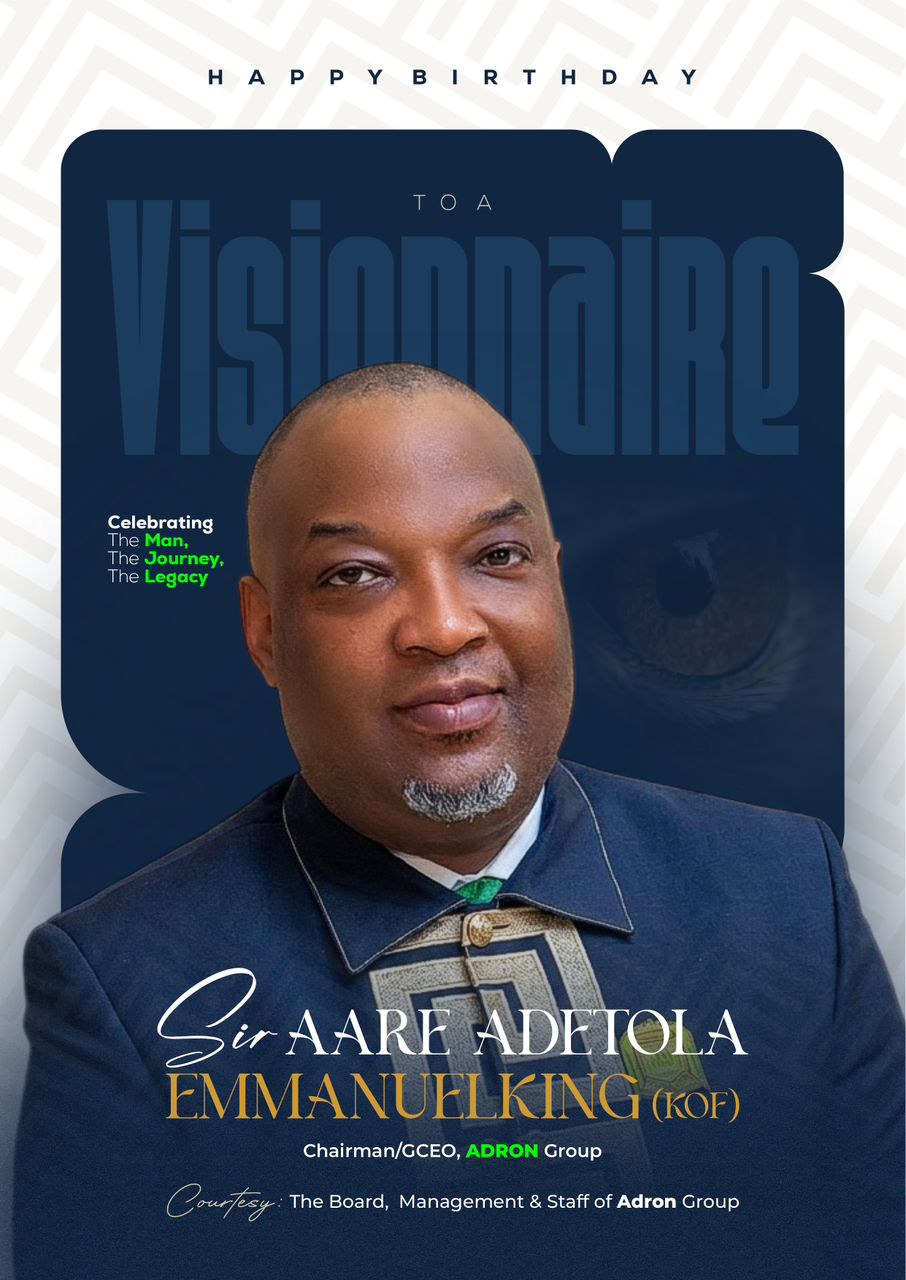
Adron Homes Celebrates Visionary Chairman, Aare Adetola Emmanuel King, at 51
The management and staff of Adron Homes and Properties Limited have joined family, friends, associates, and well-wishers across the globe to celebrate their Chairman and Chief Executive Officer, Aare Adetola EmmanuelKing, as he marks his 51st birthday.

In a statement released by the company, the milestone was described as a celebration of an exceptional leader whose vision, resilience, and entrepreneurial brilliance have not only transformed Adron Homes into a household name in Nigeria’s real estate sector but have also redefined affordable housing across the country.
Under his dynamic leadership, Adron Homes has continued to expand its footprint, delivering value-driven residential solutions while empowering thousands of Nigerians with opportunities for home ownership. His commitment to excellence, innovation, and customer satisfaction has remained the driving force behind the company’s sustained growth and industry leadership.
The statement further highlighted Aare EmmanuelKing’s passion for nation-building and community development, noting his significant contributions to job creation, youth empowerment, and the promotion of socio-economic development through real estate investments.
“As a leader, mentor, and visionary, Aare Adetola EmmanuelKing has consistently inspired a culture of excellence, integrity, and dedication within the organization. His ability to turn bold ideas into reality continues to position Adron Homes as a trailblazer in the industry,” the statement read.
The company expressed profound gratitude for his steadfast leadership and prayed for continued wisdom, strength, and sound health as he embarks on another year of impactful achievements.
As he celebrates his 51st birthday, the entire Adron Homes family proudly honours a man whose legacy continues to shape the future of real estate in Nigeria.
Happy 51st Birthday, Aare Adetola EmmanuelKing!


-

 society7 months ago
Religion: Africa’s Oldest Weapon of Enslavement and the Forgotten Truth
-

 news4 months ago
WHO REALLY OWNS MONIEPOINT? The $290 Million Deal That Sold Nigeria’s Top Fintech to Foreign Interests
-

 society6 months ago
“You Are Never Without Help” – Pastor Gebhardt Berndt Inspires Hope Through Empower Church (Video)
-

 celebrity radar - gossips2 months ago
Dr. Chris Okafor Returns with Power and Fire of the Spirit -Mounts Grace Nation Altar with Fresh Anointing and Restoration Grace on February 1, 2026
You must be logged in to post a comment Login
You must log in to post a comment.