
Politics
Edo poll: PDP alleges rigging as APC Okpebholo wins

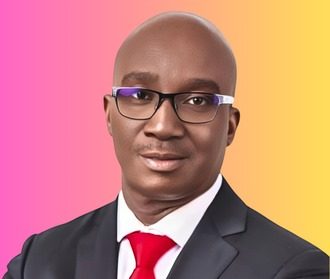
Edo poll: PDP alleges rigging as APC Okpebholo wins
Interestingly, the Peoples Democratic Party kicked against the result of Saturday’s governorship election in Edo State, which ushered in the All Progressives Congress candidate Senator Monday Okpebholo as the new governor of the state.
Adamawa State Governor, Ahmadu Fintiri, who is the Chairman, Edo State Governorship Election National Campaign Council, on Sunday, stated that the Independent National Electoral Commission should be held accountable for violating the Electoral Act.
Okpebholo polled 291,667 votes to defeat PDP’s Asue Ighodalo, who came second with 247,274 votes, and Labour Party’s Olumide Akpata, who emerged third with 22, 763 votes.
Of the 18 Local Government Areas in the state, the APC won 10 while the PDP settled for eight, but the PDP, in solidarity with its Governors Forum, insisted Ighodalo “clearly won the election.”
In a statement on Sunday, PDP’s National Publicity Secretary Debo Ologunagba responded by explaining that Fintiri presented results from the polling units showing Ighodalo in a clear lead.
The PDP stated, “The Peoples Democratic Party stands by the results of the Edo State Governorship election as garnered by its polling agents across the state and echoed by the Chairman of the Edo PDP National Campaign Council, Governor Ahmadu Fintiri of Adamawa State, which indicate that the PDP candidate, Dr. Asue Ighodalo, clearly won the election.
“The PDP asserts that the rush, venom, and hauling of insults with which the All Progressives Congress attacked Governor Fintiri only confirms APC’s violent desperation to cover its manipulations and steal the mandate freely given to Dr. Asue Ighodalo by the people of Edo State as reflected in the genuine votes cast at the Polling Units.
“As Governor Fintiri presented, the results collated from the Polling Units have Asue Ighodalo in a clear lead before the state collation exercise was hijacked by the APC, which, in connivance of some unscrupulous INEC and security officials, engaged in blatant alteration and substitution of the genuine results with fabricated figures in favour of the defeated APC candidate.”
The PDP Governors Forum, led by Bauchi State Governor, Bala Mohammed, said the Independent National Electoral Commission must live up to the expectations of the people as an “impartial umpire.”
The PDP governors urged INEC to announce results that accurately reflected the wishes of the Edo people as expressed through their votes on Saturday.
“This becomes more imperative, especially in the face of the threat to democracy by the total state capture inclination of the Tinubu-led All Progressives Congress government,” the forum stated.
“As the country perches on the horns of grave economic and security challenges, it is our expectation that INEC and everyone involved in the Edo Governorship Elections will respect the sovereign wishes of the people of Edo State and spare the nation the unpredictable consequences of a disputed result at this time.
“The PDPGF unequivocally reiterates its commitment to democratic best practices, and the peace and stability of a united Nigeria in which the citizens are not only spared the contrived ordeal of the moment but, more importantly, provided alternative opportunities to realise their legitimate dreams.
“Finally, we stand with our Governors, H/E Fintiri, H/E Diri, H/E Agbu Kefas, and H/E Oborevwori of Adamawa, Bayelsa, Taraba, and Delta States respectively, on all the actions and positions that they have taken on our behalf, with respect to maintaining the sanctity of the elections.”
At the collation centre on Sunday, the state agent of the PDP, Iyoha Osaigbovo, stated that the figures credited to APC were not a true reflection of the wish of the electorate.
Osaigbovo said, “We do not accept this result as it’s clear that the figures were allocated to the APC by INEC to aid their victory. The result, which is not a reflection of the people’s wish, may come to hunt you the people presiding over the announcement.”
However, Jarrett Tenebe, the acting APC chairman in the state, who took exception to Osaigbovo’s reference to his party in almost all his observations, said he was okay with the outcome of the election.
He stated that Edo North, which his party won, had been a stronghold of the APC and became stronger after the state’s reinstated Deputy Governor, Philip Shaibu, rejoined the party.
Reacting to the claim by Osaigbovo that the BVAS did not function or was tampered with, Tenebe said, “I would like to urge the CoS to leave the APC out of his observations and complaints. He should direct his complaints to the collation and announcement of results.”
However, the state chairman of the PDP, Tony Aziegbemi, alleged alteration of results, demanding re-collation and re-computation in a letter titled, ‘Re: Protest against manufactured vote entries and unjust inflation of APC votes and deduction of PDP votes in the collation of results of Edo State Governorship Election held on 21 September 2024.’
In the letter addressed to the office of the INEC chairman in Abuja and made available to journalists in Benin City on Sunday, the ruling party alleged that the INEC Result Viewing had inflated the votes to favour the APC.
The chairman alleged that results from some units in three Local Government Areas – Akoko Edo, Egor, and Etsako West were manipulated.
The letter read, “It has come to our attention that the Electoral Officers appointed by the INEC for the conduct of the Edo State Governorship election, made entries that are different from the actual results as uploaded on the INEC IREV, thereby unjustly inflating votes in favour of the APC and deducting the votes of the PDP.
“In Akoko Edo Local Government Area, a simple collation of all the votes recorded in the polling units results uploaded on the IREV shows that the APC obtained 25,010 votes while 34,847 votes was recorded in the EC8C declared by the LGA Returning Officer. For the PDP, a collation of the votes from the results uploaded on the IREV is 18,620 but 15,865 was returned on the EC8C declared by the LGA Returning Officer.
“It would interest you that in Ward 9 of Akoko Edo LGA, from the 36 Polling Unit results uploaded on the IREV, the total votes obtained by APC is 2,350 while 9104 was entered into the EC8B result for APC. However, the total votes for PDP is 1,359 while 633 were entered in the EC8B. Also, in Ward 6 Akoko Edo LGA, where elections were not held in Ward 6 Units 12, 17, 15, 18, 14, and 16, results were returned for the said polling units in the ward result sheet (EC8B).”
It added, “In Egor LGA, a simple collation of all the votes recorded in the polling unit results uploaded on the IREV shows that the APC obtained 10,972 votes while 16,760 votes were recorded in the ECBC declared by the LGA Returning Officer. For the PDP, a collation of the votes from the results uploaded on the IREV is 14,485 but 14,658 were returned on the EC8C declared by the LGA Returning Officer. It would interest you to note that the collation of the Egor Local Government Area was not done at the designated LGA centre but was moved to the INEC state headquarters and the PDP agent was not allowed access to be part of the exercise.
“In Etsako West, a simple collation of all the votes recorded in the polling unit results uploaded on the IREV shows that the APC obtained 29,858 votes while 32,107 votes were recorded in the EC8C declared by the LGA Returning Officer. For the PDP, a collation of the votes from the results uploaded on the IREV is 16,712 but 17,483 was returned on the EC8C declared by the LGA Returning Officer.
“The above highlighted irregularities which are very apparent are extremely scandalous and a brazen attempt to steal the mandate of the PDP and also a terrible embarrassment to the commission.”
The state’s Labour Party PRO, Sam Uruopa, told The PUNCH that his party was still reviewing the results and would come up with a position after that.
When asked if he thought that INEC skewed the result in favour of the APC, he replied, “After we review the result we will come up with a position. It is, however, disheartening that the electorate was induced with money on Election Day, which puts a dent on the credibility of the process.”
Youths protest
Some youths, who are members of the PDP, staged a protest at the office of INEC against the results. They alleged that the results had been tampered with, adding that the results announced were different from what transpired at the polling units.
Though they were restricted to Ramat Park in Ikpoba Hill area of the city by security operatives, the youths sang solidarity songs while some waved leaves to show their displeasure.
Meanwhile, a top official of the PDP told The PUNCH that the party would consider options it has, including using legal means to reverse the decision.
He noted that the party chairman had already written to the INEC chairman in Abuja, calling for a re-count and re-computing of the results.
He said, “The idea of reclaiming our mandate in the court is not a bad one but the state chairman of the party has already written a letter to the INEC Chairman’s office in Abuja and we are hoping for a favourable reply.
“However, if nothing changes, we will have to consider other options, which may also include going to court.”
The Governor of Edo State, Godwin Obaseki, urged the citizens to maintain calm and not resort to violence and destruction of property following the announcement of Okpebholo as winner of the poll.
He said, “In the last few months, the various political parties have embarked on very rigorous campaigns to sell their respective candidates for the office of governor to the people of Edo State in an exercise which came to a climax yesterday with the gubernatorial election.
“The attractive thing about democracy is the power it bestows on the people to choose who governs them. Therefore, when this power is blatantly seized from the people, it is not just a tragedy, but a travesty of democracy.
“Regrettably, the outcome of the September 21st governorship election appears to have daunted the spirit of many Edo people who feel powerless in the face of the brute force of the institutions that are supposed to protect them. It is therefore understandable that many people feel sad and aggrieved.
“But in the midst of this despair, I am urging all my fellow Edo citizens to maintain calm and not resort to violence and destruction of property in spite of this provocation.
“Peace and justice will always win at the end and this is my prescription to all the good people of Edo State who feel vexed and violated at this time.”
He added, “Clearly, it is obvious to the least discerning, the amount of impunity and reckless disregard for processes and law that was displayed in this gubernatorial election.
“In a democracy, there are safeguards for addressing grievances, and we hope that those affected will seek resolution for this blatant disregard of law and process.
“With this in mind, I implore all Edo people to go about their lawful businesses and rest assured of the commitment of our government to your wellbeing and security.”
‘God decreed Okpebholo’
Edo State Governor-elect, Senator Okpebholo, promised to replicate in the state the achievements of Senator Godswill Akpabio during his time as Governor of Akwa Ibom State.
Okpebholo spoke shortly after INEC declared him winner of last Saturday’s governorship election on Sunday.
He was at the Benin City residence of former Governor Adams Oshiomhole alongside other chieftains of the party, including Philip Shaibu, the state’s Deputy Governor.
Okpebholo thanked Edo people for standing behind him and promised not to fail them.
Oshiomhole, on his part, said, “When some people say election is about do-or-die, we say no it is about choice and power, the people having the power to hire and fire even those that have the power to sign the death warrant. Power resides only with God.
“God has decreed Senator Okpebholo to make up for the eight years disaster of Obaseki and Asue together. We did all those campaign without violence.
“Edo will now be governed by a man enriched with native wisdom, a man familiar with the custom and tradition of Edo State, a man who has used his resources to show love to the community. He has crude credentials in terms of community service. God has put those who said there will be a bloodbath in shame.”
On his part, Senator Akpabio said the victory was a turning point in the politics of Edo State.
“The will of God for the people is nothing but happiness, joy, and prosperity. The outcome of the election is a reflection of the confidence Nigerians have continued to express in President Bola Tinubu that his administration is doing its best to turn around the fortunes of Nigeria.
“What has happened in Edo is a clear reflection of what will happen in Ondo in November.”




Politics
APC Group Endorses Fubara for 2027, Calls on Tinubu and APC to Prioritise Performance Over Politics in Backing Governor’s Second Term Ambition
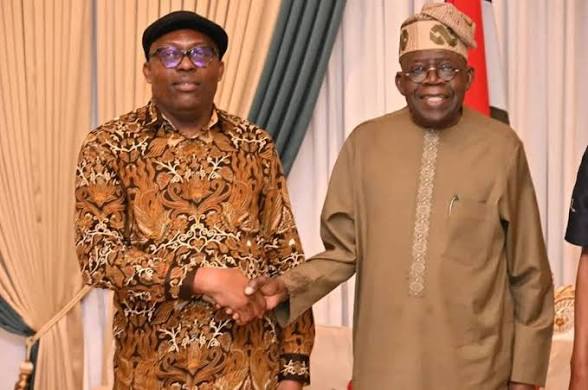
*APC Group Endorses Fubara for 2027, Calls on Tinubu and APC to Prioritise Performance Over Politics in Backing Governor’s Second Term Ambition*
The APC National Vanguard has appealed to President Bola Ahmed Tinubu and the leadership of the All Progressives Congress (APC) to support a second term in office for Siminalayi Fubara, citing what it described as “impressive and verifiable developmental strides” across Rivers State.
In a statement issued on Thursday by its National President, Dr Gbenga Salam (JP), the group said its position followed an extensive assessment tour of key infrastructure and public service projects executed under the Fubara administration.
The APC National Vanguard said the appeal was based strictly on performance, arguing that governance outcomes should outweigh partisan considerations, particularly in a state as economically significant as Rivers.
“We respectfully urge President Bola Ahmed Tinubu and the leadership of the All Progressives Congress to support the continuity of Governor Siminalayi Fubara beyond his current tenure, in recognition of his commitment to development, prudent resource management, and people-focused governance,” the statement read.
According to the group, its delegation visited multiple project sites across the state, observing ongoing and completed works spanning road construction, urban renewal, and public infrastructure upgrades.
It noted that the scale and distribution of these projects reflect a deliberate effort by the state government to extend development beyond traditional urban centres and into underserved communities.
“Our findings from the tour reveal a government that is not only active but intentional in its development agenda. The execution of capital projects across various parts of Rivers State demonstrates a clear understanding of the needs of the people and a commitment to addressing them,” Dr Salam said.
The group particularly commended what it described as prudent financial management by the administration, noting that the projects reviewed showed evidence of careful planning and efficient allocation of resources.
“At a time when economic pressures are evident across the country, it is commendable that the Rivers State government has managed its resources in a way that delivers visible and impactful development without signs of fiscal recklessness,” the statement added.
The APC National Vanguard further observed that despite political tensions in the state, the Fubara administration has maintained focus on governance, ensuring continuity in project execution and service delivery.
The group argued that such stability is critical for sustained development and should be encouraged rather than disrupted.
“Leadership must ultimately be judged by results. In Rivers State, there is clear evidence of progress—projects that are not only announced but executed, and policies that translate into real benefits for citizens,” Dr Salam noted.
The group warned that discontinuity in leadership could stall ongoing projects and reverse gains already recorded, stressing the importance of allowing a performing administration to consolidate its achievements.
“Rivers State is at a pivotal stage where continuity will allow for the completion of ongoing initiatives and the deepening of development gains. Supporting Governor Fubara for a second term is, therefore, a decision in the best interest of the people,” the statement said.
In addition to its call on the APC leadership, the group reaffirmed its support for President Tinubu, expressing confidence in his administration’s broader economic and governance reforms.
The APC group urged Nigerians to remain supportive of efforts aimed at stabilising the economy and strengthening public institutions.
“We reiterate our endorsement of President Bola Ahmed Tinubu for a second term in office, in recognition of his leadership and commitment to national development. With sustained support, the administration can consolidate its reform agenda for the benefit of all Nigerians,” Dr Salam added.
The APC National Vanguard concluded by calling on political actors to prioritise development and public interest over partisan divides, insisting that governance should always be guided by performance and accountability.
“Where leadership demonstrates prudence, delivers development, and remains focused on the welfare of the people, it deserves continuity. This is the position we have reached after a careful and independent assessment of Rivers State,” the statement added.
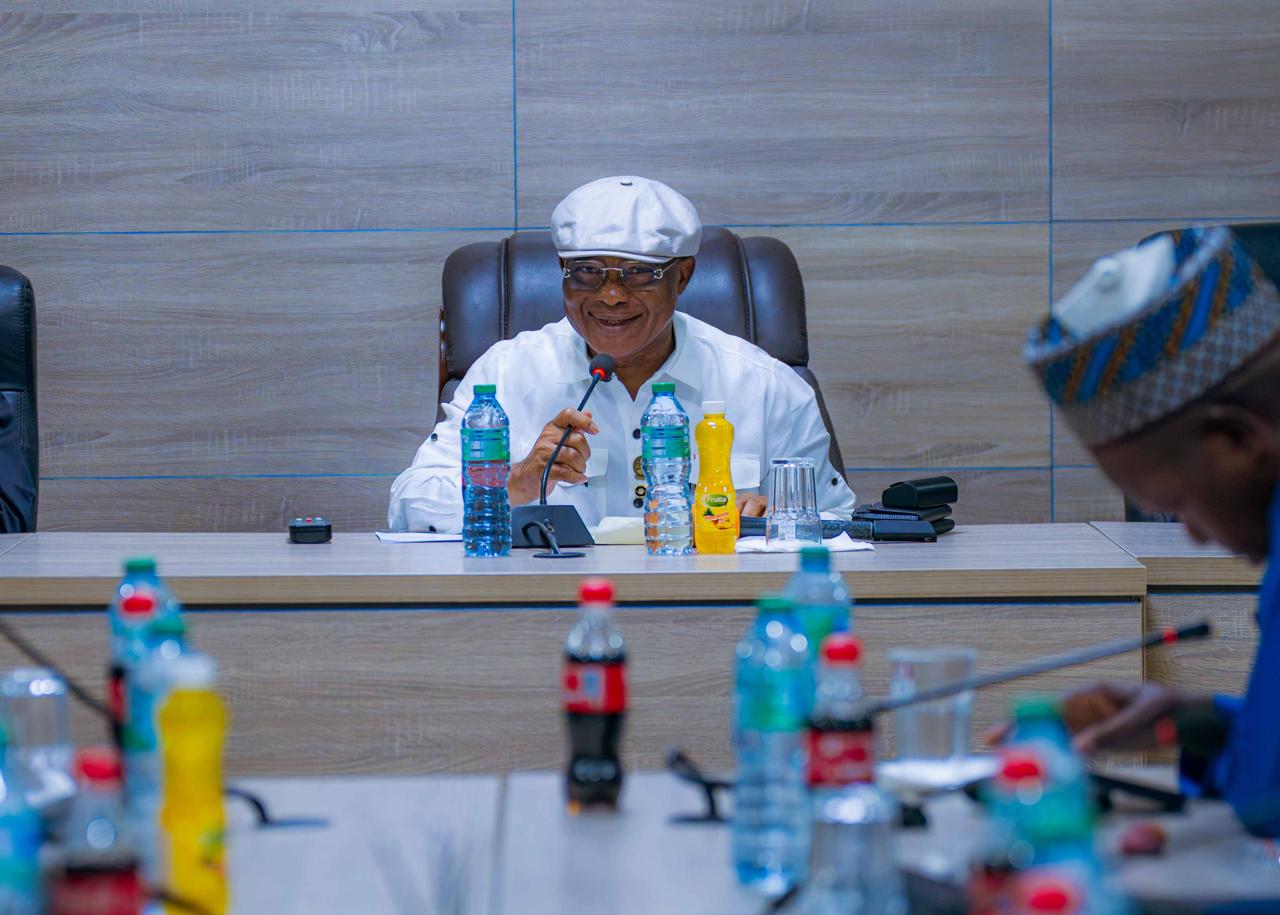
*Renewed Hope Ambassadors Step Into the Next Phase
Fresh from the successful APC 2026 National Convention, the Renewed Hope Ambassadors National, Zonal, and State leadership gathered in Abuja over the weekend, for its fourth strategic meeting, setting the tone for nationwide grassroots activation ahead of 2027.
Chaired by Governor Hope Uzodinma (Imo State) the Director General and National Coordinator of the Renewed Hope Ambassadors, alongside Deputy Director-General, Governor Uba Sani of Kaduna State, and Governor Inuwa Yahaya of Gombe State as Secretary, the session reinforced one clear direction: One Party. One Message. One Mobilization whilst also laying out a strategic roadmap for the activation of the network across all communities in Nigeria.
Backed by the strength of 31 APC-led states, the Renewed Hope Agenda is taking Bola Ahmed Tinubu’s message of progress and reform to every corner of Nigeria.
From bold economic restructuring to initiatives like NELFUND, the increase in the national minimum wage from ₦30,000 to ₦70,000, and strategic investments in critical sectors, including PNiCGI, the mission remains clear: helping Nigerians understand both the purpose and the progress of the Renewed Hope vision.
This is coordination at scale. This is grassroots engagement with purpose. This is the next phase of Renewed Hope with One Party, One Message, and One Mobilisation framework
#RenewedHopeAmbassadors #APC #WeAreAPC


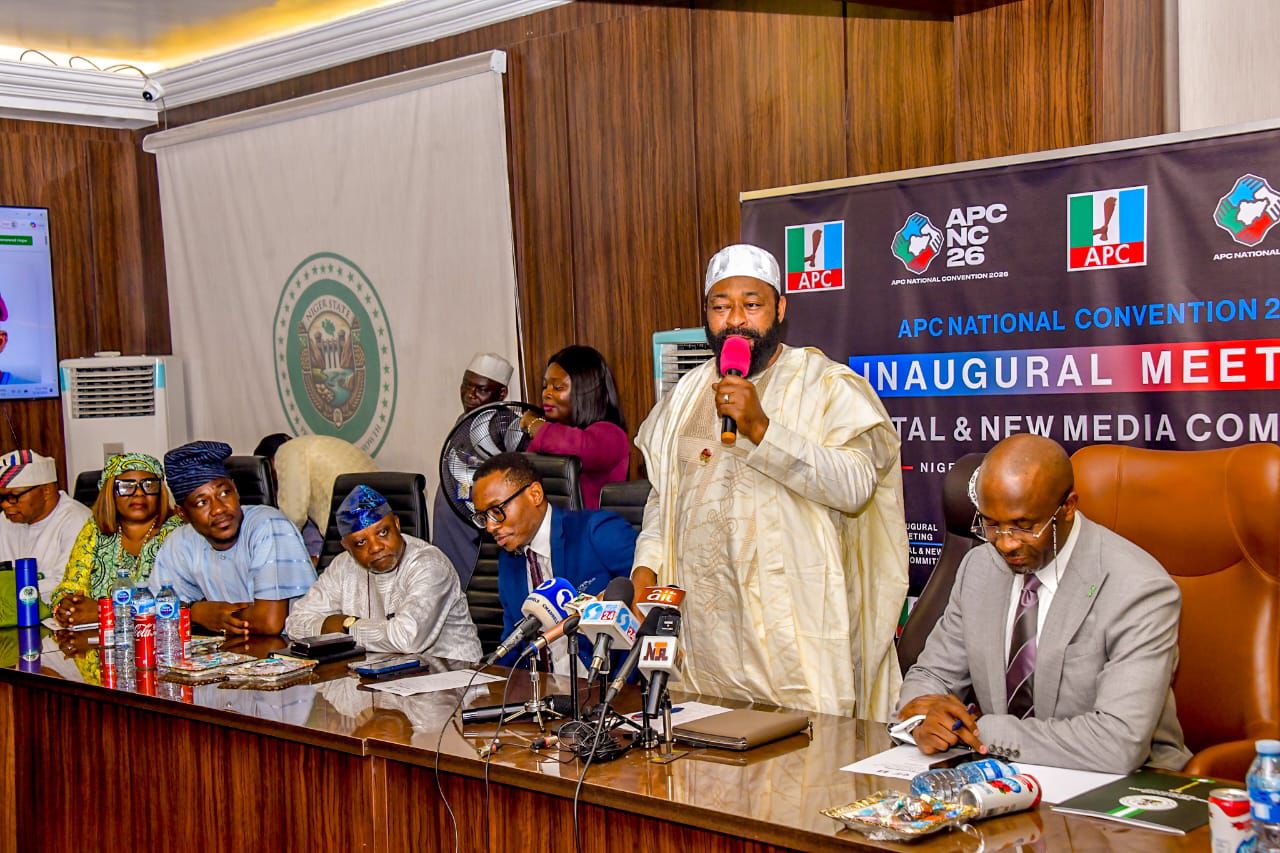
Governor Bago Inaugurates APC Digital Media Sub-Committee Ahead of National Convention.
Governor Umaru Bago has inaugurated the Digital Media Sub-Committee for the forthcoming National Convention of the All Progressives Congress (APC), scheduled to hold on March 27 and 28, 2026 in Abuja.
Chairing the sub-committee, Governor Bago tasked members with the responsibility of effectively communicating the party’s manifesto to the public.
He emphasized the need to leverage social media platforms to highlight the achievements and ongoing efforts of President Bola Ahmed Tinubu, noting that communication gaps have posed challenges that must now be decisively addressed.
The Co-Chair of the sub-committee, Hon. Benjamin Kalu, Deputy Speaker of the House of Representatives, echoed the Governor’s position, urging members to project the activities of both the party and the government to a broader audience.
He called for a deliberate and coordinated effort to showcase the party’s achievements and policy direction, stressing the importance of shaping a compelling and consistent narrative across all digital platforms.
Delivering a presentation to the committee, Otega Ogra, SSA to the President on New Media, who serves as Secretary of the sub-committee, outlined strategic focus areas to guide the team’s operations.
His presentation highlighted communication priorities and actionable steps to achieve the committee’s mandate and strengthen the party’s digital engagement.


-

 society7 months ago
Religion: Africa’s Oldest Weapon of Enslavement and the Forgotten Truth
-

 news4 months ago
WHO REALLY OWNS MONIEPOINT? The $290 Million Deal That Sold Nigeria’s Top Fintech to Foreign Interests
-

 society6 months ago
“You Are Never Without Help” – Pastor Gebhardt Berndt Inspires Hope Through Empower Church (Video)
-

 celebrity radar - gossips2 months ago
Dr. Chris Okafor Returns with Power and Fire of the Spirit -Mounts Grace Nation Altar with Fresh Anointing and Restoration Grace on February 1, 2026