
celebrity radar - gossips
End Time!! No Coming Of Jesus, Olutanmole Is Jesus- KIHEM Members

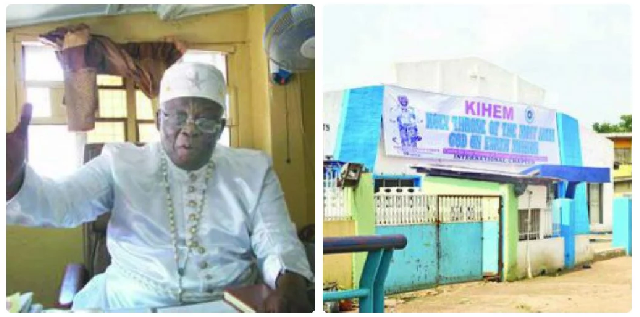

Members of Kingdom of Heaven on Earth church in Lagos has claimed that there is no coming of Jesus as their pastor is the Jesus written in the Bible.
Kingdom of Heaven on Earth church, located at Vulcaniser bus-stop of Akowonjo- Egbeda road in Lagos State is a church which differs totally from other churches you must have come across.
Although members wear white garments just like C&S and Cele churches, the practice in KIHEM is way different from what you will naturally expect from a white garment church.
The Sun was at the church at different times and some of the discoveries made were shocking. From the way of life of the members, to that of the founder of the church, Christopher Yomi Jacobs popularly called King Olutanmole of the Universe, who is in his 60s and many more, you are bound to have your mouth wide open after reading this.
Read below as first published by The Sun:
”The SATURDAY SUN team had set out initially that evening for an interview with the founder of the church, a man highly revered and almost worshipped as a deity by members. Popularly called King Olutanmole of the Universe, the man said to be in his 60s is always regal in appearance.
Investigations revealed that King Olutanmole’s original name is Christopher Yomi Jacobs and he hails from Ijebu-Ode in Ogun state. ”He started his ministry at Ilupeju area of Lagos in 1972 from a modest bungalow. Few years later when his ministry started growing, he moved to Akowonjo his present site where he was reported to have acquired large expanse of land through a female member of the church who was related to landowners in Akowonjo. The old woman now deceased was elevated to the position of Mother-In-Israel as a result of her activities in the ministry.
Her house is not far from the church. ”Although several attempts made to book an appointment for interview with King Olutanmole were futile, Saturday Sun’s team observations while on visits to the place to book appointment with Olutanmole was revealing. Although it was learnt that members of the church have been barred from speaking to the media about anything concerning the church, some observations that were made during the visits were confirmed by some members who pleaded anonymity. ‘While on one of the trips, it was noticed that members live together like in a commune.
If you were outside or inside the church you may not know this, but a close observation one evening revealed that after their service, members rather than trooping outside to take commercial buses home or drive outside the premises were seen moving towards the back of the church. But here it is a no-go area for non-members.
It is here you have apartments where members live. Even on a particular day after a group of children had just finished playing football and other games on an open field located very close to the church, about 100 of them were moving into the commune.
Boldly inscribed at the back of their Tee-shirts is ‘Olutanmole kids.’ ”Around 7 pm, some members of the church working in other parts of Lagos were also observed coming in through the main gate as they headed for the narrow path that led to the commune. Curious about this, our team sought to find out where those trooping towards the back of the church were going.
“They are going home – they are going to their residences. Their homes are inside the church but at the back. Although a visitor or non-member will just think that it is the only church we have here. We have rules for them. You have several families living here. Many even want to leave their house and join others that are living here because those that are living here enjoy Olutanmole’s special grace and favour,” a member who pleaded not to be named declared.
”At another section of the church you have what looks like a mini supermarket but what is mostly on sale here are spiritual items like holy water, oil, rosary, books, all bearing the photos and the inscription, ‘King Olutanmole of the Universe.’ The holy water is put in kegs of various sizes, and with price range with the lowest being N250.
Speaking on the holy water, another member who also spoke on condition of anonymity said there is no ailment that the water can’t cure. Thinking we are visitors that had come for spiritual counseling, he implored us to buy any of the items, insisting that buying them and using is like having personal encounter with Olutanmole himself.
“It is not easy to see Baba Olutanmole. Some people have been on the waiting list for more than six months. Some even for one year, they have not been able to see Baba. Buy those spiritual items, they will work wonders for you, they will solve all your problems at least until you are able to see Baba Olutanmole,” he pleaded.
‘On another Sunday when the SATURDAY SUN team was asked to try and see whether Olutanmole would be able to see them, it was another shocker. Inside the sprawling well-decorated church that looks like a cathedral, you see this giant seat facing you. The seat has all the marks of royalty. You will think that it is a specially designed seat for a royal father. That is where King Olutanmole sits and conducts service whenever he is around. ”In a section, you see testaments written inside a glass enclosure and they are referred to as their seven commandments.
This provoked another curiosity, and further investigations revealed that members of the church had long time ago jettisoned the 10 biblical commandments generally believed by many churches. Confirming the development, another member speaking on anonymity said: “We no longer have anything to do with the 10 commandments again. We no longer believe in the Laws of Moses.
Some years ago, around 1989 God revealed certain things to Baba while he was on the prayer mountain. When he came back, he told us that God told him to jettison the old 10 commandments and in its place have our new set of laws which are seven. If you even wake a five year old member of our ministry, he will recite the seven commandments without stress.”
”And these are the seven commandments in Olutanmole’s church namely: Be Obedient, Worship God at all Times, Be Faithful in your Deeds, Be Obedient to God the Father, Be Obedient to God the Son, Be Obedient to the Holy Spirit, and Be Obedient to Olutanmole. One interesting aspect of the Sunday service at Olutanmole’s church is that there is no limit to the number of hours members can stay. On this, another source in the church explains, “We complete or round off service as Olutanmole wishes. If Baba wishes that it should be two hours, so be it or if he says it is 24 hours, so also be it.”
‘While not describing Olutanmole as God, members fervently believe that he is Jesus Christ personified on earth. In fact, their major belief which they also professed during the Sunday worship was that they pity other Christians that still believe in the second coming of Jesus Christ. To them, Jesus Christ is not coming back again.
“Baba, King Olutanmole is Jesus Christ and he is the one that will take us to heaven to meet God and Jesus Christ his beloved son. This is why this ministry is called Kingdom of Heaven on Earth”. Taken up on this, he fired back: “Have you not read anything about Baba? Although Baba hardly talks to the media, he rarely does, on such occasions, which are few he had declared that he is the one that is being expected, that he is the messiah who will take us to heaven. Forget about Jesus coming back again.”
”It was also gathered that members that work in the church’s schools (Kindergarten, Primary and Secondary School), hospital, and bookshop earn salaries but the take home is not what can be considered as living wages. A non-member of the church who works in the hospital but who spoke on condition of anonymity said: “We are working like slaves.
It is nothing to write home about. Our own condition is even a bit better compared to what members experience. We have a situation whereby father, mother and the children either work in the hospital, bookshop, bakery or in one of the schools but their collective take home pay is not up to N20,000. What do you call that? Although, they dare not raise their voice or complain because they revere or do I say fear Olutanmole.” ”Another issue that is shrouded in mystery is the number of wives and children Olutanmole has.
A source told Saturday Sun that King Olutanmole is married to almost 100 women, and has numerous children, but another source countered that he has only one wife who has seven children for him. It was gathered that Olutanmole also made it a rule that anybody getting married to any of his daughters must quit secular work and join his ministry. Not only that he must leave his house and move to the commune inside the church.
”It was further learnt that one of the two men married to one of his daughters had to resign from his lucrative job as a banker to take up residence in the commune. Always a beehive of activities, the church’s headquarters at Akowonjo is always besieged by visitors from different parts of the country and even from outside. One of the strict rules in the church is the one that forbids members from eating anything containing palm oil every Friday.
Members are also required to pay obeisance to King Olutanmole like other earthly royals. While greeting him, you must not stand but prostrate or roll on the ground before him, while he also reportedly have the right to change name of members to whatever pleases or suits him…..”




celebrity radar - gossips
Adron Homes Celebrates Visionary Chairman, Aare Adetola Emmanuel King, at 51
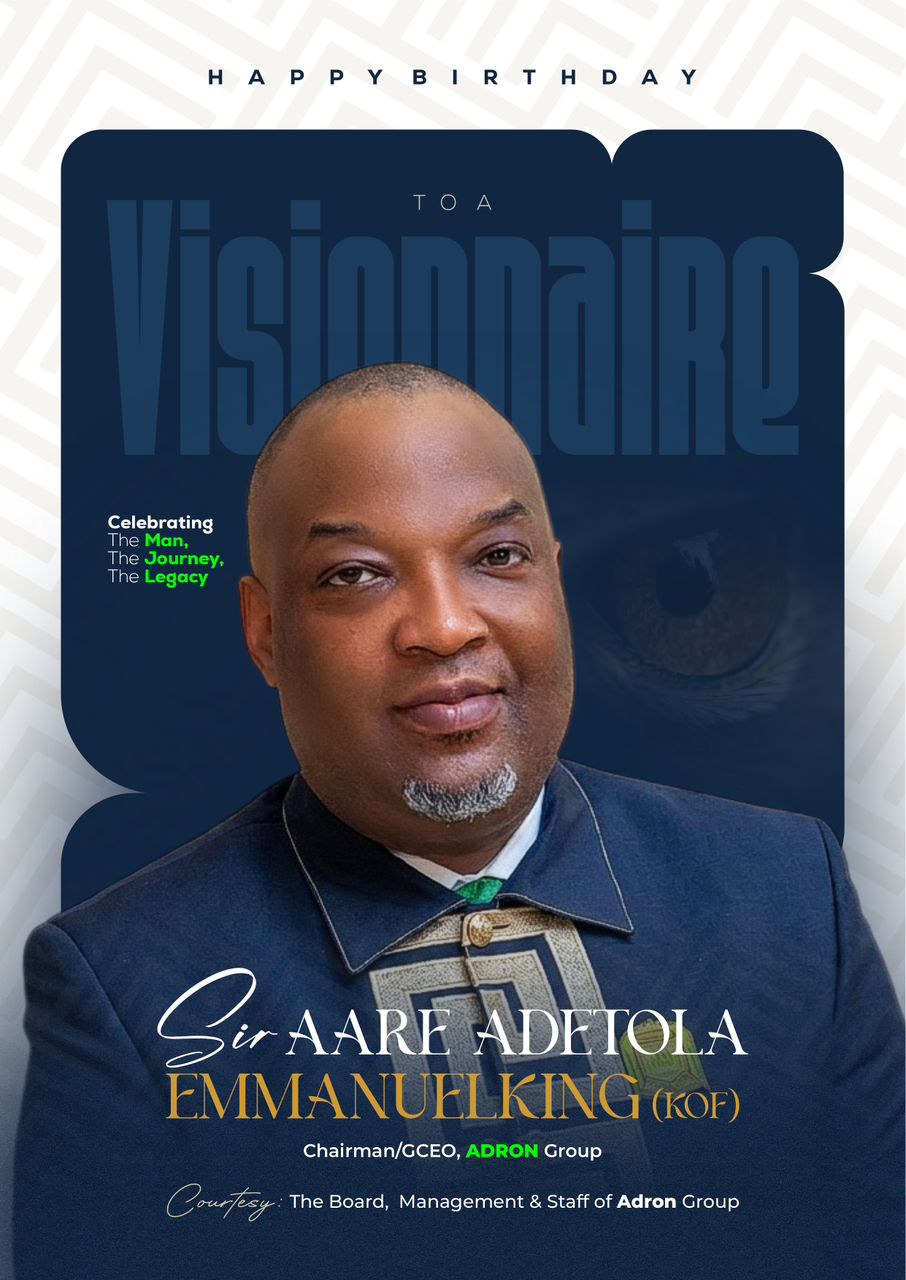
Adron Homes Celebrates Visionary Chairman, Aare Adetola Emmanuel King, at 51
The management and staff of Adron Homes and Properties Limited have joined family, friends, associates, and well-wishers across the globe to celebrate their Chairman and Chief Executive Officer, Aare Adetola EmmanuelKing, as he marks his 51st birthday.

In a statement released by the company, the milestone was described as a celebration of an exceptional leader whose vision, resilience, and entrepreneurial brilliance have not only transformed Adron Homes into a household name in Nigeria’s real estate sector but have also redefined affordable housing across the country.
Under his dynamic leadership, Adron Homes has continued to expand its footprint, delivering value-driven residential solutions while empowering thousands of Nigerians with opportunities for home ownership. His commitment to excellence, innovation, and customer satisfaction has remained the driving force behind the company’s sustained growth and industry leadership.
The statement further highlighted Aare EmmanuelKing’s passion for nation-building and community development, noting his significant contributions to job creation, youth empowerment, and the promotion of socio-economic development through real estate investments.
“As a leader, mentor, and visionary, Aare Adetola EmmanuelKing has consistently inspired a culture of excellence, integrity, and dedication within the organization. His ability to turn bold ideas into reality continues to position Adron Homes as a trailblazer in the industry,” the statement read.
The company expressed profound gratitude for his steadfast leadership and prayed for continued wisdom, strength, and sound health as he embarks on another year of impactful achievements.
As he celebrates his 51st birthday, the entire Adron Homes family proudly honours a man whose legacy continues to shape the future of real estate in Nigeria.
Happy 51st Birthday, Aare Adetola EmmanuelKing!
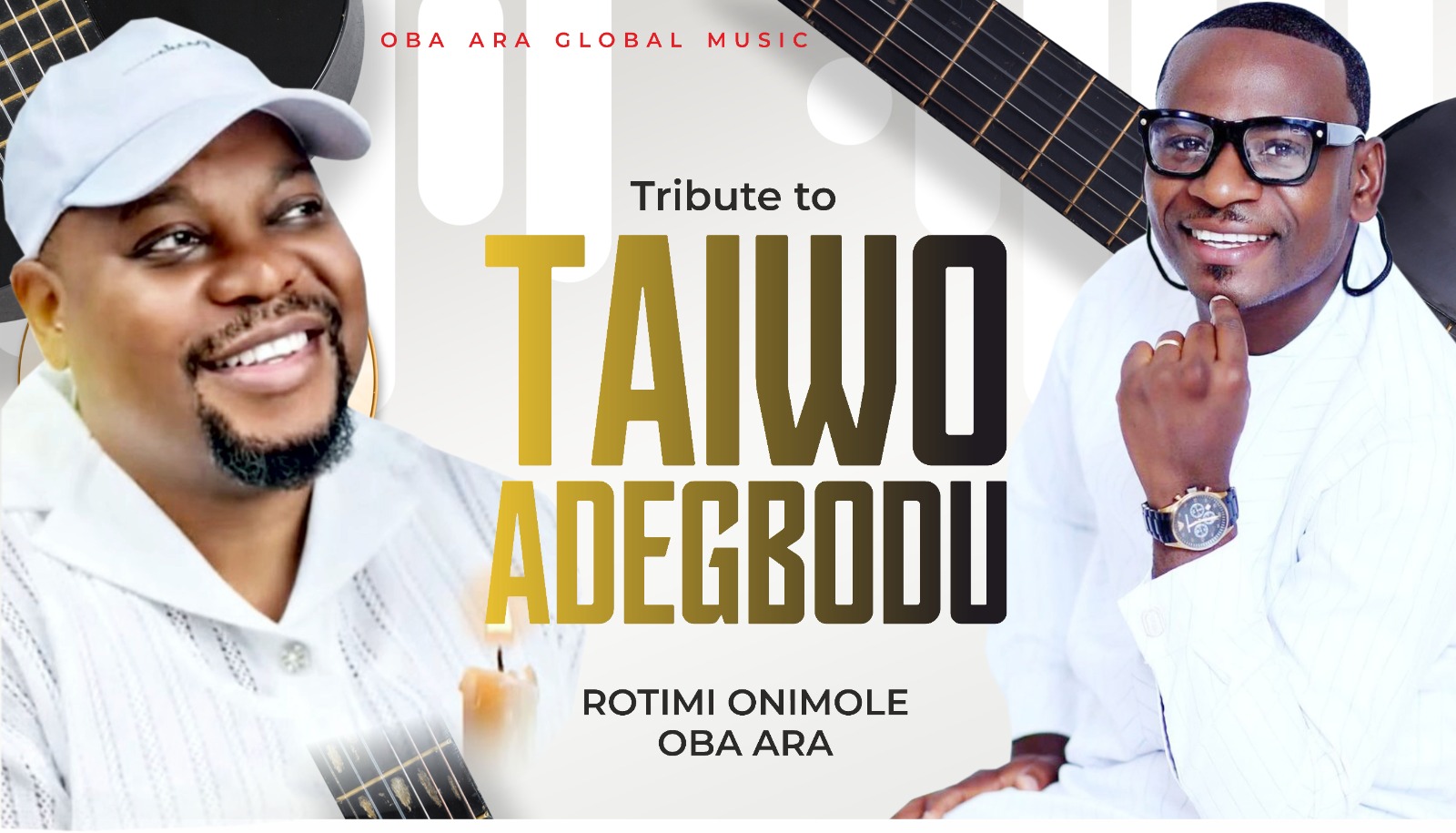
Oba Ara Releases Emotional Tribute to Late Taiwo Adegbodu
Taofik Afolabi
The gospel music community continues to grieve the painful loss of Taiwo Adegbodu, a beloved figure whose sudden departure left a deep void among fans, colleagues, and loved ones. In response to this loss, renowned gospel minister Rotimi Onimole, popularly known as Oba Ara, has released a moving tribute song that captures both the sorrow of the moment and the enduring legacy of the late singer.
Oba Ara, a proud son of Isale Eko, channels raw emotion throughout the song, using heartfelt lyrics and soul-stirring melodies to reflect on his personal connection with Taiwo Adegbodu. In the tribute, he openly expresses how deeply the news of Adegbodu’s passing shook him, describing it as a painful and unexpected loss that is difficult to come to terms with.
The song goes beyond mourning, it celebrates the life, ministry, and impact of Taiwo Adegbodu. Oba Ara highlights the late artist’s dedication to spreading the gospel through music, his inspiring voice, and the spiritual influence he had on many within and beyond Nigeria. Through powerful verses, he paints a picture of a man who lived for God and touched countless lives through his ministry.
Listeners have described the tribute as both comforting and deeply emotional, as it resonates with the collective grief of the gospel music community. It serves as a reminder that although Taiwo Adegbodu is no longer physically present, his music, message, and legacy will continue to live on.
In honoring his late colleague, Oba Ara not only pays his respects but also offers a source of healing for fans and fellow ministers, using music as a tool to process grief and celebrate a life well lived.
celebrity radar - gossips
Buratai, Fagbemi , Shagaya, Olofa, Others Eulogise Olowu Kuta’s Olori On 60th Birthday, Foundation Launch

Buratai, Fagbemi , Shagaya, Olofa, Others Eulogise Olowu Kuta’s Olori On 60th Birthday, Foundation Launch
Eminent personalities across the Nigeria stormed the TFK Event Centre, Bala Mohammed Way, Guzape, Abuja, to celebrate the 60th birthday of Olowu Kuta’s Olori, Queen Jumai Amoke and her Foundation Launch on Saturday 28, March 2026.

From former Chief of Army Staff, Lt Gen TY Buratai rtd, to the Minister of Justice and Attorney-General of the Federation, Prince Lateef Fagbemi; Olofa of Offa, HRM Oba Mufutau Gbadamosi. Even top businesswoman and socialite, Chief (Mrs) Bola Shagaya, was in attendance.


Other dignitaries were newly promoted Deputy Inspector-General of Police and former AIG Zone 2 , Lagos , Adegoke Fayoade, Major General Abdumalik, Major General Samuel Adebayo rtd (Fmr CDI);
Major General Anthony Omozoje rtd (Fmr Copp);
Alhaji Tajudeen Owoyemi (Asiwaju of Offa and CEO Radisson Hotel Nigeria;
Dr Waheed Olagunju, former managing director of Bank of Industry, Oniba of Iba, Lagos State, HRM Oba Dr Suleiman Raji ;
Justice Falola, Olu of Ile-Ogbo , Oba Adetoyese amongst many traditional rulers and captains of industry too numerous to mention.
Speaking at the occasion, the Chief Host, Olowu of Kuta, HRM Oba Dr Adekunle Oyelude Makama, CON , Tegbosun iii, who is also the husband of the celebrant commended Queen Jumai for ‘ her slender arms full of kindness’ to establish such humanitarian Foundation, ‘Amoke Children and mother in Need Foundation’ at a time Nigerians are going through economic crisis occassioned by the global meltdown.
Olowu also commended her steadfastness and love for the less privileged and downtrodden.
The monarch refrenced the task before his wife’s humanitarian gesture said her best is yet to come.
” Olori Amoke Jumai, I celebrate you. You will celebrate 70, 80, 90 and continue to shine as you continue to put a smile on people’s faces. I love you, “Olowu Kuta added.
To Lt Gen Buratai, a former army chief and former Nigerian Ambassador to Benin Republic, the reward of hard work is more work.
Buratai, who also doubles as Balogun Agba of Owu Kuta, a chieftaincy title reserved for a generalismo congratulated Queen Jumai for attaining the age of 60 in good health.
The retired army General said he’s not surprised by the turn out of eminent personalities across the country to celebrate the Olowu Kuta’s Olori because she merited it through her hospitality to all, adding that Allah the most merciful, most beneficial would accept all her act of ibadah.
The minister of Justice, Prince Fagbemi, was full of praises for Queen Jumai for deeming it fit to have a place in her heart to accommodate the needy and less privileged in ‘our society.’
Prince Fagbemi urged the guests to contribute generously to support the Foundation in order to continue to alleviate poverty and put a smile on the faces of the people.
” I congratulate you on your 60th birthday and Foundation Launch. I wish you many happy returns of the day and many more fruitful services to the country and motherland”, Prince Fagbemi added.
The celebrant, Queen Jumai who was grining from ear to ear thankfully said she was excited by the turn out and the response of the people to her foundation.
Queen Jumai, however, promised to continue to use her resources and donations received for the good of the needy and less privileged in the society.
” I want to appreciate my own Kabiesi Olofa of Offa , for his presence and im I’m using him as a point of contact to all other Kabiesis present here, the minister of justice and Attorney-General, you’re welcome, sir; Mrs Bola Shagaya, I salute your enterprise, Lt Gen Buratai, I’m grateful, sir; DIG Fayoade, Justice Falola and other dignitaries too numerous to mention, I thank you, all. To my darling husband, Kabiesi Olowu , I thank you immensely for your support. And to my family and friends, I thank you , all. E se pupo!”, she said.


-

 society7 months ago
Religion: Africa’s Oldest Weapon of Enslavement and the Forgotten Truth
-

 news4 months ago
WHO REALLY OWNS MONIEPOINT? The $290 Million Deal That Sold Nigeria’s Top Fintech to Foreign Interests
-

 society6 months ago
“You Are Never Without Help” – Pastor Gebhardt Berndt Inspires Hope Through Empower Church (Video)
-

 celebrity radar - gossips2 months ago
Dr. Chris Okafor Returns with Power and Fire of the Spirit -Mounts Grace Nation Altar with Fresh Anointing and Restoration Grace on February 1, 2026
You must be logged in to post a comment Login
You must log in to post a comment.