
society
FG Unveils National Talent Programme to Boost Youth Employment

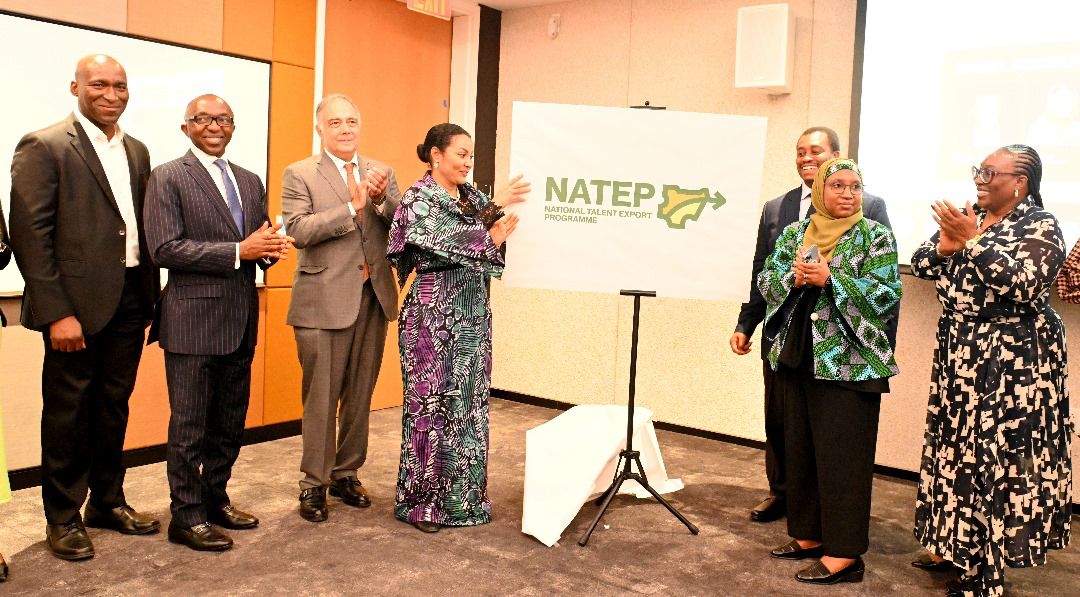
FG Unveils National Talent Programme to Boost Youth Employment
…Initiative to enhance Nigeria’s Foreign exchange earnings
On the sidelines of the 78th United Nations General Assembly (UNGA), President Bola Tinubu at the weekend launched the National Talent Export Programme (NATEP) in a bid to shore up Nigeria’s foreign exchange earnings.
President Tinubu was represented at the launch by the Minister of Industry, Trade and Investment, Dr. Doris Uzoka-Anite.
The new initiative seeks to position Nigeria as an export hub for talent outsourcing in Africa following the example of India, Bangladesh, Mexico and The Philippines.
The unveiling of the programme took place at the Microsoft Office in New York, United States of America, on Friday, September 22, 2023.
A number of dignitaries from multilateral institutions and global tech giants joined the Ministers of Industry, Trade and Investment and her counterpart from the Ministry of Communications Innovation and Digital Economy, Dr. Bosun Tijani, on the occasion.
Among those who attended were Saadia Zahidi, Managing Director of the World Economic Forum, Mr. John G. Coumantaros, Chairman, US-Nigeria Business Council, Dr. Floriezelle Liser, President and Chief Executive, Corporate Council on Africa, Amal Hassan, Chief Executive, Outsource Global, Kashifu Inuwa Abdullahi, Director-General of the National Information Technology Development Agency, Adaora Ikenze, Meta Head of Public Policy for West and Central Africa, Ola Williams, Country Manager, Microsoft Nigeria and Ghana, who joined online, Joel Ogunsola, Chief Executive, TechDev, and Dr. Femi Adeluyi, National Coordinator of the programme.
Also present were Ursula Wynhoven, Representative of the International Telecommunication Union at the United Nations, Dr. Armstrong Takang, Chief Executive of Ministry of Finance Incorporated, Mr. Charles Murito, Director, Sub Saharan Africa – Government Affairs & Public Policy, Google, Mr. Charles Okochu, Senior Business Development Manager, Amazon AWS, and Michelle Masuzyo Nsanzumuco, AfCFTA Digital Trade Expert.
In her welcome address on behalf of President Tinubu, Dr. Uzoka-Anite noted that the National Talent Export Programme is a key national initiative that will serve as a Special Purpose Vehicle (SPV) to position Nigeria as a leading global hub for service exports, talent sourcing and talent exports.
According to the Minister, NATEP will serve as a dedicated entity to address the unique needs and challenges faced by the talent and service export industry.
The programme will lay special emphasis on enhancing competitiveness, fostering innovation, and driving sustainable growth through trade in services.
The minister further noted that NATEP is part of the strategy towards achieving President Tinubu’s agenda for job creation.
The NATEP initiative will target the creation of 1 million in-demand jobs across Nigeria, over a 5-year period.
“This initiative will do three things for us as a country. One, it will create millions of jobs for our young people over the next 5 years and beyond. Secondly, it will bring in foreign exchange that our economy needs through remittances from talents that will be exported abroad and those that will be living in Nigeria and working remotely for organisations outside Nigeria and thirdly, it will generate huge tax income for state governments,” the minister said.
In her goodwill message, the Managing Director of the World Economic Forum, Saadia Zahidi, said NATEP is a timely initiative to address the very important areas of skills and jobs for Nigeria and the world.
She stated that the WEF looks forward to partnering with Nigeria on the programme.
“This is an important programme that is coming at the right time. We at WEF stand ready to work with the Nigerian government on this great initiative.”
The Minister of Communications, Innovation and Digital Economy, Dr. Bosun Tijani, who praised her counterpart for spearheading the NATEP initiative, said his ministry would collaborate and support the programme to ensure it delivers on the set objectives.

Dr. Tijani explained the importance of talents and in-demand workforce as critical part of the global economic structure, saying such is the reason why leading countries across the world are intentional about attracting and retaining top talents.
Other speakers at the event also acknowledged how auspicious and ambitious NATEP is as a national initiative capable of changing the economic fortunes of Nigeria just like India that attracts over $300 billion annually from talents export. The speakers commended the Federal Government on the laudable initiative and gave their commitment towards supporting the programme.
A panel discussion that took place during the event was moderated by the National Coordinator of NATEP, with Amal Hassan, Ola Williams and Adaora Ikenze serving as panelists.
The panel discussion attracted a lot of positive feedback from the participants and elicited their commitment to working together to support the NATEP initiative.
The event ended with the unveiling of the NATEP logo with the Minister of Industry, Trade and Investment indicating to the world that Nigeria is ready to become a global hub for talent exports.
Ajuri Ngelale
Special Adviser to the President
(Media & Publicity)
September 24, 2023




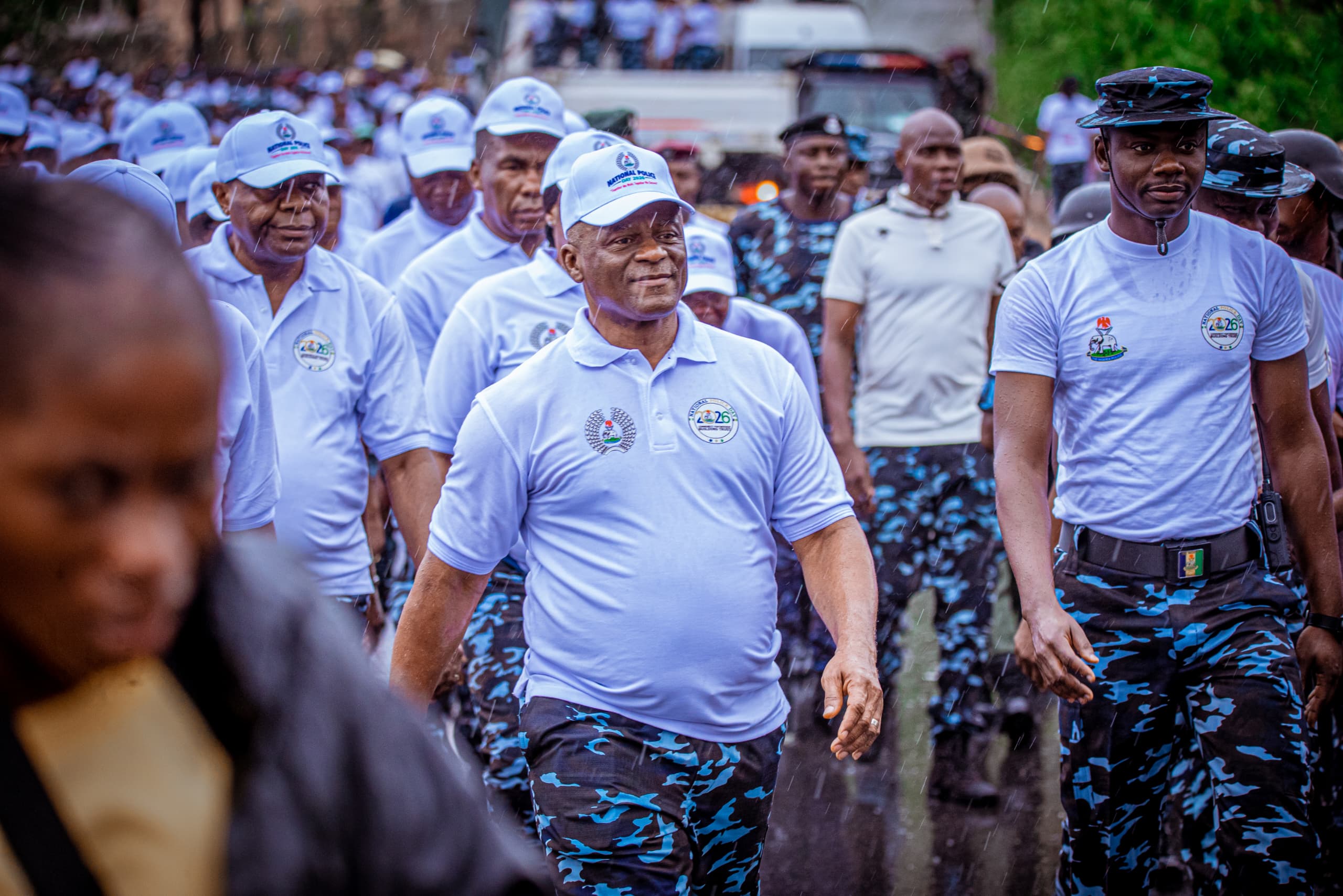
Police Day 2026: IGP Disu Leads Nationwide Walkathon To Strengthen Community Trust
The Inspector-General of Police, Olatunji Disu, on Tuesday led the management team, alongside officers and personnel of the Nigeria Police Force, in a nationwide walkathon to commemorate the 2026 National Police Day.
The event, held across state capitals and the Federal Capital Territory, formed part of activities marking Day Two of the annual celebration, themed “Community Partnership: Building Trust.”
The symbolic exercise, which drew participation from both police personnel and members of the public, was aimed at showcasing unity, discipline, and a renewed commitment to community policing and public safety.
According to the Force leadership, the walkathon underscores the Nigeria Police Force’s resolve to strengthen public trust, deepen engagement with citizens, and enhance collaboration in tackling security challenges across the country.
Participants described the initiative as a practical step toward bridging the gap between law enforcement and the communities they serve, while also promoting physical fitness and mental well-being among officers and civilians alike.
With the theme reflecting a shared responsibility for safety, the Police reiterated that sustainable security can only be achieved through active partnership with the public.
The event concluded with a renewed call for collective action under the banner: “Together We Walk, Together We Secure,” emphasizing unity of purpose in building a safer and more secure society for all Nigerians.


society
Dr. Chris Okafor invokes divine retribution upon individuals blackmailing the Grace Nation church

Dr. Chris Okafor invokes divine retribution upon individuals blackmailing the Grace Nation church
… Affirming God’s omnipotence to unveil malicious schemes.
To be frank, the ability of Doris Ogala and her associates to withstand the arduous challenges set by Senior Pastor Dr. Chris Okafor of Grace Nation Global at the culmination of the Harvest of Babies 2026 conference, the church’s flagship event, continues to elude me.
It’s advisable not to offend a powerful spiritual leader like Prophet Chris Okafor to avoid potential consequences, as seen in the situation with Doris Ogala, who was rebuked by the prophet; can she rectify the situation through confession?
Insiders close to the man of God claim that despite relentless online bullying and blackmailing, the Generational Prophet remains resolute, stating that God’s power has been evident throughout the commission’s existence. The reason for this wonderful statement is found in the scriptures, “Upon this rock I shall build my Church, and the gates of hell shall not prevail.” The more falsehoods are spread about the church and its leader, the more God elevates the church and propels him to greater heights, he asserted. He emphasized that blessings and fruitfulness are antidotes to curses, noting that God continues to bestow blessings upon the church, including miracles and the gift of children, which is one reason for the grand finale of the annual family liberation program, The Harvest of Babies.
However, the man of God issued a curse on each person speaking ill of the church, blackmailing, and uttering all sorts of falsehoods against the church, declaring that if they refused to repent within a few days, the earth would swallow them and their family members, stating that they would be of no use to themselves, their families, or society at large.
The spiritual leader cautions his followers to beware of such individuals including Doris Ogala who may taint their faith, and urges them to treat these persons as emissaries of the devil, avoiding them altogether.
Recall that the 2026 harvest of babies concluded with a remarkable birth of a miracle baby boy to a woman on the third day of the conference, accompanied by the dedication of several other miracle babies, all to the glory of God.
Christopher Sunday David writes from
Austria
“Together We Walk, Together We Secure”: Police Launch 2026 Walkathon In Abuja
The Nigeria Police Force has announced plans to host a walkathon in commemoration of the 2026 National Police Day, aimed at promoting unity, peace, and stronger community partnership.
The event is scheduled to take place on Tuesday, March 31, 2026, with participants expected to converge at the Force Headquarters Abuja by 6:00 a.m., where the walk will commence.
According to the organisers, the walkathon is designed to bring together members of the public, stakeholders, and security personnel in a show of solidarity and shared commitment to national security.
With the theme, “Together we walk, together we secure,” the initiative underscores the importance of collaboration between the police and citizens in maintaining peace and safety across the country.
Members of the public have been encouraged to participate in the exercise, which forms part of activities lined up to mark this year’s National Police Day celebration.
It is believed that the walkathon would not only foster closer ties between the police and the communities but also serve as a platform to promote awareness on collective responsibility in ensuring a safer society.


-

 society6 months ago
Religion: Africa’s Oldest Weapon of Enslavement and the Forgotten Truth
-

 news4 months ago
WHO REALLY OWNS MONIEPOINT? The $290 Million Deal That Sold Nigeria’s Top Fintech to Foreign Interests
-

 society6 months ago
“You Are Never Without Help” – Pastor Gebhardt Berndt Inspires Hope Through Empower Church (Video)
-

 celebrity radar - gossips2 months ago
Dr. Chris Okafor Returns with Power and Fire of the Spirit -Mounts Grace Nation Altar with Fresh Anointing and Restoration Grace on February 1, 2026