
celebrity radar - gossips
How I became a lecturer at law school – 24-year-old Okwor



Only 24, Kenneth Okwor is an adjunct lecturer of Corporate Law and Practice at the Nigerian Law School, Lagos Campus, and a Templars Law Firm Associate. In this interview, he tells KEMI LANRE-AREMU, about his love for the legal profession and some of his career milestones
What schools did you attend?
I attended the University of Jos where I obtained a Bachelor of Law degree; and for my vocational and professional training, I attended the Nigerian Law School, Lagos Campus. I graduated with a Second Class Upper Honours from the University of Jos, and First Class Honours from the Nigerian Law School. I graduated top of my class at the Nigerian Law School, winning several awards and prizes.
What is your work history?
Presently, I am employed as an Associate at Templars and I am also an Adjunct Lecturer of Corporate Law and Practice at the Lagos Campus of the Nigerian Law School.
What are your job responsibilities?
At Templars, I sit primarily in the finance practice area and we basically advise clients on matters relating to banking, capital markets, mergers, acquisitions and other forms of external and internal restructuring options, project finance and other financing and refinancing structures, and general advisory services on corporate and finance matters.
At the Law School, I teach Corporate Law and Practice.
Did you set out to become a lawyer or you had other professions in mind?
I actually wanted to study Literature in English. However, when it was time to fill the form that would enable me sit for the Unified Tertiary Matriculation Examination, Law was the first choice.
Why the sudden change of mind?
I do not think the decision was actuated by any altruistic feeling or by a desire to define a path for my life. Honestly, it was really about gaining admission to the university to study a prestigious course. However, when I began to study Law, I saw that I could be more and I could do more. The study of Law exposed me to deeper issues that have gone a long way in defining who I am today and what I represent.
What are your areas of speciality?
I am specialising in corporate law and finance as my core areas. For me, these areas are niche areas of practice both in Nigeria and across the world and I believe that on account of my love for corporate law and all that concerns it, I would be able to learn, grow, and contribute my quota in developing the jurisprudence in these areas.
You graduated with second class upper honours from the University of Jos and a first class from the Nigerian Law School. How did you achieve these feats?
Like I always say, it was all a function of God’s grace and hard work. Studies at the university are quite different from studies at the Law School. The approach is very different as the university emphasises substantive law and it is usually very theoretical, while the Law School teaches practical law. Even though the Law School keeps an eye out for substantive law, its emphasis is on the practical application of these laws. Therefore, if properly utilised, the knowledge gained from the university can play a key role in facilitating success at the Bar Exams.
At the university, I was diligent and hard-working, and only missed classes when they conflicted with mock trials. Why I placed more emphasis on the mock trials was because they taught me to contextualise the knowledge gained in class and taught me how they would operate in practical reality.
At the Law School, I was also diligent and hard-working. The Law School’s calendar was, and still is, properly structured such that it was perfectly possible to actively participate in the law clinic and the mock trials without missing any class, and this contributed in making the difference.
Can you recollect your first time in court?
Of course I can. It was June 6 this year. My superiors at Templars insisted that I go alone. I was scared and spent the entire weekend studying the file and rehearsing the court’s language in front of my mirror. It was a defamation suit and we were the counsel representing the claimant. In court that morning, I was nervous but the longer I waited, the more relaxed I became because I noticed that the court’s procedure was not significantly different from the mock trials I had experienced in my undergraduate and Law School days. When my matter was called, I got up and successfully did the needful.
Who and what have impacted your legal career so far?
I am an academic and a practitioner and I have mentors in both aspects of my professional life.
Albert Einstein is reputed to have observed that he saw far only because he had the privilege of standing on the shoulders of giants. My case is not different from his. My life and my story is a product of mentorship, with my parents being my first and foremost mentors. They inspire me and consistently encourage me to do more. After my parents, Mrs. Adetoun Adebiyi, the Deputy Director General and Head of Lagos Campus of the Nigerian Law School is one woman who believes that there is nothing I cannot achieve. Next on the list are my academic fathers and mentors: His Excellency, Prof. Yemi Osinbajo SAN, Prof. Nnamdi Aduba, Prof. Epiphany Azinge SAN (the one I watch from a distance), Prof.Dakas CJ Dakas SAN, Prof. Joash Amupitan SAN, Prof. Shaakaa, Mr. Alimi, Mrs.Odukoya, Mrs. Egbe, Mr.Ogbuanya, Mr. Sam Oguche, Mr.Udemezue, Mrs. James, and my best friend as far as international law is concerned – Mr. Matthias Zechariah. These persons have, whether actively or passively, consistently spurred me to aim for more.
As a practitioner, Mr. Chike Obianwu tops the list of those I work hard to be like and I learn from him daily. Working with him and Desmond Ogba has made me commercially aware, has changed the way I think, and given me deeper insights into the practical application of legal principles and the provision of ‘A’ grade services to clients.
All these persons have had positive impacts on my legal career and have contributed in pushing me this far in my very young career. I mean, I only became a year old at the Bar on December 16, 2016.
What key skills and qualities must one possess to become a successful solicitor/barrister?
Humility, hard work, diligence, high moral and ethical standards, commercial awareness, reliability, a sound knowledge of the law, continuous professional development, and of course, paying clients!
What do you think are the most important characteristics and abilities for any person’s success?
At the risk of sounding ecclesiastic, grace is a necessary tool for success in whatever we do. In addition to grace, anyone who wants to attain success must merge humility with hard work, smart work, diligent work, and excellent work. Having said that, I must state that I would typically not advice anyone to pursue success alone. I advocate excellence and if I am permitted to quote Ranchoddas of the 3 Idiots, “pursue excellence and success will pursue you pants down.”
How did you arrive at the decision to become an Adjunct Lecturer at the Nigerian Law School?
I have always wanted to teach and I developed that dream while I was a sophomore at the University of Jos. However, the opportunity to teach came when I least expected it and at a level that is best left to imagination. In my eyes, the Law School is a sacred institution reserved only for superior legal minds and I did not permit myself to dream of teaching at the Law School because I did not know that I had the requisite superior mind. Consequently, when Mrs. Adebiyi invited me to be her adjunct lecturer, I was overwhelmed with joy and disbelief.
How do you relate with your students considering your young age?
That has been a challenge – a major challenge actually. I started out by being very friendly with them, but trust students, they started abusing it. Then I switched and became strict, and they said I was proud. Even elderly students consistently try to use the age factor against me. But by and large, God has kept me through. I try to be very friendly with them, but I draw lines where necessary.
What is your ultimate career goal?
To develop the jurisprudence in the theory and practice of corporate law and finance in Nigeria as a scholar and as a practitioner, to fight for a vibrant Nigerian Bar that is made up of lawyers who are driven by a positive sense of ethics and high professional conduct, to fight for the protection of human rights (particularly the rights of internally displaced persons), to make positive impacts on legal education pre-call and mandatory continuing professional development post-call. These are at the vanguard of the career I am building.
In between all that you do, what other things interest you?
Classical music! They always bring peace with them. I also love to watch law-related television series. Arts and nature also interest me. Besides these, I lead a very boring life!
How do you achieve a work life balance?
Truthfully, I do not. In between church, Templars, the Law School, and my personal efforts towards self-development, I have no extra time to myself. Right now, the prospects of a work life balance for me is utopian.
Punch




celebrity radar - gossips
Accolades to Empress Genevieve Wining as she Celebrate birthday in Grand style

Accolades to Empress Genevieve Wining as she Celebrate birthday in Grand style
Emmanuel Clement
Vilnius, Lithuania – The Grand Hotel Vilnius will host a grand birthday celebration in honor of Her Majesty The Empress Genevieve Wining of the United Kingdom of Atlantis (UKA) on April 4th, 2026.
The four-day event promises to be an extravagant affair, marking the special birthday of Empress Genevieve Wining. The celebration will take place at the prestigious Grand Hotel Vilnius, Lithuania, renowned for its luxurious ambiance and exceptional service.

According to the event flyer, the birthday celebration will be a spectacular occasion, fitting for an empress. Guests can expect an elegant setting adorned with golden accents, sparkling champagne, and festive decorations, creating a regal atmosphere befitting the occasion.
The Empress Genevieve Wining of UKA is expected to grace the event, which will include various festivities and celebrations in her honor. The occasion aims to bring together dignitaries, followers, and guests to commemorate the empress’s birthday with grandeur and joy.
For media inquiries, accreditation, or further information about the birthday celebration of The Empress Genevieve Wining of UKA, please contact the event organizers.
Courtesy of His Excellency Emperor Prof. Solomon Wining. UKA

Today, Dr. Chris Okafor turns a year older
~By Sunday Adeyemi
It is widely acknowledged that the exceptional Dr. Chris Okafor, a man of great character, always celebrates his birthday on April 4th, and in recognition of this occasion, I am inspired to write this special tribute to honor him.
Today marks a momentous occasion as we commemorate the birthday anniversary of Dr. Chris Okafor, a rare gem, a perfect gentleman, and the revered founder of Grace Nation Church, aka Liberation City.
Without reservation, this versatile and dependable Oracle foundry has consistently proven itself worthy of the accolades bestowed upon it on this notable anniversary.
Let it be reiterated that Dr. Chris Okafor is a leader known for his generosity and commitment to humanity’s welfare and advancement. The special gifts donated recently to widows and widowers within and outside the church are a testament to his exceptional leadership.
Your reputation as an outstanding and authentic man of God is evident in your exceptional goodwill and philanthropic endeavors.
Your dedication and perseverance have yielded impressive results, and numerous people, including myself, are justifiably proud of the remarkable work you are doing.
You have consistently exemplified outstanding leadership in the Christian community, demonstrating the profound impact of your role as a gift from God to humanity. I firmly believe this to be true.
Here’s to a year of productivity, success, and happiness. Congratulations and warm wishes on your birthday, sir.
Sunday Adeyemi
Your Son
celebrity radar - gossips
Adron Homes Celebrates Visionary Chairman, Aare Adetola Emmanuel King, at 51
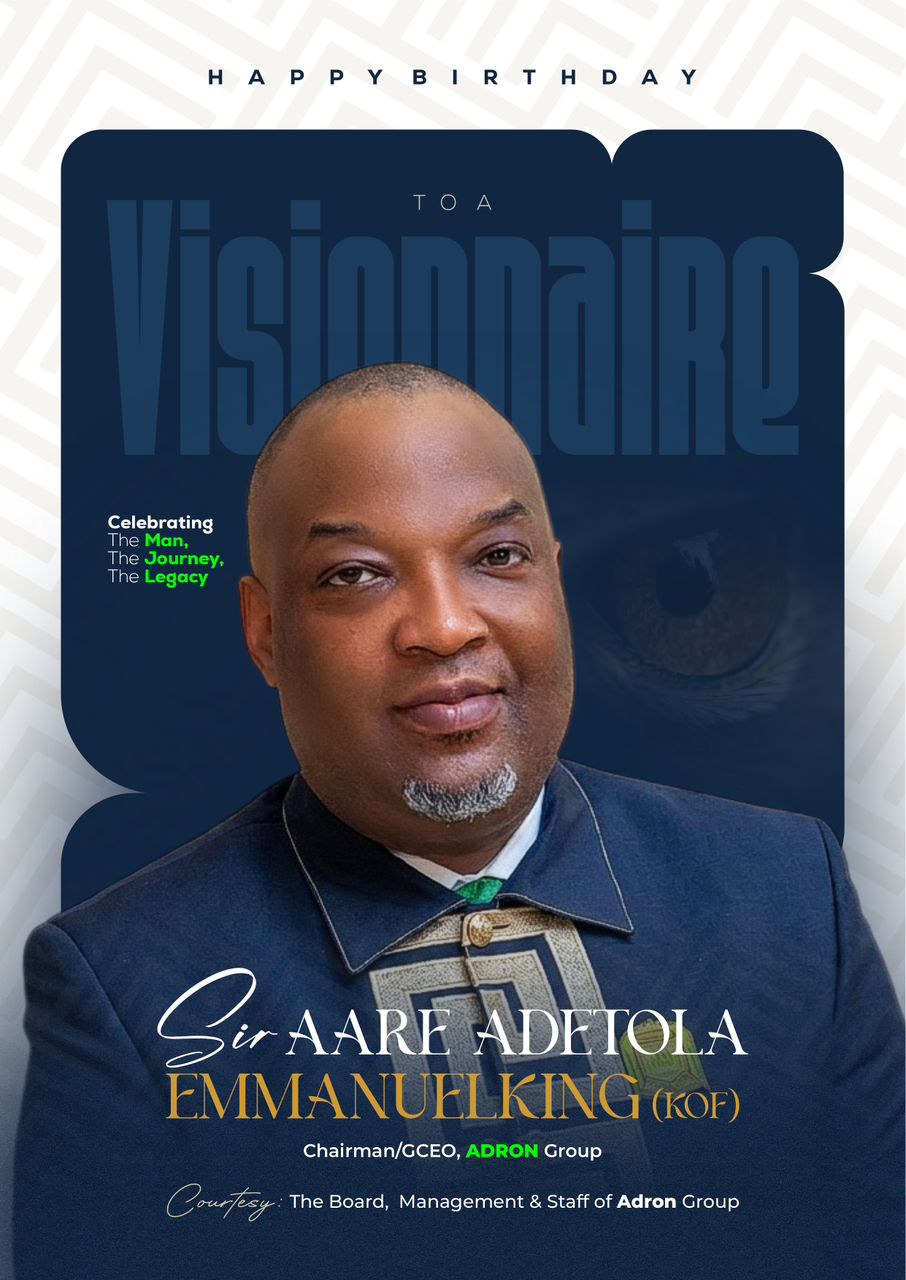
Adron Homes Celebrates Visionary Chairman, Aare Adetola Emmanuel King, at 51
The management and staff of Adron Homes and Properties Limited have joined family, friends, associates, and well-wishers across the globe to celebrate their Chairman and Chief Executive Officer, Aare Adetola EmmanuelKing, as he marks his 51st birthday.

In a statement released by the company, the milestone was described as a celebration of an exceptional leader whose vision, resilience, and entrepreneurial brilliance have not only transformed Adron Homes into a household name in Nigeria’s real estate sector but have also redefined affordable housing across the country.
Under his dynamic leadership, Adron Homes has continued to expand its footprint, delivering value-driven residential solutions while empowering thousands of Nigerians with opportunities for home ownership. His commitment to excellence, innovation, and customer satisfaction has remained the driving force behind the company’s sustained growth and industry leadership.
The statement further highlighted Aare EmmanuelKing’s passion for nation-building and community development, noting his significant contributions to job creation, youth empowerment, and the promotion of socio-economic development through real estate investments.
“As a leader, mentor, and visionary, Aare Adetola EmmanuelKing has consistently inspired a culture of excellence, integrity, and dedication within the organization. His ability to turn bold ideas into reality continues to position Adron Homes as a trailblazer in the industry,” the statement read.
The company expressed profound gratitude for his steadfast leadership and prayed for continued wisdom, strength, and sound health as he embarks on another year of impactful achievements.
As he celebrates his 51st birthday, the entire Adron Homes family proudly honours a man whose legacy continues to shape the future of real estate in Nigeria.
Happy 51st Birthday, Aare Adetola EmmanuelKing!


-

 society7 months ago
Religion: Africa’s Oldest Weapon of Enslavement and the Forgotten Truth
-

 news4 months ago
WHO REALLY OWNS MONIEPOINT? The $290 Million Deal That Sold Nigeria’s Top Fintech to Foreign Interests
-

 society6 months ago
“You Are Never Without Help” – Pastor Gebhardt Berndt Inspires Hope Through Empower Church (Video)
-

 celebrity radar - gossips2 months ago
Dr. Chris Okafor Returns with Power and Fire of the Spirit -Mounts Grace Nation Altar with Fresh Anointing and Restoration Grace on February 1, 2026
You must be logged in to post a comment Login
You must log in to post a comment.