
celebrity radar - gossips
Jonathan Finally Releases Details Of His Defeat in 2015 Election

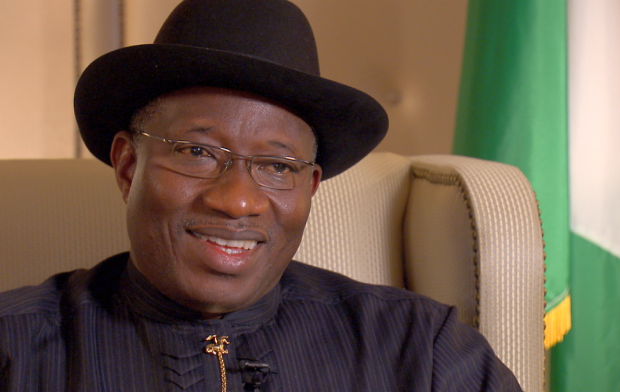

Former President, Goodluck Jonathan has released details of his defeat in 2015 election.
Jonathan had claimed that Adeniyi’s book contained many distortions concerning his defeat in 2015. He then promised to reveal the real situation.
In a new book, ‘Facts Versus Fiction: (The True Story of Jonathan Years, Chibok, 2015 and The Conspiracies) authored by Reno Omokri and to be released in the second week of July 2017, Jonathan accused northern governors under his administration of conniving with the United States to get him out of office.
He specifically mentioned former Governor of Adamawa state, Murtala Nyako, among others as one of the arrowheads of the move. He also detailed the alleged roles Nyako played in the entire saga.
Jonathan released excerpts of the chapter one of the book in which Omokri quoted one Matthew Page as giving details of what happened when the former northern governors visited the White House.
Read the excerpt:
Chapter 1 – THE CONSPIRACY TO REMOVE JONATHAN
The recent revelations from Segun Adeniyi’s book, Against the Run of Play: How an incumbent president was defeated in Nigeria, have promoted reactions and counter reactions to some of the more astounding accounts detailed in that book.
Former President Jonathan in his interview with Segun Adeniyi, gave some detail of a conspiracy to remove him from office due to patriotic policies and actions he undertook which might have set him at variance with foreign powers.
Amongst other things, Adeniyi quotes Dr Goodluck Jonathan as saying: “I got on very well with Prime Minister David Cameron but at some point, I noticed that the Americans were putting pressure on him and he had to join them against me. But I didn’t know how far President Obama was prepared to go to remove me until France caved into the pressure from America.”
Since these revelations came to light, a former Governor of Niger state, Mr Babangida Aliyu has also been quoted making comments in Segun Adeniyi’s book that corroborate the statements by Dr Jonathan.
According to Mr. Aliyu, the Obama administration had invited twelve governors from Northern Nigeria to sound them out on their commitment to the plot to unseat Dr Jonathan.
Mr. Aliyu is quoted in Segun Adeniyi’s book as saying: “I have no proof of course, but I think the idea was to ascertain what the disposition of the north would be to the idea of another term for President Jonathan. That was my reading of the situation. I believe it was all about the 2015 election for which the Americans had resolved not to support Jonathan. They just wanted to size us up for the level of commitment to regime change.”
Mr. Aliyu was referring to a series of meetings that twelve Northern governors had in the U.S. in March 2014.
Why did the Obama administration organize those meetings? What occurred at those meetings? Who said what, where, when and why? The answer to those questions will help throw light on whether or not there was a conspiracy by the Obama administration (not the United States) to remove then President Jonathan from office.
I tracked down Mr Matthew T Page who until his resignation in 2016 was the US State Department’s top intelligence analyst on Nigeria. Matthew Page also served as Deputy National Intelligence Officer for Africa with the National Intelligence Council. He sat in on each of the meetings the twelve Northern Nigerian governors attended, beginning from their meetings at the United States Institute for Peace and thereafter their meetings at the State Department.
In 2016, Mr Page left the State Department and moved to Cambridge in the United Kingdom from where he spoke to me. He was adamant that Mr Babangida Aliyu’s version of the events at those meetings where not accurate and was keen to set the records straight.
According to Mr Page, the meetings were attended by twelve Northern governors of whom the most vocal was the then governor of Adamawa state, Admiral Murtala Nyako. Others at the meetings who voiced anti Jonathan sentiments were then Kano governor, Rabiu Musa Kwankwaso, Aliyu Wammako of Sokoto and Kashim Shettima of Borno. The then governors of Kwara and Kogi were in attendance but were non-committal.
Mr Page noted that the meetings at the United States Institute for Peace were innocuous but that when the governors proceeded to the closed-door sessions at the US State Department, things changed.
According to Mr Page, present at the State Department meetings were Ambassador Linda Thomas Greenfield who was then the Assistant Secretary of State for African Affairs in the Department of State’s Bureau of African Affairs. Also present at the meeting was the then number three man at the State Department, Ambassador Thomas Alfred “Tom” Shannon Jr, acting Deputy Secretary of State of the United States and the Under Secretary of State for Political Affairs.
At that meeting, Admiral Murtala Nyako read out a memo he had written itemizing the case against Jonathan. He was so openly and almost violently against the Jonathan administration in his speech that he had to be openly rebuked at the meeting by the then Nigerian ambassador to the US, Ambassador Adebowale Adefuye of blessed memory.
Admiral Nyako’s belligerence against the Jonathan administration was so venomous that it prompted a rebuttal from the Gombe state governor, Ibrahim Hassan Dankwambo, who showed loyalty to the then Nigerian President. According to Mr. Page, this prompted most of the other Northern governors present to turn on him.
In my interview with him, Mr Page revealed to me that after the anti Jonathan tirades by these governors, they were shepherded to the White House on March 18, 2014 for more meetings. Even though Mr Page attended the reception at the White House for the Northern governors, he did not make me privy to who were at that particular meeting other than stating that the governors met with then National Security Adviser, Susan Rice. Ms. Rice is however a known Nigerian specialist and was the person who on July 7, 1998, allegedly made the tea that the presumed winner of the June 12, 1993 Nigerian Presidential election, chief MKO Abiola, drank minutes before passing away after reportedly foaming at the mouth.
After the meeting, the Obama White House released a statement which said, amongst other things: “Rice and the governors discussed the need to bring an end to the violence and insurgency in northern Nigeria; create broad-based economic opportunity in the north and throughout Nigeria; protect and respect human rights; strengthen democratic governance; and ensure that the 2015 election in Nigeria are free and fair.”
What the White House statement did not say, but which I verified from other sources, was that at that meeting, Admiral Nyako accused then President Jonathan of being behind Boko Haram, the Islamic terrorist group that is behind the insurgency in Nigeria’s Northeast (the same accusation was publicly made by Nasir El-rufai in 2014. El-rufai was one of a handful of All Progressive Congress party officials that related directly with David Axelrod’s firm as AKPD Message and Media prepared the APC for the 2015 elections). One question arises though. When sub national officials from a nation that is friendly to the United States espouse comments that undermine the president of that friendly nation, why would such persons be honored with very high level meetings that stretched from the State Department to the White House? When I asked Mr Page if he thought that the Obama administration was opposed to the re-election of the then Nigerian president, Goodluck Jonathan, he paused and said: “My objective opinion is that it was not as if the administration was against Jonathan. There were a few issues.
The Obama administration was a bit disappointed (I know that sounds paternalistic) but there were some issues they felt let down on, and you have to remember that the Obama administration supported the transfer of power to Jonathan in 2010.
The issues were the human rights situation in the Northeast which has still not changed under Buhari and Diezani Alison-Madueke who they felt should have been removed. Washington also took issue with some clauses in the Same S*x Marriage (Prohibition) Bill 2013, even though they understood that Nigerian cultural values were more conservative on the issue than American ones.”
Mr Page continuing said: “The US ambassador to Nigeria at the time was actually anti-Buhari, believing he failed to call his followers to order during the post-election violence of 2011.” Although he listed three reasons why the Obama administration felt let down on by Dr Jonathan, my conversation with Mr Page gave me a sense that the first two reasons were just excuses and that the main reason was because of the Same S*x Marriage (Prohibition) Bill 2013.
That issue was a deal breaker for the Obama administration because of the strong support they had from the LGBT (L*sbian, Gay, Bis*xual or Transgender) community for Mr Obama’s re-election campaign of 2012. Per the New York Times, the gay vote was “crucial” to Obama’s re-election, whereas to CNN, the LGBT community not only made the difference in 2012 by trooping out to vote for Obama, they were also his top donors.
In Tracy Baim’s book, Obama and the Gays: A Political Marriage, she details the influence that the former American President wields with the LGBT community. Very few voting blocs have the get out the vote power that the LGBT community has, being that they are great at organizing for the purpose of advancing their agenda.
NAIJ.com reports that on March 18, 2014, Ms Rice met with the 12 governors in the US where issues of strategic importance to both the United States and Nigeria were discussed.
Part of the issues discussed, according to the White House, included the need to bring an end to the violence and insurgency in northern Nigeria; create broad-based economic opportunity in the north and throughout Nigeria; protect and respect human rights; strengthen democratic governance; and ensure that the 2015 elections in Nigeria are free and fair.
“Ambassador Rice drew special attention to the importance of Nigeria’s 2015 elections; the role that governors can play in countering corruption; and how the United States remains committed to partnering with Nigeria to address shared challenges,” the White House statement had said.
Naij.





Today, Dr. Chris Okafor turns a year older
~By Sunday Adeyemi
It is widely acknowledged that the exceptional Dr. Chris Okafor, a man of great character, always celebrates his birthday on April 4th, and in recognition of this occasion, I am inspired to write this special tribute to honor him.
Today marks a momentous occasion as we commemorate the birthday anniversary of Dr. Chris Okafor, a rare gem, a perfect gentleman, and the revered founder of Grace Nation Church, aka Liberation City.
Without reservation, this versatile and dependable Oracle foundry has consistently proven itself worthy of the accolades bestowed upon it on this notable anniversary.
Let it be reiterated that Dr. Chris Okafor is a leader known for his generosity and commitment to humanity’s welfare and advancement. The special gifts donated recently to widows and widowers within and outside the church are a testament to his exceptional leadership.
Your reputation as an outstanding and authentic man of God is evident in your exceptional goodwill and philanthropic endeavors.
Your dedication and perseverance have yielded impressive results, and numerous people, including myself, are justifiably proud of the remarkable work you are doing.
You have consistently exemplified outstanding leadership in the Christian community, demonstrating the profound impact of your role as a gift from God to humanity. I firmly believe this to be true.
Here’s to a year of productivity, success, and happiness. Congratulations and warm wishes on your birthday, sir.
Sunday Adeyemi
Your Son
celebrity radar - gossips
Adron Homes Celebrates Visionary Chairman, Aare Adetola Emmanuel King, at 51
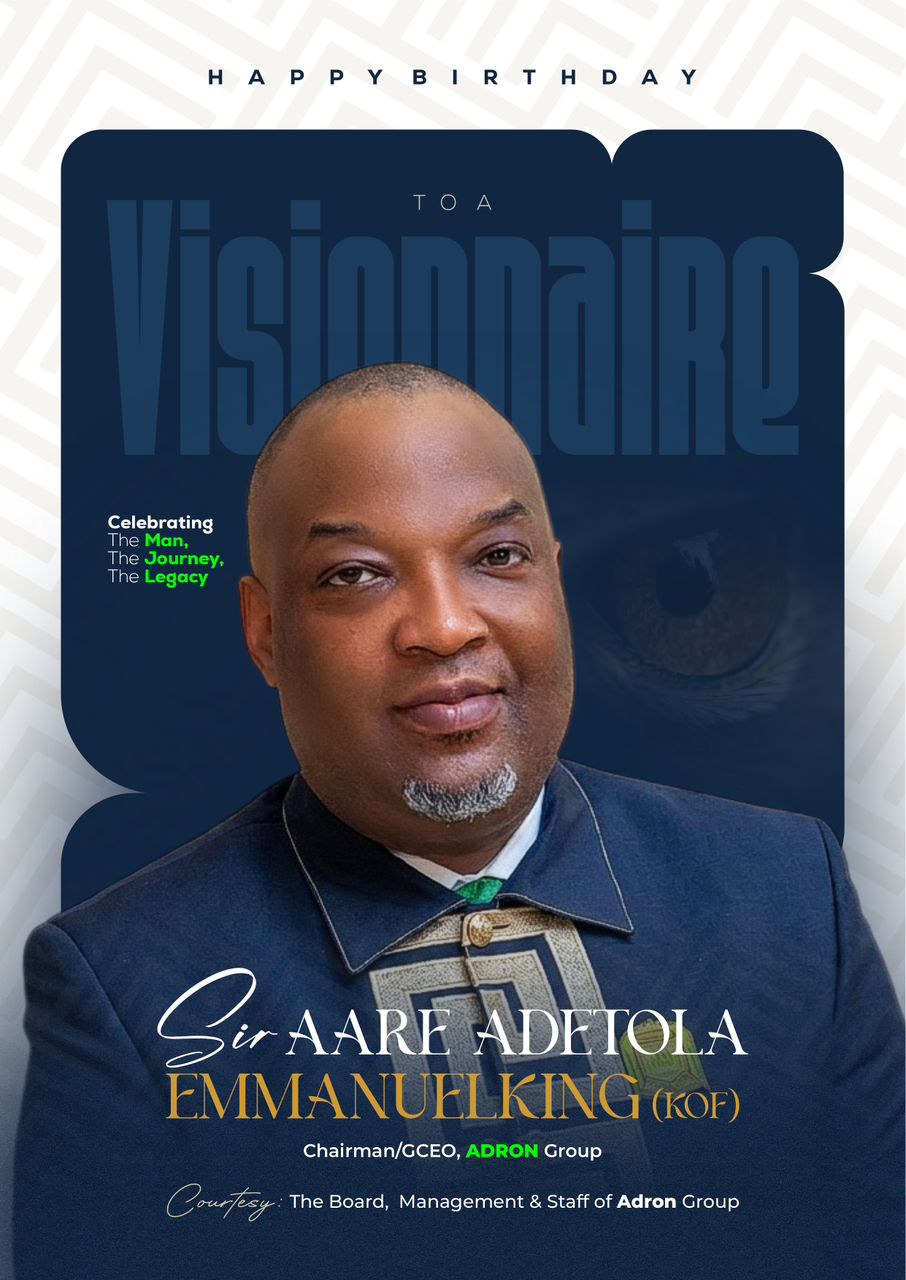
Adron Homes Celebrates Visionary Chairman, Aare Adetola Emmanuel King, at 51
The management and staff of Adron Homes and Properties Limited have joined family, friends, associates, and well-wishers across the globe to celebrate their Chairman and Chief Executive Officer, Aare Adetola EmmanuelKing, as he marks his 51st birthday.

In a statement released by the company, the milestone was described as a celebration of an exceptional leader whose vision, resilience, and entrepreneurial brilliance have not only transformed Adron Homes into a household name in Nigeria’s real estate sector but have also redefined affordable housing across the country.
Under his dynamic leadership, Adron Homes has continued to expand its footprint, delivering value-driven residential solutions while empowering thousands of Nigerians with opportunities for home ownership. His commitment to excellence, innovation, and customer satisfaction has remained the driving force behind the company’s sustained growth and industry leadership.
The statement further highlighted Aare EmmanuelKing’s passion for nation-building and community development, noting his significant contributions to job creation, youth empowerment, and the promotion of socio-economic development through real estate investments.
“As a leader, mentor, and visionary, Aare Adetola EmmanuelKing has consistently inspired a culture of excellence, integrity, and dedication within the organization. His ability to turn bold ideas into reality continues to position Adron Homes as a trailblazer in the industry,” the statement read.
The company expressed profound gratitude for his steadfast leadership and prayed for continued wisdom, strength, and sound health as he embarks on another year of impactful achievements.
As he celebrates his 51st birthday, the entire Adron Homes family proudly honours a man whose legacy continues to shape the future of real estate in Nigeria.
Happy 51st Birthday, Aare Adetola EmmanuelKing!
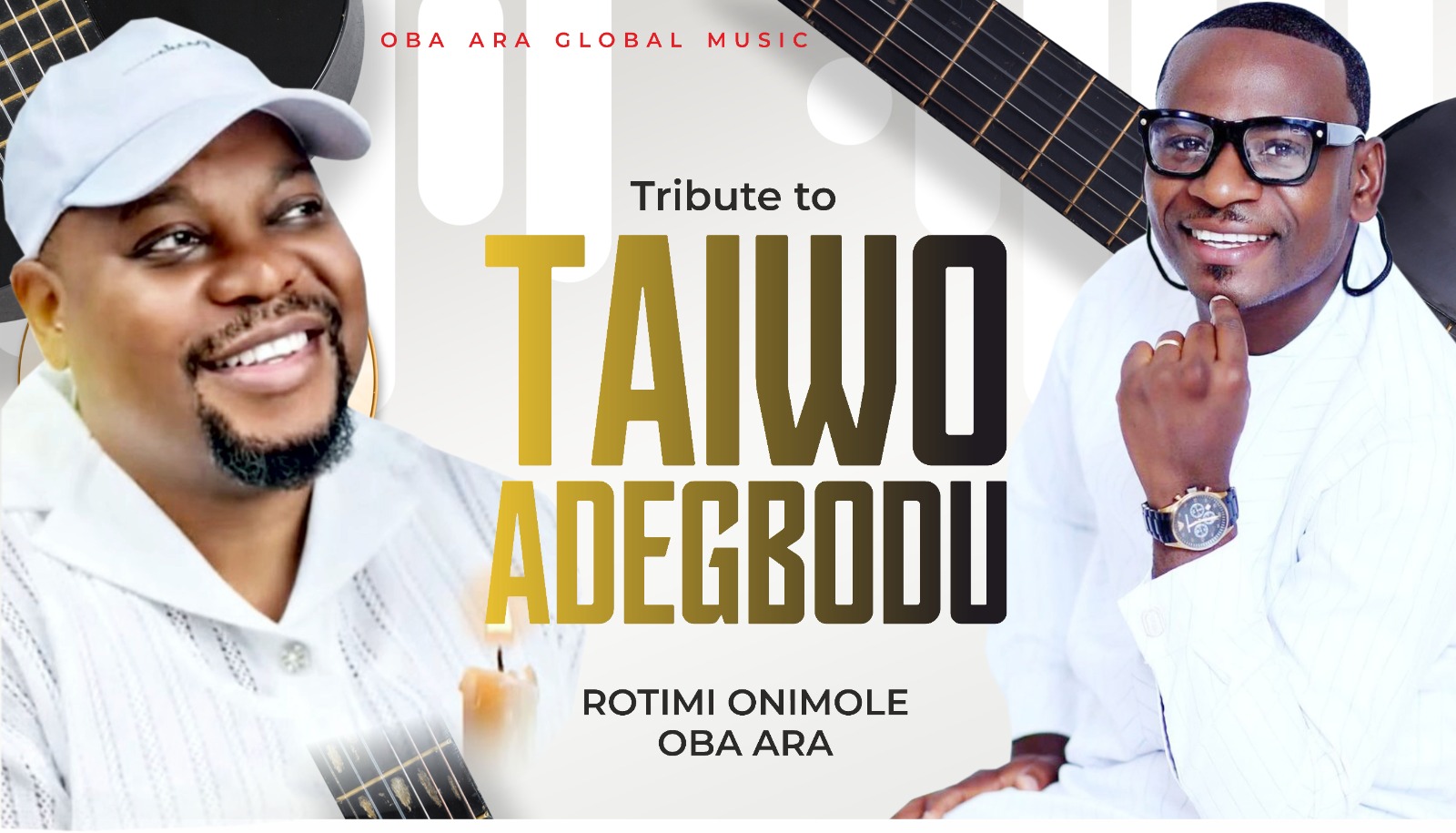
Oba Ara Releases Emotional Tribute to Late Taiwo Adegbodu
Taofik Afolabi
The gospel music community continues to grieve the painful loss of Taiwo Adegbodu, a beloved figure whose sudden departure left a deep void among fans, colleagues, and loved ones. In response to this loss, renowned gospel minister Rotimi Onimole, popularly known as Oba Ara, has released a moving tribute song that captures both the sorrow of the moment and the enduring legacy of the late singer.
Oba Ara, a proud son of Isale Eko, channels raw emotion throughout the song, using heartfelt lyrics and soul-stirring melodies to reflect on his personal connection with Taiwo Adegbodu. In the tribute, he openly expresses how deeply the news of Adegbodu’s passing shook him, describing it as a painful and unexpected loss that is difficult to come to terms with.
The song goes beyond mourning, it celebrates the life, ministry, and impact of Taiwo Adegbodu. Oba Ara highlights the late artist’s dedication to spreading the gospel through music, his inspiring voice, and the spiritual influence he had on many within and beyond Nigeria. Through powerful verses, he paints a picture of a man who lived for God and touched countless lives through his ministry.
Listeners have described the tribute as both comforting and deeply emotional, as it resonates with the collective grief of the gospel music community. It serves as a reminder that although Taiwo Adegbodu is no longer physically present, his music, message, and legacy will continue to live on.
In honoring his late colleague, Oba Ara not only pays his respects but also offers a source of healing for fans and fellow ministers, using music as a tool to process grief and celebrate a life well lived.


-

 society7 months ago
Religion: Africa’s Oldest Weapon of Enslavement and the Forgotten Truth
-

 news4 months ago
WHO REALLY OWNS MONIEPOINT? The $290 Million Deal That Sold Nigeria’s Top Fintech to Foreign Interests
-

 society6 months ago
“You Are Never Without Help” – Pastor Gebhardt Berndt Inspires Hope Through Empower Church (Video)
-

 celebrity radar - gossips2 months ago
Dr. Chris Okafor Returns with Power and Fire of the Spirit -Mounts Grace Nation Altar with Fresh Anointing and Restoration Grace on February 1, 2026
You must be logged in to post a comment Login
You must log in to post a comment.