
celebrity radar - gossips
Nigerian Elections: Law Professor Rubbishes Chimamanda Adichie in Open Letter to Biden, Trudeau


Nigerian Elections: Law Professor Rubbishes Chimamanda Adichie in Open Letter to Biden, Trudeau
Interestingly, Yemi Oke, a top Nigerian lawyer and professor, has penned down an open letter to Canadian Prime Minister Justin Trudeau and US President Joe Biden on Nigerian elections, faulting popular Nigerian novelist Chimamanda Adichie’s stand on the February 25 presidential polls.

In the letter dated Sunday, April 9, Mr. Oke said Ms. Adichie’s letter to Joe Biden is “seditious” and a “case of extraterritorial ethnocentric politicking of a non-resident Nigerian-American.” Mr Oke added that “Chimamanda’s letter is most unbecoming” and she went below expectations to pen-down a “seditious letter against the Government and people of Nigeria.”
The academic said he found it “most bewildering” that Ms Adichie, a “privileged Nigerian-born writer, has decided to paint her country of origin black.”
“Chimamanda’s letter was against entire Nigeria’s Democracy that was fought and procured with patriotic bloods and undeterred resolve of democrats, chief among them being Asiwaju Bola Ahmed Tinubu,” he said.
Ms Adichie, the internationally acclaimed Nigerian novelist and essayist, wrote a piece titled “Nigeria’s hollow democracy” published in the latest edition of The Atlantic magazine on April 6.
Ms Adichie, 45, had said in her open letter to Mr Biden that the process of the Nigerian presidential poll was imperilled by “deliberate manipulation” and the “electoral commission ignored so many glaring red flags in its rush to announce a winner.”
Before the elections, Ms Adichie publicly declared support for Peter Obi, the candidate of the Labour Party, and hoped he would win “as many polls had predicted.”
Mr Tinubu of the All Progressives Congress was declared the winner of the presidential elections by the the Independent National Electoral Commission (INEC).
Ms. Adichie believes Mr. Tinubu could not have won the election if “results had been uploaded in real-time to the INEC portal. Mr. Tinubu of the APC polled 8,794,726 votes to defeat his closest challenger, Atiku Abubakar of the Peoples Democratic Party (PDP) who scored a total of 6,984,520 votes. The Labour Party (LP) candidate, Peter Obi came third with 6,101,533 votes.
Ms Adichie also alleged in her piece that: “Many believe that the INEC Chair has been “compromised” but there is no evidence of the astronomical US-dollar amounts he is rumoured to have received from the President-elect.”
“It was surprising to see the U.S. State Department congratulates Bola Tinubu on his victory while rage is brewing, especially among young people in Nigeria,” the novelist said, adding that “American intelligence surely cannot be so inept. A little homework and they would know what is manifestly obvious to me and so many others,” she said.

“Ludicrous claims”
In his letter, Mr Oke said: “Chimamanda’s claims and assertions on the recently concluded Presidential elections in Nigeria is not only ludicrous, it is also illogical, baseless and depicts ignoble ranting of an uninformed mind about legal and judicial processes or procedures.”
“It is unimaginable that someone who did not participate or vote in an election would make categorical statements about an election she did not witness,” Mr Oke said.
The academic added that Ms Adichie represents recent generations of Nigerian intelligentsia in the diaspora.
Her lonely voice on the election of President-Elect Bola Ahmed Tinubu is, at best, a muted trumpet which is audible to no one except herself and her co-travelers,” he noted.
The full details of Mr Oke’s letter is reproduced below.
April 9, 2023,
OPEN LETTER TO:
Mr. Justin Pierre James Trudeau, Prime Minister of Canada
and
Mr. Joseph Robinette Biden Jr., President of the United States of America,
Dear PM and President,
RE: CHIMAMANDA’S SEDITIOUS OPEN LETTER TO PRESIDENT JOE BIDEN – A CASE OF EXTRATERRITORIAL ETHNOCENTRIC POLITICKING OF A NON-RESIDENT NIGERIAN-AMERICAN
Background:
It is most bewildering that a privileged Nigerian-born writer, Chimamanda Ngozi Adichie born in Enugu, Nigeria in 1977 but now lives in the United State of America, has decided to paint her country of origin “black”. Sadly, Chimamandi’s letter is a reckless affront to our resolve not to be part of the “brain-drain” syndrome against our dear country Nigeria like the writer. Some of us are determined to be “brain-gain” to Nigeria. It is in view of this that we felt taken aback that Chimamanda went below expectations to pen-down a seditious letter against the Government and people of Nigeria.
Chimamandi’s letter titled “Nigeria’s Hollow Democracy” was not about the election or person of the President-Elect, Bola Ahmed Tinubu whose victory was freely and fairly unveiled despite dis-oriented opposition politicking and those of their supporters in Nigeria and their allies in the diaspora. Chimamandi’s letter was against the entire “Nigeria’s Democracy” that was fought and procured with patriotic bloods, labour, efforts, lives, and undeterred resolve of democrats, chief among them being Asiwaju Bola Ahmed Tinubu, who, by divine arrangement, is now the President-Elect of the Federal Republic of Nigeria.
The misplaced reference to certain “The smoldering disillusionment felt by many Nigerians” in her letter is, at best Chimamanda’s sole experience of agonies of defeat suffered by her and her preferred candidate/Party in the recently concluded Presidential elections in Nigeria.
Seditious Elements of Chimamandi’s Letter:
Sedition is an offence in the US where Chimamandi lives. It is also an offence in Nigeria, her country of origin that she now holds and views with disdains. Sedition not only covers a person’s actions but also any words or writings in print that may incite, encourage or promote the overthrowing of a government. The US criminalizes seditious conspiracy by virtue of 18 U.S.C. § 2384.
Sedition is a transnational crime defined as the “inciting by words or writing to show disaffection towards the state or constituted authority”. The transnational nature of sedition committed by US resident against sovereign nations led to the enactment of the Alien and Sedition Acts (1798) which aimed to prevent “aliens,” or non-citizens, living in the United States from resorting to seditious acts or conduct, like Chimamandi did in her letter. The law authorized the President to deport “aliens,” and also permitted their arrest, imprisonment, and deportation for seditious acts or conduct. The Sedition Act also made it a crime for American citizens to “print, utter, or publish…any false, scandalous, and malicious writing” about a government.
Locus Standi of Chimamandi’s Letter
Under the Nigerian constitution, Chimamandi’s franchise, the constitutional right to vote and be voted for, is guaranteed but the writer opted to snub the legal right by refusing to collect a PVC- Permanent Voter’s Card. She opted to be more “American” than the real Americans! She also did not participate in Nigeria’s election as a candidate or as an eligible voter. She opted to make several videos to publicly endorse and campaign for her “messianic” candidate of the Labour Party. Chimamandi became needlessly embittered because her tribal option and those of her political Party failed woefully.
Chimamandi’s claims and assertions on the recently concluded Presidential elections in Nigeria is not only ludicrous, it is also illogical, baseless and depicts ignoble ranting of an uninformed mind about legal and judicial processes or procedures. It is unimaginable that someone who did not participate or vote in an election would make categorical statements about an election she did not witness. What Chimamandi did not tell her gullible readers is that her candidate won mostly in her/his ethnic enclaves and that the President-Elect, Bola Tinubu, President Buhari, notable Nigerian Governors, Senators and others also lost in their strongholds, which should ordinarily have been their locational advantage for “manipulating” the outcome, as Chimamandi unconscionably and recklessly alleged.
The Writer-turned ethnic politician did also not indicate that the Presidential election was conducted on the same date as the National Assembly elections in which the ruling party won about 60% of all seats in the Senate and House of Representatives. The winning trends of the APC is obvious, real, actual and all-embracing.
Chimamandi represents recent generations of Nigerian intelligentsias in the diaspora. Her lonely voice on the election of President-Elect Bola Ahmed Tinubu is, at best, a muted trumpet which is audible to no one except herself and her co-travelers. The only legal and legitimate option is for her candidate, Peter Obi, not Chimamandi herself because she lacks the locus standi, to approach the Presidential Election Petition Tribunal as provided by Constitution of the Federal Republic of Nigeria, 1999 (as amended). This has since been done, and further makes it illogical for Chiamamandi to resort to writing letters capable of inciting ethnic or violent reactions in Nigeria while she resides in the comfort of the US, her new found home or haven, which was fought for and procured with hard labour and commitment of Americans. If Chimamandi is unwilling to sacrifice to make Nigeria better, she should kindly desist from undermining the resolve of those of us who believe that Nigeria could be better if we all make necessary sacrifices like American did to build their country where Chimamadi now sojourns.
Chimamandi’s and Reckless Undermining of Judicial Process
Chimamandi’s letter is most unbecoming. Nigerians have spoken with their votes in the election, and they spoke loudly and clearly. The losers have since taken to the legal and legitimate options of challenging the outcome. Legally speaking, the issue is now subjudice. Chimammadi’s letter may be viewed as an attempt to undermine the course of justice or pre-empt the outcome of judicial processes. This is similar to the same way and manner her party and candidate orchestrated polls to pre-empt the outcome of an election they knew they could never win, as they planked their electioneering and campaign activities on tribal and other ethnocentric and religious sentiments. This is also reflected in the outcome of the elections as results empirically validated this assertion.
The position of law in Nigeria (and similar to all civilized democracies of the world, including Canada and the US), is that: any individual or political party that intends to challenge or question the result of an election must ensure the petition is established on a valid ground or reason recognized by law. An election petition can only succeed with valid grounds recognized by the 1999 Constitution or Electoral Act, 2022.
The GIANT called NIGERIA Will Rise and Never Fall Again:
The expectations of Nigerians are very high on the up-coming Bola Ahmed Tinubu Presidency, which had triumphed over all known forces of religious bigotry of “Muslim-Muslim ticket, ethnicity and other divisive tendencies. Elections have come and gone. The battle now shifts to the Presidential Election Tribunal. The act of serious, progressive and purposeful governance must immediately commence and continue pending legal battles. The President-Elect is no longer for the APC. He has declared that he is now for APC as much as for PDP, LP, and other major political parties in Nigeria. More importantly, he has also declared that his administration will govern for the benefit of those who voted for or against it. Now that the season of politics, politicking and electioneering is over, it is time for all of us to collaborate, including diaspora Nigerian citizens, writers and intelligentsias like the Chimamandis of the US, Canada, the UK and elsewhere, to team-up and get Nigeria working again under PRESIDENT BOLA AHMED TINUBU.
The GIANT called NIGERIA must rise, and never fall again!
Conclusion:
The intention of this open letter is not to vilify, ridicule or incite and set the law of sedition in motion against Chimamandi. It is to right-size her over-bloated ego of perceived global self-esteem. She needs to realise that thousands, if not millions of Nigerians (including those of us who are now back home in Nigeria- but still frequently travel to those sides – to be a part of the solution and those still in the diaspora) have had similar and even better opportunities in Canada, US, UK and other countries of the world without deploying our privileged positions to undermine our country of origin, Nigeria.
At a time all hands are on deck to build a Nigeria of Renewed Hope under the in-Coming President Bola Ahmed Tinubu, the unpatriotic Chimamandis opted for the ignoble act of stimulating crisis against Nigeria, a country that prepared them for their perceived global fames. This is not the Canadian or American culture we had imbibed and which has now positively and progressively shaped our worldviews and socio-political and other forms of engagements. For the records, the pride of Canada and the US democracies is Multi-ethnicity and Multiculturalism, not ethnocentrism. This is a vital lesson for all concerned.
Thank you.
Yours faithfully,
Prof. Yemi Oke, PhD, FCTI, FCIArb.




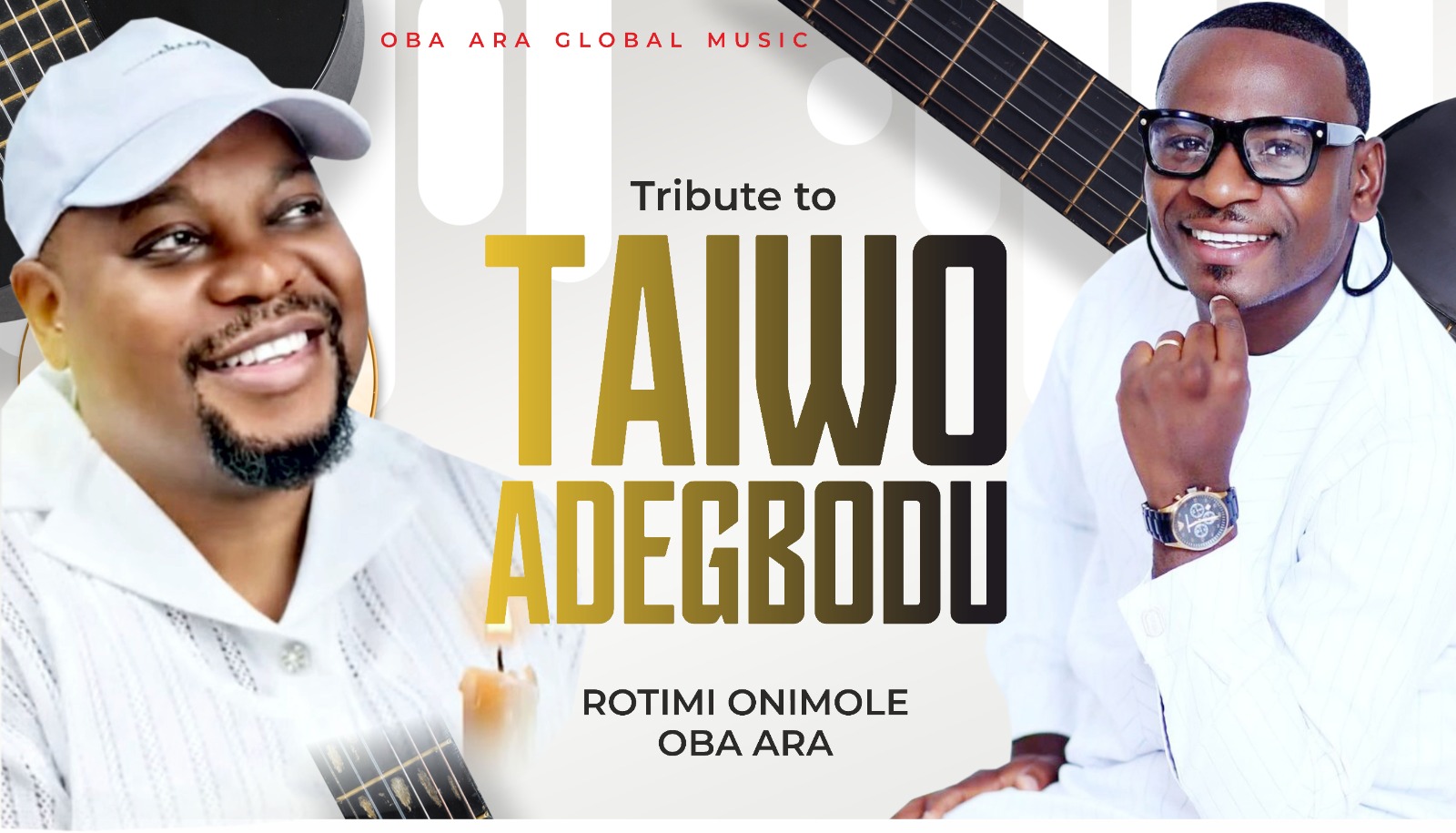
Oba Ara Releases Emotional Tribute to Late Taiwo Adegbodu
Taofik Afolabi
The gospel music community continues to grieve the painful loss of Taiwo Adegbodu, a beloved figure whose sudden departure left a deep void among fans, colleagues, and loved ones. In response to this loss, renowned gospel minister Rotimi Onimole, popularly known as Oba Ara, has released a moving tribute song that captures both the sorrow of the moment and the enduring legacy of the late singer.
Oba Ara, a proud son of Isale Eko, channels raw emotion throughout the song, using heartfelt lyrics and soul-stirring melodies to reflect on his personal connection with Taiwo Adegbodu. In the tribute, he openly expresses how deeply the news of Adegbodu’s passing shook him, describing it as a painful and unexpected loss that is difficult to come to terms with.
The song goes beyond mourning, it celebrates the life, ministry, and impact of Taiwo Adegbodu. Oba Ara highlights the late artist’s dedication to spreading the gospel through music, his inspiring voice, and the spiritual influence he had on many within and beyond Nigeria. Through powerful verses, he paints a picture of a man who lived for God and touched countless lives through his ministry.
Listeners have described the tribute as both comforting and deeply emotional, as it resonates with the collective grief of the gospel music community. It serves as a reminder that although Taiwo Adegbodu is no longer physically present, his music, message, and legacy will continue to live on.
In honoring his late colleague, Oba Ara not only pays his respects but also offers a source of healing for fans and fellow ministers, using music as a tool to process grief and celebrate a life well lived.
celebrity radar - gossips
Buratai, Fagbemi , Shagaya, Olofa, Others Eulogise Olowu Kuta’s Olori On 60th Birthday, Foundation Launch
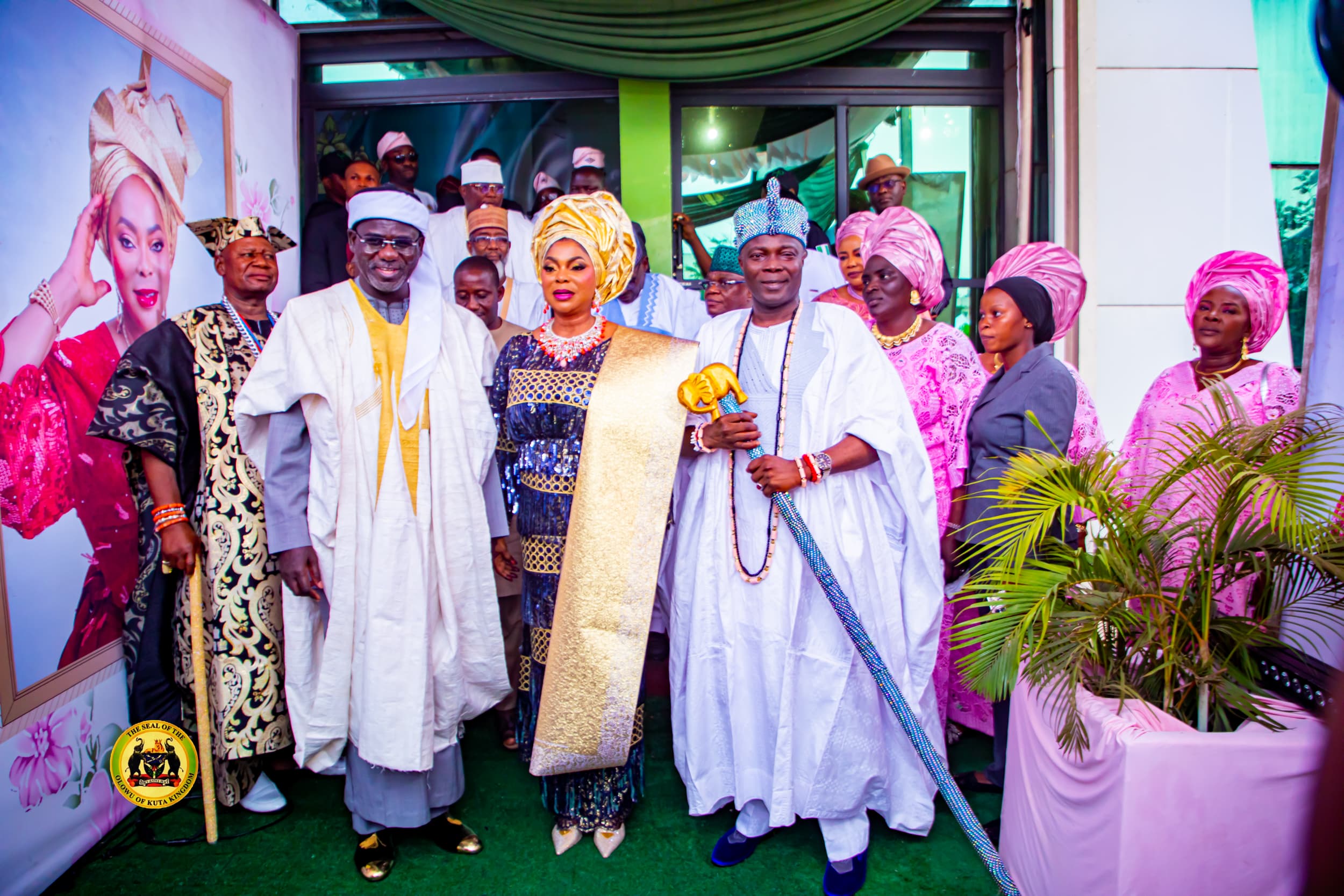
Buratai, Fagbemi , Shagaya, Olofa, Others Eulogise Olowu Kuta’s Olori On 60th Birthday, Foundation Launch
Eminent personalities across the Nigeria stormed the TFK Event Centre, Bala Mohammed Way, Guzape, Abuja, to celebrate the 60th birthday of Olowu Kuta’s Olori, Queen Jumai Amoke and her Foundation Launch on Saturday 28, March 2026.

From former Chief of Army Staff, Lt Gen TY Buratai rtd, to the Minister of Justice and Attorney-General of the Federation, Prince Lateef Fagbemi; Olofa of Offa, HRM Oba Mufutau Gbadamosi. Even top businesswoman and socialite, Chief (Mrs) Bola Shagaya, was in attendance.


Other dignitaries were newly promoted Deputy Inspector-General of Police and former AIG Zone 2 , Lagos , Adegoke Fayoade, Major General Abdumalik, Major General Samuel Adebayo rtd (Fmr CDI);
Major General Anthony Omozoje rtd (Fmr Copp);
Alhaji Tajudeen Owoyemi (Asiwaju of Offa and CEO Radisson Hotel Nigeria;
Dr Waheed Olagunju, former managing director of Bank of Industry, Oniba of Iba, Lagos State, HRM Oba Dr Suleiman Raji ;
Justice Falola, Olu of Ile-Ogbo , Oba Adetoyese amongst many traditional rulers and captains of industry too numerous to mention.
Speaking at the occasion, the Chief Host, Olowu of Kuta, HRM Oba Dr Adekunle Oyelude Makama, CON , Tegbosun iii, who is also the husband of the celebrant commended Queen Jumai for ‘ her slender arms full of kindness’ to establish such humanitarian Foundation, ‘Amoke Children and mother in Need Foundation’ at a time Nigerians are going through economic crisis occassioned by the global meltdown.
Olowu also commended her steadfastness and love for the less privileged and downtrodden.
The monarch refrenced the task before his wife’s humanitarian gesture said her best is yet to come.
” Olori Amoke Jumai, I celebrate you. You will celebrate 70, 80, 90 and continue to shine as you continue to put a smile on people’s faces. I love you, “Olowu Kuta added.
To Lt Gen Buratai, a former army chief and former Nigerian Ambassador to Benin Republic, the reward of hard work is more work.
Buratai, who also doubles as Balogun Agba of Owu Kuta, a chieftaincy title reserved for a generalismo congratulated Queen Jumai for attaining the age of 60 in good health.
The retired army General said he’s not surprised by the turn out of eminent personalities across the country to celebrate the Olowu Kuta’s Olori because she merited it through her hospitality to all, adding that Allah the most merciful, most beneficial would accept all her act of ibadah.
The minister of Justice, Prince Fagbemi, was full of praises for Queen Jumai for deeming it fit to have a place in her heart to accommodate the needy and less privileged in ‘our society.’
Prince Fagbemi urged the guests to contribute generously to support the Foundation in order to continue to alleviate poverty and put a smile on the faces of the people.
” I congratulate you on your 60th birthday and Foundation Launch. I wish you many happy returns of the day and many more fruitful services to the country and motherland”, Prince Fagbemi added.
The celebrant, Queen Jumai who was grining from ear to ear thankfully said she was excited by the turn out and the response of the people to her foundation.
Queen Jumai, however, promised to continue to use her resources and donations received for the good of the needy and less privileged in the society.
” I want to appreciate my own Kabiesi Olofa of Offa , for his presence and im I’m using him as a point of contact to all other Kabiesis present here, the minister of justice and Attorney-General, you’re welcome, sir; Mrs Bola Shagaya, I salute your enterprise, Lt Gen Buratai, I’m grateful, sir; DIG Fayoade, Justice Falola and other dignitaries too numerous to mention, I thank you, all. To my darling husband, Kabiesi Olowu , I thank you immensely for your support. And to my family and friends, I thank you , all. E se pupo!”, she said.
celebrity radar - gossips
Adron Homes Elevates Cultural Pride as Dignitaries Grace 39th Lisabi Festival in Abeokuta
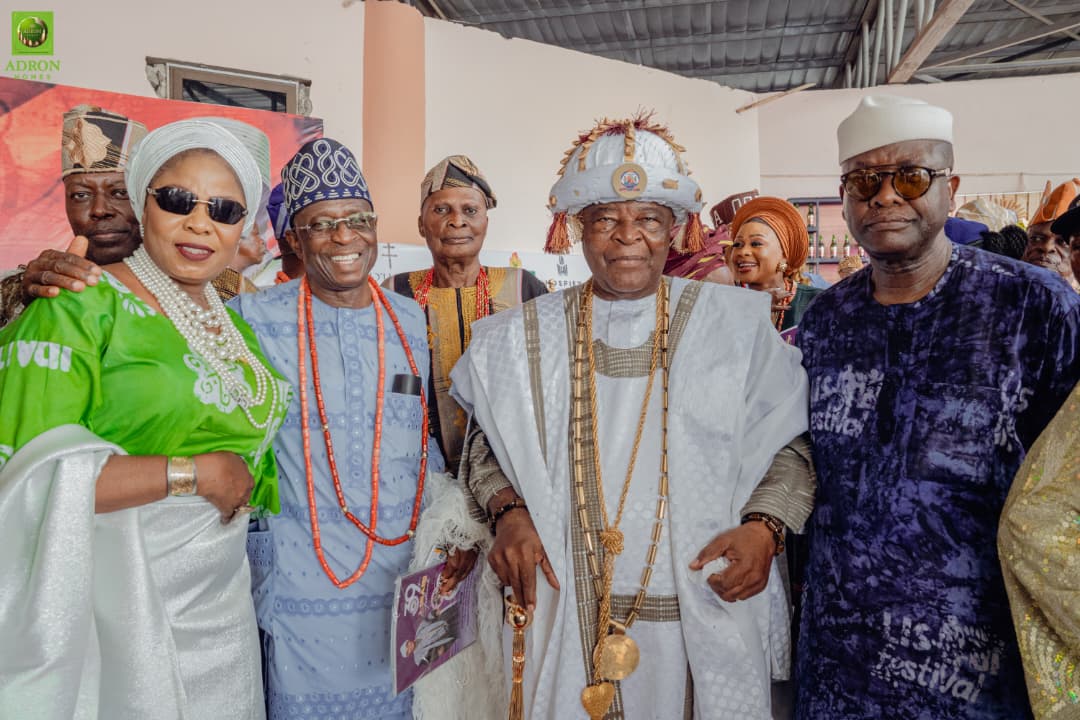
Adron Homes Elevates Cultural Pride as Dignitaries Grace 39th Lisabi Festival in Abeokuta
The ancient city of Abeokuta came alive in a grand display of culture, history, and unity as dignitaries from across Nigeria converged at the iconic Ake Palace Ground for the 39th edition of the Lisabi Festival, an annual celebration deeply rooted in the Egba people’s heritage.
The event, proudly supported by Adron Homes and Properties Limited, witnessed an impressive parade of distinguished personalities, traditional rulers, government officials, business leaders, and cultural enthusiasts, all captured in vibrant pictures that tell the story of a people united by history and pride.
From richly adorned monarchs in regal attire to elegantly dressed guests reflecting the depth of Yoruba tradition, the images from the festival encapsulate moments of honour, reverence, and celebration. Each photograph portrays not just faces, but influence, leaders, and stakeholders who continue to shape cultural preservation and community development.
At the heart of the celebration was the revered Oba Adedotun Aremu Gbadebo, whose presence underscored the festival’s significance as a symbol of Egba resilience and identity. Surrounding him were eminent dignitaries whose attendance further amplified the prestige of the event.
Adron Homes and Properties Limited stood out prominently, not only as a sponsor but as a key driver of cultural sustainability. Through its strategic support, the company reinforced its commitment to preserving indigenous heritage while fostering community engagement. The brand’s visibility across the venue and within the pictorial highlights reflects a deliberate alignment with culture, tradition, and people-centered development.
Beyond real estate, Adron Homes has continued to position itself as a cultural partner, investing in platforms that celebrate history and strengthen communal bonds. Its involvement in the Lisabi Festival is a testament to its broader vision of building not just homes, but legacies rooted in identity and pride.
The 39th Lisabi Festival, as captured through the lens of dignitaries in attendance, is more than an event, it is a narrative of continuity. And through its unwavering support, Adron Homes has once again set the pace, demonstrating that corporate institutions can play a vital role in sustaining the cultural heartbeat of a people.
As the echoes of drums fade and the colours of the festival linger in memory, one thing remains clear: the story told through these images is one of unity, heritage, and the enduring partnership between tradition and progress.


-

 society6 months ago
Religion: Africa’s Oldest Weapon of Enslavement and the Forgotten Truth
-

 news4 months ago
WHO REALLY OWNS MONIEPOINT? The $290 Million Deal That Sold Nigeria’s Top Fintech to Foreign Interests
-

 society6 months ago
“You Are Never Without Help” – Pastor Gebhardt Berndt Inspires Hope Through Empower Church (Video)
-

 celebrity radar - gossips2 months ago
Dr. Chris Okafor Returns with Power and Fire of the Spirit -Mounts Grace Nation Altar with Fresh Anointing and Restoration Grace on February 1, 2026