
society
Nigeria’s $9 Million Image-Laundering Debacle: Misplaced Priorities, Diplomatic Failure and the Cost of Reputation Over Security

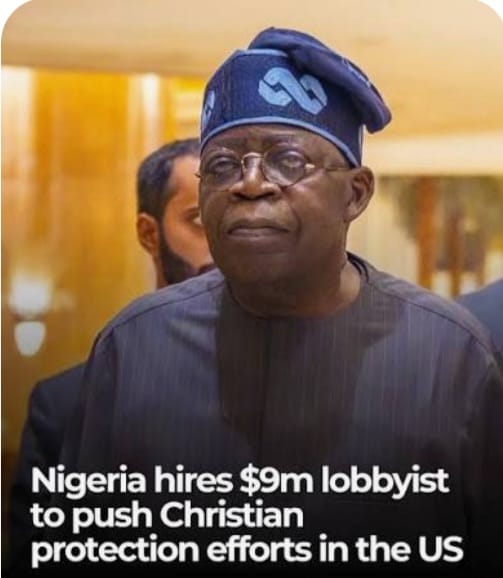
Nigeria’s $9 Million Image-Laundering Debacle: Misplaced Priorities, Diplomatic Failure and the Cost of Reputation Over Security.
By George Omagbemi Sylvester
“Why Abuja’s Decision to Spend Millions on U.S. Lobbying Amid Deepening Insecurity and Economic Hardship Is a National Embarrassment.”
In a decision that has sparked domestic outrage and intensified global scrutiny, the Federal Government of Nigeria has entered into a $9 million (about ₦13.5 billion) lobbying contract with a Washington-based public affairs firm in a bid to shape the narrative over alleged “GENOCIDE” claims against Christians in the country. The contract, which was executed on December 17, 2025, was signed on behalf of the Nigerian government by Aster Legal, a Kaduna-based law firm and DCI Group, an American lobbying and public affairs company. The agreement mandates that DCI Group help communicate Nigeria’s actions to protect Christian communities and sustain U.S. support for counter-terrorism efforts.

Yet, this costly engagement abroad has provoked resounding condemnation from political parties, civil society organizations and policy analysts who argue that such an expenditure (at a time of worsening insecurity and economic hardship) reflects a distorted sense of national priority and diplomatic failure.
A $9 Million Contract Amid Crises at Home. Under the terms of the contract, Nigeria paid an upfront $4.5 million on December 12, 2025, covering the first six months of the lobbying engagement. The remaining amount is structured as a monthly retainer of $750,000, bringing the total value to $9 million over one year, with the initial period running until June 30, 2026, and subject to automatic renewal unless terminated by either party with a 60-day notice.
The ostensible objective, officials say, is to “assist the Nigerian government in communicating its actions to protect Nigerian Christian communities and maintaining U.S. support in countering West African jihadist groups and other destabilizing elements.”
On its face, this may seem like a legitimate diplomatic engagement. However, critics argue it is reductive, counterproductive and a glaring misallocation of public funds at a time when Nigerians are confronted with everyday threats and from rampant banditry and terrorism to crippling inflation and infrastructure decay.

Misplaced Priorities, According to Critics. Commentators and civil society leaders have condemned the contract as scandalous, indefensible and morally blind. The African Democratic Congress (ADC), for instance, described the expenditure as “OBSCENE,” saying no amount of paid lobbying would hide the government’s failure to protect lives and property at home. The party’s National Publicity Secretary said: “While the ADC recognizes the importance of representing Nigeria’s interests internationally, spending $9 million on image management at a time when millions of Nigerians cannot afford food, fuel, or basic healthcare is a clear case of misplaced priorities and moral blindness.”
Similarly, the Peoples Democratic Party (PDP) labeled the public relations contract “DEFECTIVE and DECEPTIVE,” questioning why a government with vacant ambassadorial positions would outsource core diplomatic functions to a private law firm and yet fail to articulate its record effectively through its own diplomatic corps.
Human Rights Writers Association of Nigeria (HURIWA) also weighed in, calling the move a “senseless waste of public funds” when those resources could have been deployed to address security gaps that have cost thousands of lives and displaced millions.
Diplomacy by Proxy: A Sign of Institutional Weakness?

The Nigerian government’s turn to paid lobbying in Washington exposes a deeper institutional weakness in Nigeria’s diplomatic architecture. Diplomats and foreign service professionals are meant to champion Nigeria’s interests abroad. Yet, the reliance on external firms suggests that the government views international image management as a technical exercise to be contracted rather than a fundamental part of statecraft to be pursued through capable, accountable institutions.
An experienced former foreign service officer, speaking anonymously, noted: “A government that has left key ambassadorial positions vacant now seeks to outsource diplomacy to lobbyists, further weakening Nigeria’s institutional credibility and reducing foreign policy to transactional propaganda.” This view echoes widespread concern that international perception cannot be effectively rebranded without genuine improvement in security and governance on the ground.
The Genocide Narrative and Its Complexity. The backdrop to this lobbying contract is a contentious narrative surrounding alleged violence against Christian communities in Nigeria. In 2025, influential U.S. political figures, including former President Donald Trump, characterized the violence as “GENOCIDE,” a designation the Nigerian government has firmly rejected. Nigerian authorities insist that insecurity affects all communities irrespective of religion, attributing violence to terrorism, banditry and criminality rather than systematic religious persecution.
Yet the issue has gained traction among foreign policymakers, think tanks and diaspora advocates who argue that ethno-religious violence in Nigeria is intensifying and requires urgent international attention. This has created a competitive narrative environment in Washington, with various lobbyists, including groups linked to pro-Biafra activism, vying to influence U.S. policy and perceptions. According to recent reporting, Nigeria may well be outspending these lobbyists in an effort to shape the narrative in its favour.
While the debate is complex and multifaceted, the government’s heavy investment in narrative management abroad raises a fundamental question: Why spend millions on perception management when realities on the ground cry out for sound governance and security solutions?
A Government Under Pressure. Nigeria’s diplomatic outreach comes at a time when its international standing is under pressure. Aside from allegations of targeted violence, the country grapples with allegations of human rights violations in various regions and concern over the effectiveness of its counter-terrorism strategies. Meanwhile, within Nigeria, citizens face deteriorating economic conditions, skyrocketing inflation and daily insecurity.
A respected international relations scholar, Professor Amina Yusuf, summed up the dilemma: “Reputation is a by-product of reality, not a substitute for it. A government cannot buy legitimacy abroad while legitimacy at home collapses.”
This insight is particularly poignant in a nation where tertiary education experts and economists have repeatedly argued that security and economic stability are prerequisites for a positive global image and not the other way around. Investing in robust public institutions and ensuring citizens’ safety should logically precede investment in public relations abroad.
Toward an Authentic National Narrative. If Nigeria is to defend its global image effectively, the starting point must be substantive improvements at home. International audiences (policymakers, investors and civil society) look beyond glossy talking points to concrete developments: declining rates of violence, improved access to justice, respect for human rights and economic progress.
A veteran diplomatic analyst, Ambassador (ret.) Chukwuemeka Okafor, stresses this point: “Diplomacy without results is propaganda, and propaganda without results is hypocrisy. Our ambassadors must be empowered to tell our story, grounded in progress, not spin.”
The current approach (outsourcing narrative management while core domestic issues fester) runs the risk of projecting desperation rather than confidence. It is akin to repainting a crumbling wall instead of repairing the foundation.
Summative Perspective: Rebuilding Trust Through Action. Nigeria’s $9 million image management deal with a U.S. lobbying firm lays bare a deeper crisis of governance. It exemplifies a decisions-over-delivery mindset, prioritizing perception over performance. At a time when millions of Nigerians face insecurity, economic hardship and eroding trust in state institutions, this contract underscores a leadership disconnected from the immediate needs of its people.
A government that truly cares about its global reputation must first ensure security, accountability and prosperity at home. Only then can international narratives shift, but not through paid lobbyists but through undeniable progress. As Professor Yusuf aptly concludes: “A nation’s reputation is earned in the field, not bought in the boardroom.”
This report was compiled with reference to multiple sources including Nigeria’s recent $9 million lobbying engagement to counter alleged genocide claims and critical analyses of the broader political responses.






Celebrating Chinedu Nsofor’s birthday with the Bethnews Publisher
…A visionary expert and a distinguished writer
~By Oluwaseun Fabiyi
Oluwaseun Fabiyi, a Lagos-based journalist and publisher of BethNews Media International magazine, celebrates Chinedu Nsofor’s birthday, extolling the young man’s dynamic character and exceptional writing abilities.
In a formal statement released on Tuesday, Oluwaseun commended Chinedu Nsofor as an influential young leader whose enduring legacy will transcend time. The statement read: “Today, I personally celebrate your birthday and the profound impact you are making. As a trusted associate, astute politician, successful entrepreneur, and dedicated community developer, your visionary leadership has catalyzed significant growth and created numerous opportunities for those around you. We at Work While in School Media BethNews Media are honored to be part of your remarkable journey and contributions.”
Your consistent support throughout our journey has harmoniously combined faith and teamwork, fostering our confidence and ambitions. May this special day overflow with joy.
Your trailblazing career serves as a powerful inspiration to young people, shining like a beacon of excellence. With leadership skills honed in Nigeria and abroad, you embody perseverance, innovation, and a steadfast commitment to achieving exceptional results.
Your stories of perseverance and resolve, where you’ve skillfully turned challenges into opportunities and brought your vision to life, have undoubtedly enhanced our collective experiences, and we are forever grateful for the honor of acknowledging your accomplishments.
As I commend your wisdom and divine direction in life, may your future days flourish with success and rapidity.
Your stature as a globally renowned technocrat is matched by the humility and brilliance that define your illustrious career. May your birthday celebration be a testament to your success, with divine wisdom guiding your path and peace filling your heart.


society
United Kingdom of Atlantis Issues Comprehensive Public Disclaimer Warning Against Unauthorized Coin Promotion
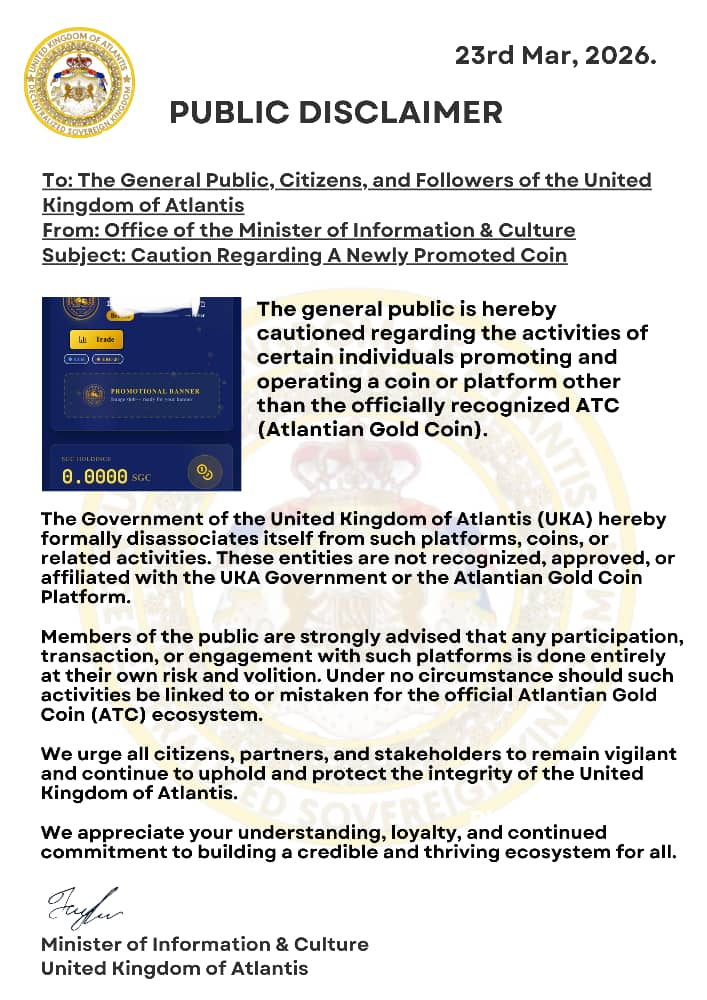
United Kingdom of Atlantis Issues Comprehensive Public Disclaimer Warning Against Unauthorized Coin Promotion
23rd March, 2026 – The Office of the Minister of Information & Culture of the United Kingdom of Atlantis (UKA) has issued an official public disclaimer cautioning citizens, followers, and the general public about the activities of individuals promoting and operating a coin or platform that is *not* the officially recognized Atlantian Gold Coin (ATC).
### Official Statement from the UKA Government
The Government of the United Kingdom of Atlantis formally *disassociates* itself from any such unauthorized platforms, coins, or related activities. These entities are *not recognized, approved, or affiliated* with the UKA Government or the official Atlantian Gold Coin (ATC) ecosystem. The UKA reaffirms its commitment to protecting its citizens from fraudulent financial schemes and maintaining the credibility of its national monetary instruments.
### Key Highlights of the Public Disclaimer
1. *Public Warning*: The general public is advised that participation in, transaction with, or engagement in these unauthorized platforms is undertaken entirely at the individual’s *own risk and volition*. The UKA will not provide any protection or recourse for losses incurred from such engagements.
2. *No Association*: The UKA government explicitly states that the unofficial coin should *not* be linked to or mistaken for the legitimate Atlantian Gold Coin (ATC) platform. Any branding or naming similarity is purely coincidental and unauthorized.
3. *Call for Vigilance*: Citizens, partners, and stakeholders are urged to remain vigilant and to uphold and protect the integrity of the United Kingdom of Atlantis. The government encourages proactive verification of all financial products to safeguard national economic stability.
4. *Appreciation*: The government expresses gratitude for the public’s understanding, loyalty, and continued commitment to building a credible and thriving ecosystem for all Atlantians. This support is vital for the sustainable development of the UKA’s financial infrastructure.
5. *Actionable Advice*: The Minister of Information & Culture advises citizens to conduct thorough due diligence, seek official certifications, and consult authorized financial institutions before investing in any coin or digital platform.
### Minister’s Emphasis on Transparency & Security
The Minister of Information & Culture emphasizes that the UKA is dedicated to maintaining transparency and security within its financial ecosystem. The government has established regulatory frameworks to ensure that only authorized and vetted financial instruments operate within the Atlantian economy. The public is encouraged to report any suspicious activities related to unauthorized coins or platforms to the appropriate authorities.
### Impact on the Atlantian Economy
The unauthorized promotion of alternative coins poses risks of financial fraud, market disruption, and reputational damage to the legitimate Atlantian Gold Coin (ATC). The UKA’s disclaimer aims to protect investors and preserve trust in the national monetary system, fostering a safe environment for economic growth and innovation.
Next Steps for Stakeholders
– *Verification*: Check official registries for approved financial products.
– *Reporting*: Submit information on suspicious platforms to the UKA regulatory authorities.
– *Education*: Engage in public awareness campaigns about the risks of unregulated financial instruments.
Crisis Everywhere, Governance Nowhere: What The Omoluabi Ethos Demands
Nigeria stands at a crossroads, gripped by multiple crises while governance appears slow, distant, and at times absent. From rising insecurity to deepening economic strain, citizens face daily hardships that demand urgent and decisive leadership. Yet the response has often seemed reactive rather than strategic, leaving millions to navigate uncertainty on their own in a country of over 200 million people.
Security challenges continue to spread at an alarming rate. The insurgency in the North East, now over 15 years old, persists despite repeated military campaigns. In 2025 alone, hundreds of civilians were killed in attacks across Borno, Zamfara, and Plateau states, while kidnapping for ransom has become a thriving criminal enterprise. More than two million Nigerians remain internally displaced in the North East, and several rural communities across the North West and North Central have effectively fallen outside full state control. What began as a regional crisis has evolved into a nationwide threat, weakening agriculture, disrupting supply chains, and discouraging investment.
Economic realities offer little comfort. Nigeria’s GDP grew by about 3.87 percent in 2025, up slightly from 3.38 percent in 2024, yet this growth has not translated into improved living standards. Inflation, though moderating from over 30 percent in 2024 to around 15 percent in early 2026, continues to erode purchasing power. Food inflation remains particularly severe, with staples rising beyond the reach of average households. With a minimum wage that struggles to match the cost of living, millions of Nigerians now spend a disproportionate share of their income on basic survival.
Poverty and food insecurity deepen the strain. An estimated 129 million Nigerians live below the poverty line, while nearly 100 million face varying levels of food insecurity. Malnutrition rates among children remain high, and access to basic healthcare and education continues to decline in vulnerable communities. The informal sector, which employs over 80 percent of the workforce, remains largely unregulated and unstable. Official unemployment figures hover around 4.9 percent, but this masks widespread underemployment and precarious work conditions that offer little economic security.
Fiscal pressures further complicate the situation. Recent reforms, including the removal of fuel subsidies and the unification of exchange rates, have improved government revenue and reduced the fiscal deficit to about 4.5 percent of GDP. However, these gains have come at a steep social cost, with transport, energy, and food prices rising sharply. Public debt stands at roughly 34 percent of GDP, while oil production, Nigeria’s primary revenue source, continues to underperform. Although output recovered to about 1.5 million barrels per day in 2025, it remains below both OPEC quotas and national targets due to theft, pipeline vandalism, and chronic underinvestment.
These challenges are deeply interconnected and point to a broader governance deficit. Insecurity disrupts farming and trade, economic hardship drives poverty, and limited fiscal space constrains effective intervention. The result is a cycle of vulnerability that continues to tighten around millions of citizens.
The Omoluabi ethos offers a clear alternative. It represents leadership defined by character, discipline, accountability, and an unwavering duty to the people. Under such a framework, security would be treated as a sacred responsibility, not a recurring crisis. Government would act with urgency and coordination to protect lives and property, while economic policy would be deliberately people centred, focused on reducing the cost of living, stabilising prices, and supporting small businesses and agriculture. Growth would be measured not just in statistics but in the improved welfare of citizens.
Public institutions under this ethos would function with purpose and discipline. Ministries would operate with clear targets, coordination, and accountability for results. Fiscal decisions would reflect prudence, balancing reforms with social protection so that citizens are not crushed under the weight of policy adjustments. Above all, leadership would be empathetic and present, grounded in the daily realities of the people and responsive to their needs. Governance, in this sense, would not be distant or abstract but a visible commitment to improving lives.
Measured against this standard, the present stewardship of the Nigerian state clearly falls outside the Omoluabi ethos. Persistent insecurity, rising living costs, and the widening gap between economic indicators and lived reality reflect a leadership approach that lacks the discipline, accountability, and people centred focus that define that value system. Rather than embodying empathy and responsibility, governance has often appeared distant, reactive, and insufficiently attuned to the human consequences of its decisions. The issue, therefore, is not merely one of policy but of principle. Until leadership aligns with values that prioritise service, accountability, and the welfare of the people, the crises will endure and the question will remain, se na like this we go de dey?


-

 society6 months ago
Religion: Africa’s Oldest Weapon of Enslavement and the Forgotten Truth
-

 news3 months ago
WHO REALLY OWNS MONIEPOINT? The $290 Million Deal That Sold Nigeria’s Top Fintech to Foreign Interests
-

 society6 months ago
“You Are Never Without Help” – Pastor Gebhardt Berndt Inspires Hope Through Empower Church (Video)
-

 celebrity radar - gossips2 months ago
Dr. Chris Okafor Returns with Power and Fire of the Spirit -Mounts Grace Nation Altar with Fresh Anointing and Restoration Grace on February 1, 2026