celebrity radar - gossips
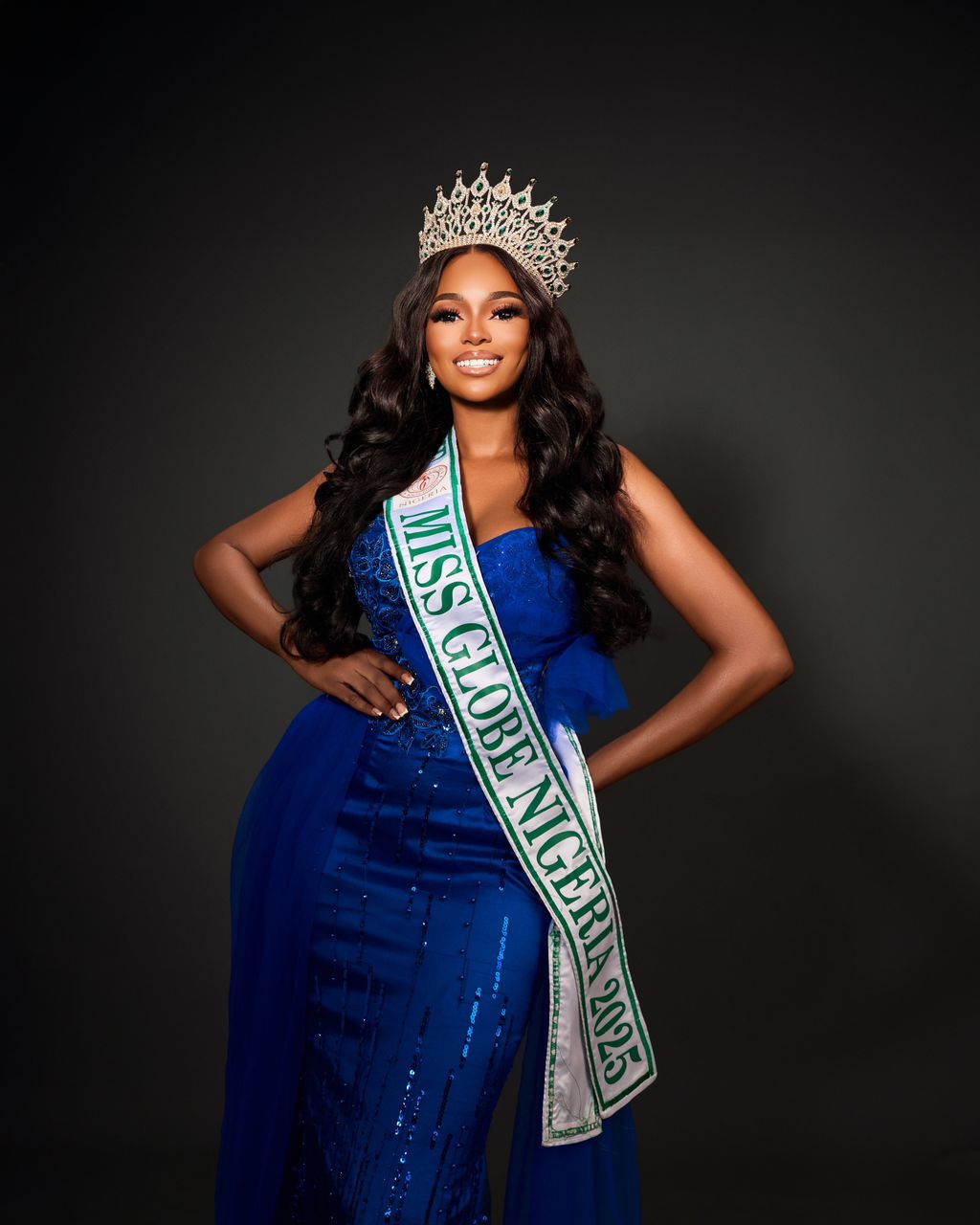
Nigeria’s Funmi Oribayo Glows Globally: Makes Top 10 at Miss Globe World 2025
Nigeria’s Funmi Oribayo Shines at Miss Globe World 2025, Makes Top 10 Among 80 Countries
Nigeria’s representative to the Miss Globe World 2025 beauty pageant, Miss Funmi Oribayo, has made the nation proud after making it to Top 10 finalists at the recently concluded global competition held in Tirana, Albania.
Miss Oribayo, who emerged as Miss Globe Nigeria 2025 after a highly competitive national pageant, walked tall among stunning contestants from 80 countries across the world to secure her place in the top 10—an impressive feat that further highlights Nigeria’s growing presence on the global beauty stage.
The 22nd edition of the Miss Globe World Pageant took place on October 15, 2025, at the Palace of Congresses in Tirana, Albania, with Miss Thailand, Chayathanus Saradatta, crowned as The Miss Globe 2025 by her predecessor, Colombian-born Diana Moreno.
Representing Nigeria with grace, elegance, and intellect, Miss Oribayo captivated the audience with her poise and inspiring advocacy. Hailing from Abeokuta North Local Government Area of Ogun State, the proud Nigerian beauty queen is a farmer, serial entrepreneur, and graduate of English from the University of Lagos.
Speaking after her return, the elated Miss Oribayo expressed deep gratitude for the opportunity to represent Nigeria on the global stage. She also revealed her plans to pay a courtesy visit to the Governor of Ogun State, Prince Dapo Abiodun, to share her experiences from the pageant and her aspirations to serve as a youth ambassador promoting empowerment, education, and entrepreneurship among young Nigerians.
Her remarkable achievement at Miss Globe World 2025 is not only a personal triumph but also a celebration of Nigerian beauty, talent, and determination on the international scene.
celebrity radar - gossips
Sowore and the Nnamdi Kanu Protest; When the state gags one man, it gags the conscience of millions
Sowore and the Nnamdi Kanu Protest; When the state gags one man, it gags the conscience of millions.
By George Omagbemi Sylvester | Published by SaharaWeeklyNG.com
Tear gas, court orders and a million promised feet – Abuja became the latest battleground for Nigeria’s right to dissent.
On Monday, October 20, 2025, Nigeria’s capital once again became the theatre of a deepening crisis between an assertive civil society and a nervous state. Human-rights activist Omoyele Sowore (veteran campaigner, publisher and organiser of mass actions) led calls for a #FreeNnamdiKanuNow demonstration that sought to spotlight what many Nigerians say is an overreaching, politicised prosecution of Nnamdi Kanu, leader of the proscribed INDIGENOUS PEOPLE OF BIAFRA (IPOB). The response from the security architecture was predictably heavy: teargas, water cannon, mass arrests, according to witnesses and multiple international news agencies, the sound of gunshots in pockets of the city as police sought to prevent demonstrators from pressing toward sensitive government sites.
Sowore cast the protest as more than a ONE-ISSUE MOBILIZATION. “This is not TRIBAL, not RELIGIOUS, it is social justice,” he declared in speeches and social posts urging Nigerians to remember that the right to assemble is the oxygen of democracy. Thousands answered the call in Abuja and in cities across the southeast, pausing commerce, closing markets and (for a day) forcing the nation to witness a popular outcry against what many see as selective justice. Yet the state quickly sought to frame the demonstrations as a security threat; a Federal High Court order issued days earlier restricted protests around Aso Rock, the National Assembly, the Court of Appeal, Eagle Square and other sensitive locations and the police warned organisers to obey the injunction. Sowore and allies rejected this as a pretext to criminalise dissent.
Facts matter. Nnamdi Kanu (a British citizen who leads the outlawed IPOB) has been in custody since a 2021 re-arrest and faces terrorism and treason charges that carry life sentences if convictions are secured. His trials have been postponed, contested and are now being heard under repeated judicial time pressure; his defence has filed motions and sought extended time to call dozens of witnesses. Kanu’s supporters insist his detention is political, citing years of perceived marginalisation in the southeast. The state insists it is prosecuting criminal conduct. Those competing narratives are at the heart of this confrontation.
The most damning reaction to the security response came from organisations that cannot be easily dismissed as partisan. Amnesty International publicly condemned the “LETHAL USE OF FORCE” and called for impartial investigations into arrests, beatings and indiscriminate use of tear gas on peaceful demonstrators, journalists and lawyers. International and local observers reminded citizens and the authorities alike that the International Covenant on Civil and Political Rights (to which Nigeria is a party) recognises the right to peaceful assembly and places strict limits on state force. Amnesty’s intervention was not rhetorical flourish, but a mirror held up to a state that has frequently weaponised the security apparatus against popular protest.
Sowore’s involvement sharpened the politics. He promised to place “ONE MILLION PEOPLE” on the streets of Abuja a provocative, HEADLINE-GRABBING claim that sought to make the mobilisation irreversible. Critics accused him of grandstanding and of pressing a volatile issue without adequate safeguards; sympathisers argued that bold numbers are sometimes the only way to force a stalled judicial and political process into the light. Veteran commentators and analysts offered sober warnings, the right to protest is sacrosanct, yes, but protests must be responsibly organised to avoid giving authorities the cover to crack down. Reuben Abati, among others, argued that while protest is constitutional, it must be executed within “THE BOUNDS OF REASON AND SANITY” a counsel that simultaneously defends assembly and cautions against actions that might provoke the state into escalation.
What this clash reveals is not merely a TUG-OF-WAR over one man’s freedom; it exposes a broader crisis of trust in Nigeria’s institutions. Courts, security agencies and political leaders are perceived by significant portions of the population as instruments of narrow partisan interest rather than neutral guarantors of rule and rights. When a Federal High Court is asked to restrain a protest, when police posture with armoured vehicles and water cannon and when journalists covering these events report harassment or equipment seizure, the inevitable public reading is that civic space is shrinking. Human-rights veterans such as Chidi Odinkalu have long warned that Nigeria’s right to dissent faces structural threats, warnings validated anew each time citizens exercising their constitutional rights are met with force.
Yet there is a paradox at the core of these confrontations: the more the state attempts to stifle protest with injunctions and baton-charges, the more the grievance it seeks to bury germinates and ripens. The 20 October protests coincided with the fifth anniversary of the EndSARS movement’s climax, a date that carries fresh wounds and unresolved moral questions about the state’s appetite for accountability. By choosing that date, activists deliberately linked Kanu’s case to a broader narrative of impunity and state violence. That linkage is political theatre and sometimes, politics must court theatre to be heard.
What should happen next is not conjecture but a sober checklist of democratic repair. First, the authorities must ensure transparent, impartial investigations into all allegations of excessive force and arbitrary arrests; those found culpable must be prosecuted under the law. Second, the courts must guard their independence and be seen to provide a fair, expeditious hearing for Kanu because JUSTICE DELAYED IS JUSTICE DENIED and because politicised court processes only legitimate extra-legal remedies. Third, civil-society organisers bear responsibility to plan peaceful, de-escalatory demonstrations and to engage neutral observers to reduce the chance of confrontation. Finally, national leaders should step back from demonising dissent and instead treat protest as a barometer of governance; a signal that frustrations exist and must be addressed not a pathology to be cured by force. Amnesty’s call for impartial probes and Human Rights Watch’s repeated admonitions about protest rights should guide any forward-looking response.
There is a temptation in Nigeria’s current moment to reduce the story to binary loyalties, you are either for the state or for separatism; you are either for Sowore or against him. That temptation must be resisted. The essence of democracy is the capacity to tolerate dissent while resolving disputes inside a framework of rights and rules. Sowore’s mobilisation for Kanu’s release (dramatic, disruptive and deeply divisive) forces the country to ask a fundamental question: Will we strengthen institutions so they earn the public’s trust or will we continue the cycle in which force begets protest and protest begets force?
If Nigeria wants peace that lasts, it must first learn to treat protest not as a public nuisance to be smothered but as a legitimate expression of grievance to be heard and addressed. Until then, the streets (and the courts) will remain battlegrounds where citizens and the state test the true limits of the republic. The events of October 20, 2025, were another chapter in that contest: messy, painful, instructive and for the sake of Nigeria’s democratic future, impossible to ignore.
celebrity radar - gossips
Oluomo K-Shanana : Juju’s Vibrant Voice Honoured at the 6th OSRA Awards
Alhaji Arems
The rhythm of juju music pulsed proudly in Ile-Ife on October 18, 2025, as Adenuga Oluwakayode Oladipupo, better known as K Shanana, received the Award of Recognition at the 6th Oodua Special Recognition Awards (OSRA) held at the Ojaja Arena Resort, Osun State.
Presented under the royal blessing of the Ooni of Ife, the OSRA honour highlighted K Shanana’s steady rise as one of juju music’s most respected modern ambassadors — a performer whose sound bridges generations and whose leadership continues to inspire a new wave of discipline and excellence within the industry.
*A Leader Beyond the Stage*
Currently serving as the Task Force Chairman of the Association of Juju Musicians of Nigeria (AJUMN), Lagos State Chapter, K Shanana plays a crucial role in maintaining structure, unity, and professionalism among practitioners of the genre. Working alongside Bakorin Segzy Da Water, the AJUMN Eko Governor, he has been instrumental in strengthening the association’s activities and ensuring that juju music retains its vitality in Nigeria’s ever-evolving soundscape.
*Double Recognition, One Outstanding Year*
2025 has been a landmark year for K Shanana. Before the OSRA recognition, he was named Dynamic Juju Artist of the Year at the Rainbow Hall of Fame Award (Season 11) — two major accolades that reflect not only his talent but also his enduring influence.
For his growing fan base, these awards affirm what has long been clear: K Shanana’s stagecraft, soulful compositions, and dedication to his craft have made him one of the most engaging voices in contemporary juju. His performances blend old-school grace with modern rhythm — a sound that connects elders who built the genre with younger audiences just discovering its depth.
*Championing the Future of Juju*
Beyond music, K Shanana is a mentor and advocate. He frequently emphasizes the importance of preserving juju’s cultural roots while embracing innovation. Through his work within AJUMN and his public engagements, he encourages upcoming musicians to pursue excellence with integrity and cultural pride.
His message is consistent: the sustainability of juju depends on unity, structure, and a shared respect for its heritage.
*A Bright Chapter Ahead*
For K Shanana, the OSRA recognition is not just a personal triumph — it’s a celebration of juju music’s resilience and continued relevance. As applause echoes from Lagos to Ile-Ife, one thing remains certain: his rhythm, leadership, and artistry continue to light the path forward for the genre.
The beat goes on — and so does the legacy of K Shanana, a true son of juju and a shining symbol of Yoruba musical excellence.
celebrity radar - gossips
You Are Nigeria’s Icon” -Prince Kassim Afegbua Extols Lancelot Imasuen’s 30 Years Of Movie Making
“You Are Nigeria’s Icon” -Prince Kassim Afegbua Extols Lancelot Imasuen’s 30 Years Of Movie Making
Edo State Commissioner for Information and Strategy, prince Kassim Afegbua, who is also a renowned publiscist and information management strategist, has thrown a solid weight behind Lancelot Oduwa Imasuen’s 30-years job in Nollywood.
During a courtesy visit in his office yesterday, Monday October, 20, 2025 in Benin the Edo state capital, prince Afegbua a renowned Image maker , insisted that he will be present in all the events oulined by Lancelot Imasuen to mark his 30 years in Nollywood.
He said that it’s important that the state supports Lancelot, whom they regard as an icon, saying the state is very proud of him and all that he has achieved in Nollywood. Most especially his love for Edo State and placing the state in the map of great places to visit and invest in.
“His coming home to do most of his projects, most especially the Benin Film Academy that is affiliated to the Igbinedion University, which i believed many could have set up somewhere else, is a remarkable feat.”
“Look at all the iconic cultural films that he has produced and how well they have helped shaped and projected the image of the Benin Kingdom. So celebrating 30 years of his illustrious career should be a plus for Edo State and a major thing to key into, said the commissioner who gave Lancelot and his team of local organising team a warm reception
Prince Afegbua was also the image maker of former Nigerian President Ibrahim Gbadamosi Babangida. He was also the Commissioner for Information during the time of former Governor Adams Oshiomole, now a Senator representing Edo North.
In a similar vein, Lancelot Oduwa Imasuen also visited the Edo State Commissioner for Education, Dr. Paddy Itami. The elated commissioner who agreed to partner with lancelot in resuscitating drama as a major tool for social orientation praised the iconic filmmaker for his various exploits.
The event is billed to start on November 15th, 2015 with an open street casting that is going to happen in various major streets in Benin and ending at the place where he grew up as a young child. Then, the colloquium, which will be the major event, will take place in Benin, which will see the unveiling of Oduwa Imasuen Lancelot, OIL Foundation. A Foundation that is poised to help resuscitating and rejuvenating dramatic and Film Clubs across various schools in Edo State.
-
Politics4 months agoNigeria Is Not His Estate: Wike’s 2,000‑Hectare Scandal Must Shake Us Awake
-
society7 months agoBroken Promises and Broken Backs: The ₦70,000 Minimum Wage Law and the Betrayal of Nigerian Workers
-
society5 months agoOGUN INVESTS OVER ₦2.25 BILLION TO BOOST AQUACULTURE
-
celebrity radar - gossips5 months agoFrom ₦200 to ₦2 Million: Davido’s Barber Reveals Jaw-Dropping Haircut Fee