
celebrity radar - gossips
Olukoya Set To Lose Mountain Of Fire Prayer City

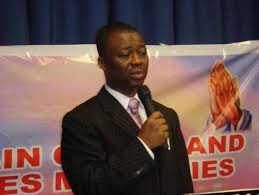

Founder and General Overseer of Mountain of Fire and Miracles Ministries (MFM), Daniel Kolawole Olukoya, is on the verge of losing the vast land on which MFM Prayer City sits.
A court ruling delivered on 12 May by Justice A.A Akinyemi of the Abeokuta Division of the High Court of Ogun State stated that the Adejonlu family are the bona fide owners of the land on which the famous crusade and camp ground sits in the Ogun State section along the Lagos/Ibadan Expressway.
This implies that Mr. Olukoya’s church had bought the land from, and paid, the wrong people. Ownership dispute over the the land began in 2003 and took the form of litigation via two different cases (Suit Nos. AB/60/2003 and AB/61/2003) between the Adejonlu and Oduleye families.
Justice Akinyemi’s ruling, exclusively obtained by SaharaReporters, declared the Adejonlu family genuine owners of the land situated in Magada, Obafemi/Owode Local Government Area, and that they are entitled to the right of occupancy over the land.
Following the ruling handing ownership and right of occupancy to the Adejonlu family, their lawyer, Mr. R. O. Sadik, told SaharaReporters that he wrote many letters to Mr. Olukoya for negotiation and settlement. Mr. Sadik said he took the steps because of the profile of the pastor and his church.

One of the letters, sighted by SaharaReporters, was dated 7 July and signed by one Miss Lateefa Sadik for Mr. Sadik’s chambers. The letter recalled a meeting held between the legal firm and MFM representatives led by one Pastor Alewi.
The letter then proceeded with demands by the land owners. Notably, the landowners requested the church, assisted by their lawyers, to determine the size and portion of their land on which MFM Prayer City sits. The letter also demanded a payment of N5million per plot to cover the acreage that would be agreed on by the land owners and the church. Similarly, the letter demanded the immediate payment of 40 per cent of the total cost of the acreage agreed upon.
But these demands, Mr. Sadik told SaharaReporters, have been met with indifference. According to him, Mr. Olukoya is unwilling to negotiate with the landowners. He, however, warned that the owners are keen on enforcing the court ruling and taking full possession of the land.
“We have written to Dr. Olukoya over 10 times, and it is like he is not ready for settlement. He set up a committee, which was headed by Pastor Alewi, to look into the matter and our follow-up investigation shows that the report of the committee has got to Dr. Olukoya. But we have not heard any positive comment from him. In fact, his body language does not suggest he is ready to pay any money for the land belonging to my client,” Mr. Sadik said. He explained that he met with representatives of the church on 8 October, but Mr. Olukoya was not at the meeting.
“Presently, we are the practical owners of the land, according to the judgment delivered by the Court, but the pastor is unlawfully and illegally using it and selling part of it thereby making money off us while we are not getting anything,” alleged Mr. Sadik.
Another party to the matter, Chief Gbolahan Timson (Oba Jagunmolu of Shomolu/Bariga), said he was disappointed by Mr. Olukoya’s conduct all through the time of litigation. He also claimed that Mr. Olukoya went back on his promise and his failure to act is affecting the family members.
“The Oduleye family were so greedy, and they were bent on taking over our land. For this reason, they went ahead sue us. We were served the court letter right in the office of Dr. Olukoya, and he said good luck to the winner and that he would settle whoever won the case. He made that statement when the case started 13 years ago. Now that we have won, he decided not to pay us. We explained to him that he paid the wrong party and he should pay our family who are the real owners of the land but he has refused,” he said.
He added that Mr. Olukoya is saddened that he may have to pay more for the land. According to Chief Timson, the landowners gave a figure to the church. After receipt of the sum demanded, the General Overseer is not happy with us winning as he is going set up a committee to look into the case, but the committee came up with a much lower sum.
“From the information I got, he wanted to pay the money twice. But now, he is saying he is not paying us any money. I want to get people to talk to him so as to avoid unnecessary rancor like what is happening now. We cannot fight a battle for 13 years and still be begging for our right after winning. The court has declared us winner and the order of the court must be obeyed no matter who you are and what you do for a living,” he said.




celebrity radar - gossips
Accolades to Empress Genevieve Wining as she Celebrate birthday in Grand style

Accolades to Empress Genevieve Wining as she Celebrate birthday in Grand style
Emmanuel Clement
Vilnius, Lithuania – The Grand Hotel Vilnius will host a grand birthday celebration in honor of Her Majesty The Empress Genevieve Wining of the United Kingdom of Atlantis (UKA) on April 4th, 2026.
The four-day event promises to be an extravagant affair, marking the special birthday of Empress Genevieve Wining. The celebration will take place at the prestigious Grand Hotel Vilnius, Lithuania, renowned for its luxurious ambiance and exceptional service.

According to the event flyer, the birthday celebration will be a spectacular occasion, fitting for an empress. Guests can expect an elegant setting adorned with golden accents, sparkling champagne, and festive decorations, creating a regal atmosphere befitting the occasion.
The Empress Genevieve Wining of UKA is expected to grace the event, which will include various festivities and celebrations in her honor. The occasion aims to bring together dignitaries, followers, and guests to commemorate the empress’s birthday with grandeur and joy.
For media inquiries, accreditation, or further information about the birthday celebration of The Empress Genevieve Wining of UKA, please contact the event organizers.
Courtesy of His Excellency Emperor Prof. Solomon Wining. UKA

Today, Dr. Chris Okafor turns a year older
~By Sunday Adeyemi
It is widely acknowledged that the exceptional Dr. Chris Okafor, a man of great character, always celebrates his birthday on April 4th, and in recognition of this occasion, I am inspired to write this special tribute to honor him.
Today marks a momentous occasion as we commemorate the birthday anniversary of Dr. Chris Okafor, a rare gem, a perfect gentleman, and the revered founder of Grace Nation Church, aka Liberation City.
Without reservation, this versatile and dependable Oracle foundry has consistently proven itself worthy of the accolades bestowed upon it on this notable anniversary.
Let it be reiterated that Dr. Chris Okafor is a leader known for his generosity and commitment to humanity’s welfare and advancement. The special gifts donated recently to widows and widowers within and outside the church are a testament to his exceptional leadership.
Your reputation as an outstanding and authentic man of God is evident in your exceptional goodwill and philanthropic endeavors.
Your dedication and perseverance have yielded impressive results, and numerous people, including myself, are justifiably proud of the remarkable work you are doing.
You have consistently exemplified outstanding leadership in the Christian community, demonstrating the profound impact of your role as a gift from God to humanity. I firmly believe this to be true.
Here’s to a year of productivity, success, and happiness. Congratulations and warm wishes on your birthday, sir.
Sunday Adeyemi
Your Son
celebrity radar - gossips
Adron Homes Celebrates Visionary Chairman, Aare Adetola Emmanuel King, at 51
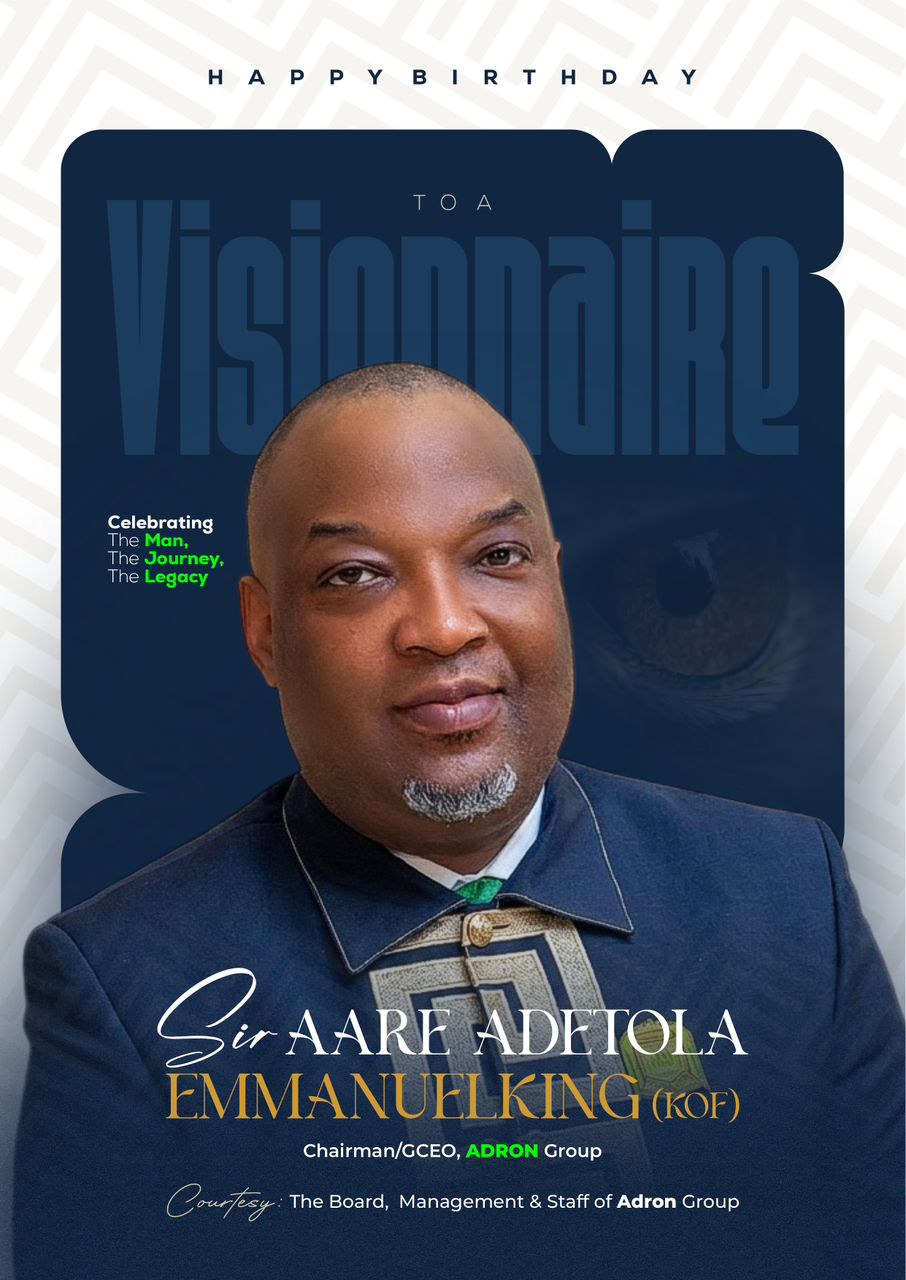
Adron Homes Celebrates Visionary Chairman, Aare Adetola Emmanuel King, at 51
The management and staff of Adron Homes and Properties Limited have joined family, friends, associates, and well-wishers across the globe to celebrate their Chairman and Chief Executive Officer, Aare Adetola EmmanuelKing, as he marks his 51st birthday.

In a statement released by the company, the milestone was described as a celebration of an exceptional leader whose vision, resilience, and entrepreneurial brilliance have not only transformed Adron Homes into a household name in Nigeria’s real estate sector but have also redefined affordable housing across the country.
Under his dynamic leadership, Adron Homes has continued to expand its footprint, delivering value-driven residential solutions while empowering thousands of Nigerians with opportunities for home ownership. His commitment to excellence, innovation, and customer satisfaction has remained the driving force behind the company’s sustained growth and industry leadership.
The statement further highlighted Aare EmmanuelKing’s passion for nation-building and community development, noting his significant contributions to job creation, youth empowerment, and the promotion of socio-economic development through real estate investments.
“As a leader, mentor, and visionary, Aare Adetola EmmanuelKing has consistently inspired a culture of excellence, integrity, and dedication within the organization. His ability to turn bold ideas into reality continues to position Adron Homes as a trailblazer in the industry,” the statement read.
The company expressed profound gratitude for his steadfast leadership and prayed for continued wisdom, strength, and sound health as he embarks on another year of impactful achievements.
As he celebrates his 51st birthday, the entire Adron Homes family proudly honours a man whose legacy continues to shape the future of real estate in Nigeria.
Happy 51st Birthday, Aare Adetola EmmanuelKing!


-

 society7 months ago
Religion: Africa’s Oldest Weapon of Enslavement and the Forgotten Truth
-

 news4 months ago
WHO REALLY OWNS MONIEPOINT? The $290 Million Deal That Sold Nigeria’s Top Fintech to Foreign Interests
-

 society6 months ago
“You Are Never Without Help” – Pastor Gebhardt Berndt Inspires Hope Through Empower Church (Video)
-

 celebrity radar - gossips2 months ago
Dr. Chris Okafor Returns with Power and Fire of the Spirit -Mounts Grace Nation Altar with Fresh Anointing and Restoration Grace on February 1, 2026
You must be logged in to post a comment Login
You must log in to post a comment.