
celebrity radar - gossips
Prophet T.B Joshua Donates $60,000 To Nigerian Olympic Team In Rio 2016

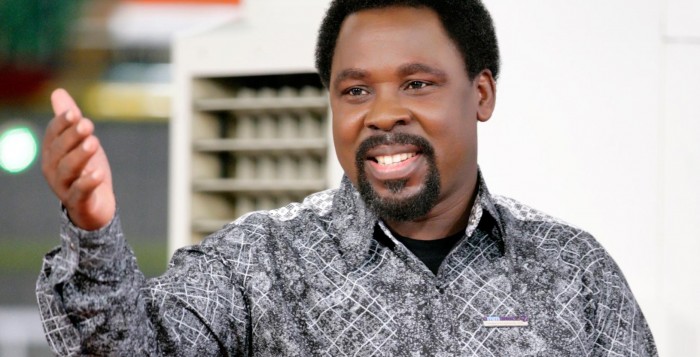

Just a few weeks ago, the Nigerian Olympic Team made headline when it was reported that the football team was stuck at the Hartfield-Jackson Atlanta International Airport, due to the non-payment of their airfare. The reports basically called out the Nigerian Ministry of Youth and Sports as responsible for the unpaid flight bill.
Thankfully, we have been seeing Nigeria represented in various sporting competitions at the Olympics in Rio, including football where they emerged bronze medallists. So, this morning while watching NTA, it was to my surprise when during an interview the Minister of Sports, Solomon Dalong, and the Nigerian Ambassador to Brazil, Adamu Emozozo, lauded – none other than – Pastor T.B. Joshua for his ‘moral’ and ‘financial’ contributions to the Nigerian Olympic Team. (For those of you not convinced, I found the clip on YouTube.)
My surprise was not actually based on the said ‘support’ provided by T.B. Joshua because his track-record of assistance when it comes to Nigerian sports is proven and he is said to be a sport enthusiast. My shock, however, was borne out of the fact that the Nigerian Government actually pointed him out, recognised and appreciated him – something very unusual! The discussion broadcasted on NTA did not delve into the specific details of what that ‘contribution’ actually entails. However, for the Minister of Sports as well as the Ambassador to Brazil to specifically point the cleric out, in the manner in which they did, the ‘support’ was evidently far beyond ‘spiritual’ assistance in terms of prayer or prophecy. There must have been some HUGE financial backing from the pastor.
Why do I say this?
- T.B. Joshua has been previously, on numerous occasions, applauded for his active support to the Nigerian sport scene. Remember when the late Shaibu Amodu publicly thanked Joshua (at The SCOAN) for his prayers and support – which he said was instrumental to Nigeria’s miraculous qualification for the 2010 World Cup in South Africa?
- The late Stephen Keshi was said to have been in regular contact with TB Joshua during Nigeria’s 2013 AFCON games, where Nigeria later triumphed. Interestingly, Joshua ‘prophesied’ the outcome of the final between Burkina Faso and Nigeria; and as an aside, one of the key Super Eagle’s players during the 2013 AFCON matches was Ogenyi Onazi, a former member of Joshua’s grassroots football team, My People FC. Incidentally, a brief check reveals that My People FC has just been promoted to Nigeria’s Premier League, having secured back-to-back promotion for the last three years running in Nigeria’s amateur leagues.
Still on Joshua’s record in the sports scene … 3. Remember the gifts totalling up to N60,000,000 he donated to the Nigerian Paralympian’s who made our nation proud in the Commonwealth Games? 4. Putting Nigeria aside, recall the role T.B. Joshua played in Ghana’s historic U-20 World Cup win? The coach Sellas Tetteh publicly acknowledged his spiritual guidance, especially in the final against Brazil. This is to mention just a few.
Why am I reminding you of all this? Throughout Joshua’s ‘support’ over the years, there has been no mention of him (whatsoever!) by those in government. No acknowledgement. No gratitude. No vote of thanks. Nothing. Now in Rio, there’s suddenly a deluge of praise. Well, I am not surprised because I have it on good knowledge, from a reliable source (a Nigerian based in Brazil who worked as a volunteer during the Olympics), that T.B. Joshua gave close to $60,000 to the Nigerian Olympic team! No wonder Ambassador Adamu Emozozo called him a “flagbearer” for Nigeria in terms of supporting good causes.




celebrity radar - gossips
Accolades to Empress Genevieve Wining as she Celebrate birthday in Grand style

Accolades to Empress Genevieve Wining as she Celebrate birthday in Grand style
Emmanuel Clement
Vilnius, Lithuania – The Grand Hotel Vilnius will host a grand birthday celebration in honor of Her Majesty The Empress Genevieve Wining of the United Kingdom of Atlantis (UKA) on April 4th, 2026.
The four-day event promises to be an extravagant affair, marking the special birthday of Empress Genevieve Wining. The celebration will take place at the prestigious Grand Hotel Vilnius, Lithuania, renowned for its luxurious ambiance and exceptional service.

According to the event flyer, the birthday celebration will be a spectacular occasion, fitting for an empress. Guests can expect an elegant setting adorned with golden accents, sparkling champagne, and festive decorations, creating a regal atmosphere befitting the occasion.
The Empress Genevieve Wining of UKA is expected to grace the event, which will include various festivities and celebrations in her honor. The occasion aims to bring together dignitaries, followers, and guests to commemorate the empress’s birthday with grandeur and joy.
For media inquiries, accreditation, or further information about the birthday celebration of The Empress Genevieve Wining of UKA, please contact the event organizers.
Courtesy of His Excellency Emperor Prof. Solomon Wining. UKA

Today, Dr. Chris Okafor turns a year older
~By Sunday Adeyemi
It is widely acknowledged that the exceptional Dr. Chris Okafor, a man of great character, always celebrates his birthday on April 4th, and in recognition of this occasion, I am inspired to write this special tribute to honor him.
Today marks a momentous occasion as we commemorate the birthday anniversary of Dr. Chris Okafor, a rare gem, a perfect gentleman, and the revered founder of Grace Nation Church, aka Liberation City.
Without reservation, this versatile and dependable Oracle foundry has consistently proven itself worthy of the accolades bestowed upon it on this notable anniversary.
Let it be reiterated that Dr. Chris Okafor is a leader known for his generosity and commitment to humanity’s welfare and advancement. The special gifts donated recently to widows and widowers within and outside the church are a testament to his exceptional leadership.
Your reputation as an outstanding and authentic man of God is evident in your exceptional goodwill and philanthropic endeavors.
Your dedication and perseverance have yielded impressive results, and numerous people, including myself, are justifiably proud of the remarkable work you are doing.
You have consistently exemplified outstanding leadership in the Christian community, demonstrating the profound impact of your role as a gift from God to humanity. I firmly believe this to be true.
Here’s to a year of productivity, success, and happiness. Congratulations and warm wishes on your birthday, sir.
Sunday Adeyemi
Your Son
celebrity radar - gossips
Adron Homes Celebrates Visionary Chairman, Aare Adetola Emmanuel King, at 51
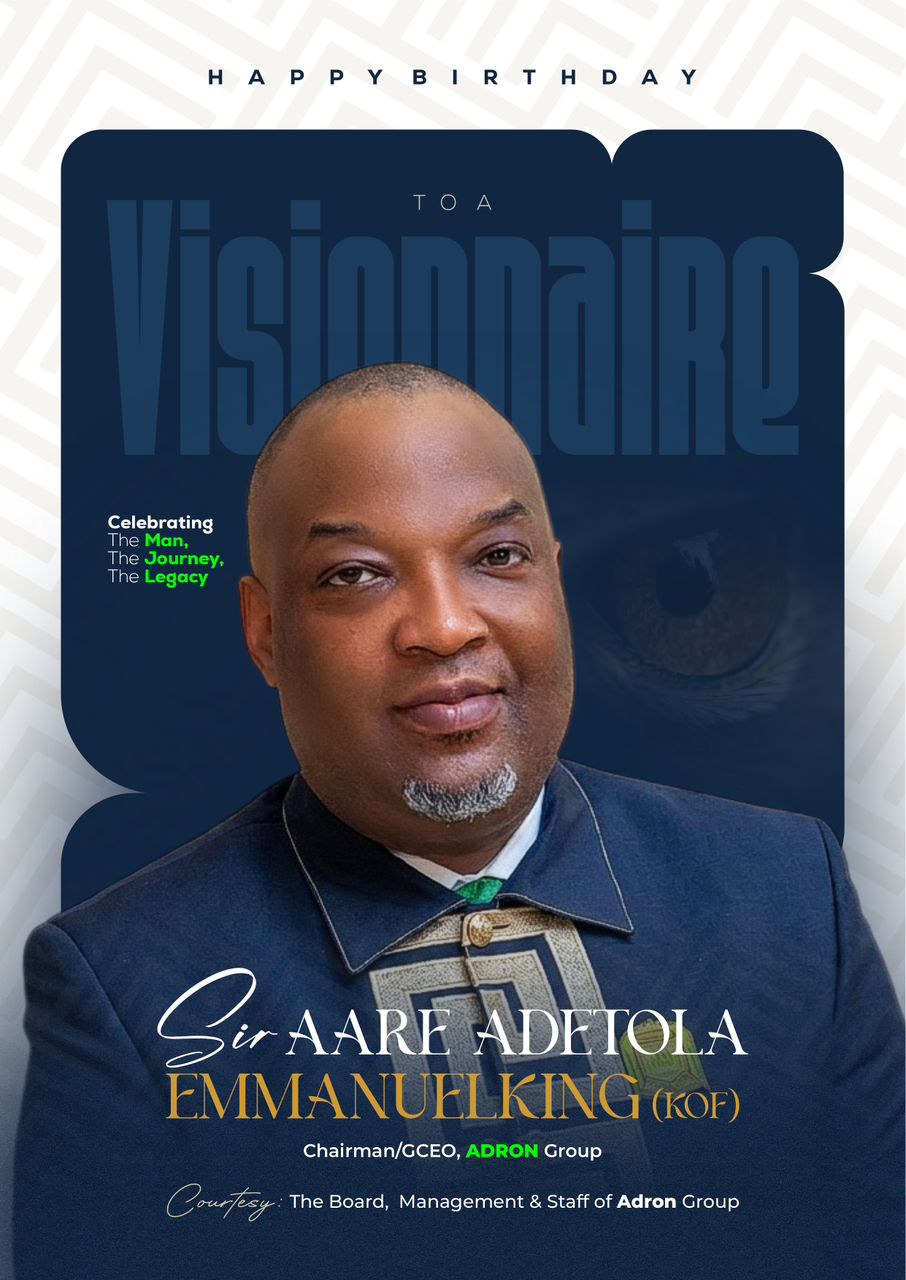
Adron Homes Celebrates Visionary Chairman, Aare Adetola Emmanuel King, at 51
The management and staff of Adron Homes and Properties Limited have joined family, friends, associates, and well-wishers across the globe to celebrate their Chairman and Chief Executive Officer, Aare Adetola EmmanuelKing, as he marks his 51st birthday.

In a statement released by the company, the milestone was described as a celebration of an exceptional leader whose vision, resilience, and entrepreneurial brilliance have not only transformed Adron Homes into a household name in Nigeria’s real estate sector but have also redefined affordable housing across the country.
Under his dynamic leadership, Adron Homes has continued to expand its footprint, delivering value-driven residential solutions while empowering thousands of Nigerians with opportunities for home ownership. His commitment to excellence, innovation, and customer satisfaction has remained the driving force behind the company’s sustained growth and industry leadership.
The statement further highlighted Aare EmmanuelKing’s passion for nation-building and community development, noting his significant contributions to job creation, youth empowerment, and the promotion of socio-economic development through real estate investments.
“As a leader, mentor, and visionary, Aare Adetola EmmanuelKing has consistently inspired a culture of excellence, integrity, and dedication within the organization. His ability to turn bold ideas into reality continues to position Adron Homes as a trailblazer in the industry,” the statement read.
The company expressed profound gratitude for his steadfast leadership and prayed for continued wisdom, strength, and sound health as he embarks on another year of impactful achievements.
As he celebrates his 51st birthday, the entire Adron Homes family proudly honours a man whose legacy continues to shape the future of real estate in Nigeria.
Happy 51st Birthday, Aare Adetola EmmanuelKing!


-

 society7 months ago
Religion: Africa’s Oldest Weapon of Enslavement and the Forgotten Truth
-

 news4 months ago
WHO REALLY OWNS MONIEPOINT? The $290 Million Deal That Sold Nigeria’s Top Fintech to Foreign Interests
-

 society6 months ago
“You Are Never Without Help” – Pastor Gebhardt Berndt Inspires Hope Through Empower Church (Video)
-

 celebrity radar - gossips2 months ago
Dr. Chris Okafor Returns with Power and Fire of the Spirit -Mounts Grace Nation Altar with Fresh Anointing and Restoration Grace on February 1, 2026
You must be logged in to post a comment Login
You must log in to post a comment.