
Bank
Recapitalisation Reality Check: Uncovering the Truth Behind Nigeria’s Banking Boom

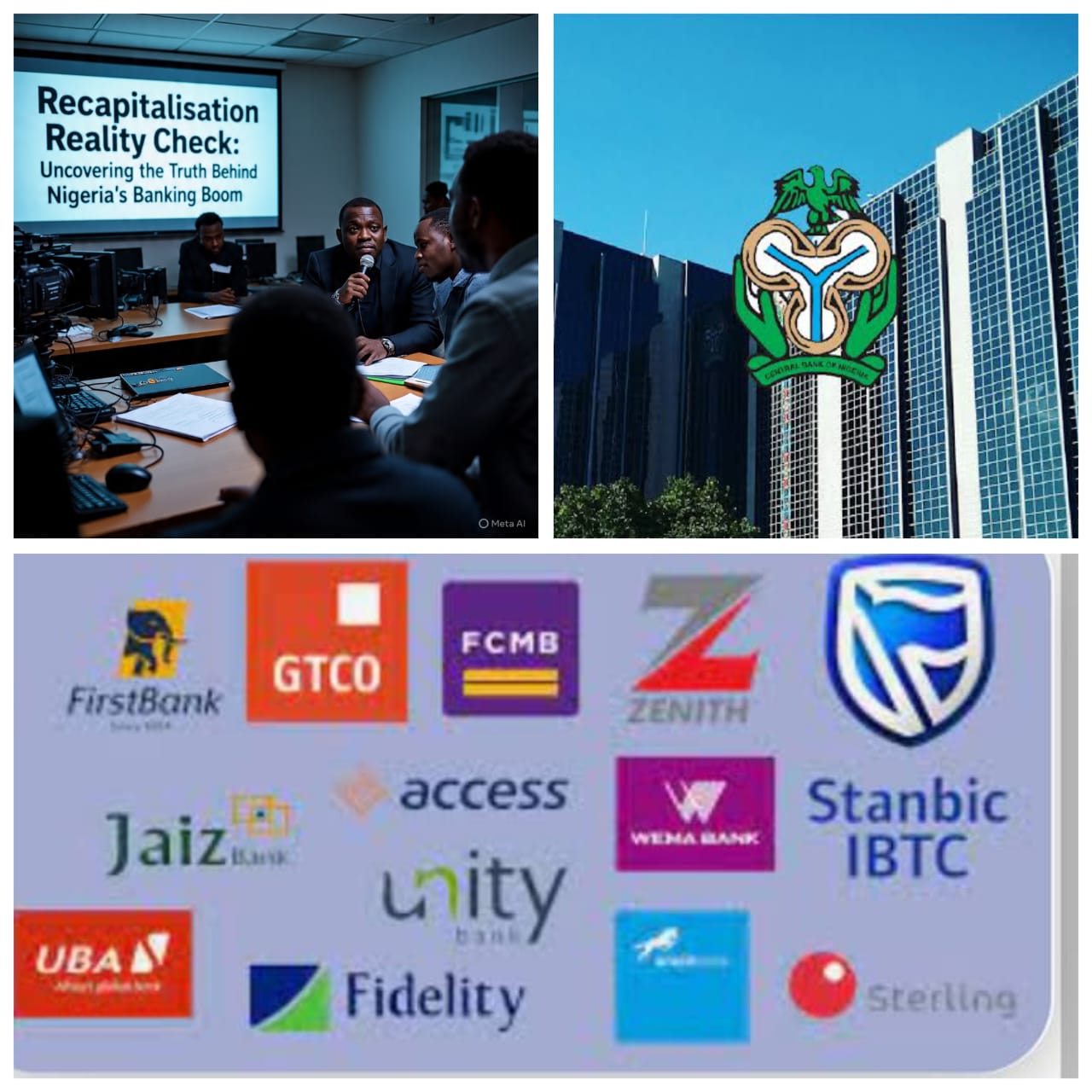
Recapitalisation Reality Check: Uncovering the Truth Behind Nigeria’s Banking Boom
BY BLAISE UDUNZE
When the Central Bank of Nigeria (CBN) announced a new round of bank recapitalisation in March 2024, many expected the leading banks, especially those boasting record-breaking profits in the hundreds of billions and trillions, to sail through with ease. Their financial statements glistened with prosperity, with expanding balance sheets, rising dividends, and bullish share prices.
Indeed, five of Nigeria’s top 10 banks reported a combined pre-tax profit of N4.6 trillion in 2024, showing a staggering 70 percent increase from the previous year, with Zenith Bank and Guaranty Trust Holding Company crossing the trillion-naira mark for the first time. The results painted a picture of robust profitability and resilience.
Yet, barely months after the profit announcements, the same banks found themselves racing back-to-back to the capital market to raise fresh funds. By the first half of 2025, Nigeria’s banking industry was at a crossroads. Behind the glitter of trillion-naira profits lay a more sobering reality of an industry scrambling to meet the CBN’s recapitalisation directive.
The contradiction is stark: record profits on one hand, desperate fundraising on the other. If the banks were truly as profitable and resilient as they claimed, they wouldn’t be begging investors for fresh equity to meet new thresholds.
Behind the strong showing of the market leaders lies an even deeper concern. The smaller commercial and regional banks are struggling to formulate credible recapitalisation strategies. As the March 31, 2026 deadline looms, the CBN has confirmed that only 14 banks have so far scaled the recapitalisation hurdle. That leaves nearly 19 institutions still in search of capital in a market already skeptical of their true worth.
The recapitalisation push has therefore become the clearest indicator of the sector’s underlying fragility. The CBN’s new capital requirements of N500 billion for international banks, N200 billion for national banks, and N50 billion for regional banks have forced lenders to confront a fundamental question. How much of their reported profits actually represents real financial strength?
Much of Nigeria’s profit boom has been a deception, a mirage built on foreign exchange revaluation gains and arbitrary fees rather than genuine operational efficiency. The unification of exchange rates and subsequent naira depreciation in 2023 and 2024 delivered massive revaluation windfalls on dollar-denominated assets, inflating balance sheets overnight. But these were paper gains, not cash profits, and could not be deployed to strengthen capital or fund new loans.
Beyond FX gains, Nigerian banks have increasingly relied on fees and charges as easy revenue. Despite repeated CBN sanctions for breaching its Guide to Charges, banks continue to extract billions from customers through transfers, withdrawals, ATM fees, SMS alerts, and account maintenance. With over 312 million active bank accounts, these charges now contribute more to profitability than traditional lending or genuine financial intermediation.
It is little surprise, then, that the recapitalisation exercise has exposed the widening gap between declared profitability and true solvency. While five Tier-1 banks together raked in N4.6 trillion in pre-tax profit in 2024, nearly 70 percent higher than in 2023, many mid-tier banks can barely keep pace. The recapitalisation gap across the sector is now estimated at N4.7 trillion.
As of September 2025, only 14 banks had crossed the line, while others scramble for mergers, rights issues, or license downgrades to survive. The CBN’s insistence that only paid-up capital and share premium will count while excluding retained earnings has stripped away the accounting camouflage that once masked weakness.
For the market leaders, the race has been aggressive but achievable. Access Holdings raised N351 billion through a fully subscribed rights issue. Zenith Bank’s N350.4 billion hybrid offer was oversubscribed by 160 percent. Wema Bank, once a mid-tier lender, successfully raised N200 billion and became a national success story. Among specialised institutions, Greenwich Merchant Bank sealed its own recapitalisation, supported by capital injections and debt-to-equity conversions that secured its merchant banking license, while Jaiz Bank rose above the N20 billion target to remain the flagship of Islamic banking. Lotus has met the N10 billion bar, consolidating its place in Nigeria’s fast-growing alternative sector.
Another notable entrant is Globus Bank, which in 2024 raised N52.9 billion to lift its capital to N98.6 billion and followed in 2025 with a further N102 billion via rights issues and private placements. The raise subscribed entirely by existing shareholders took its capital above N200 billion. The bank now awaits final verification from the CBN before being formally recognized as compliant.
For others, however, it has been a painful crawl. Fidelity Bank’s N205.45 billion hybrid offer still leaves a N160 billion gap to the N500 billion benchmark. Guaranty Trust Bank reached its own target through a two-phased approach that started with a rights issue in Nigeria that netted N365.8 billion. Subsequently, GT listed shares on the London Stock Exchange with proceeds of $105 million to reach the required target, while UBA Plc launched a N157 billion rights issue in July 2025, following a N239 billion offer in November 2024 that was oversubscribed at N251 billion, with N240 billion accepted. The new offer, extended to September 19, 2025, helped the bank meet the CBN’s N500 billion capital requirement.
As of September 2025, First Bank has secured N187.6 billion and plans an additional N350 billion in private placements, but it still needs to secure the remaining funds to meet the CBN’s requirements. FCMB Group Plc launched a N160 billion public share offer to meet the CBN’s N500 billion capital requirements for international banks, with the offer closing on November 6, 2025. The offer follows a successful N147.5 billion share sale in 2024.
Fidelity raised N176 billion in fresh capital in 2024 and is moving to get an additional N195 billion via private placement before the end of the year. Sterling Bank has not yet completed its recapitalisation as it commenced an N87.067 public offer. This offer follows completion of a N75 billion private placement and a N28.79 billion rights issue, which was significantly oversubscribed by its shareholders.
Consolidation pressures are once again reshaping Nigeria’s banking landscape. Titan Trust’s acquisition of Union Bank and the completed Providus and Unity Bank’s merger reflect the reality that not every institution will raise sufficient equity alone. More combinations are expected in the months ahead, with smaller lenders likely to be folded into stronger franchises as the recapitalisation deadline approaches.
This trend mirrors the 2005 consolidation era, which trimmed 89 banks down to 25, ushering in a new era of scale and scrutiny. The 2024-2026 recapitalisation may well repeat history, producing fewer but sturdier players, banks large enough to finance Nigeria’s economic transformation.
But history offers a warning that recapitalisation is not reform. Bigger balance sheets may shield banks from global shocks, but they do not guarantee developmental relevance. Unless the philosophy of Nigerian banking itself changes from profit-first to purpose-driven intermediation, the sector will keep producing “giant banks in a fragile economy.”
The real challenge is not size, but substance. Nigeria doesn’t just need bigger banks; it needs better banks. It needs institutions that see SMEs as partners rather than liabilities, that lend to real producers rather than recycle deposits into government securities. It needs lenders that adopt fintech-driven underwriting, regulators that reward productive lending, and policymakers that create the infrastructure, power, and security needed to make risk-taking viable.
Recapitalisation, in this light, should not be seen merely as a regulatory hurdle but as a mirror reflecting both the success and the shame of Nigeria’s banking system. The trillion-naira profits may have dazzled investors, but the scramble for new capital reveals the truth that the sector’s foundations remain fragile, its governance inconsistent, and its contribution to real economic development still limited.
The CBN’s policy, painful as it may be, is a necessary reality check. It forces banks to prove that their wealth is more than paper-deep and that their balance sheets can support Nigeria’s ambitious $1 trillion economy vision. For investors and depositors, it is a wake-up call that what glitters in the financial statements may not always be gold.
In the end, recapitalisation is not just about raising funds; it is about restoring credibility. Because trust, once eroded by profit manipulation and corporate posturing, takes far more than a balance sheet to rebuild.
Blaise, a journalist and PR professional writes from Lagos, can be reached via: [email protected]




GTCO Plc Releases 2025 Full Year Audited Result
…Declares Another Record Dividend of ₦12.76k; Re-affirming Unrivalled Capacity to Creating Value
Guaranty Trust Holding Company Plc (“GTCO” or the “Group”) has released its Audited Consolidated and Separate Financial Statements for the year ended December 31, 2025, to the Nigerian Exchange Group (NGX) and London Stock Exchange (LSE).
The Group reported profit before tax of ₦1.23trillion underpinned by strong growth in core earnings, with interest income and fee income increasing y-o-y by 23.2% and 25.9%, respectively. The performance reaffirms its capacity to generate sustainable earnings and builds on the momentum from 2024, when GTCO delivered a record profit of ₦1.27trillion, driven in part by ₦517.5billion in fair value gains, which did not recur in 2025.
The Group’s 2025 profit after tax came in at ₦865.75billion against ₦1.02trillion recorded in 2024. The profit after tax reflects the impact of recent fiscal policy adjustments to the taxation of investment securities, notably withholding tax on short-term instruments. However, when normalised for this effect, underlying earnings remain robust, driven by growth in core operating income.
The Group continues to maintain a well-structured, healthy, and diversified balance sheet in all the jurisdictions wherein it operates a Banking franchise, as well as across its Payments, Pension and Funds Management business verticals. Total assets and shareholders’ funds closed at ₦17.8trillion and ₦3.4trillion, respectively. Capital Adequacy Ratio (CAR) remained very robust and strong, closing at 43.8%, likewise asset quality improved as evidenced by IFRS 9 Stage 3 Loans which closed at 3.4% and 5.0% at Bank and Group level in FY-2025 (Bank, 3.5%, and Group, 5.2% in December 2024). Cost of Risk (COR) also improved to 2.2% from 4.9% in December 2024. In specific terms, the Group’s loan book (net) grew by 12.4% from ₦2.79trillion as of December 2024 to ₦3.13trillion in December 2025. Similarly, deposit liabilities grew by 23.8% from ₦10.40trillion to ₦12.87trillion during the same period.
Commenting on the results, the Group Chief Executive Officer of Guaranty Trust Holding Company Plc, Mr. Segun Agbaje, said: “Our 2025 result underscores the resilience and depth of our earnings capacity. Following a record 2024, which included significant fair value gains, our focus has been on strengthening the sustainability of our earnings by driving growth across our core banking and ecosystem businesses. The strength of our underlying earnings, despite a stronger Naira and tighter regulatory parameters, reflects the quality of our franchise and the discipline with which we execute our strategy. Importantly, this strong core earnings performance underpins our capacity to sustain and grow shareholder returns. Our record dividend payout this year is not only a reflection of our current profitability but also of our confidence in the Group’s long-term earnings potential. Looking ahead, we remain focused on scaling our ecosystem, driving innovation across our financial services platform, and delivering consistent, high-quality earnings that support superior value creation for our shareholders.”
Overall, the Group continues to post one of the best metrics in the Nigerian Financial Services Industry in terms of key financial ratios i.e., Post-Tax Return on Equity (ROAE) of 28.3%, Post-Tax Return on Assets (ROAA) of 5.3%, Capital Adequacy Ratio (CAR) of 43.8% and Cost to Income Ratio of 27.9%.
Guaranty Trust Holding Company Plc is a leading financial services group with operations across Africa and the United Kingdom. Renowned for its strong corporate governance, innovative financial solutions, and customer-centric approach, the Group provides a wide range of banking and non-banking services including payments, funds management, and pension fund administration. GTCO Plc is committed to delivering long-term value to stakeholders while driving growth and development across its markets

ZENITH BANK OPENS MANCHESTER BRANCH TO SUPPORT CROSS-BORDER TRADE AND INVESTMENT
Zenith Bank Plc has announced the opening of a new branch in Manchester, United Kingdom, marking another significant milestone in the bank’s international growth and its commitment to strengthening financial connections between Africa and global markets.
The official opening ceremony, scheduled to hold on Tuesday, March 17, 2026, is expected to attract government officials from Nigeria and the United Kingdom, regulators, investors, customers, and business leaders from both countries, underscoring the growing economic ties and investment opportunities between the two markets.
The new Manchester branch will complement Zenith Bank’s existing operations in the United Kingdom and serve as a strategic hub for supporting businesses engaged in international trade and investment. Through the branch, the bank will provide corporate banking, trade finance, treasury and related financial services to clients operating across the United Kingdom, Europe and Africa.Speaking ahead of the launch, the Group Managing Director/Chief Executive Officer of Zenith Bank Plc, Dame Dr. Adaora Umeoji, OON, said: “The opening of our Manchester branch represents another important step in Zenith Bank’s growth as a leading African financial institution connecting businesses and markets across continents. Manchester is one of the United Kingdom’s most dynamic commercial centres, and our presence here will further strengthen financial connections between businesses in the UK and opportunities across Africa’s rapidly expanding markets.
”Founded in 1990 by its Founder and Chairman, Jim Ovia, CFR, Zenith Bank has grown into one of Africa’s most respected banking institutions, boasting a robust capital base and a remarkable history of year-on-year profitability. Built on a strong foundation of people, technology and service, the Bank has consistently delivered innovative financial solutions while maintaining a disciplined approach to growth and risk management. The impressive performance of the Bank has consistently earned it excellent ratings, recognition and endorsement from local and international agencies and institutions.Headquartered in Lagos, Nigeria, Zenith Bank operates over 500 branches and business offices across the 36 States of the Federation and the Federal Capital Territory (FCT). The Bank currently operates subsidiaries in several African countries including Ghana, Sierra Leone, Gambia, and Cote d’Ivoire, while maintaining a presence in major international financial centres including the United Kingdom, France, UAE and China.
In recent years, Zenith Bank has continued to expand its international network as part of its strategy to support global trade and investment flows involving Africa.Manchester, widely regarded as one of the United Kingdom’s most vibrant economic centres, hosts a diverse base of businesses across sectors such as manufacturing, engineering, logistics, technology and consumer goods. The city’s strong commercial ecosystem and international outlook align closely with Zenith Bank’s expertise in corporate banking, structured finance and trade finance.The Manchester branch will work closely with the Bank’s London operations and its broader international network to support clients seeking to expand across markets and unlock new opportunities in both the United Kingdom and Africa.
With the opening of the Manchester branch, Zenith Bank continues to advance its vision of building a truly global African banking institution that connects businesses, facilitates trade and investment, and creates stronger economic bridges between Africa and the world.

Alpha Morgan Bank Deepens Presence in Abuja with New Branch in Utako
Marking another milestone in its expansion drive, Alpha Morgan Bank has opened a new branch in Utako, Abuja, reinforcing its strategy of building closer institutional ties within key business communities and bringing its financial expertise closer to individuals, and enterprises driving the city’s growth.
The new branch, located at Plot 1121 Obafemi Awolowo Way, Utako, Abuja is strategically positioned to serve individuals, entrepreneurs, and corporate clients within Utako and surrounding districts.
The expansion follows the Bank’s recently concluded Economic Review Webinar held in February 2026, as the bank continues to position as a thought-leader in the financial services industry.
Speaking on the opening, Ade Buraimo, Managing Director of Alpha Morgan Bank, said the move underscores the Bank’s commitment to accessibility and service excellence.
“Proximity matters in banking. As communities grow and commercial activity expands, financial institutions also evolve to meet customers where they are. The Utako Branch allows us to deliver our services to people in that community efficiently while maintaining the high standards our customers expect,”
The Utako location will provide a full suite of retail and corporate banking services, including account opening, deposits, transfers, business banking solutions, and financial advisory support.
Customers and members of the public are invited to visit the new Utako Branch to experience the Bank’s approach to satisfying banking.


- Seychelles Strengthens Human Rights Reporting through National Workshop April 8, 2026
- ABB’s Application Configurator brings speed and precision to grid-feeding protection system design April 7, 2026
- Can Equatorial Guinea Reposition as West Africa’s Gas Hub? April 7, 2026
- Afreximbank Partners with African Energy Week 2026 to Drive Africa-Led Energy Deals April 7, 2026
- Merck Foundation Marks ‘World Health Day’ 2026 – Transforming Patient Care in Africa and Beyond through 2600+ Scholarships for Healthcare Providers From 52 Countries April 7, 2026
- Morocco Gas Plan Reset Could Open Door to New Investment Models April 7, 2026
- African Petroleum Producers Organization (APPO) Secretary General Joins Angola Oil & Gas (AOG) 2026 as African Energy Bank Eyes June 2026 Debut April 7, 2026
- Ghanaian Biomedical Specialist Receives International Award April 7, 2026
- Grey Connects the Africa-Canada Money Corridor With Instant Transfers via Interac April 7, 2026
- Nigeria’s Oil Revival in Focus as Petroleum Minister Lokpobiri Joins Paris Energy Forum April 7, 2026
- Seychelles Strengthens Human Rights Reporting through National Workshop April 8, 2026
- ABB’s Application Configurator brings speed and precision to grid-feeding protection system design April 7, 2026
- Can Equatorial Guinea Reposition as West Africa’s Gas Hub? April 7, 2026
- Afreximbank Partners with African Energy Week 2026 to Drive Africa-Led Energy Deals April 7, 2026
- Merck Foundation Marks ‘World Health Day’ 2026 – Transforming Patient Care in Africa and Beyond through 2600+ Scholarships for Healthcare Providers From 52 Countries April 7, 2026
- Morocco Gas Plan Reset Could Open Door to New Investment Models April 7, 2026
- African Petroleum Producers Organization (APPO) Secretary General Joins Angola Oil & Gas (AOG) 2026 as African Energy Bank Eyes June 2026 Debut April 7, 2026
-

 news4 months ago
WHO REALLY OWNS MONIEPOINT? The $290 Million Deal That Sold Nigeria’s Top Fintech to Foreign Interests
-

 society7 months ago
“You Are Never Without Help” – Pastor Gebhardt Berndt Inspires Hope Through Empower Church (Video)
-

 celebrity radar - gossips2 months ago
Dr. Chris Okafor Returns with Power and Fire of the Spirit -Mounts Grace Nation Altar with Fresh Anointing and Restoration Grace on February 1, 2026
-

 celebrity radar - gossips4 months ago
Prophet Kingsley Aitafo Releases 2026 Prophecy: ‘Nigeria Will Rise, but the World Must Prepare for Turbulence’