
celebrity radar - gossips
Rivers rerun: Controversy trails leaked audio tape

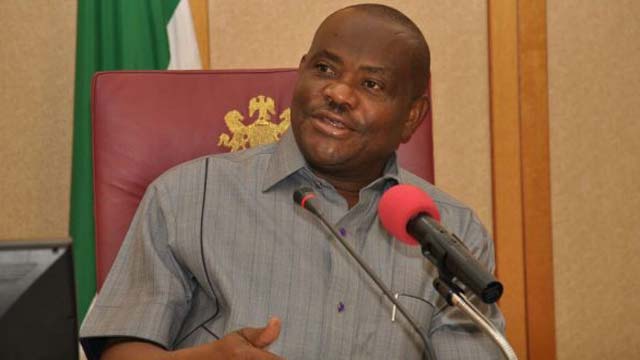

Controversy has greeted a leaked audio recording in which a voice bearing a striking similarity with that of Rivers State Governor, Nyesom Wike, was heard admitting bribery and threatening to kill electoral officers in the December 10 rerun elections in Rivers State.
The All Progressives Congress on Thursday said the leaked audio recording confirmed its worst fears that the elections were rigged.
It noted that revelations contained in the said recording, made public by an online newspaper, Sahara Reporters, on Thursday, provided evidence of alleged unwholesome practices.
The party also said the audio recording was a pointer to the fact that the governor might have compromised the integrity of the electoral process and the integrity of his office as Chief Security Officer.
This was contained in a statement signed by the APC’s National Publicity Secretary, Bolaji Abdullahi, in Abuja.
He said, “The leaked audio recording showing the Rivers State Governor, Nyesom Wike, admitting to bribing some electoral officials and threatening to kill them if his instructions were not followed, has confirmed the fears raised by the All Progressives Congress in the countdown to the recently conducted December 10, 2016, legislative rerun elections in the State.
“Going by the revelations from the leaked audio recording, it is obvious that Governor Wike might have engaged in unwholesome conducts that might have compromised the integrity of the electoral process and undermined his office as the Chief Security Officer of a state.
“The only logical conclusion from this, therefore, is that the electoral victories of the Peoples Democratic Party might have been achieved through underhand dealings and intimidation of officials.”
The statement recalled that the APC alerted security agencies to reports of massive arm build-up and sinister plots by Wike and the PDP.
It said, “On December 6, 2016, the APC alerted security agencies to reports of a massive arms build-up and other sinister plots that Wike and the PDP planned to execute on the day of the legislative rerun elections in Rivers State.
“Nigerians have watched with grave concern how the process of the just concluded legislative rerun elections has led to the deaths of ordinary citizens in the state, including security officers. The statement that Governor Wike appeared to have made on the record has now pointed directly at where responsibility should be placed for the violence that attended the election.”
The APC also argued that the audio recording provided evidence that the allegation by the Rivers State Government and the Peoples Democratic Party of an assassination threat on Wike and the allegation by Wike that APC governors funded violence in the state during the election might have been deliberately contrived to hide the role the governor played in the violence that attended the election.
It also urged security agencies to do the needful and ensure that the sponsors and perpetrators of violence, no matter how highly placed, were brought to justice.
But the Rivers State Government has denied the allegation that Wike threatened to kill an official of the Independent National Electoral Commission.
The Rivers State Commissioner for Information, Dr. Austin Tam-George, said on Thursday that the governor never made any contact with INEC officials in person or through the telephone.
Tam-George argued that the online outfit, Saharareporters.com, engaged in an audio impersonation of the governor, using a voice changer technology.
“We categorically deny these latest allegations as a sick fabrication, an outright lie. Governor Wike never made any contact with INEC officials in person or by telephone.
“Saharareporters.com is the online propaganda bullhorn of the All Progressives Congress. Their publications are typically false and the writers are professional hawkers of fiction.
“No one would have thought that the APC and its cowardly media allies would resort to an audio impersonation of Governor Nyesom Wike, using a voice changer technology.
“The voice changer technology is often used by teenagers mainly in South Korea and Japan to launch innocent technological pranks at each other, mainly for laughs.
“The APC and Saharareporters.com are inmates in the prison of their own lies. We reject the latest blackmail by the APC,” he added.
Punch




celebrity radar - gossips
Accolades to Empress Genevieve Wining as she Celebrate birthday in Grand style

Accolades to Empress Genevieve Wining as she Celebrate birthday in Grand style
Emmanuel Clement
Vilnius, Lithuania – The Grand Hotel Vilnius will host a grand birthday celebration in honor of Her Majesty The Empress Genevieve Wining of the United Kingdom of Atlantis (UKA) on April 4th, 2026.
The four-day event promises to be an extravagant affair, marking the special birthday of Empress Genevieve Wining. The celebration will take place at the prestigious Grand Hotel Vilnius, Lithuania, renowned for its luxurious ambiance and exceptional service.

According to the event flyer, the birthday celebration will be a spectacular occasion, fitting for an empress. Guests can expect an elegant setting adorned with golden accents, sparkling champagne, and festive decorations, creating a regal atmosphere befitting the occasion.
The Empress Genevieve Wining of UKA is expected to grace the event, which will include various festivities and celebrations in her honor. The occasion aims to bring together dignitaries, followers, and guests to commemorate the empress’s birthday with grandeur and joy.
For media inquiries, accreditation, or further information about the birthday celebration of The Empress Genevieve Wining of UKA, please contact the event organizers.
Courtesy of His Excellency Emperor Prof. Solomon Wining. UKA

Today, Dr. Chris Okafor turns a year older
~By Sunday Adeyemi
It is widely acknowledged that the exceptional Dr. Chris Okafor, a man of great character, always celebrates his birthday on April 4th, and in recognition of this occasion, I am inspired to write this special tribute to honor him.
Today marks a momentous occasion as we commemorate the birthday anniversary of Dr. Chris Okafor, a rare gem, a perfect gentleman, and the revered founder of Grace Nation Church, aka Liberation City.
Without reservation, this versatile and dependable Oracle foundry has consistently proven itself worthy of the accolades bestowed upon it on this notable anniversary.
Let it be reiterated that Dr. Chris Okafor is a leader known for his generosity and commitment to humanity’s welfare and advancement. The special gifts donated recently to widows and widowers within and outside the church are a testament to his exceptional leadership.
Your reputation as an outstanding and authentic man of God is evident in your exceptional goodwill and philanthropic endeavors.
Your dedication and perseverance have yielded impressive results, and numerous people, including myself, are justifiably proud of the remarkable work you are doing.
You have consistently exemplified outstanding leadership in the Christian community, demonstrating the profound impact of your role as a gift from God to humanity. I firmly believe this to be true.
Here’s to a year of productivity, success, and happiness. Congratulations and warm wishes on your birthday, sir.
Sunday Adeyemi
Your Son
celebrity radar - gossips
Adron Homes Celebrates Visionary Chairman, Aare Adetola Emmanuel King, at 51
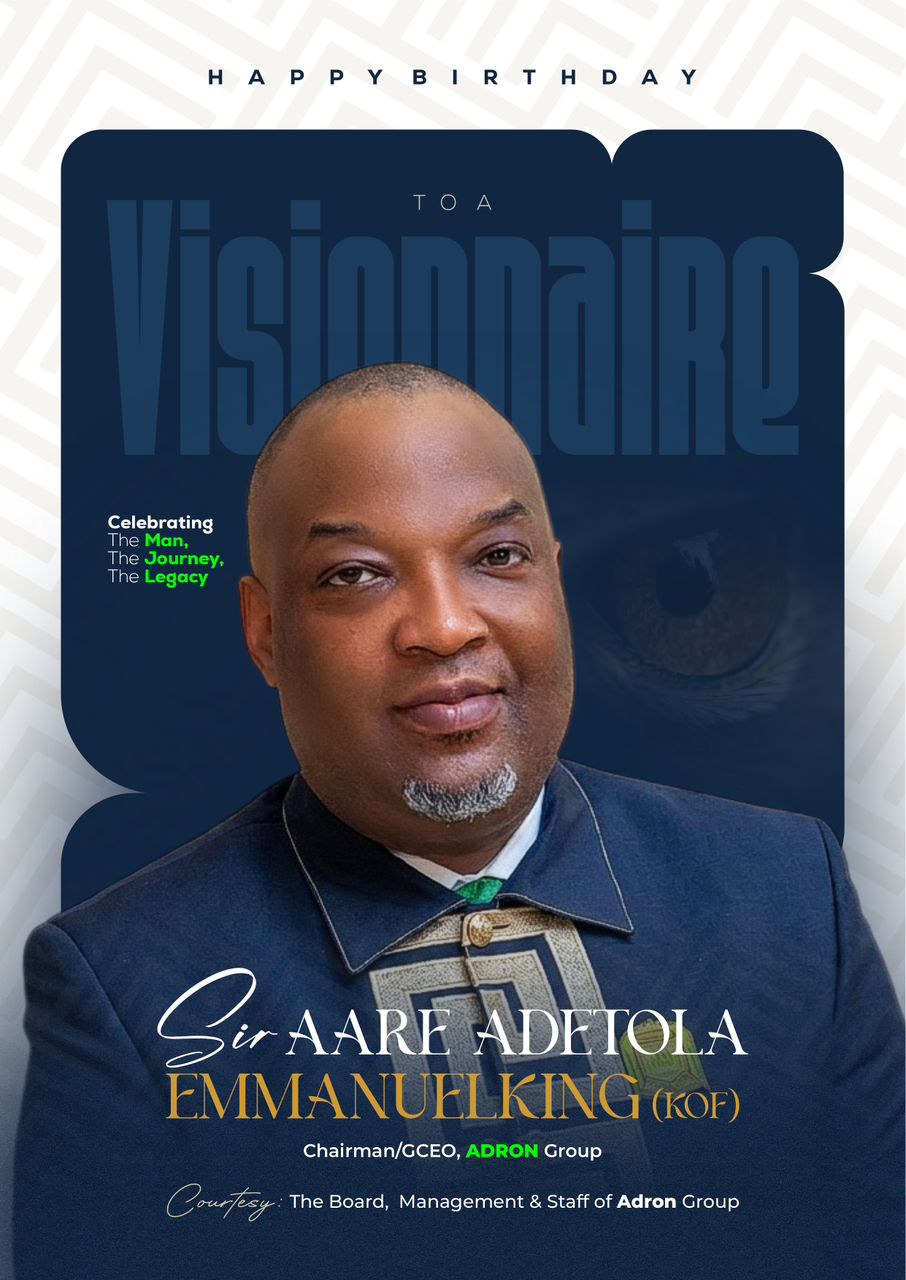
Adron Homes Celebrates Visionary Chairman, Aare Adetola Emmanuel King, at 51
The management and staff of Adron Homes and Properties Limited have joined family, friends, associates, and well-wishers across the globe to celebrate their Chairman and Chief Executive Officer, Aare Adetola EmmanuelKing, as he marks his 51st birthday.

In a statement released by the company, the milestone was described as a celebration of an exceptional leader whose vision, resilience, and entrepreneurial brilliance have not only transformed Adron Homes into a household name in Nigeria’s real estate sector but have also redefined affordable housing across the country.
Under his dynamic leadership, Adron Homes has continued to expand its footprint, delivering value-driven residential solutions while empowering thousands of Nigerians with opportunities for home ownership. His commitment to excellence, innovation, and customer satisfaction has remained the driving force behind the company’s sustained growth and industry leadership.
The statement further highlighted Aare EmmanuelKing’s passion for nation-building and community development, noting his significant contributions to job creation, youth empowerment, and the promotion of socio-economic development through real estate investments.
“As a leader, mentor, and visionary, Aare Adetola EmmanuelKing has consistently inspired a culture of excellence, integrity, and dedication within the organization. His ability to turn bold ideas into reality continues to position Adron Homes as a trailblazer in the industry,” the statement read.
The company expressed profound gratitude for his steadfast leadership and prayed for continued wisdom, strength, and sound health as he embarks on another year of impactful achievements.
As he celebrates his 51st birthday, the entire Adron Homes family proudly honours a man whose legacy continues to shape the future of real estate in Nigeria.
Happy 51st Birthday, Aare Adetola EmmanuelKing!


-

 society7 months ago
Religion: Africa’s Oldest Weapon of Enslavement and the Forgotten Truth
-

 news4 months ago
WHO REALLY OWNS MONIEPOINT? The $290 Million Deal That Sold Nigeria’s Top Fintech to Foreign Interests
-

 society6 months ago
“You Are Never Without Help” – Pastor Gebhardt Berndt Inspires Hope Through Empower Church (Video)
-

 celebrity radar - gossips2 months ago
Dr. Chris Okafor Returns with Power and Fire of the Spirit -Mounts Grace Nation Altar with Fresh Anointing and Restoration Grace on February 1, 2026
You must be logged in to post a comment Login
You must log in to post a comment.