
celebrity radar - gossips
“The Blood Of My Unborn Child Is On Your Head,” Ex-Girlfriend To Uber Couple Makes Shocking Revelation



An ex-girlfriend to the viral couple who met via ride hailing service, Uber has come forward to make shocking claims regarding the new husband.
The ex-girlfriend who claimed the blood of her unborn child is on the newly married man noted that she accommodated him and his brother when they had nothing but he repaid her by demanding an abortion after she lost her job on his account.
The lady identified as Temile wrote:
THE UBER GUY”S ALLEGED LOVE STORY, First off i heard Shola Okorodudu Gregory got married but i kept quiet because i wanted to let things slide while recovering from the torture he put me through.After Church today i kept on receiving calls and tags from my friends about the so called love story. Wow what a wicked world! Anyway i have decided to break the silence…… I am Temile Fortune i met Shola 2014 when he just graduated from Delsu, i was with him before he travelled to the UK at Salford University for his Masters. After their Masters, himself and his brother relocated back to nigeria with nothing but the car they bought for their Uber business. I accommodated them, fed them( he loves Ukodo’ yam pepper soup with goat meat) i did everything to make him happy. I always spent my salary before month end and also borrow money from @miss_beckiesha @chickittto just for him to stand on his feet. After a while he started the Uber business and he got an apartment with his Lawyer friend and brother at Surulere. He kept on complaining about how bad business was, i will give him money to fix his car, to fuel his car, to the extent that there was a day his car was towed at Computer village i had leave the office to Oshodi to pick up the car. He lived in a 2 bedroom flat with his brother and friend, i will cook , clean, subscribe his smile wifi just to make him happy. At times because he shares a room with his brother ,we will sleep in the living room on the floor and he will make promises of how he will never forget all i have done for him. Along the line because I accommodated him and his brother at my company’s apartment,I was reported to my MD by my colleague and i lost my job. He started acting funny, along the line I was duped of the sum of 2million from my weavon business money by an agent in Dubai. He changed and started giving me attitude eventually I got pregnant. I was 6 weeks pregnant then i applied for a US VISA and my interview was in Abuja. He drove me to the airport after agreeing that when am i granted the visa, myself and my unborn child and him can have a better life he also promised he was going to pay my bride price before travelling.
Unfortunately i was denied the visa, i ended up crying eyes out at the embassy ,I called him on phone and told him everything that had happened. On 27th of August 2016 i came back to lagos but he wasn’t at the airport to pick me up as planned, i called him but he wasnt picking up so i took a taxi straight to his house and met him at home. Later that night, he called me and told to go for an abortion but i refused and told him having an abortion will be the last thing on my mind, he was yelling saying he doesnt want a liability but i stood my ground saying i won’t go for an abortion and i received a resounding slap on my face , he kept on pushing his weight on my petite self saying he was going to kill me and i was screaming but he kept on using his fist and if not for the timely intervention of his neighbour i would have been dead by now and his brother and friend wasn’t around. I passed out and i found myself in a nearby clinic where i was told that i have lost my baby and had internal pain in my arms. He never bothered to call nor apologise to me . Four days later, i knew nobody will be at home, i went to his house and i took his school credentials infact all his documents, i wanted to commit suicide with it but my family members and friends begged me not to. I had to give the documents back to a friend to give them back to him after much plea from his friends and family members. He never called to apologize till date, All for me to hear that he got married. The funniest part is I still wasnt bothered until i read the trash his wife wrote about him, this was a man cheating on me with this same lady simply because things became tight and i wasn’t giving him money the way i used to. There is an African proverb that says”the cane that was used to beat the first wife is on the top roof for the second. Sigh I remember when Shola and Toju Okorodudu had food poisoning i was the one taking care of them, to the extent of bathing him and carrying him to poo.
Part 3….. Remember one thing, the blood of my unborn child is on ur head , u are murderer , my friends saw through you and they kept on warning me but i refused thinking they were haters. I was the perfect girlfriend bcos i saw a future in us not knowing u were after the money . You couldn’t even pretend for a while when things wasn’t working well for me. @bigsholz i was dating you until August 27th and u engaged a lady september 21st. I got to realised that he actually wanted me to go to d US and be funding him while he is married here. I should have listened to my dearest aunty that told me to send your document so she could dump it in Los Angeles beach for me. @bigsholz Gregory okorodudu, every pain you made me go through, you will go through same in a hundred fold in the mighty name of Jesus amen! I remember when i shopped for you, @bigsholz and your brother Toju. I have decided to leave you in the hand of God , i know some people will say i am a hater but no i am not, i just hate the fact that he is deceiving his wife and also he is portraying a perfect picture of him it is so disgusting. I am pained to see myself doing this but i don’t have a choice. I had to come out and say everything i went through in the hands of this beast, pretender, he knows how to a pet a lady to a fault until he showed me his true colours. I know lots of people that can bear me withness about how u treated me. How i lost my pregnancy, keep on pretending it wont be long before u show her ur colours eventually you will. Good night everyone




celebrity radar - gossips
Accolades to Empress Genevieve Wining as she Celebrate birthday in Grand style

Accolades to Empress Genevieve Wining as she Celebrate birthday in Grand style
Emmanuel Clement
Vilnius, Lithuania – The Grand Hotel Vilnius will host a grand birthday celebration in honor of Her Majesty The Empress Genevieve Wining of the United Kingdom of Atlantis (UKA) on April 4th, 2026.
The four-day event promises to be an extravagant affair, marking the special birthday of Empress Genevieve Wining. The celebration will take place at the prestigious Grand Hotel Vilnius, Lithuania, renowned for its luxurious ambiance and exceptional service.

According to the event flyer, the birthday celebration will be a spectacular occasion, fitting for an empress. Guests can expect an elegant setting adorned with golden accents, sparkling champagne, and festive decorations, creating a regal atmosphere befitting the occasion.
The Empress Genevieve Wining of UKA is expected to grace the event, which will include various festivities and celebrations in her honor. The occasion aims to bring together dignitaries, followers, and guests to commemorate the empress’s birthday with grandeur and joy.
For media inquiries, accreditation, or further information about the birthday celebration of The Empress Genevieve Wining of UKA, please contact the event organizers.
Courtesy of His Excellency Emperor Prof. Solomon Wining. UKA

Today, Dr. Chris Okafor turns a year older
~By Sunday Adeyemi
It is widely acknowledged that the exceptional Dr. Chris Okafor, a man of great character, always celebrates his birthday on April 4th, and in recognition of this occasion, I am inspired to write this special tribute to honor him.
Today marks a momentous occasion as we commemorate the birthday anniversary of Dr. Chris Okafor, a rare gem, a perfect gentleman, and the revered founder of Grace Nation Church, aka Liberation City.
Without reservation, this versatile and dependable Oracle foundry has consistently proven itself worthy of the accolades bestowed upon it on this notable anniversary.
Let it be reiterated that Dr. Chris Okafor is a leader known for his generosity and commitment to humanity’s welfare and advancement. The special gifts donated recently to widows and widowers within and outside the church are a testament to his exceptional leadership.
Your reputation as an outstanding and authentic man of God is evident in your exceptional goodwill and philanthropic endeavors.
Your dedication and perseverance have yielded impressive results, and numerous people, including myself, are justifiably proud of the remarkable work you are doing.
You have consistently exemplified outstanding leadership in the Christian community, demonstrating the profound impact of your role as a gift from God to humanity. I firmly believe this to be true.
Here’s to a year of productivity, success, and happiness. Congratulations and warm wishes on your birthday, sir.
Sunday Adeyemi
Your Son
celebrity radar - gossips
Adron Homes Celebrates Visionary Chairman, Aare Adetola Emmanuel King, at 51
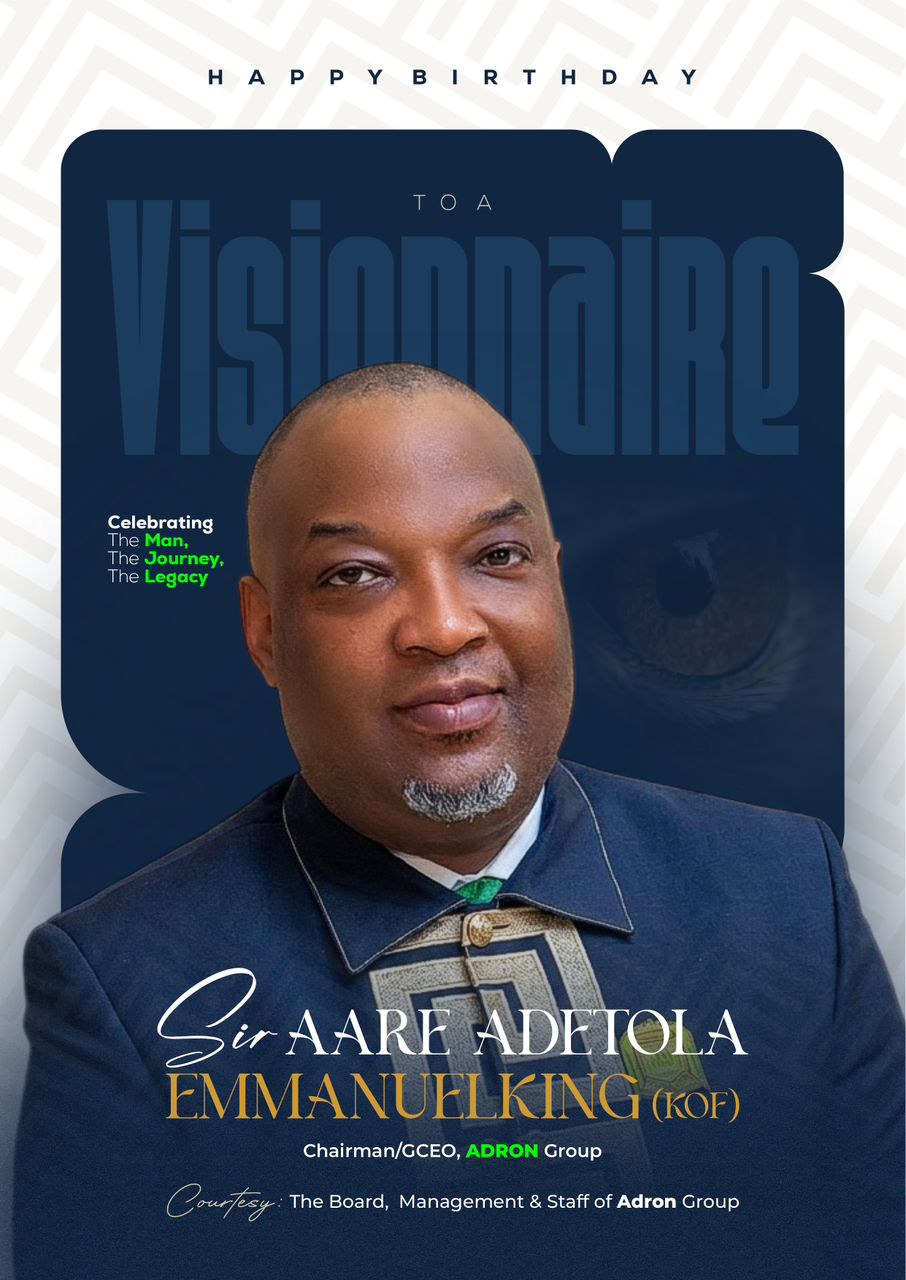
Adron Homes Celebrates Visionary Chairman, Aare Adetola Emmanuel King, at 51
The management and staff of Adron Homes and Properties Limited have joined family, friends, associates, and well-wishers across the globe to celebrate their Chairman and Chief Executive Officer, Aare Adetola EmmanuelKing, as he marks his 51st birthday.

In a statement released by the company, the milestone was described as a celebration of an exceptional leader whose vision, resilience, and entrepreneurial brilliance have not only transformed Adron Homes into a household name in Nigeria’s real estate sector but have also redefined affordable housing across the country.
Under his dynamic leadership, Adron Homes has continued to expand its footprint, delivering value-driven residential solutions while empowering thousands of Nigerians with opportunities for home ownership. His commitment to excellence, innovation, and customer satisfaction has remained the driving force behind the company’s sustained growth and industry leadership.
The statement further highlighted Aare EmmanuelKing’s passion for nation-building and community development, noting his significant contributions to job creation, youth empowerment, and the promotion of socio-economic development through real estate investments.
“As a leader, mentor, and visionary, Aare Adetola EmmanuelKing has consistently inspired a culture of excellence, integrity, and dedication within the organization. His ability to turn bold ideas into reality continues to position Adron Homes as a trailblazer in the industry,” the statement read.
The company expressed profound gratitude for his steadfast leadership and prayed for continued wisdom, strength, and sound health as he embarks on another year of impactful achievements.
As he celebrates his 51st birthday, the entire Adron Homes family proudly honours a man whose legacy continues to shape the future of real estate in Nigeria.
Happy 51st Birthday, Aare Adetola EmmanuelKing!


-

 society7 months ago
Religion: Africa’s Oldest Weapon of Enslavement and the Forgotten Truth
-

 news4 months ago
WHO REALLY OWNS MONIEPOINT? The $290 Million Deal That Sold Nigeria’s Top Fintech to Foreign Interests
-

 society6 months ago
“You Are Never Without Help” – Pastor Gebhardt Berndt Inspires Hope Through Empower Church (Video)
-

 celebrity radar - gossips2 months ago
Dr. Chris Okafor Returns with Power and Fire of the Spirit -Mounts Grace Nation Altar with Fresh Anointing and Restoration Grace on February 1, 2026
You must be logged in to post a comment Login
You must log in to post a comment.