
celebrity radar - gossips
Tinubu And Afenifere’s Curse: Dialogue With Yinka Odumakin’s Ghost By Felix Oboagwina


Tinubu And Afenifere’s Curse: Dialogue With Yinka Odumakin’s Ghost
By
Felix Oboagwina
Felix, what is happening? Will you guys continue to sleep and allow this man to ride roughshod over Afenifere once again?

Wetin we go do now, Yinkus? Bola Ahmed Tinubu is a Yoruba project. Therefore, all Yoruba people should queue behind him, including Afenifere. As the foremost Yoruba socio-political group, shouldn’t Afenifere be leading the charge to have a Yoruba presidency come 2023?
Who says? This man tried using us to bring Afenifere down. If not for the spirit of Obafemi Awolowo that made us see the light, Jimi Agbaje and me, and the Babas’ exceptional magnanimity, tell me the Afenifere that Tinubu would be going to today to curry blessings for his ambition.
It means the man too has seen the light and repented, just like you and JK. If the Elders could forgive you Yinka and elevate you from Admin Secretary to Spokesman of Afenifere, then Tinubu deserves a second chance. After all, it is your Yoruba people who say that if we fail to forget yesterday’s quarrel, we will not have people to play and confer with tomorrow. Also, Omo eni kin se di bebere ka fi l’eke si t’omo elomiran.
You this “kobokobo” Edo boy, who has been teaching you Yoruba proverbs?
Ewe mi ti pe l’ara ose, now! I have lived long enough in Rome to begin to mouth some Latin. Don’t forget I was born here, schooled here, married here, live here, have all my children here. Moreover, Edo and Yoruba are one. Oba of Benin is a son of Oduduwa. Therefore, I am a son of Oodua tokantokan, undiluted. (Chuckle)
Story! You are the one talking of “omo eni kin se di bebere.” Have you forgotten the case of Mulikat Adeola Akande, House of Representatives Member from Orire 1&2, Oyo State? President Goodluck Jonathan and PDP ceded to her the Number 4 position, Speaker of the House of Representatives in 2011. Jonathan did it to keep the Speakership in the hands of the Yoruba South-West and give them a sense of belonging. Have you forgotten that Tinubu marshalled all his cronies in the House to vote against her and instead rooted for an Aminu Tambuwal from Sokoto State? The little boy insults the mystic Iroko tree and flees, the spirits would take their pound of flesh somehow, someday. For Tinubu, payback time has come.
The one that confuses people is why Afenifere cannot speak on one voice about Tinubu. Chief Ayo Adebanjo distances the group from, Chief Reuben Fasoranti welcomes him.
Pitching Pa Adebanjo against Pa Fasoranti is Jagaban deploying the same divide-and-rule tactics he has used against Afenifere since 1999! Only the gullible will fall for it. This same way he split the leadership of Abraham Adesanya. That was the same way he pitched the three other AD (Alliance for Democracy) governors against the Afenifere leaders, except for Ondo State’s Governor Adebayo Adefarati, who stuck with the old men because of his direct loyalty to Awolowo, Awoism and the Awo legacy. The rift that Tinubu caused in Afenifere hastened the death of Pa Adesanya.
Slow down, Yinka, don’t jump to conclusions. At 86, Senator Adesanya was already old and good to go!
Who says? The man died heartbroken. The man died regretting. The man died cursing. He used to tell me, “Yinka, do you see how Tinubu has scattered on my head the house that Awolowo built? Do you see how this legacy institution is being destroyed in my own time? What will I tell my predecessors, Chief Obafemi Awolowo and Chief Adekunle Ajasin, when we meet in the afterlife? Will I tell them that the ileke omo Oduduwa (cord of Oduduwa) that they kept in trust in my hands broke and scattered under my care, in my own time?”
Or do you forget what you said Chief Olaniwun Ajayi told you at the Afenifere secretariat at Jibowu, Yaba, when you were DPA Lagos Director of Publicity, the curses the old man extracted from the Bible and heaped on Tinubu. Felix, have you suddenly gone senile?
Yinka, how can I forget such a weighty matter?
Tinubu split Afenifere and engineered from it a renegade Afenifere Renewal Group (ARG) in 2008. Tinubu singlehandedly destroyed AD. He cared little that AD was the June 12 and NADECO vehicle that M.K.O. Abiola’s supporters virtually arm-twisted General Abubakar Abdulsalami to register, even after his earlier resolve to run a two-party transition in 1999. Bola Tinubu dismembered AD, the party that brought him into power, the emblematic phoenix that rose from the ashes of Awo’s First Republic Action Group and Second Republic UPN. On AD’s carcass, Tinubu as Lagos Governor founded the Action Congress, AC, that later transmuted into the Action Congress of Nigeria, ACN, which formed a strong pillar in what became today’s All Progressives Congress, APC.
Hold it there, Yinka, the man has won the APC ticket. Old sins have passed away. Even you forgave former President Olusegun Obasanjo although you abused the hell out of him, didn’t you, despite starting out as his hater? You even wrote a book against him, “Monitoring the Monitor” or “Observing the Observer” or so.
Olodo! Dullard! My book was Watch The Watcher (2014). What are we saying; and what are you saying? Obasanjo never identified with Afenifere. In fact, Afenifere worked against him and his PDP in 1999. Yes, we fell out with Obasanjo over all that he did against Tinubu, seizing local government funds when Tinubu created more local government areas in Lagos, and our belief that he rigged the 1999 and 2003 elections and unapologetically positioned himself as a stooge of the North. Even then, the man later saw the light, and I went to work with him –not “for him,” mind you, but “with him.” We aligned to create a third force to rescue Nigeria from the plundering vultures that PDP and APC had become in government.
With Tinubu going to seek Fasoranti’s blessing last Sunday, it shows he too has seen the light.
No. Tinubu went to Fasoranti with the same sense of Emilokan entitlement, which he deployed to secure the APC ticket. He believes that with money, nothing shall be impossible.
Was that why Pa Adebanjo accused Tinubu of bribing his way into the old man’s home in Akure? On ground at Fasoranti’s place were men of eminence: Former Finance Minister Olu Falae, former Minister and Senator Dayo Adeyeye, former Ogun’s Governor Gbenga Daniel, former Osun Governor Bisi Akande, Senator Iyiola Omisore. Could all such people have been bribed?
I have not said so. Just know this and know peace: The person whose price Jagaban cannot pay does not exist.
That was how he got you too, abi, if we are to extrapolate your statement?
Na you know! The issue here is why this man will now want to court Afenifere, a group he spent his entire post-2003 political career denigrating and eroding. The height of it was when the daughter of this same Pa Fasoranti was killed. Eyewitnesses and those familiar with that Ondo-Ore axis, where bandits had shot her dead, identified the killers as Fulani herdsmen. Tinubu paid a condolence visit to the grieving old man; and when journalists asked him what should be done about the insecurity being perpetrated by Fulani herdsmen in Yoruba land, Tinubu petulantly said: “Where are the cows?” Insult upon injury! I was there. I heard him.
Did you notice that Governor Rotimi Akeredolu was not part of that charade of a visit? This is despite the fact that Tinubu is his party’s flag-bearer. Moreover, Aketi is the home Governor and this visit happened right in the state capital, a shouting distance to the Government House.
His Excellency might have been busy that day and otherwise engaged.
Who wants to use his head to carry a curse, Felix?
Curse, keh! What curse? Yinka, have you come again? When will you stop making all these your weighty insinuations?
Oh, you don’t know there is an Afenifere curse? Of course, there is. Ladoke Akintola betrayed Afenifere, did he not pay heavily for his treachery, slaughtered like a chicken during the 1966 coup? Even the one they used to call Baba Kekere, Alhaji Lateef Jakande, the best civilian Governor Lagos has ever had. Jakande was Awolowo’s alter ego and heir apparent. When this falcon broke away from Afenifere his falconer and gummed himself to General Sani Abacha against June 12 and NADECO, did that error not finish Jakande politically? Even General Oladipo Diya, who was championing an alternative Yoruba leadership when Afenifere refused to abandon Abiola’s cause and follow him to lick Abacha’s anus, did Diya end well? Did he not escape the hangman’s noose only by the whiskers? Even Abacha, how did he end up after he spent his tenure hunting and killing Afenifere followers and leaders? How about Navy Captain Anthony Onyearugbulem, the Military Administrator of Ondo State, who brutishly, irreverently and indecently invaded Afenifere Leader, Pa Adekunle Ajasin’s home in Owo, and vilified the old man, like a headmaster would pour scum on a primary school pupil? Did Onyearugbulem end well? Even his Wikipedia profile said the man “died suddenly in a hotel room in Kaduna in somewhat mysterious circumstances.” He abused an old man and he did not grow old too, 47.
If you didn’t know, know it today, Felix: The fear of Afenifere’s curse is the beginning of wisdom.
I am just curious, did Abiola’s fate have to do with the curse? He antagonised Awolowo too in the NPN days. The way his mandate was taken away from him remains an inexplicable anti-climax. Did it have to do with the curse?
Spirit I may have become, Mr. Oboagwina, that doesn’t imbue me with omniscience. I don’t have answers to all of life’s mysteries.
If the fear of the curse made Tinubu run to reconcile with Afenifere, why is heaven not rejoicing over this repentant sinner? Why has the whole Afenifere turned upside down over Pa Fasoranti giving him not only audience, but also his blessing on October 30? After all, isn’t it you Yoruba people who say that if you cane a child with the right hand, you should use your other hand to embrace him?
Did Tinubu go seeking Afenifere’s blessing; or he went to get Pa Fasoranti’s blessing? They are two different things, Felix. Afenifere is an institution, a legacy institution. Since its creation in 1951, it has remained the spirit of the Yoruba people, their compass even. It may not pack the same power today as it did under Awolowo or Ajasin, but its mysticism remains. It radiates in its collegiate leadership. That leadership college, March last year, agreed with Fasoranti that, being 95 years old, he should retire and Adebanjo should take up the leadership. When Adebanjo pronounced that, for the sake of equity, belongingness and social-justice, power should rotate to the Igbo nationality this time around, the voice was indeed the voice of Adebanjo; but the authority came from beyond him. That pronouncement emanated from the pantheon of Afenifere leaders, living and dead.
Therefore, what you are telling me is that Peter Obi is only an accidental beneficiary.
Spot on! Power should go to Igbo people this time around. In 1999, to redress the injustice we Yoruba suffered over June 12 and Abiola’s death, the entire country left the field free to the monopoly of two Yoruba contestants, Obasanjo and Olu Falae. The country owes the Igbo no less in 2023. It will bring a close to the Civil War and redress the enduring injustice that has reignited calls for the resurrection of Biafra.
Shouldn’t Afenifere maintain neutrality, simply allow a level playing field, without tilting one way or the other, and let all contestants struggle for power? Bola Tinubu will tell you that power, political power, is never served a la carte.
Yes, that is his favourite cliché. Ptcheew! (Hiss) As if, his victory over Funsho Williams in the AD primaries of 1999 came by his own power and his own might. That story we leave for another day. The question you should be asking is, whether Tinubu himself has created a level playing field for political contestants under his wings. Confront him with that. He chooses. He enthrones. He dethrones. He dictates. He only and only he is the Alpha and Omega of who becomes what in Lagos, without tolerating inputs from anyone else. So why should he kick when Afenifere borrows his modus operandi? Here is the guillotiner becoming jumpy at the sight of a sword.
Yinka, he is Yoruba’s son, more than any Peter Obi. Omo wa ni e je ko se o!
Yoruba o bi omokomo o! Should I break that down for you? Yoruba have no hooligan for a son.
My own is why is this man making so many mistakes? Christians have already backed away from his Muslim-Muslim ticket; they have raised hell and high water over his choice of Kashim Shettima as Running Mate, when he had zillions of eminent Northern Christians to choose from. Yet Buhari rejected him in 2011 and 2015 for this same reason that the ticket would be Muslim-Muslim. Add to that the fact that he is bungling his public speaking engagements with inexplicable verbal accidents at every adlib attempt. It looks like this man’s handlers have lost vigilance, programming him for failure.
Yinka, I see you have risen up –preparatory to taking your leave. Have you considered one point?
What is that?
From the time of Awolowo versus Tafawa Balewa in the First Republic, to Awolowo versus Shehu Shagari in the Second Republic, to Obasanjo versus Olu Falae in the Fourth Republic in 1999, to Obasanjo versus Muhammadu Buhari in 2003, to Umar Yar’Adua versus Buhari in 2007, to Goodluck Jonathan versus Buhari in 2011, to Goodluck Jonathan versus Buhari in 2015, to Buhari versus Atiku Abubakar in 2019, don’t you see a disturbing trend?
Which is?
Not once has Afenifere backed a winning horse. Afenifere has never been in mainstream politics.
Felix, I told you before: I might be a ghost, but I do not have answers to all mysteries.




celebrity radar - gossips
Adron Homes Celebrates Visionary Chairman, Aare Adetola Emmanuel King, at 51
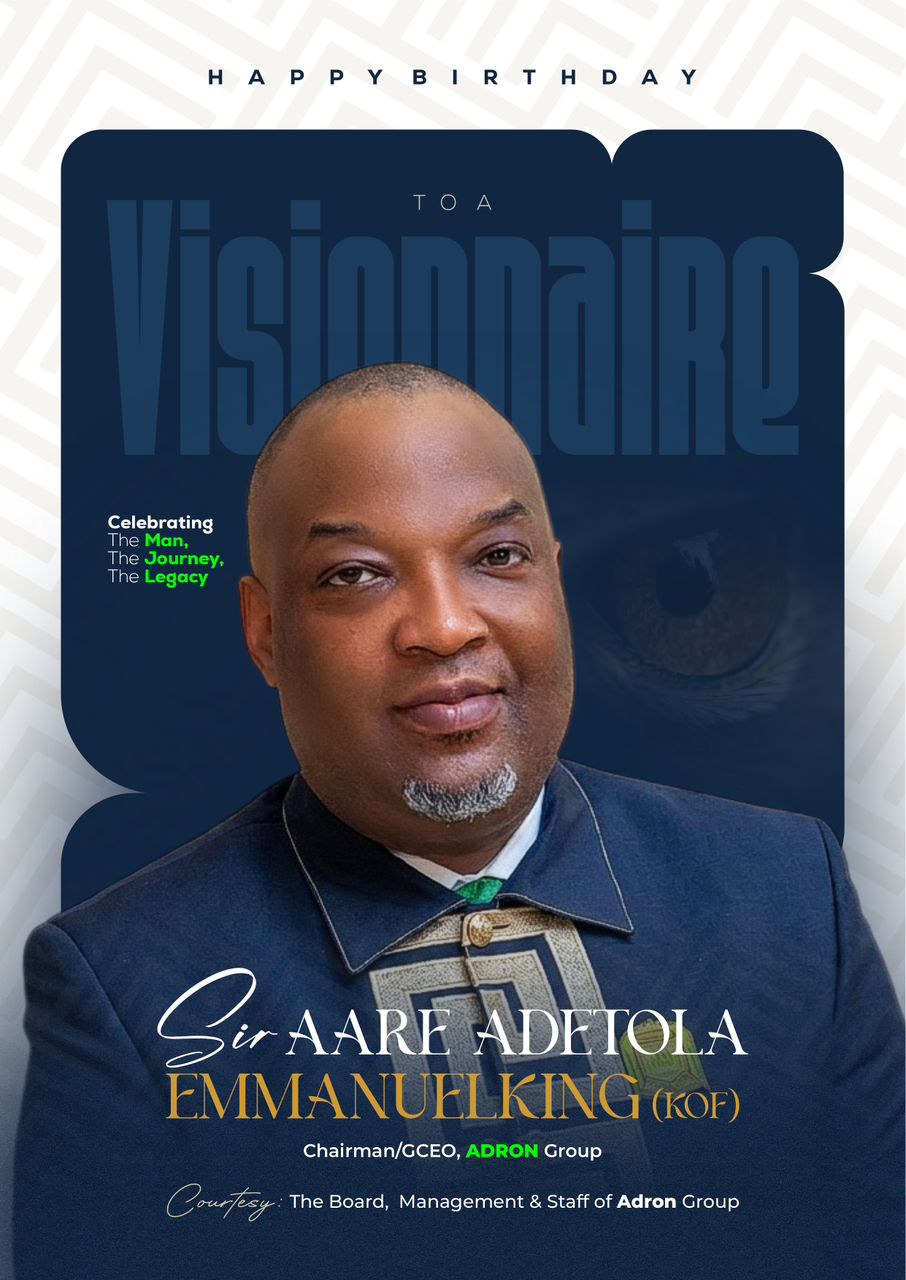
Adron Homes Celebrates Visionary Chairman, Aare Adetola Emmanuel King, at 51
The management and staff of Adron Homes and Properties Limited have joined family, friends, associates, and well-wishers across the globe to celebrate their Chairman and Chief Executive Officer, Aare Adetola EmmanuelKing, as he marks his 51st birthday.

In a statement released by the company, the milestone was described as a celebration of an exceptional leader whose vision, resilience, and entrepreneurial brilliance have not only transformed Adron Homes into a household name in Nigeria’s real estate sector but have also redefined affordable housing across the country.
Under his dynamic leadership, Adron Homes has continued to expand its footprint, delivering value-driven residential solutions while empowering thousands of Nigerians with opportunities for home ownership. His commitment to excellence, innovation, and customer satisfaction has remained the driving force behind the company’s sustained growth and industry leadership.
The statement further highlighted Aare EmmanuelKing’s passion for nation-building and community development, noting his significant contributions to job creation, youth empowerment, and the promotion of socio-economic development through real estate investments.
“As a leader, mentor, and visionary, Aare Adetola EmmanuelKing has consistently inspired a culture of excellence, integrity, and dedication within the organization. His ability to turn bold ideas into reality continues to position Adron Homes as a trailblazer in the industry,” the statement read.
The company expressed profound gratitude for his steadfast leadership and prayed for continued wisdom, strength, and sound health as he embarks on another year of impactful achievements.
As he celebrates his 51st birthday, the entire Adron Homes family proudly honours a man whose legacy continues to shape the future of real estate in Nigeria.
Happy 51st Birthday, Aare Adetola EmmanuelKing!
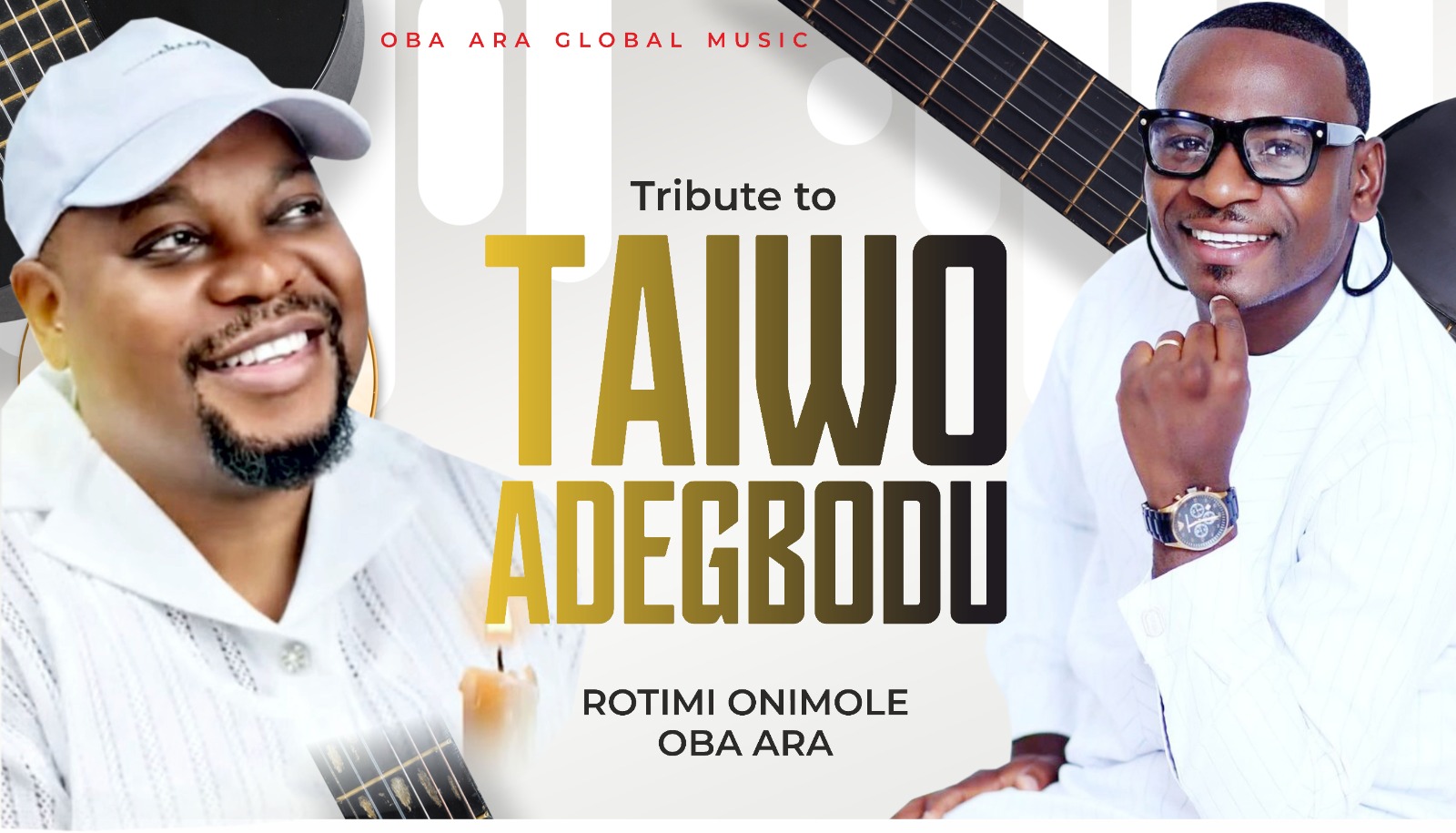
Oba Ara Releases Emotional Tribute to Late Taiwo Adegbodu
Taofik Afolabi
The gospel music community continues to grieve the painful loss of Taiwo Adegbodu, a beloved figure whose sudden departure left a deep void among fans, colleagues, and loved ones. In response to this loss, renowned gospel minister Rotimi Onimole, popularly known as Oba Ara, has released a moving tribute song that captures both the sorrow of the moment and the enduring legacy of the late singer.
Oba Ara, a proud son of Isale Eko, channels raw emotion throughout the song, using heartfelt lyrics and soul-stirring melodies to reflect on his personal connection with Taiwo Adegbodu. In the tribute, he openly expresses how deeply the news of Adegbodu’s passing shook him, describing it as a painful and unexpected loss that is difficult to come to terms with.
The song goes beyond mourning, it celebrates the life, ministry, and impact of Taiwo Adegbodu. Oba Ara highlights the late artist’s dedication to spreading the gospel through music, his inspiring voice, and the spiritual influence he had on many within and beyond Nigeria. Through powerful verses, he paints a picture of a man who lived for God and touched countless lives through his ministry.
Listeners have described the tribute as both comforting and deeply emotional, as it resonates with the collective grief of the gospel music community. It serves as a reminder that although Taiwo Adegbodu is no longer physically present, his music, message, and legacy will continue to live on.
In honoring his late colleague, Oba Ara not only pays his respects but also offers a source of healing for fans and fellow ministers, using music as a tool to process grief and celebrate a life well lived.
celebrity radar - gossips
Buratai, Fagbemi , Shagaya, Olofa, Others Eulogise Olowu Kuta’s Olori On 60th Birthday, Foundation Launch
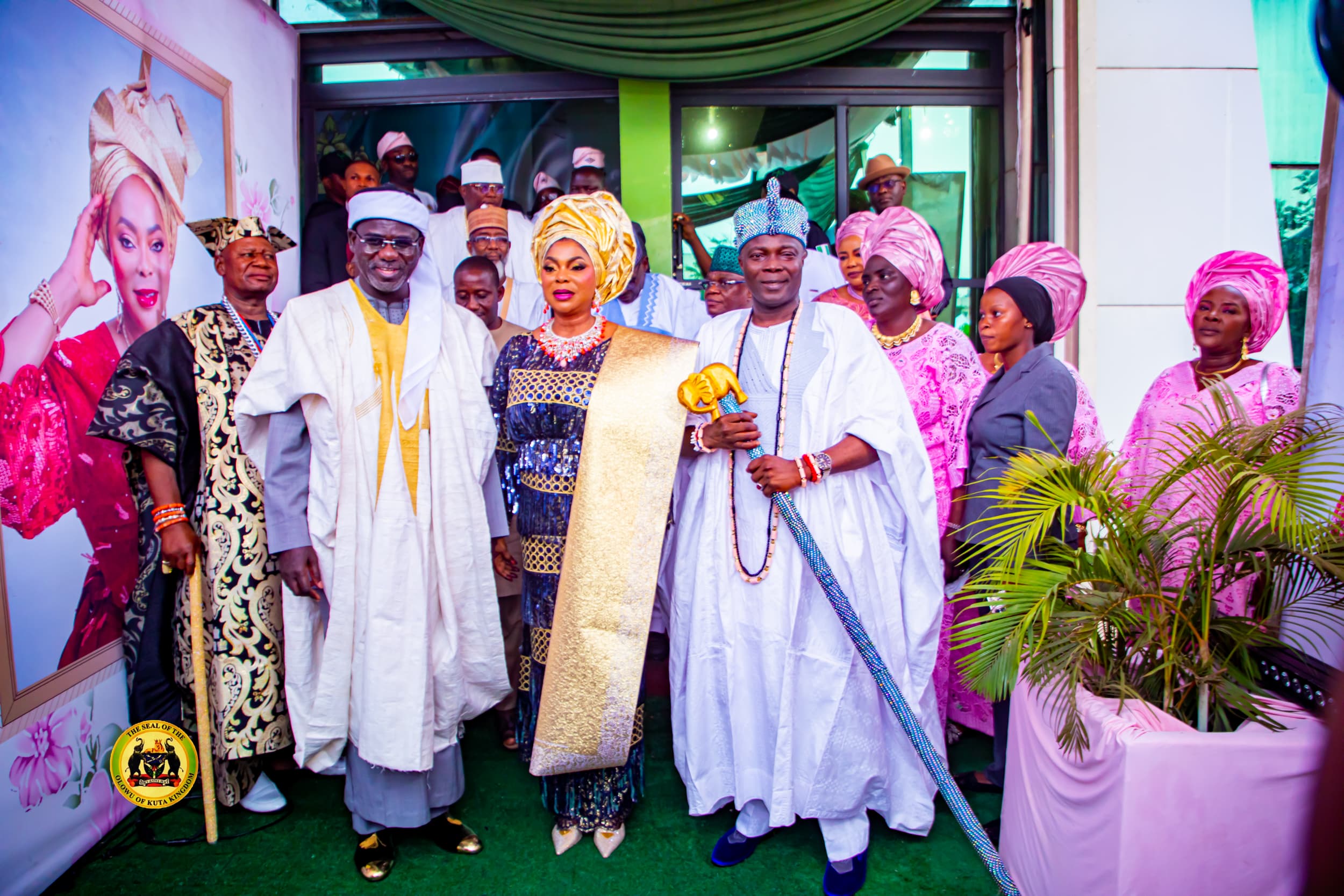
Buratai, Fagbemi , Shagaya, Olofa, Others Eulogise Olowu Kuta’s Olori On 60th Birthday, Foundation Launch
Eminent personalities across the Nigeria stormed the TFK Event Centre, Bala Mohammed Way, Guzape, Abuja, to celebrate the 60th birthday of Olowu Kuta’s Olori, Queen Jumai Amoke and her Foundation Launch on Saturday 28, March 2026.

From former Chief of Army Staff, Lt Gen TY Buratai rtd, to the Minister of Justice and Attorney-General of the Federation, Prince Lateef Fagbemi; Olofa of Offa, HRM Oba Mufutau Gbadamosi. Even top businesswoman and socialite, Chief (Mrs) Bola Shagaya, was in attendance.


Other dignitaries were newly promoted Deputy Inspector-General of Police and former AIG Zone 2 , Lagos , Adegoke Fayoade, Major General Abdumalik, Major General Samuel Adebayo rtd (Fmr CDI);
Major General Anthony Omozoje rtd (Fmr Copp);
Alhaji Tajudeen Owoyemi (Asiwaju of Offa and CEO Radisson Hotel Nigeria;
Dr Waheed Olagunju, former managing director of Bank of Industry, Oniba of Iba, Lagos State, HRM Oba Dr Suleiman Raji ;
Justice Falola, Olu of Ile-Ogbo , Oba Adetoyese amongst many traditional rulers and captains of industry too numerous to mention.
Speaking at the occasion, the Chief Host, Olowu of Kuta, HRM Oba Dr Adekunle Oyelude Makama, CON , Tegbosun iii, who is also the husband of the celebrant commended Queen Jumai for ‘ her slender arms full of kindness’ to establish such humanitarian Foundation, ‘Amoke Children and mother in Need Foundation’ at a time Nigerians are going through economic crisis occassioned by the global meltdown.
Olowu also commended her steadfastness and love for the less privileged and downtrodden.
The monarch refrenced the task before his wife’s humanitarian gesture said her best is yet to come.
” Olori Amoke Jumai, I celebrate you. You will celebrate 70, 80, 90 and continue to shine as you continue to put a smile on people’s faces. I love you, “Olowu Kuta added.
To Lt Gen Buratai, a former army chief and former Nigerian Ambassador to Benin Republic, the reward of hard work is more work.
Buratai, who also doubles as Balogun Agba of Owu Kuta, a chieftaincy title reserved for a generalismo congratulated Queen Jumai for attaining the age of 60 in good health.
The retired army General said he’s not surprised by the turn out of eminent personalities across the country to celebrate the Olowu Kuta’s Olori because she merited it through her hospitality to all, adding that Allah the most merciful, most beneficial would accept all her act of ibadah.
The minister of Justice, Prince Fagbemi, was full of praises for Queen Jumai for deeming it fit to have a place in her heart to accommodate the needy and less privileged in ‘our society.’
Prince Fagbemi urged the guests to contribute generously to support the Foundation in order to continue to alleviate poverty and put a smile on the faces of the people.
” I congratulate you on your 60th birthday and Foundation Launch. I wish you many happy returns of the day and many more fruitful services to the country and motherland”, Prince Fagbemi added.
The celebrant, Queen Jumai who was grining from ear to ear thankfully said she was excited by the turn out and the response of the people to her foundation.
Queen Jumai, however, promised to continue to use her resources and donations received for the good of the needy and less privileged in the society.
” I want to appreciate my own Kabiesi Olofa of Offa , for his presence and im I’m using him as a point of contact to all other Kabiesis present here, the minister of justice and Attorney-General, you’re welcome, sir; Mrs Bola Shagaya, I salute your enterprise, Lt Gen Buratai, I’m grateful, sir; DIG Fayoade, Justice Falola and other dignitaries too numerous to mention, I thank you, all. To my darling husband, Kabiesi Olowu , I thank you immensely for your support. And to my family and friends, I thank you , all. E se pupo!”, she said.


-

 society6 months ago
Religion: Africa’s Oldest Weapon of Enslavement and the Forgotten Truth
-

 news4 months ago
WHO REALLY OWNS MONIEPOINT? The $290 Million Deal That Sold Nigeria’s Top Fintech to Foreign Interests
-

 society6 months ago
“You Are Never Without Help” – Pastor Gebhardt Berndt Inspires Hope Through Empower Church (Video)
-

 celebrity radar - gossips2 months ago
Dr. Chris Okafor Returns with Power and Fire of the Spirit -Mounts Grace Nation Altar with Fresh Anointing and Restoration Grace on February 1, 2026