
celebrity radar - gossips
Tinubu Unveils His Agenda For Nigeria

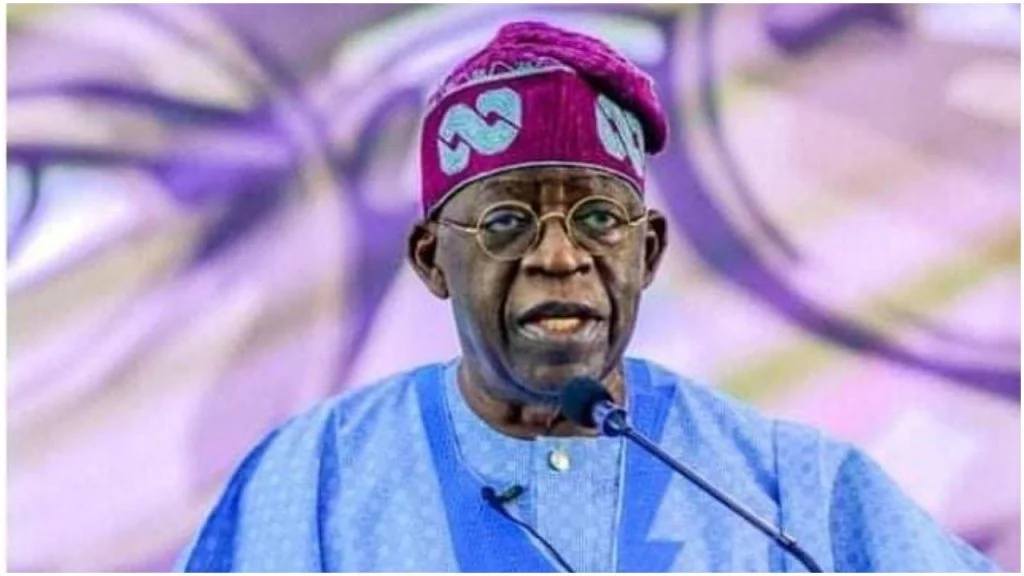
Tinubu Unveils His Agenda For Nigeria
As part of his campaign itinerary, the Presidential candidate of the All Progressives Congress (APC), Asiwaju Bola Ahmed Tinubu, on Monday, reeled out his blueprint for the country, saying his administration would bring out workable policies to ensure that insecurity is nipped in the bud in the North and across the country.

Tinubu, who spoke during an interaction with northern leaders under the aegis of the Arewa Joint Committee at Arewa House, Kaduna, noted that he would transform Nigeria just like he did upon assumption as Lagos State governor.

The former Lagos State governor noted that the whole country is endowed with resources that can be harnessed for greater economic development.
He praised past leaders of the country, including Nigeria’s late Premier of Northern region, Sir Ahmadu Bello, Nigeria’s first and only Prime minister, Tafawa Balewa, Chief Obafemi Awolowo, and Chief Nnamdi Azikiwe for being visionary leaders who gave their all to nation-building.
Before addressing the Northern leaders, Tinunu had earlier visited the tomb of the late Saudauna of Sokoto, who he prayed for, for his invaluable sacrifice to the North and country.
Riding on the wings of the heroes of Nigeria’s independence and history, Tinubu said he would continue to give his best even as president to ensure the country remains indivisible, achieving greatness together as one.
He noted: “As I said when I chaired the Sardauna Memorial Lecture, last year, I have a solemn feeling of responsibility and duty to our country every time I am here. Standing here evokes memories of a great leader and a father of this nation, the Late Sir Ahmadu Bello, the late Sardauna of Sokoto. The contributions of the Sardauna to nation-building remain a reference point for us all. He was a visionary builder of men and institutions.
“The dream of Sardauna, and indeed that of our other great leaders such as Chief Obafemi Awolowo, Dr Nnamdi Azikiwe, and our first and only prime minister, Sir Abubakar Tafawa Balewa was for one indivisible and prosperous nation built on shared values of patriotism, equity, justice, and brotherhood.
“It is, therefore, no coincidence that at Independence this vision was clearly laid out and encapsulated in our first National Anthem. It says: ‘Though tribes and tongue may differ, in brotherhood we stand.’
“This is a strong statement that acknowledges our diversity, and, therefore, the existence of different perspectives and interests, and how that should not stand on the path of our unity as brothers.
“The framers of this anthem, God rest their souls, will cringe to know that 62 years after, someone would come to this hallowed platform to campaign on the basis of tribe or where others come from.
“The dream of those forefathers, ladies, and gentlemen, was for a nation ‘Where no man is oppressed, a nation ‘with peace and plenty, and these – unity in diversity, peace and prosperity – are the fulcrum of my mission in this contest. They also form the bulk of my address to you this afternoon, in line with the areas the organizers wanted me to address,” Tinubu said.
On his plans for Nigeria as president, Jagaban Borgu promised to consolidate on the investments of President Muhammadu Buhari’s administration in all sectors of the nation to build on the successes recorded.
“Our economic plan would utilize the vast natural resources we have, through strategic investment in infrastructure which will lead to the diversification of the economy and wealth creation across the entire country. We will pay attention to modern economic drivers such as the digital economy, creative industries, and sports and entertainment sectors for the benefit of our young people.
“The APC Federal Government has taken several measures to build infrastructure and improve the ease of doing business across the country. This has been complemented by the efforts of some of our states to attract investments in diverse sectors of the economy,” he added.
Tinubu also stated that under his leadership, the Nigerian government will be business-friendly, adding that he would focus on tackling underinvestment and effective management.
He continued: “We shall support private businesses in our country and attract foreign direct investment to create jobs, re-industrialize our country and accelerate economic development. Nigerian businesses in sectors like banking and cement have successfully ventured out of the country to build thriving subsidiaries.
“We will build a strong domestic economy, expand the capacity of our domestic market to support growth and encourage export capacity in the areas of our competitive advantage. We have the endowments to be a prosperous country. I will lead a renewed push to move us from the status of a nation of potential into a country of actual accomplishments as an economic dynamo.”
Tinubu also promised to focus on using his experience of building human capital, which made Lagos one of the largest economies in Africa to grow the nation’s economy to an enviable height.
“Using my experience of building human capital, industries, and institutions, which has led to Lagos being one of the largest economies on the continent, I will reposition our existing industries and make them a competitive source of industrialization and growth not just for the North but the entire country. It is time to fetch water from a dry well and I, Bola Ahmed Tinubu, have done it before and I will do it. We will find a way where there are no roads!
“I will ensure that we take advantage of our resources to convert cotton to textile, plants to pharmaceutical products, groundnut to edible oil, cassava to ethanol and starch, etc., thereby building competitive advantage for our farmers through value addition.
“I will attract investments and create the enabling environment that will ensure the resurgence of our moribund industries and continue the infrastructural revolution of this administration on the railways and highways all over the country and invest in our inland waterways for safer and efficient transportation to complement this industrialization vision,” he said.
Tinubu further noted that the North has a greater advantage in agriculture and under his presidency, the region will emerge as the hub of agribusiness in Africa through huge investment in the sector in collaboration with the private sector.
He said, “Agriculture is of special interest to me. It is both an economic and existential issue for every country.
“Experience in the last seven years has shown the potential of agriculture in solving the problem of unemployment and boosting our GDP. For example, recent investment in the rice value chain has led to the springing up of rice mills across the country with attendant wealth creation and a reduction in our import bill.
“The North has a greater advantage in this regard due to its large and abundant arable land. My vision is for the region to be the hub of agribusiness in sub-Saharan Africa.
“We will improve investment in our livestock value chain. Specifically, subsectors like the dairy industry that has the potential of adding billions of dollars into our economy will receive significant attention.
“In collaboration with the private sector and governments at sub-national levels, we will make available high yield seeds and inputs, invest heavily in post-harvest storage and processing facilities so that we can significantly increase the value of what we produce. To ensure optimizing the full value of their produce, we will utilize Commodity Exchanges to guarantee return on investments, and enhanced wealth for the farmers.
“We will make available funds for research and development to provide the right inputs that will ensure greater yields and tackle climatic challenges bedeviling farmers such as flooding and desertification through enhancement of national drainage architecture and investment in shelter belts.
“Financing is critical to our vision for the agricultural sector. I assure you; I will attract the much-needed investment and re-engineer financing institutions to provide impactful interventions for maximal output.”
On his plans for education and helping reduce the out-of-school children in the North, the APC presidential standard bearer said, “Education is the most effective weapon against poverty. Comparative with other countries, education in Nigeria suffers from a funding deficit on account of our population and limited resources. I will provide the required leadership and mobilize investment for the development of the sector. We will work with both states and local governments to reform and retool the system. These reforms will give special attention to the welfare and training of our teachers and lecturers as necessary catalysts for the better system we desire.
“We will work with stakeholders to evolve creative solutions to the funding needs of our higher education that will bring a terminal end to challenges of funding and the attendant perennial industrial actions. To ease financing for basic education and expand access, we will cut down on the counterpart fund required by states to access UBEC grants to an affordable percentage.
\
“Millions of our children are currently roaming the streets instead of being in classrooms. My administration will invest heavily in infrastructure to allow for the proper integration of these children into our conventional schools.
“Thankfully, the current APC government has rolled out several initiatives, in partnership with development partners, to provide alternative access to education and vocation to this particular demographic.”
The event was attended by leaders from Northern Nigeria across party lines, academics, civil society, and youth organizations.
With Tinubu at the event are APC Governors from the North, including the Kaduna State governor, Nasir El-Rufai; Plateau State governor, Simon Lalong, who is the director general of the Tinubu-Shettima Presidential Campaign Council; Governors of Nasarawa State, Abdullahi Sule; Yobe State governor, Mai Bala Buni, and Zamfara, Bello Matawalle.
Former APC national chairman and deputy director general of the campaign council, Adams Oshiomhole, and Hadiza Bala Usman, deputy director general of the campaign council, were also at the event.




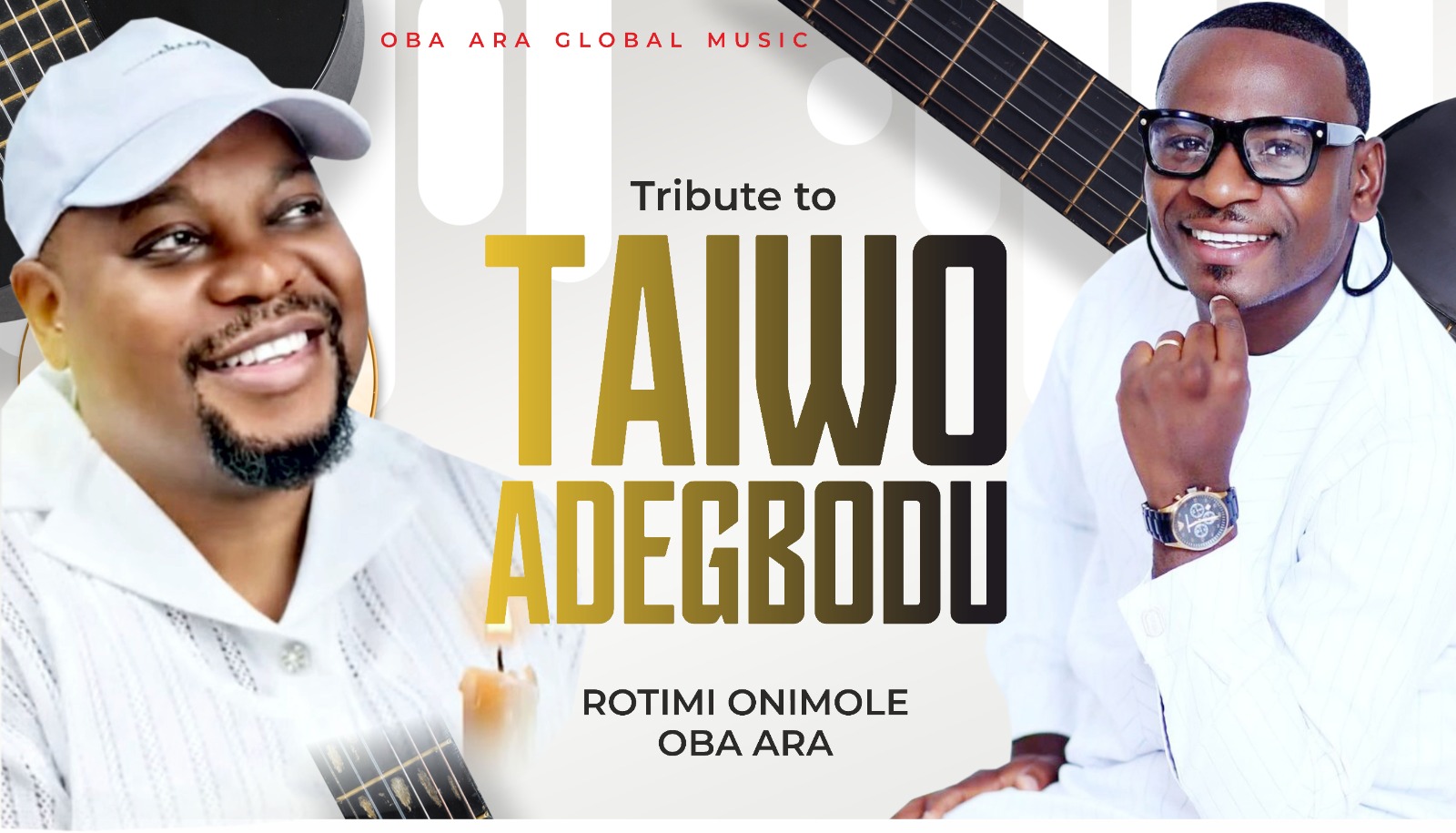
Oba Ara Releases Emotional Tribute to Late Taiwo Adegbodu
Taofik Afolabi
The gospel music community continues to grieve the painful loss of Taiwo Adegbodu, a beloved figure whose sudden departure left a deep void among fans, colleagues, and loved ones. In response to this loss, renowned gospel minister Rotimi Onimole, popularly known as Oba Ara, has released a moving tribute song that captures both the sorrow of the moment and the enduring legacy of the late singer.
Oba Ara, a proud son of Isale Eko, channels raw emotion throughout the song, using heartfelt lyrics and soul-stirring melodies to reflect on his personal connection with Taiwo Adegbodu. In the tribute, he openly expresses how deeply the news of Adegbodu’s passing shook him, describing it as a painful and unexpected loss that is difficult to come to terms with.
The song goes beyond mourning, it celebrates the life, ministry, and impact of Taiwo Adegbodu. Oba Ara highlights the late artist’s dedication to spreading the gospel through music, his inspiring voice, and the spiritual influence he had on many within and beyond Nigeria. Through powerful verses, he paints a picture of a man who lived for God and touched countless lives through his ministry.
Listeners have described the tribute as both comforting and deeply emotional, as it resonates with the collective grief of the gospel music community. It serves as a reminder that although Taiwo Adegbodu is no longer physically present, his music, message, and legacy will continue to live on.
In honoring his late colleague, Oba Ara not only pays his respects but also offers a source of healing for fans and fellow ministers, using music as a tool to process grief and celebrate a life well lived.
celebrity radar - gossips
Buratai, Fagbemi , Shagaya, Olofa, Others Eulogise Olowu Kuta’s Olori On 60th Birthday, Foundation Launch
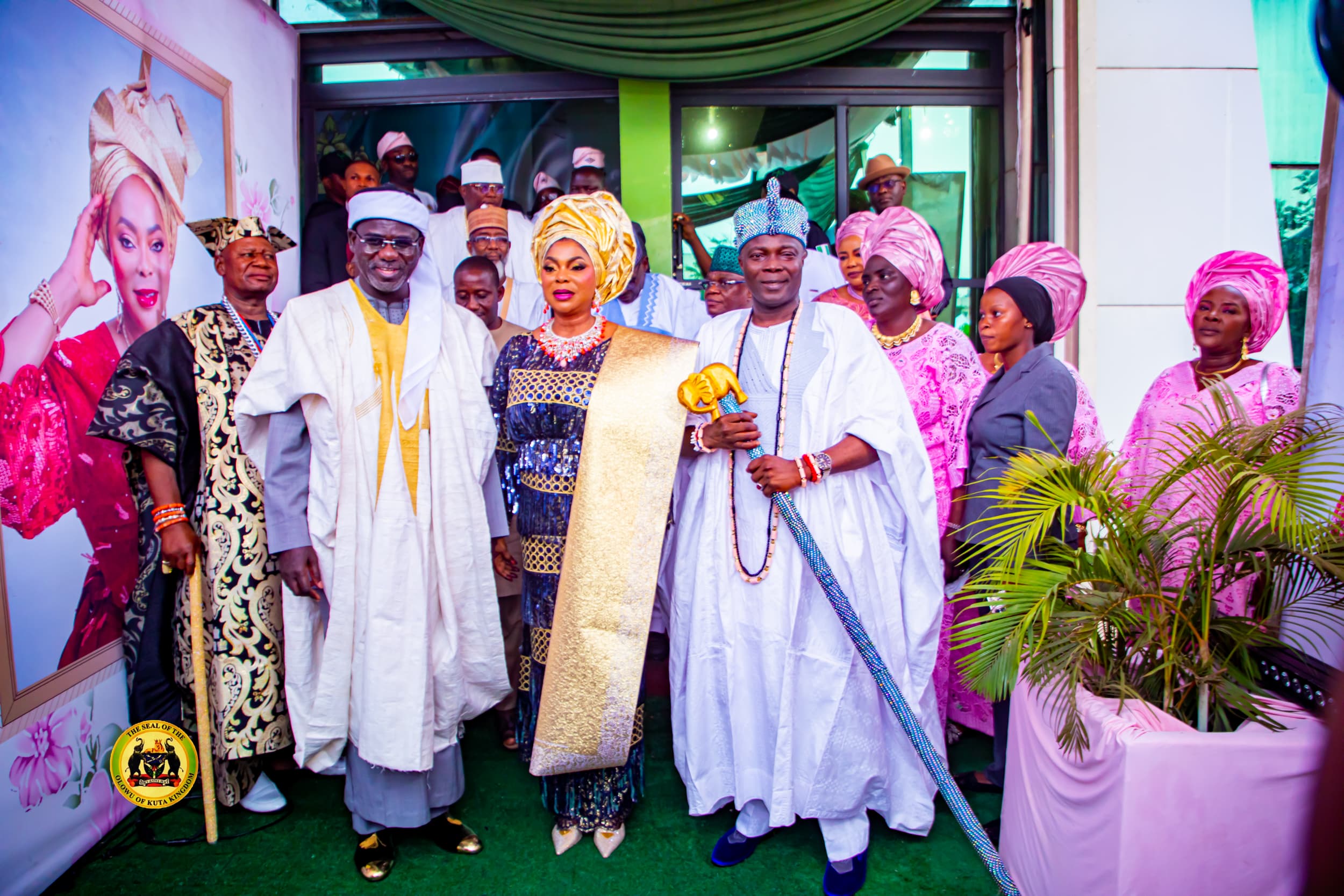
Buratai, Fagbemi , Shagaya, Olofa, Others Eulogise Olowu Kuta’s Olori On 60th Birthday, Foundation Launch
Eminent personalities across the Nigeria stormed the TFK Event Centre, Bala Mohammed Way, Guzape, Abuja, to celebrate the 60th birthday of Olowu Kuta’s Olori, Queen Jumai Amoke and her Foundation Launch on Saturday 28, March 2026.

From former Chief of Army Staff, Lt Gen TY Buratai rtd, to the Minister of Justice and Attorney-General of the Federation, Prince Lateef Fagbemi; Olofa of Offa, HRM Oba Mufutau Gbadamosi. Even top businesswoman and socialite, Chief (Mrs) Bola Shagaya, was in attendance.


Other dignitaries were newly promoted Deputy Inspector-General of Police and former AIG Zone 2 , Lagos , Adegoke Fayoade, Major General Abdumalik, Major General Samuel Adebayo rtd (Fmr CDI);
Major General Anthony Omozoje rtd (Fmr Copp);
Alhaji Tajudeen Owoyemi (Asiwaju of Offa and CEO Radisson Hotel Nigeria;
Dr Waheed Olagunju, former managing director of Bank of Industry, Oniba of Iba, Lagos State, HRM Oba Dr Suleiman Raji ;
Justice Falola, Olu of Ile-Ogbo , Oba Adetoyese amongst many traditional rulers and captains of industry too numerous to mention.
Speaking at the occasion, the Chief Host, Olowu of Kuta, HRM Oba Dr Adekunle Oyelude Makama, CON , Tegbosun iii, who is also the husband of the celebrant commended Queen Jumai for ‘ her slender arms full of kindness’ to establish such humanitarian Foundation, ‘Amoke Children and mother in Need Foundation’ at a time Nigerians are going through economic crisis occassioned by the global meltdown.
Olowu also commended her steadfastness and love for the less privileged and downtrodden.
The monarch refrenced the task before his wife’s humanitarian gesture said her best is yet to come.
” Olori Amoke Jumai, I celebrate you. You will celebrate 70, 80, 90 and continue to shine as you continue to put a smile on people’s faces. I love you, “Olowu Kuta added.
To Lt Gen Buratai, a former army chief and former Nigerian Ambassador to Benin Republic, the reward of hard work is more work.
Buratai, who also doubles as Balogun Agba of Owu Kuta, a chieftaincy title reserved for a generalismo congratulated Queen Jumai for attaining the age of 60 in good health.
The retired army General said he’s not surprised by the turn out of eminent personalities across the country to celebrate the Olowu Kuta’s Olori because she merited it through her hospitality to all, adding that Allah the most merciful, most beneficial would accept all her act of ibadah.
The minister of Justice, Prince Fagbemi, was full of praises for Queen Jumai for deeming it fit to have a place in her heart to accommodate the needy and less privileged in ‘our society.’
Prince Fagbemi urged the guests to contribute generously to support the Foundation in order to continue to alleviate poverty and put a smile on the faces of the people.
” I congratulate you on your 60th birthday and Foundation Launch. I wish you many happy returns of the day and many more fruitful services to the country and motherland”, Prince Fagbemi added.
The celebrant, Queen Jumai who was grining from ear to ear thankfully said she was excited by the turn out and the response of the people to her foundation.
Queen Jumai, however, promised to continue to use her resources and donations received for the good of the needy and less privileged in the society.
” I want to appreciate my own Kabiesi Olofa of Offa , for his presence and im I’m using him as a point of contact to all other Kabiesis present here, the minister of justice and Attorney-General, you’re welcome, sir; Mrs Bola Shagaya, I salute your enterprise, Lt Gen Buratai, I’m grateful, sir; DIG Fayoade, Justice Falola and other dignitaries too numerous to mention, I thank you, all. To my darling husband, Kabiesi Olowu , I thank you immensely for your support. And to my family and friends, I thank you , all. E se pupo!”, she said.
celebrity radar - gossips
Adron Homes Elevates Cultural Pride as Dignitaries Grace 39th Lisabi Festival in Abeokuta
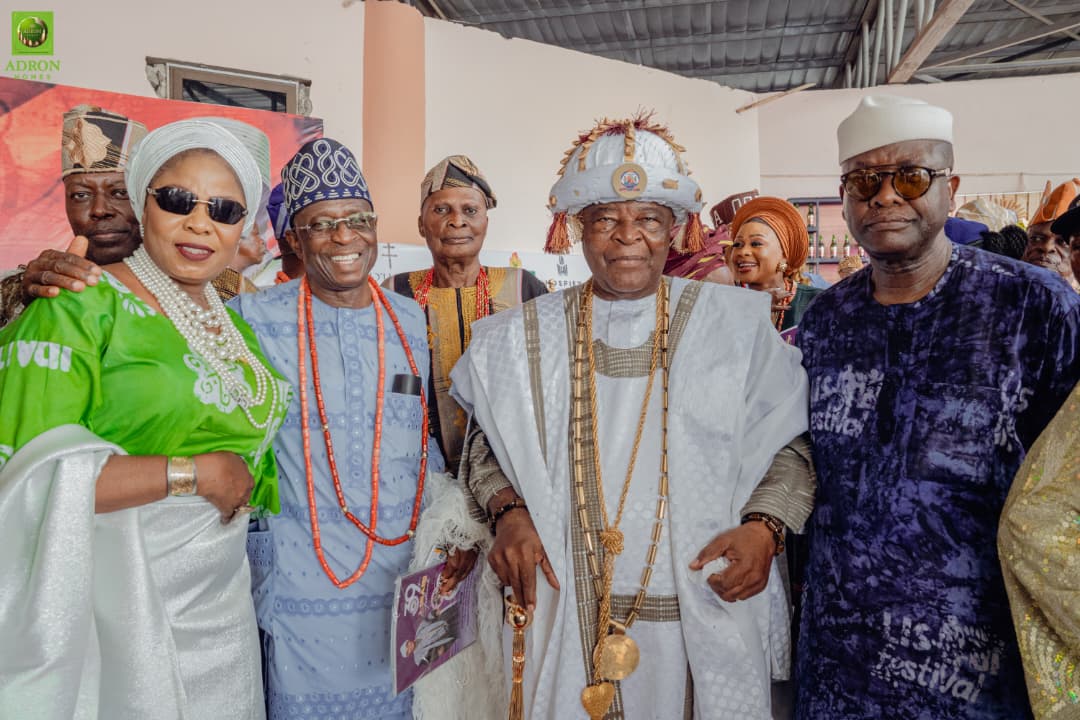
Adron Homes Elevates Cultural Pride as Dignitaries Grace 39th Lisabi Festival in Abeokuta
The ancient city of Abeokuta came alive in a grand display of culture, history, and unity as dignitaries from across Nigeria converged at the iconic Ake Palace Ground for the 39th edition of the Lisabi Festival, an annual celebration deeply rooted in the Egba people’s heritage.
The event, proudly supported by Adron Homes and Properties Limited, witnessed an impressive parade of distinguished personalities, traditional rulers, government officials, business leaders, and cultural enthusiasts, all captured in vibrant pictures that tell the story of a people united by history and pride.
From richly adorned monarchs in regal attire to elegantly dressed guests reflecting the depth of Yoruba tradition, the images from the festival encapsulate moments of honour, reverence, and celebration. Each photograph portrays not just faces, but influence, leaders, and stakeholders who continue to shape cultural preservation and community development.
At the heart of the celebration was the revered Oba Adedotun Aremu Gbadebo, whose presence underscored the festival’s significance as a symbol of Egba resilience and identity. Surrounding him were eminent dignitaries whose attendance further amplified the prestige of the event.
Adron Homes and Properties Limited stood out prominently, not only as a sponsor but as a key driver of cultural sustainability. Through its strategic support, the company reinforced its commitment to preserving indigenous heritage while fostering community engagement. The brand’s visibility across the venue and within the pictorial highlights reflects a deliberate alignment with culture, tradition, and people-centered development.
Beyond real estate, Adron Homes has continued to position itself as a cultural partner, investing in platforms that celebrate history and strengthen communal bonds. Its involvement in the Lisabi Festival is a testament to its broader vision of building not just homes, but legacies rooted in identity and pride.
The 39th Lisabi Festival, as captured through the lens of dignitaries in attendance, is more than an event, it is a narrative of continuity. And through its unwavering support, Adron Homes has once again set the pace, demonstrating that corporate institutions can play a vital role in sustaining the cultural heartbeat of a people.
As the echoes of drums fade and the colours of the festival linger in memory, one thing remains clear: the story told through these images is one of unity, heritage, and the enduring partnership between tradition and progress.


-

 society6 months ago
Religion: Africa’s Oldest Weapon of Enslavement and the Forgotten Truth
-

 news4 months ago
WHO REALLY OWNS MONIEPOINT? The $290 Million Deal That Sold Nigeria’s Top Fintech to Foreign Interests
-

 society6 months ago
“You Are Never Without Help” – Pastor Gebhardt Berndt Inspires Hope Through Empower Church (Video)
-

 celebrity radar - gossips2 months ago
Dr. Chris Okafor Returns with Power and Fire of the Spirit -Mounts Grace Nation Altar with Fresh Anointing and Restoration Grace on February 1, 2026