
celebrity radar - gossips
‘Why i accepted my Appointment as Buhari’s campaign spokesman’ – Festus Keyamo reveals

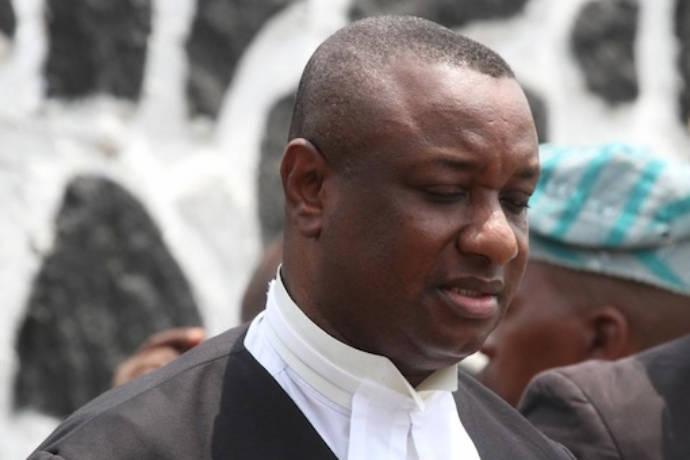

Just yesterday, my appointment as the Director, Strategic Communications of President Muhammadu Buhari Campaign Organisation was made public. In that capacity, I would be the Official Spokesperson of the President’s campaigns for the 2019 Presidential Election.
Let me put it on record that I was indeed consulted before the announcement. Upon the offer, I wholeheartedly and proudly accepted the challenge to do this for the good of my country and for posterity. For in President Buhari I have found an approximation of the lofty values I cherish and have fought for all my life.
I know millions of Nigerians have never seen me in the mould of partisan politics. This is because for the past two and half decades, I have been under intense public scrutiny while engaging successive governments (military and civilian) in the most critical way possible. The public has also watched me grow steadily all the way from that young, restless lawyer to the exalted position of a Senior Advocate of Nigeria (SAN). In the process of my restless and relentless engagements of the authorities, I have been hounded, arrested, detained, paraded like a criminal, charged and discharged from courts severally, but remain unbowed. Hence, some of us have been branded as “radicals” and seen as completely apolitical.
However, the ultimate aim of every struggle is not really to enthrone a perfect, flawless system. Only the starry-eyed, younger ones think such is possible. That is Utopia. Rather, the ultimate aim of the struggle is to enthrone a government (yes, even with the normal human flaws) that is focused, determined and fiercely opposed to the unscrupulous wheeler-dealers in the society, committed to protecting the interests of the down-trodden, the weak and vulnerable.
One of the obvious ways to do this is to ensure that what belongs to all is not cornered by a few; and if they do so, to ensure that they are made to account and brought to justice. I can boldly say that no Government in the history of Nigeria has recovered so much looted funds as that of President Muhammadu Buhari. The fact that this Government has clearly chosen this path in protecting the masses of our country (as unpleasant as it has been to some) is one of the many reasons why I am so proud and bold about my support for the re-election bid of President Muhammadu Buhari.
In doing this, I take a cue from my revered late boss, Chief Gani Fawehinmi, SAN who mentored me. Throughout his career, he also consistently and fiercely engaged every government in Nigeria and suffered as a result. Guess what? THE ONLY GOVERNMENT HE FULLY SUPPORTED THROUGHOUT HIS LIFETIME was that led by General Muhammdu Buhari in 1984 – 1985; and that was to the chagrin of some of his professional colleagues and fellow “radicals”. However, he saw what they did not see at that time, because when that government was overthrown by General Babangida, what followed was the worst era in our history in terms of institutionalizing corruption and political chicanery in Nigeria. In the 2007 Presidential election, my late boss again endorsed General Buhari in the following words: “When we talk of anti-corruption war, there is no way you will exclude General Buhari. I don’t want to hear what a political party is going to do, whether ANPP or PDP or NDP or which other political organization. Tell me who is leading the party, tell me who is leading the government, that’s my concern. It’s a matter of leadership. This is a serious election, very serious one”.
Some of those same forces and interests that saw the back of General Buhari in 1985 are still very much around with us. You can hear their voices getting louder of late, preaching hate and toiling hard to incite the people against the President. They want us to go back to our old ways, disguised as if they genuinely care for the masses of this country. When you look at the profile and ignoble antecedents of these characters – the emergency heroes, some of us have no option but to undertake this role we have been called upon to assume just to ensure that they do not succeed in their selfish enterprise.
For all I have said above, my convictions about this job are deep and well thought-out. Given my background, it is clear that I cannot be a sycophantic rabble-rouser, looking for some personal gains. Having reached the top echelon of my career, some of us can conveniently stay away from all these, and continue to earn a good living from our thriving law practice. However, the call of duty beckons because we are at a critical crossroads in our history where one wrong turn may take us back to the sorry state from which we are emerging. We are here to convince and appeal to the masses not to allow us take that wrong turn.
Now, it is important I elaborate a bit on this “sorry state” from which we are coming. Some people always attempt to befuddle the issues by continually reminding us of certain statistics that existed before 2015 and after 2015. However, our situation before 2015 is comparable to that of a car on a high speed, seemingly doing well on the road, but with the temperature gauge already rising. That car is in trouble. But to the uninformed, the car would be seen as doing well. However, the callous driver, fully aware of the rising temperature in the engine, continues to speed on. After some time, it is inevitable that the engine of the car would overheat and crash. In that state, the callous driver hands over the car to the new driver. The new driver, seeing the condition of the vehicle, decides to fix the radiator first which is responsible for the overheating in order to protect the engine, before setting out on the road again. Yet, the callous driver mischievously calls everyone to come and see how the new driver has parked the car to fix the engine before setting out once again. The callous driver tells everyone that the new driver is clueless; that that is why the car was parked briefly.
The above anecdote is a graphic reflection of the situation we find ourselves. With the crash in oil prices just before 2015, the previous government resorted to borrowing to pay salaries and recklessly drew down on our foreign reserves, just to give the impression that all was well. So much unearned money was also circulating in the country amongst a few, giving the false impression that we were in a buoyant economy. However, the economy was headed for a crash. All the indices show that the slip into recession started shortly before this government took over, like the car which engine was already over-heating.
The attempt by a few to deceive the people that all was well with us before this government took over, is one of the reasons some of us have decided to come out of our shells to put a hole in that false narrative. It is simply a big lie. I am persuaded that the Buhari Government took the right measures to halt a bigger disaster awaiting our economy had it been otherwise. Those who are persuaded otherwise are within their legitimate right to do so. We are all patriots, trying to find the right answers to our problems as a nation. However, if you are persuaded otherwise, kindly state in details what exactly should have been done to run the economy better, given the crash in oil prices and production that dropped to around 700,000 barrels per day. Surely, discerning Nigerians would no longer buy the fable of “Buhari destroyed our economy”.
If I voted Buhari in 2015 and I am to vote for him again in 2019, then why can’t I campaign vigorously for him? I see no reason. It is a fallacy to say you are neutral in politics, yet you step forward to cast your vote at elections. If you are persuaded enough to vote for a candidate of your choice, then you must also be persuaded enough to campaign for that candidate, because your vote would be lost if you do not convince others to also adopt your position.
That is why I have made my choice for 2019 and I will publicly stand by it. That choice is President Muhammadu Buhari. For those who are persuaded otherwise, I challenge them to also name their choices because you cannot criticise my choice of a candidate without naming your own choice. After all, the President would not be running against ghosts or against a vacuum. Therefore, this is not a time to hide behind a blanket criticism of any candidate. Each candidate should be assessed in comparative terms with other candidates.
There has also been much attempt to de-market the President using his age and health as pummeling tools, and as such raising the decibel in the clarion call for a young or younger President. Firstly, on the issues of age and health, it would be ungodly and outrageous for a mere mortal to assume the status of God Almighty to speculate on the longevity or strength of any human being. Even doctors have been proven wrong on so many occasions. It is a matter entirely in the hands of God. Our past Presidents that died in office (Abacha and Yar’Adua) were in their prime. In fact, Abacha did not even show any sign of a failing health before he slumped and died. In Zimbabwe, the main opposition candidate for years, Morgan Tsvangirai used the issue of age and health to campaign against President Mugabe, urging him to go and retire and rest. Yet, just a few weeks ago, Morgan Tsvangirai died at the age of 65 and Mugabe is still alive and kicking at the age of 94. Those are the mysterious ways of God Almighty. No human being should even use that as a campaign gimmick. That person would be courting the wrath of God Almighty.
In addition, no one can argue that age has anything to do with the required integrity to be the President of a country. I also firmly believe that our value systems in politics and the society have been so damaged pre-2015, that a firm and experienced hand is needed to reset our collective psyche before we can set sail again. The notion that public office is just available to share money which was the norm pre-2015 is gradually being changed. Spending a few more years to sustain that kind of re-orientation will do us a world of good. President Buhari is one of the very last of the upright Mohicans in Nigeria available to help reclaim public integrity before he takes his bow in 2023, if the Nigerian people so wish. We must take advantage of his still being around to deepen the nation’s moral fabric.
The choices before us have never been so CLEAR in the history of our country. On the one hand are those who are already in the mud and seeking to drag others into the mud. These are the ones who keep saying “We are all corrupt together”, and who keep confessing and apologising like people coming out of a trance. They say they should be forgiven because they have been “honest” enough to confess and apologise. Fellow Nigerians, there is nothing like an honest thief. It is a disgusting oxymoron. A thief is a thief. This is especially so if the thief did not willingly come out to admit he was a thief until his hands were caught right inside the cookie jar.
The other choice before us is a President who has been accused of everything that is false but even his most ardent critics, and detractors locally and internationally have not accused him of having a penchant for wealth accumulation. I am persuaded to campaign for him by his austere lifestyle, his Spartan taste and frugal nature. I am not looking for a god or an angel to vote for. They are not around here on earth. I am only looking for someone with these minimum personal qualities I have enumerated above. The President’s other human flaws may be there, but I am waiting for the candidates of our opponents to show me their credentials from heaven.
People can easily point to those with questionable past in the ruling party, the APC. With my antecedents and in my true conscience, I cannot defend them and cannot make excuses for them. However, in joining the President’s party, they are subjecting themselves to the disciplined leadership of the President. Like Chief Gani Fawehinmi, SAN said above, it is the leadership that matters. Like I always ask: should we all stop going to church because some known sinners also throng to churches every Sunday? The obvious answer is in the negative. On the other hand, the other party whose key leaders were all part of those who pilfered our commonwealth are about to present us with one amongst themselves as a Presidential candidate in 2019. Of course, reasonable Nigerians are waiting to dismiss that before it happens.
However, for some of my friends, colleagues and associates who are still persuaded by the other way of running our country, and who belong to different political platforms, all I can do is to wish them well, but also state that this is a time for us to agree to disagree. It is all for the good of our country. It will bring out the best in us in canvassing our persuasions. However, I will be putting my heart and soul to this assignment and if anyone is offended by my commitment to the cause, I offer no apology. You can also do likewise to advance your cause. Nigerians would decide at the end of the day.
My message to all those teeming supporters who did it in 2015 for our President is that you do not abandon a ship with which you set sail midway. Our race is not a 100-meter dash. It is a marathon race to rescue our country. We are almost there. When we turn the corner in 2019, you will see the tape at the finishing line. We must not run out of breaths. We believed in 2015. We must keep that belief alive. The hallmark of true supporters is to stand firm in times of storm and in times of calm. The storm is almost over. The President has battled to take control of the steering wheel of the nation and we are on course.
Do not let the naysayers bully you whether in real life or in cyberspaces. When they run out of arguments, they resort to abuses. If they abuse you, see them as patriots, but misguided ones; if they attack you, see them as patriots, but misguided ones; if they call you unprintable names, see them as passionate patriots, but misguided ones. Do not retaliate. With time, especially when majority of votes wipe out their minority opinions in 2019, they will come round to you and acknowledge your vision. So, hold your own and keep your heads up.
For us, this race is never a do-or-die affair. We shall present the facts as we see them and let Nigerians decide. We do not have to hire Cambridge Analytica to scare the electorate. They are already sufficiently scared by the humongous corruption that took place under the watch of the last government; the electorate are already sufficiently scared by those who are apologizing just to sneak their way back to power; the electorate are also sufficiently scared by the tons of cash buried in graveyards, farm houses, luxury flats in Ikoyi, in Yachts in the High Seas and those used to buy real estate strewn all over the world.
Nigerians know from where their problems came. They know it is not President Buhari. They know it came from some of those battling tooth and nail to displace him. Those who are persuaded by us should not remain aloof, please. Kindly join us in this journey.
Thank you.




celebrity radar - gossips
Adron Homes Celebrates Visionary Chairman, Aare Adetola Emmanuel King, at 51
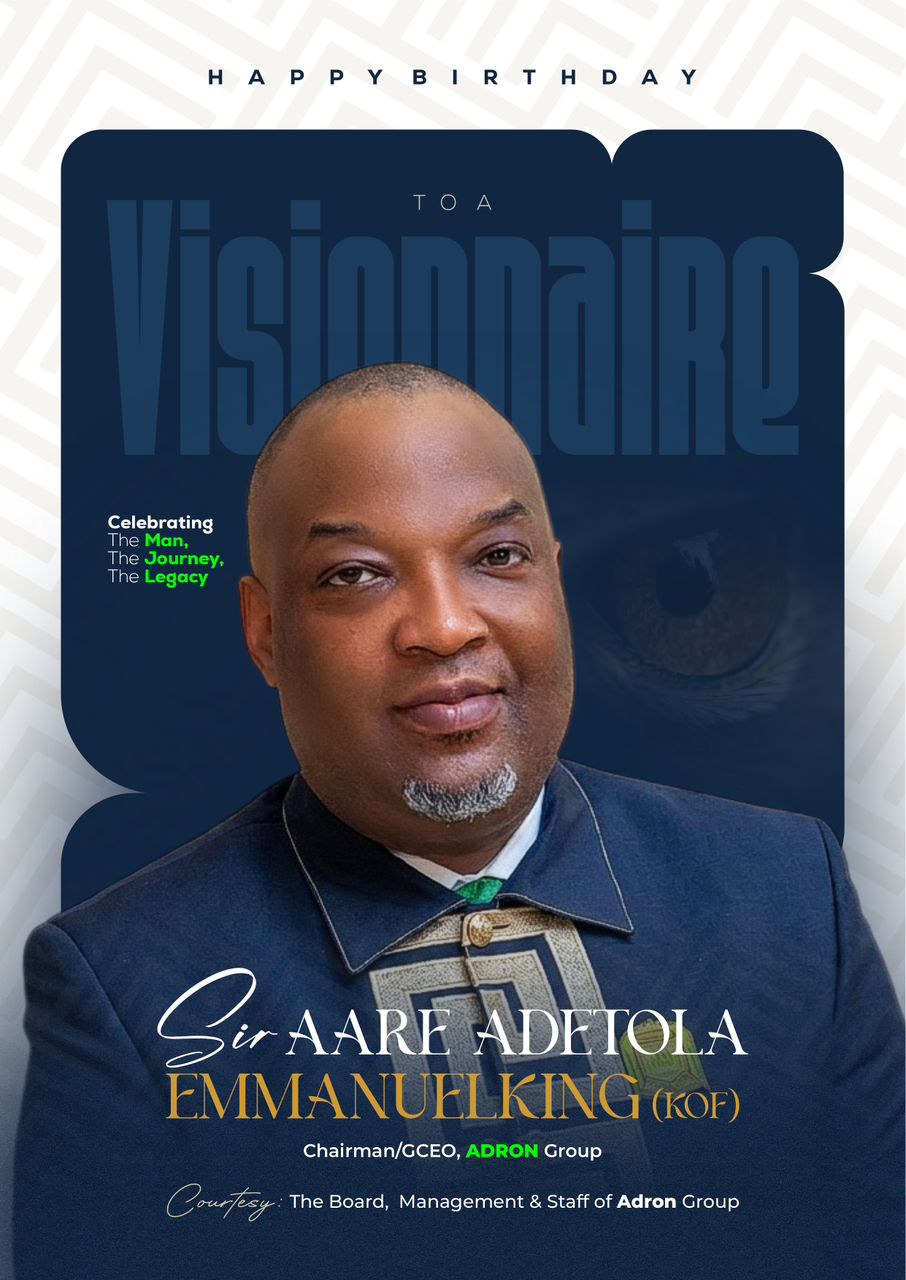
Adron Homes Celebrates Visionary Chairman, Aare Adetola Emmanuel King, at 51
The management and staff of Adron Homes and Properties Limited have joined family, friends, associates, and well-wishers across the globe to celebrate their Chairman and Chief Executive Officer, Aare Adetola EmmanuelKing, as he marks his 51st birthday.

In a statement released by the company, the milestone was described as a celebration of an exceptional leader whose vision, resilience, and entrepreneurial brilliance have not only transformed Adron Homes into a household name in Nigeria’s real estate sector but have also redefined affordable housing across the country.
Under his dynamic leadership, Adron Homes has continued to expand its footprint, delivering value-driven residential solutions while empowering thousands of Nigerians with opportunities for home ownership. His commitment to excellence, innovation, and customer satisfaction has remained the driving force behind the company’s sustained growth and industry leadership.
The statement further highlighted Aare EmmanuelKing’s passion for nation-building and community development, noting his significant contributions to job creation, youth empowerment, and the promotion of socio-economic development through real estate investments.
“As a leader, mentor, and visionary, Aare Adetola EmmanuelKing has consistently inspired a culture of excellence, integrity, and dedication within the organization. His ability to turn bold ideas into reality continues to position Adron Homes as a trailblazer in the industry,” the statement read.
The company expressed profound gratitude for his steadfast leadership and prayed for continued wisdom, strength, and sound health as he embarks on another year of impactful achievements.
As he celebrates his 51st birthday, the entire Adron Homes family proudly honours a man whose legacy continues to shape the future of real estate in Nigeria.
Happy 51st Birthday, Aare Adetola EmmanuelKing!
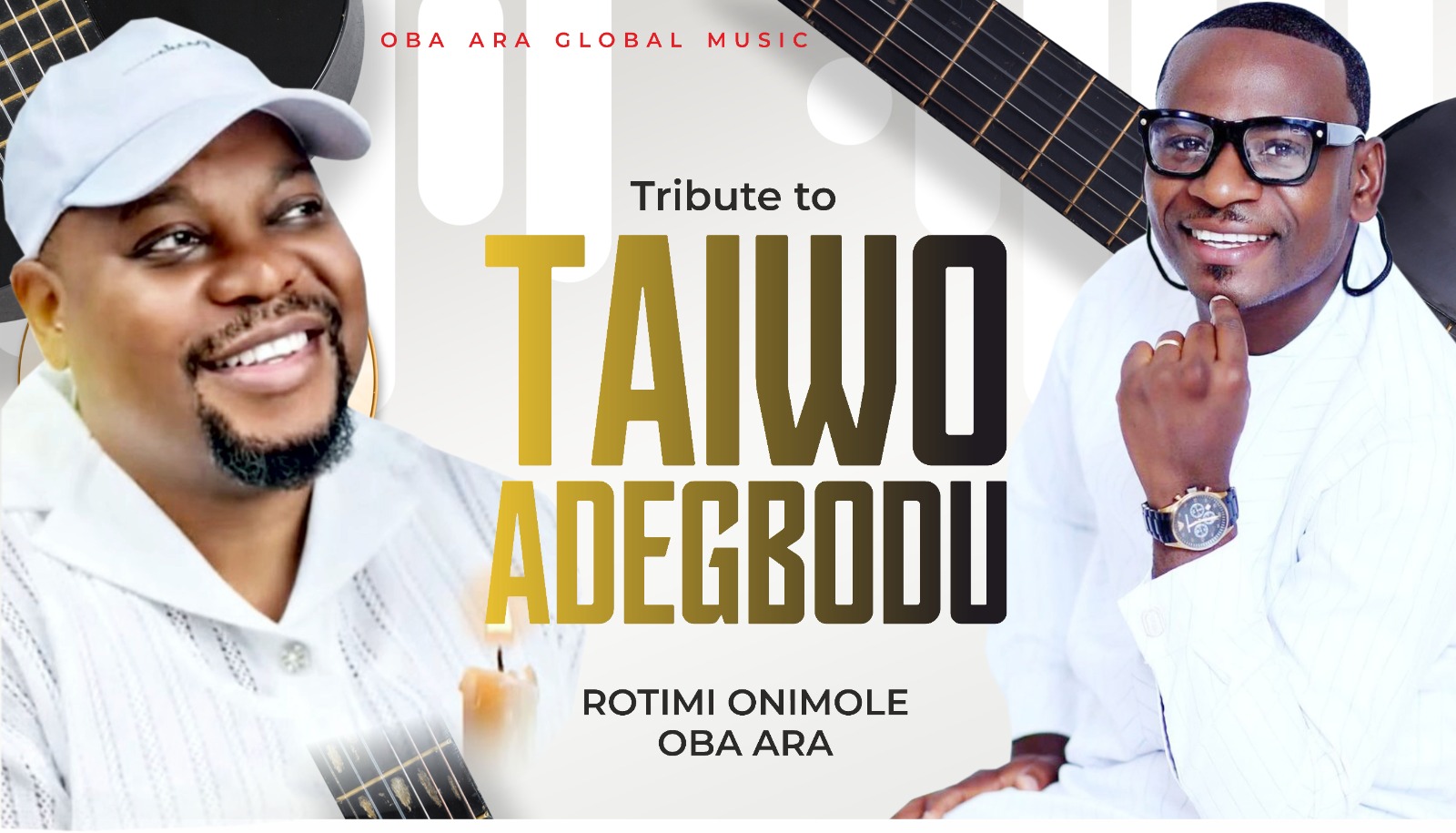
Oba Ara Releases Emotional Tribute to Late Taiwo Adegbodu
Taofik Afolabi
The gospel music community continues to grieve the painful loss of Taiwo Adegbodu, a beloved figure whose sudden departure left a deep void among fans, colleagues, and loved ones. In response to this loss, renowned gospel minister Rotimi Onimole, popularly known as Oba Ara, has released a moving tribute song that captures both the sorrow of the moment and the enduring legacy of the late singer.
Oba Ara, a proud son of Isale Eko, channels raw emotion throughout the song, using heartfelt lyrics and soul-stirring melodies to reflect on his personal connection with Taiwo Adegbodu. In the tribute, he openly expresses how deeply the news of Adegbodu’s passing shook him, describing it as a painful and unexpected loss that is difficult to come to terms with.
The song goes beyond mourning, it celebrates the life, ministry, and impact of Taiwo Adegbodu. Oba Ara highlights the late artist’s dedication to spreading the gospel through music, his inspiring voice, and the spiritual influence he had on many within and beyond Nigeria. Through powerful verses, he paints a picture of a man who lived for God and touched countless lives through his ministry.
Listeners have described the tribute as both comforting and deeply emotional, as it resonates with the collective grief of the gospel music community. It serves as a reminder that although Taiwo Adegbodu is no longer physically present, his music, message, and legacy will continue to live on.
In honoring his late colleague, Oba Ara not only pays his respects but also offers a source of healing for fans and fellow ministers, using music as a tool to process grief and celebrate a life well lived.
celebrity radar - gossips
Buratai, Fagbemi , Shagaya, Olofa, Others Eulogise Olowu Kuta’s Olori On 60th Birthday, Foundation Launch
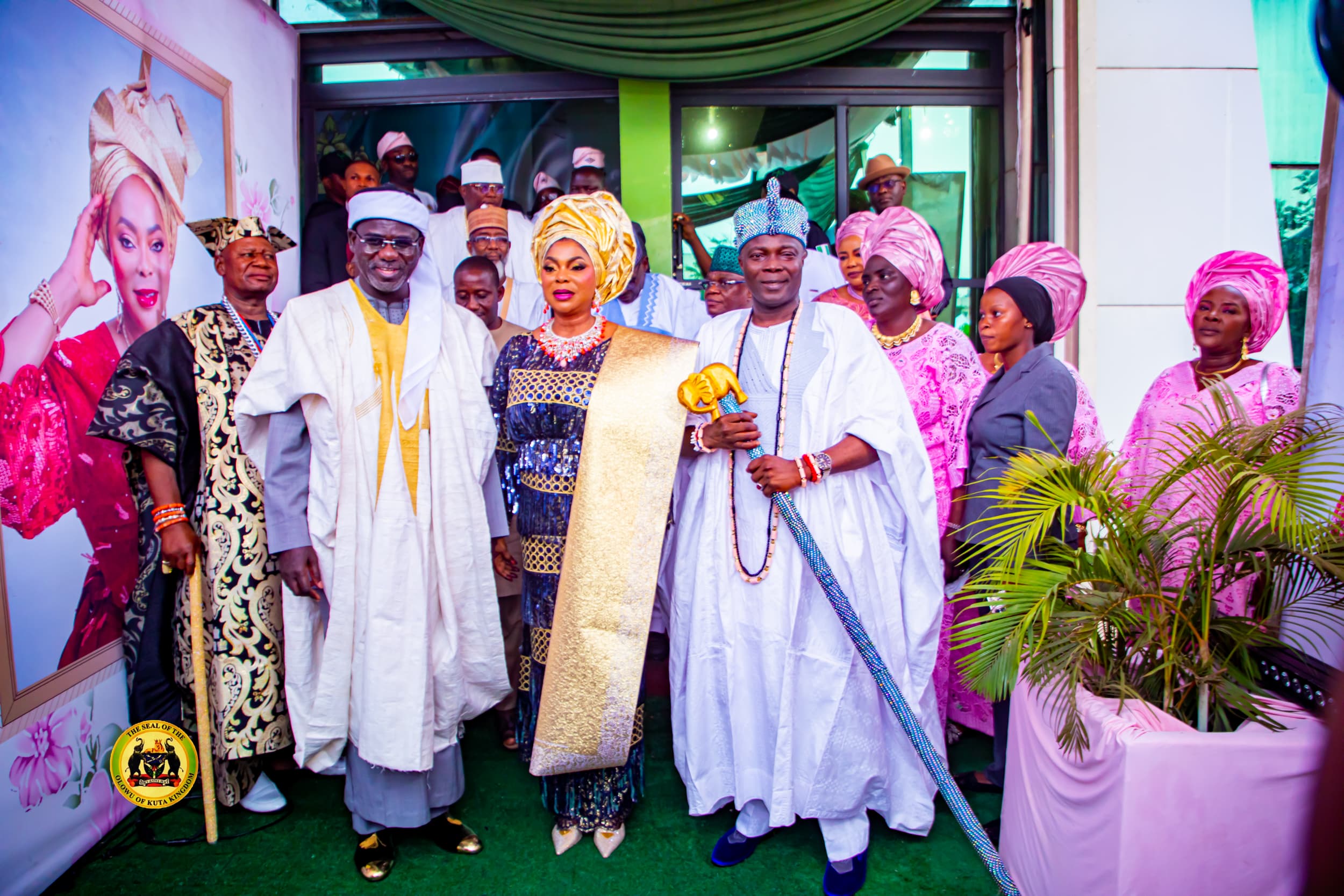
Buratai, Fagbemi , Shagaya, Olofa, Others Eulogise Olowu Kuta’s Olori On 60th Birthday, Foundation Launch
Eminent personalities across the Nigeria stormed the TFK Event Centre, Bala Mohammed Way, Guzape, Abuja, to celebrate the 60th birthday of Olowu Kuta’s Olori, Queen Jumai Amoke and her Foundation Launch on Saturday 28, March 2026.

From former Chief of Army Staff, Lt Gen TY Buratai rtd, to the Minister of Justice and Attorney-General of the Federation, Prince Lateef Fagbemi; Olofa of Offa, HRM Oba Mufutau Gbadamosi. Even top businesswoman and socialite, Chief (Mrs) Bola Shagaya, was in attendance.


Other dignitaries were newly promoted Deputy Inspector-General of Police and former AIG Zone 2 , Lagos , Adegoke Fayoade, Major General Abdumalik, Major General Samuel Adebayo rtd (Fmr CDI);
Major General Anthony Omozoje rtd (Fmr Copp);
Alhaji Tajudeen Owoyemi (Asiwaju of Offa and CEO Radisson Hotel Nigeria;
Dr Waheed Olagunju, former managing director of Bank of Industry, Oniba of Iba, Lagos State, HRM Oba Dr Suleiman Raji ;
Justice Falola, Olu of Ile-Ogbo , Oba Adetoyese amongst many traditional rulers and captains of industry too numerous to mention.
Speaking at the occasion, the Chief Host, Olowu of Kuta, HRM Oba Dr Adekunle Oyelude Makama, CON , Tegbosun iii, who is also the husband of the celebrant commended Queen Jumai for ‘ her slender arms full of kindness’ to establish such humanitarian Foundation, ‘Amoke Children and mother in Need Foundation’ at a time Nigerians are going through economic crisis occassioned by the global meltdown.
Olowu also commended her steadfastness and love for the less privileged and downtrodden.
The monarch refrenced the task before his wife’s humanitarian gesture said her best is yet to come.
” Olori Amoke Jumai, I celebrate you. You will celebrate 70, 80, 90 and continue to shine as you continue to put a smile on people’s faces. I love you, “Olowu Kuta added.
To Lt Gen Buratai, a former army chief and former Nigerian Ambassador to Benin Republic, the reward of hard work is more work.
Buratai, who also doubles as Balogun Agba of Owu Kuta, a chieftaincy title reserved for a generalismo congratulated Queen Jumai for attaining the age of 60 in good health.
The retired army General said he’s not surprised by the turn out of eminent personalities across the country to celebrate the Olowu Kuta’s Olori because she merited it through her hospitality to all, adding that Allah the most merciful, most beneficial would accept all her act of ibadah.
The minister of Justice, Prince Fagbemi, was full of praises for Queen Jumai for deeming it fit to have a place in her heart to accommodate the needy and less privileged in ‘our society.’
Prince Fagbemi urged the guests to contribute generously to support the Foundation in order to continue to alleviate poverty and put a smile on the faces of the people.
” I congratulate you on your 60th birthday and Foundation Launch. I wish you many happy returns of the day and many more fruitful services to the country and motherland”, Prince Fagbemi added.
The celebrant, Queen Jumai who was grining from ear to ear thankfully said she was excited by the turn out and the response of the people to her foundation.
Queen Jumai, however, promised to continue to use her resources and donations received for the good of the needy and less privileged in the society.
” I want to appreciate my own Kabiesi Olofa of Offa , for his presence and im I’m using him as a point of contact to all other Kabiesis present here, the minister of justice and Attorney-General, you’re welcome, sir; Mrs Bola Shagaya, I salute your enterprise, Lt Gen Buratai, I’m grateful, sir; DIG Fayoade, Justice Falola and other dignitaries too numerous to mention, I thank you, all. To my darling husband, Kabiesi Olowu , I thank you immensely for your support. And to my family and friends, I thank you , all. E se pupo!”, she said.


-

 society6 months ago
Religion: Africa’s Oldest Weapon of Enslavement and the Forgotten Truth
-

 news4 months ago
WHO REALLY OWNS MONIEPOINT? The $290 Million Deal That Sold Nigeria’s Top Fintech to Foreign Interests
-

 society6 months ago
“You Are Never Without Help” – Pastor Gebhardt Berndt Inspires Hope Through Empower Church (Video)
-

 celebrity radar - gossips2 months ago
Dr. Chris Okafor Returns with Power and Fire of the Spirit -Mounts Grace Nation Altar with Fresh Anointing and Restoration Grace on February 1, 2026
You must be logged in to post a comment Login
You must log in to post a comment.