
Business
Why NUPENG and PENGASSAN Must Stop Terrorising Nigerians


Why NUPENG and PENGASSAN Must Stop Terrorising Nigerians
By Kunle Ayo
Recent actions by the Nigeria Union of Petroleum and Natural Gas Workers (NUPENG) and the Petroleum and Natural Gas Senior Staff Association of Nigeria (PENGASSAN) in the oil and gas sector reveal a desperate attempt by certain actors to exploit Nigerians’ sensibilities, perpetuating lawlessness, economic sabotage, and threats to national security for the benefit of a few at the expense of the broader population.
It is an affront to Nigerians’ intelligence that NUPENG and PENGASSAN, historically complicit in the deliberate and egregious degeneration of the oil and gas sector, have long acted as enablers of self-interest. These unions have been directly implicated in decades of inflicting untold hardship on ordinary Nigerians through their neglect, complicity, and collaboration with enemies of the state. Their sudden posturing as defenders of workers’ rights—when their actions have contributed to the suffering of millions—is both hypocritical and insulting.
The recent decision by NUPENG and PENGASSAN to embark on strike action aligns with their persistent assault on the foundation of Nigeria’s economy, which President Tinubu’s administration is working tirelessly to revive. This calculated move seeks to drag the nation back to the dark days of fuel scarcity, economic instability, and national embarrassment, orchestrated by a handful of Nigerians and their foreign collaborators, with NUPENG and PENGASSAN as willing participants.
To call their actions detrimental to Nigeria’s social and economic progress is an understatement. The negative impact on social services is immense, as their strikes have led to the shutdown of thermal power plants, threatening to plunge the nation into physical and economic darkness. This cripples economic and social activities, placing millions of households and small businesses at a severe disadvantage.
NUPENG and PENGASSAN have made no secret of their self-serving intentions, prioritizing a culture of impunity, primitive wealth accumulation, monopoly, and destructive behavior over patriotism.
Their actions consistently place personal gain above the needs of the nation and its citizens, undermining Nigeria’s corporate existence, independence, and economic growth.
Under the guise of unionism and workers’ rights, NUPENG and PENGASSAN have chosen to inflict undue hardship on Nigerians, rejecting platforms for constructive dialogue. Their concerns are not genuine but rather mischievous, selfish, and treasonable, opting for self-help tactics that bring untold suffering to citizens and residents instead of pursuing collaborative solutions.
The federal government’s efforts to facilitate peaceful resolutions to these disputes have been rebuffed by NUPENG and PENGASSAN, who instead escalate their campaign to promote economic instability. Blinded by self-interest, they have failed to grasp the broader implications of their actions and refused to work toward solutions that benefit Nigerians.
Nigerians are neither fools nor gullible enough to fall for their deceptive tactics. The unions’ attempt to sell a false narrative about mass layoffs at Dangote Refinery is a fraud, mirroring their own duplicity. Their efforts to mislead Nigerians for selfish ends have failed. These misguided actors, driven by corrupt motives, remain insensitive to the decades of suffering caused by oil subsidy profiteers.
For years, NUPENG and PENGASSAN remained silent during fuel scarcity crises, ignoring the plight of Nigerians who were reduced to economic servitude in one of the world’s richest oil-producing nations. Yet, they now claim to champion workers’ rights at a time when fuel prices are stabilizing, the forex market is steady, the naira is strengthening against the dollar, and inflation is declining. They suddenly find fault when fuel is widely available, governors can pay salaries and pensions, and viable competition thrives in Nigeria’s upstream petroleum sector, attracting foreign investment due to economic stability.
How can any sincere labour union, concerned with the welfare of its members and the nation’s economic viability, remain silent when massive fraud is perpetrated by a few citizens in collaboration with foreign actors? Billions of dollars in Nigerian funds have been laundered under fictitious pretexts by union officials, and the fraudulent fuel subsidy scheme, orchestrated through a corrupt Nigerian National Petroleum Company Limited (NNPCL), has caused immense harm.
Yet, NUPENG and PENGASSAN now claim to fight for workers’ rights with a fabricated narrative.
NUPENG and PENGASSAN should be well aware of labor laws and their applications. They cannot claim ignorance that the Academic Staff Union of Universities (ASUU) does not compel staff of private universities to unionize, nor does the National Union of Road Transport Workers (NURTW) force workers at private transport companies like GUO or God is Good Motors to join its union.
Similarly, the Nigeria Union of Teachers (NUT) does not mandate teachers in private schools to become members. Union membership is an individual’s private and exclusive right, not a mandatory or national obligation. How many times have NUPENG and PENGASSAN gone on strike to address the failures of Nigeria’s refineries despite billions spent, or to end the fuel subsidy scam?
NUPENG and PENGASSAN have no right to interfere in the internal administration of Dangote Refinery or any other private corporate entity. Their consistent role as saboteurs, aimed at derailing national progress, reveals them as stooges of sedition and terrorism. In a foolish attempt to serve their paymasters, they have declared war on the common man, making a mockery of themselves.
How does halting crude oil and gas supplies serve justice if workers are laid off?
Can self-help and blackmail assist affected staff or benefit ordinary Nigerians? Dialogue and legal avenues, not reckless actions, are the appropriate means to resolve disputes. Ironically, the processes NUPENG and PENGASSAN oppose are the very ones that have brought relief, alleviated suffering, and restored hope. These processes have stabilized fuel costs, promoted deregulation, reduced foreign interference in the oil and gas sector, and delivered numerous benefits.
We must echo the voice of Hon. Dr. Philip Agbese, Deputy Spokesperson of the Federal House of Representatives, who rightly declared this affront against Dangote Refinery as an attack on national security, the economy, and the common man. NUPENG and PENGASSAN must cease acting as tools of saboteurs to derail Nigeria’s progress. They must stop making a caricature of themselves, as times have changed, and a new era of accountability has begun.
The Dangote Refinery has come to stay, driving Nigeria’s economic independence and progress through its transformative impact on the oil and gas sector. Nigerians stand united in resolute support of this vital enterprise, rejecting the sabotage of self-serving actors posing as trade unionists. With the people’s backing, Dangote Refinery will prevail against these economic adversaries, securing a future of stability and prosperity.
*Ayo writes from Lagos





Fidelity Bank grows gross earnings by 38% to N434.95b in Q1
Fidelity Bank Plc recorded 37.9 per cent growth in gross earnings to N434.95 billion in first quarter 2026 as the international commercial bank continued to expand its core banking market share.
Interim report and accounts of Fidelity Bank for the three months ended March 31, 2026 released at the Nigerian Exchange (NGX) showed that gross earnings rose from N315.42 billion in first quarter 20025 to N434.95 billion in first quarter 2026, representing an increase of 37.9 per cent.
The top-line performance was driven by impressive growth in the bank’s core business operations with interest incomes rising by 22.8 per cent to N314.48 billion in first quarter 2026 as against N256.10 billion in first quarter 2025.
With net interest income at N180.97 billion, the bank closed the period with profit before tax of N92.48 billion. After taxes, net profit stood at N74.47 billion for the three-month period. Earnings per share remained high at N5.69, underlining the capacity of the bank to reward its shareholders.
The balance sheet of the bank also emerged stronger. Total assets crossed the N11 trillion mark to N11.35 trillion by March 2026 compared with N10.46 trillion recorded in December 2025. Customers’ deposits increased from N6.89 trillion to N7.38 trillion. Total equity rode on the back of earnings growth to a 27.5 per cent increase from N1.09 trillion in December 2025 to N1.39 trillion by March 2026.
The first quarter 2026 results further consolidated the strong earnings outlook of the bank, which had successfully completed its recapitalisation amidst impressive earnings performance in 2025.
Fidelity Bank had recorded double-digit growths in interest and non-interest incomes as well as key balance sheet items during the year ended December 31, 2025.
The audited report showed that gross earnings rose from N1.04 trillion in 2024 to N1.52 trillion in 2025, an increase of 45.6 per cent. Interest and similar incomes had grown by 38.7 per cent from N803.1 billion in 2024 to N1.11 trillion in 2025. Fees and commission incomes also rose by 44.7 per cent from N78.4 billion to N113.4 billion. The bank recorded net profit after tax of N242.4 billion in 2025.
The bank’s balance sheet emerged stronger with total assets rising by 18.6 per cent to N10.46 trillion in 2025 as against N8.82 trillion in 2024. Customer deposits increased by 16.1 per cent from N5.94 trillion to N6.89 trillion, reflecting continued franchise strength and an improved funding profile. Net loans and advances meanwhile declined by 2.4 per cent to N4.28 trillion in 2025 as against N4.39 trillion in 2024, attributable to customers paying down on their mature obligations.
The bank had in 2025 strengthened its capital position, with eligible capital rising to N561 billion, above the regulatory minimum of N500 billion for banks with international authorisation. In addition, capital adequacy had remained robust, with Capital Adequacy Ratio of 30.94 per cent by December 2025 as against 23.47 per cent by December 2024.
Managing Director, Fidelity Bank Plc, Dr. Nneka Onyeali-Ikpe, said the first quarter 2026 results reinforced the bank’s strong and resilient business model.
She noted that with the remarkable success of its recapitalisation programme and continuing expansion, Fidelity Bank has entered a new era of growth and impressive returns.
“We are on a stronger footing and confident that we will set new growth records that are reflective of our legacy and the future we are working on,” Onyeali-Ikpe said.
Business
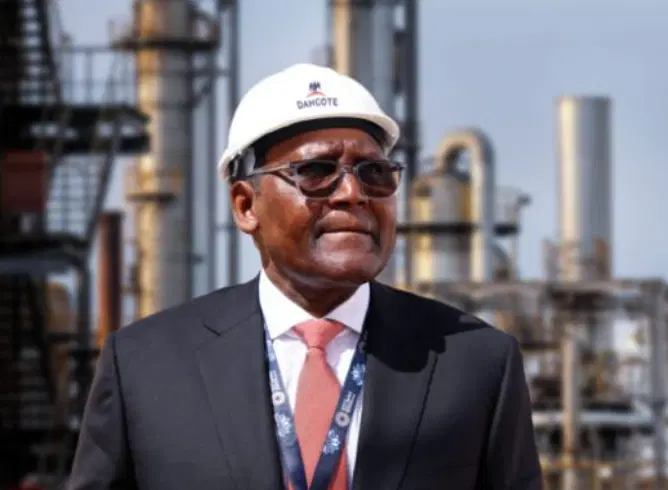
Dangote Refinery Ends Nigeria’s Era of Fuel Import Dependence, Boosts GDP, FX Earnings — EIU
Dangote Refinery Ends Nigeria’s Era of Fuel Import Dependence, Boosts GDP, FX Earnings — EIU
The operational ramp up of the 650,000 barrels per day Dangote Petroleum Refinery & Petrochemicals is fundamentally reshaping Nigeria’s downstream oil sector, significantly reducing the country’s dependence on imported refined petroleum products and strengthening its external position, according to the Economist Intelligence Unit (EIU).
In its latest assessment on Nigeria’s fuel market and regulatory environment, the EIU said the refinery has already transformed a sector that was previously characterised by heavy reliance on imported fuel despite Nigeria being Africa’s largest crude oil producer. The report noted that the refinery met nearly 80 per cent of domestic petrol demand in April and produced enough volumes to satisfy local consumption requirements as operations approached full capacity.
The EIU described Nigeria’s downstream petroleum sector before the refinery as “long dysfunctional”, noting that the country had remained almost entirely dependent on costly imported fuel while producing nearly 1.5 million barrels of crude oil daily.
According to the report, the emergence of the refinery has reduced import dependence, improved domestic fuel availability and strengthened Nigeria’s balance of payments position through lower import demand and rising exports of refined petroleum products.
“The gradual ramp up of the 650,000 barrel/day Dangote refinery since May 2023 has transformed Nigeria’s long dysfunctional downstream sector,” the report stated. “The country’s main refineries, all state owned, had been inoperative for years and Nigeria was almost entirely reliant on costly imported fuel.”
The research and analysis division of The Economist Group, London added that the refinery’s attainment of full operational capacity and its planned expansion would further support Nigeria’s economic growth and foreign exchange earnings over the medium term.
“Meanwhile, the attainment of full capacity at, and an increase in exports from, the Dangote refinery will support real GDP growth and foreign exchange earnings in 2026 and 2027 and beyond, as a planned doubling of the plant’s output comes on stream around the end of the decade,” it added.
Industry analysts said the refinery is increasingly positioning Nigeria as an emerging refining and export hub, altering energy trade flows across Africa and reducing the vulnerability associated with fuel import dependence.
The EIU noted that the refinery’s expansion has coincided with major reforms in Nigeria’s downstream sector, including the removal of fuel subsidies and the introduction of market driven pricing mechanisms.
The report, however, said the transition from a state dominated fuel import structure to large scale domestic refining has triggered resistance from interests linked to the old import regime.
The latest tensions emerged following the decision by the Nigerian Midstream and Downstream Petroleum Regulatory Authority to relax restrictions on petrol imports despite the refinery’s growing capacity to meet domestic demand.
Dangote Industries subsequently initiated legal action, arguing that continued import approvals undermine domestic refining investments and conflict with the objectives of the Petroleum Industry Act, which seeks to encourage local refining capacity and reduce import dependence.
Analysts noted that the availability of large-scale domestic refining capacity has improved Nigeria’s energy security and reduced exposure to external supply shocks and foreign exchange volatility.
The Centre for the Promotion of Private Enterprise also cautioned against unrestrained importation of petroleum products, warning that such a policy could weaken Nigeria’s industrialisation drive and discourage investments in domestic refining.
Chief Executive Officer of CPPE, Muda Yusuf, said continued dependence on imported fuel had historically contributed to pressure on foreign reserves, exchange rate instability and fiscal leakages.
The refinery’s growing impact is also being reflected in Nigeria’s broader macroeconomic indicators. Earlier this month, S&P Global Ratings cited increased domestic refining capacity and rising hydrocarbon exports among the major factors supporting Nigeria’s sovereign credit rating upgrade – the first in 14 years.
Beyond Nigeria, analysts said the refinery is increasingly being viewed as a strategic industrial asset for Africa, where many countries remain heavily dependent on imported fuel despite rising demand for transportation, manufacturing, and power generation.
Business
BREAKING: Court Dismisses $19.6 Million Claim Against NNPCL — Rules Contract Scope Cannot Be Changed Orally
BREAKING: Court Dismisses $19.6 Million Claim Against NNPCL — Rules Contract Scope Cannot Be Changed Orally
In a landmark ruling on Friday, May 22, 2026, the Federal Capital Territory High Court in Abuja threw out a $19.6 million lawsuit filed by Alternate Dimensions Ventures Ltd against the Nigerian National Petroleum Company Limited (NNPCL), affirming a key legal principle: a written contract cannot be expanded through oral agreements or conduct.
Alternate Dimensions had sought $19,600,000 in professional fees, claiming the scope of its Direct Sale, Direct Purchase (DSDP e-pro) contract with NNPCL was orally expanded. Represented by counsel Patrick Peter, the firm argued it was entitled to the revised sum for services rendered under the alleged new terms.
But NNPCL, through its lawyer Ituah Imhanze of KENNA LP, pushed back sharply, arguing that parties are bound exclusively by the clear terms of their written agreement. Imhanze contended that without any written amendment, the claim was legally unsound, and the court agreed.
Delivering judgment, Justice Hamza Mu’azu upheld NNPCL’s defense, stating that the contract was unambiguous and that no evidence was adduced during the trial, which supported the alleged scope expansion. The court further found that NNPCL fully complied with all contractual terms and committed no breach.
Dismissing the suit as meritless, Justice Mu’azu reinforced the doctrine of sanctity of contract: any amendment to a written agreement must be express, unequivocal, and documented, not implied or verbal.
The ruling spares NNPCL from the S19.6 million claim and also a floodgate of similar potential liabilities.


- Pitcher Awards Announces 2026 Winners, Marking a Landmark Year for Pan‑African Creativity May 30, 2026
- Ghana Commemorates 78th International Day of United Nations Peacekeepers May 30, 2026
- South Africa: President Ramaphosa receives second interim report of Madlanga Commission May 30, 2026
- Asmara Marathon 2026 to be held May 30, 2026
- Powerful call for dialogue and compromise to secure peace in South Sudan issued on International Peacekeepers Day May 30, 2026
- Over 1,000 Participants Join Rwenzori Marathon Activation Run in Mombasa May 30, 2026
- World Health Organization (WHO) actively participated in the 2nd Summit on Healthcare Integration in Portuguese-speaking countries May 30, 2026
- Annual Meetings (AM) 2026: “Africa has what It takes” - Experts call for stronger financial systems to help Africa mobilise capital at scale May 30, 2026
- Eritrea Participates at Organization of African, Caribbean and Pacific States Meetings May 30, 2026
- Annual Meetings 2026 (AM2026): African Development Bank Group’s 2025 Annual Report Highlights Strong Results and a New Chapter for Africa’s Transformation May 29, 2026
- Pitcher Awards Announces 2026 Winners, Marking a Landmark Year for Pan‑African Creativity May 30, 2026
- Ghana Commemorates 78th International Day of United Nations Peacekeepers May 30, 2026
- South Africa: President Ramaphosa receives second interim report of Madlanga Commission May 30, 2026
- Asmara Marathon 2026 to be held May 30, 2026
- Powerful call for dialogue and compromise to secure peace in South Sudan issued on International Peacekeepers Day May 30, 2026
- Over 1,000 Participants Join Rwenzori Marathon Activation Run in Mombasa May 30, 2026
- World Health Organization (WHO) actively participated in the 2nd Summit on Healthcare Integration in Portuguese-speaking countries May 30, 2026
-

 news6 months ago
WHO REALLY OWNS MONIEPOINT? The $290 Million Deal That Sold Nigeria’s Top Fintech to Foreign Interests
-

 society4 weeks ago
SOCIAL MEDIA IS NOT A BATTLEFIELD COMMAND – WHY THE NIGERIAN ARMY’S ACTION AGAINST JUSTICE CRACK IS A NATIONAL SECURITY IMPERATIVE
-

 celebrity radar - gossips4 months ago
Dr. Chris Okafor Returns with Power and Fire of the Spirit -Mounts Grace Nation Altar with Fresh Anointing and Restoration Grace on February 1, 2026
-

 celebrity radar - gossips6 months ago
Prophet Kingsley Aitafo Releases 2026 Prophecy: ‘Nigeria Will Rise, but the World Must Prepare for Turbulence’