
Education
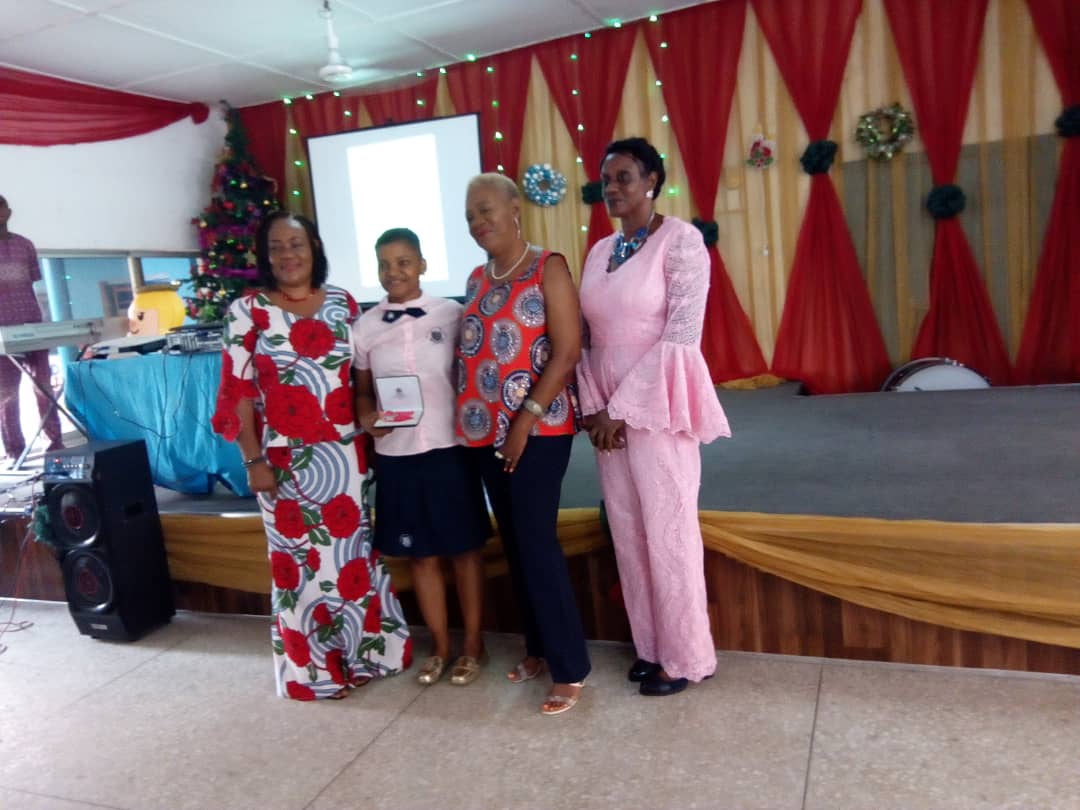
Yewande Memorial School Lagos Celebrate Aina On Her Conferment Of the Member of the order of the British Empire (MBE)

By Ifeoma Ikem
It was all joy today at the school hall of yewande Memorial School, James Robertson road, Surulere, Lagos, As the management of the institution converge to honour one of her old students Olasubomi Iginla Aina who was recently confered with the prestigious member of the order of the British Empire (MBE) by the Queen of England.
The former student of the school Aina who was born in January 17,1978 passed out from Yewande Memorial School in 1991,before proceeding to the Anglican Girls Grammar school for her secondary education.
She later gain admission to the Obafemi Awolowo university where she bagged her first degree and founded the Organization for Youths and Women Affairs (OYWA) later metamorphosed to become light up foundation.
She was once the student union government president of the Obafemi Awolowo university a position that led her becoming the youngest focal person for the National Women’s peace group which was inaugurated by former Nigeria president Olusegun Obasanjo.
Aina was once celebrated as a “Good Samaritan “on the BBC when she was caught on camera shopping for elderly people in her local area (new Addington) in 2010.
The human right crusader now being celebrated all over the world, created the Bay of Hope (BOH) which is now a rallying point for activities raising awareness of the United Nations (UN) Rights of the child.
On January 8,2018 she started a nursery and primary school which is now running where the less privilege ones now have access to education for free, it is situated at Ikhare Island settlement in Lagos State.
She is using the light up foundation platform even the project is solely funded by her.
In a separate interview with journalists at the event, Aina said her foundation have empowered no fewer than 800 children who were released from prison had also be empowered by the foundation in different skills at Abeokuta,the Ogun State capital and over 100 of such children had also be trained in different skill in Kwara State.
According to her the goal of the foundation is to work in at least three major prison in Nigeria to rescue children whose age ranges between 12 to18 years and empower them as well as reunite them to their families.
She explained that all her exploit there is nothing she can do that will not be linked to charity”i exhitied leadership when I was in secondary school this made me to become the Head girl”,.she recalled.
While speaking to the pupils of Yewande Memorial School, she advice every student and pupils as well as the audience not to give up hope in life because it is not over until is over. “everything about me come from God I consider myself to have been enjoying sanity from God which made it possible to be celebrating here today at Yewande”.
Also speaking one of the Director of Yewande Memorial School Mrs Iyabo Smith described Aina as a wonderful lady and an aluminus of the school who have done very well in her endeavor ,received a big honour from the British monarch and Prime Minister of Britain then come back home to celebrate with the school and also motivate the pupils of the school through motivational talk based on her experiences across the globe.
Another Director of the school Architect Abimbola Ajayi said the coming home to the school by Mrs Aina to celebrate the honour was very encouraging because the honour from the British authorities is not just a national one but a global honour which have done the school to be proud of one of theirs.
Mrs Abimbola advice parents not to look at any child with levity because every child has something special in him or her that will them rise globally.






NIGERIA’S EDUCATION STRIDES, GLOBAL ACKNOWLEDGMENT: When Evidence Travels from Jigawa
…as President Tinubu set to commission Africa’s largest schools complex in Lagos
By O’tega Ogra
There is a quiet shift happening in Nigeria’s education system. You will not find it in speeches neither will you find it in long policy documents. But if you look closely, you will see it in something far more difficult to dismiss. Evidence.
Last week in San Francisco, at the Comparative and International Education Society (CIES) conference, data from classrooms in Jigawa State was presented before a global audience. Not projections. Not estimates. A record of what is happening inside a public system in Nigeria. 
That distinction matters. For years, much of what the world has understood about education in countries like ours has been assembled from a distance. National averages. Modelled estimates and reports written long after the fact. What was presented this time came from within. Attendance tracked daily. Teachers reassigned based on need. Classrooms observed as they function. All under a digitalised ecosystem.
In Jigawa, under the JigawaUNITE foundational learning digital programme, the numbers tell a simple story. Within roughly 150 days of implementation which commenced at the end of 2024, 95 previously understaffed schools were fully staffed. Pupil teacher ratio moved from 114:1 to 70:1. Daily attendance rose from 39 per cent to 77 per cent. This remarkable improvement was not achieved by expanding the workforce. It came from reorganising what already existed under a digital umbrella.
There is something instructive in that. Nigeria has never lacked policy. What we have often lacked is the discipline of execution. The ability to take what already exists and make it work as intended. That is where the real shift is beginning to show.
But it would be too convenient to reduce this to one programme.
At the federal level, the direction has also been adjusting. The Minister of Education, Dr. Maruf Tunji Alausa, has placed measurable outcomes, foundational learning, and teacher quality back at the centre of policy. UBEC, the Federal Government’s Universal Basic Education body, continues to drive national interventions around school improvement and teacher development, even as it insists that reform must remain system-led and not fragmented.
The First Lady’s education interventions, through the Renewed Hope Initiative, have reinforced education as a national priority, particularly around access, learning materials, and inclusion. These are different levers, but they are part of the same ecosystem.
And then there is the fiscal reality.
Recent reforms under President Bola Ahmed Tinubu have increased allocations to subnational governments, creating more room for states to act. In a federation like Nigeria, that matters. Because education is not delivered from Abuja. It is delivered in states. In schools. In classrooms.
What Jigawa has done is to use that room and the Executive Governor of the state, the State Universal Basic Education Board, and their partners on the JigawaUNITE project, New Globe, must be given kudos.
However, Jigawa is not alone in this journey.
In Kwara, efforts to align teaching with actual learning levels are beginning to correct a structural mismatch in classrooms. In Lagos and Edo, structured pedagogy and closer monitoring are improving consistency in teaching. Across the entire ecosystem, state governments, federal institutions like UBEC, and delivery partners like NewGlobe are pushing at the same question from different angles.
How do children actually learn better?
In a prior reflection, Ifeyinwa Ugochukwu, VP at NewGlobe, captured the urgency clearly. With the right tools, training, and use of data, foundational learning outcomes can improve at scale. The real risk, she noted, is delay, allowing learning gaps to become permanent.
That warning should not be ignored because the context remains difficult. Nigeria still carries one of the largest out of school populations in the world. Learning gaps remain. Progress in one state does not resolve a national challenge, but it does something else.
It proves that movement is possible.
What was presented in Washington did not claim success. It demonstrated function. It showed that a Nigerian sub-national can generate evidence that holds up in a global room. That reform does not always require something new. Sometimes it requires using what already exists more honestly and more efficiently.
The real question now is whether this remains an exception.
Or whether it becomes a pattern.
Because reform at scale is never built on isolated wins. It is built on systems that can reproduce them.
And perhaps that is why the timing matters.
This week, another subnational, Lagos State, is expected to commission the Tolu Schools Complex in Ajegunle, a sprawling 36-school integrated facility spread across 11.7 hectares, designed to serve over 20,000 students, and described as the largest school community in Africa. 
There is a connection here that should not be missed.
On one hand, a classroom system in Jigawa is learning how to organise itself better. On the other, a state like Lagos is building the physical scale required to carry thousands of learners at once.
One is structure. The other is capacity.
Real progress sits where both meet because education reform is not only about what we build, it is about how well what we build actually works.
For once, the data was not explaining Nigeria from the outside.
It was coming from within.
And it carried weight.

FAB Luxury Court Sets A Rare Benchmark For Excellence In Africa
~By Oluwaseun Fabiyi
Fab Luxury Court distinguishes itself as the premier choice for reliable investors and proactive developers in Nigeria and Africa.While numerous real estate entities operate within the country, Fab Luxury Court stands out for its exceptional honesty and integrity, delivering on the promises showcased on its social media page to distinguished customers globally.
As of now, no investors, whether domestic or international, have expressed regret over investing in or partnering with Fab Luxury Court. The company’s commitment to accessibility, accountability, and transparent financial reviews sets it apart from its contemporaries, rendering it a prized asset among its extensive clientele worldwide. Thousands of customers continue to patronize Fab Luxury Court due to its impeccable integrity and visionary approach.
*Why is Fab Luxury Court a worthwhile investment that warrants prompt consideration rather than hesitation?*
Fab Luxury Court’s security measures are exemplary and deserving of commendation, providing investors with capital protection through a robust structured framework, transparent reporting, and comprehensive legal documentation, thereby guaranteeing outstanding and secure returns.
Fab Luxury Court has further cemented its position as a leading developer and real estate powerhouse in Nigeria and Africa, currently managing several high-end estates in Maryland, Ikeja, Lagos and its surrounding areas.Fab Luxury Court demonstrates its unwavering commitment to excellence in Nigeria’s real estate sector through its best-selling estates in Ikeja.
Undoubtedly, partnering with and patronizing Fab Luxury Court will significantly contribute to securing your future; as you plan to associate with them in 2027, we encourage you to maintain a positive outlook and unwavering confidence in your future wealth.



Edukate Africa holds summit to tackle funding barrier in education
By Ifeoma Ikem
Edukate Africa, an edu-fintech platform is set to host the Disrupt Education Summit Africa (Disrupt ED) aimed at tackling funding barriers, skills gaps and curriculum mismatch in Nigeria’s education system.
The Director of Edukate Africa, Francis Omorojie who disclosed this to newsmen explained that the initiative was driven by the high rate of school dropouts linked largely to financial constraints, particularly at the higher institution
Omorojie said the summit scheduled for January 29 at the University of Lagos will bring together government officials, universities, financial institutions, private sector players and philanthropies to rethink education financing and prepare young Nigerians for the realities of today’s digital workforce.
He said that more than 50 percent of students who drop out of higher institutions do so because they cannot afford tuition and related costs, a situation he described as a major contributor to unemployment, brain drain and irregular migration.
“Africa’s youthful population could either become an economic advantage or a liability, depending on how well education and talent development are managed.
“Education is a fundamental need, but financial exclusion has continued to shut out many promising young people. When students drop out, it feeds unemployment and social instability.
“Our mission is to build innovative and sustainable financial models that keep young Africans in school and help them become productive,” he said.
He noted that Edukate Africa is deploying blended financing solutions that include tuition guarantees, technology driven scholarship platforms, gig and remote work opportunities for students, and partnerships with universities and philanthropies to establish endowment and alumni funds.
He said that the platform pays tuition directly to institutions after verifying students’ admission and academic records, ensuring transparency and accountability for donors.
“The summit would focus on aligning education with the fast changing nature of work, driven by digital transformation, artificial intelligence and emerging technologies as any university curricula are lagging behind workplace realities, leaving graduates ill prepared for employment.
“There is a clear disconnect between what students are taught and what employers need. This summit will create a roundtable where government, academia and the private sector can agree on the skills required for today’s economy and how to integrate them into learning.
“It will also examine education financing models, including how banks and financial institutions can design student friendly funding products, and how existing initiatives such as the Nigeria Education Loan Fund can be strengthened and scaled.’’
Omorojie added that Edukate Africa would use the summit to launch the CommUniversity Endowment Fund, a community led investment fund designed to generate sustainable returns that will be used to sponsor vulnerable students and support young entrepreneurs.
Unlike traditional grant models, he said the fund would invest in revenue generating businesses, with dividends channeled into education support and seed funding for student led startups.
He said the initiative would also promote innovation through activities such as Pitch My Dissertation, Africathon and inter university debates, encouraging students to turn academic research into commercial solutions and job creating ventures.
According to him, over 1,000 students and recent graduates are expected at the summit, with a partners’ pavilion providing employers and organisations direct access to top talent.
He added that Edukate Africa has already supported students in Nigeria, the United Kingdom and Uganda to complete their education, in some cases with relatively small amounts that made the difference between graduation and dropping out.
He said that the ultimate goal is to move beyond access to education and ensure that young people graduate with relevant skills, funding support and pathways into employment or entrepreneurship, thereby contributing meaningfully to Nigeria’s economic development.
Also speaking, Tosin Adebisi, Co-Founder of Edukate Africa said the Disrupt ED Summit was designed as a disruptive and transformative convergence that would move beyond familiar conversations to practical collaboration.
Adebisi said the summit was built around a new framework called Communiversity, which seeks to integrate universities, policymakers, industry, the third sector and students into a single ecosystem.
“Rather than everyone working in silos, Communiversity brings together policymakers, universities, industry and civil society, with students at the centre, to address access to education, the future of work and Africa’s competitiveness.
“Communiversity model would leverage alumni networks, high net worth individuals and diaspora support to unlock sustainable funding for universities.
“The summit is being organised in partnership with the University of Lagos and the University of Birmingham, with support from the Federal Ministry of Education.’’
The dignitaries that would grace the occasion include, Minister of Education, Dr Tunji Alausa; the Provost and Vice Principal of the University of Birmingham, Professor Nick, the Chief Operating Officer of Semicolon Africa, Ms Ashley Immanuel; and the Chief Executive Officer of Sterling One Foundation, Mrs Olapeju Ibikwe


- Century Group Joins African Energy Week (AEW) 2026 as Floating Production Storage and Offloading (FPSO) Partner, Showcasing Regional Offshore Expansion April 10, 2026
- Climate Litigation Surge Reshapes Energy Policy as Africa Seeks Stronger Legal Voice April 10, 2026
- ES-KO Secures Five-Year Catering & Facilities Management Contract Renewal with TotalEnergies EP Congo April 10, 2026
- Beyond the Court: The Kalahari Conference Solidifies its Status as Africa’s Premier Sports & Lifestyle Destination April 10, 2026
- Africa Sports Unified Launches Pan-African Sports Deals Tracker to Improve Market Visibility and Decision-Making April 10, 2026
- Nigeria and Senegal Must Follow Ghana and Mozambique Against Exclusionary Practices April 10, 2026
- Sheraton Nouakchott marks the entry of Marriott International in Mauritania April 10, 2026
- Eritrea: Seminar to Nationals in Nairobi and Its Environs April 10, 2026
- African financial institutions call for coordinated financing solutions to unlock Africa’s digital transformation April 9, 2026
- African Energy Chamber (AEC) Supports Perenco Partnership to Advance Industry 4.0 Skills in Central Africa April 9, 2026
- Century Group Joins African Energy Week (AEW) 2026 as Floating Production Storage and Offloading (FPSO) Partner, Showcasing Regional Offshore Expansion April 10, 2026
- Climate Litigation Surge Reshapes Energy Policy as Africa Seeks Stronger Legal Voice April 10, 2026
- ES-KO Secures Five-Year Catering & Facilities Management Contract Renewal with TotalEnergies EP Congo April 10, 2026
- Beyond the Court: The Kalahari Conference Solidifies its Status as Africa’s Premier Sports & Lifestyle Destination April 10, 2026
- Africa Sports Unified Launches Pan-African Sports Deals Tracker to Improve Market Visibility and Decision-Making April 10, 2026
- Nigeria and Senegal Must Follow Ghana and Mozambique Against Exclusionary Practices April 10, 2026
- Sheraton Nouakchott marks the entry of Marriott International in Mauritania April 10, 2026
-

 news4 months ago
WHO REALLY OWNS MONIEPOINT? The $290 Million Deal That Sold Nigeria’s Top Fintech to Foreign Interests
-

 society7 months ago
“You Are Never Without Help” – Pastor Gebhardt Berndt Inspires Hope Through Empower Church (Video)
-

 celebrity radar - gossips2 months ago
Dr. Chris Okafor Returns with Power and Fire of the Spirit -Mounts Grace Nation Altar with Fresh Anointing and Restoration Grace on February 1, 2026
-

 celebrity radar - gossips4 months ago
Prophet Kingsley Aitafo Releases 2026 Prophecy: ‘Nigeria Will Rise, but the World Must Prepare for Turbulence’
You must be logged in to post a comment Login
You must log in to post a comment.