
society
Governor Bulldozes Parliament And No One Bothers? By Felix Oboagwina


Governor Bulldozes Parliament And No One Bothers?
By
Felix Oboagwina
I care little for former Rivers State’s Governor Nyesom Wike and the 25 pro-Wike lawmakers in the State House of Assembly. However, in their current quarrel with the incumbent Governor Simi Fubara (the godson who succeeded Wike), only one factor works against Wike in the court of public opinion: In the 2023 elections, the Rivers strongman worked for the emergence of Bola Ahmed Tinubu as President; and Tinubu has today raised Nigerians’ pain and poverty to record proportions! President Tinubu’s failures solely win for Fubara massive support in this lingering faceoff with Wike, his erstwhile godfather, predecessor and current Minister of the Federal Capital Territory.
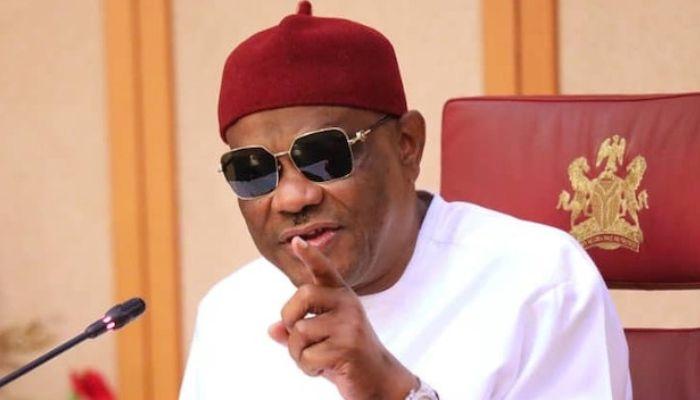
This colourless former Rivers State Accountant-General emerged as the Dark Horse and clinched the Rivers governorship completely by the grace of Wike. How? In the penchant of political godfathers to prepare for themselves a soft post-office landing, by planting spineless acolytes as successors, Wike manipulated Fubara over far popular and formidable aspirants, and handed him PDP’s Rivers State governorship ticket. Wike financed all the campaigns, swayed the rostrum with his oratory and persona, brought in the votes and handed Fubara the election on a platter of gold. But talk of Karma. Not only has Fubara turned around to bite the fingers that moulded him, he has injured Democracy in the most unimaginable fashion.
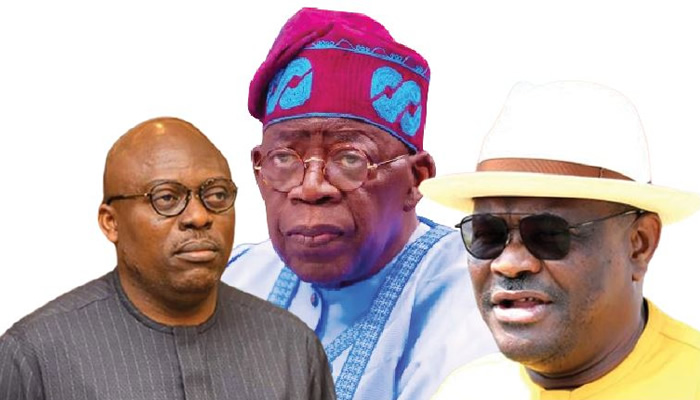
As the Yoruba say, the new king devours the kingmaker first. Fubara turned against Wike and rubbished him. Not done, Fubara, late 2023, stormed the Rivers State House of Assembly (having majority 25-7 as Wike PDP loyalists), with police firing gunshots and water cannons to keep the rampaging Governor at bay!
His supporters thereafter set ablaze the Parliament building.
Fubara then sent the demolition squad to bulldoze the entire complex to smithereens.
Every single one of these anti-legislative steps amounted to a desecration of Democracy and an assault on a sacred institution of popular government. It amounts to treason!
This much President Tinubu told Fubara to his face when the First Citizen brokered peace between these gladiators. The Parliament, everywhere, exists as the truest representation of the people and the incontrovertible custodian of Democracy. Whereas the Executive and the Judiciary exist in other forms of government (autocracy, military, monarchical), the Legislature’s participation distinguishes Democracy from all of them. Thus, demolishing its habitation connotes the highest threat to Democracy. The Congress is an institution; and we have always mouthed the need to build strong institutions as opposed to strong politicians.
Fubara went further. Most recently, he AGAIN stormed the makeshift accommodation that the Rivers Parliament resorted to at the Assembly Quarters. Then, on May 10, “Emperor” Fubara enacted an Executive Order to force the House of Assembly to hold its sittings inside the Government House! Sacrilege! Whatever happened to the Doctrine of the Separation of Powers?
Imagine the contradiction. An Executive Order passed on the Legislature! The Executive ORDERS the Legislature! How can? Nowhere does the Constitution place the control of the Legislature (and the Judiciary) under the Executive.
These assaults the Rivers State Legislature has endured.
Pray, who advises this guy?
The Legislature is made so potently powerful that the Constitution allows it to overrule the Governor and railroad a Bill into law without his consent.
Section 96(5) says:
Where the Governor withholds assent and the bill is again passed by the House of Assembly by two-thirds majority, the bill shall become law and the assent of the Governor shall not be required.
Even the budget of the Legislature, like that of the Judiciary, goes by first-line charge, all in order to ensure its independence and the Separation of Powers.
How can a Governor with the vast resources at his disposal prove incapable of lobbying, courting and winning over the State House of Assembly, and instead His Excellency resorts to thuggish, strong-arm tactics? You wonder what terror this character wouldn’t unleash if backed by a Rivers State Police Force completely at his beck and call!
Fubara-Wike’s wahala factionalised the House of Assembly 25 to seven and the Accountant-General-turned Governor chose to work with the minority, in clear violation of Section 96 that says:
(1) The quorum of a House of Assembly shall be one-third of all the members of the House.
(2) If objection is taken by any member of a House of Assembly present that there are present in that House (besides the person presiding) fewer than one-third of all the members of that House and that it is not competent for the House to transact business, and after such interval as may be prescribed in the rules of procedure of the House, the person presiding ascertains that the number of members present is still less than one-third of all the members of the House, he shall adjourn the House.
The majority of Rivers legislators, for political expediency and most likely to take cover under the Federal might, crossed carpet to the ruling APC.
Commissioners are resigning from Fubara’s cabinet, citing the toxic atmosphere working with him.
The 23 local government chairmen have drawn a battle line with him.
All these could be predictable because most of those officials owe their emergence in office and pledge loyalty to Wike. They all jumped ship after Fubara, egged on by whomever, flung reconciliation with Wike against the rocks.
Contrary to President Tinubu’s peace agreement that Fubara and Wike’s group signed December 2023 at Aso Rock, the Governor refused to re-present the 2024 budget to the State House of Assembly, continuing to work with an illegal Appropriation Act passed by a mere seven out of 32 lawmakers. This he did even when, in the spirit of that agreement, the majority Wike group of legislators withdrew their lawsuits against him and aborted impeachment proceedings on the understanding that the budget would be properly presented for passage.
Bottom line? The crisis in Rivers goes beyond a Fubara-Wike brouhaha. It queries the very essence of Nigeria’s Democracy and the sanctity of the Nigerian Constitution. Everyone taking sides does so with the mentality of “the enemy of my enemy is my friend.” But power corrupts and absolute power corrupts absolutely. Those beating the drum for Fubara’s dance of madness are pushing Nigerian Democracy to ride the back of a tiger. How do you end the ride without Democracy ending up as a meal down the tiger’s throat? If Fubara’s style of burning, demolishing and choking the Legislature becomes a culture, then what fate befalls this Democracy? If the President takes a cue and chooses to tackle the National Assembly in a similar style? What species of Legislature will the Upper and Lower Chambers turn to, being Executive-ordered to perform legislative duties right inside the Aso Rock Villa, under the nose of the President?
The problem that lovers of Democracy must tackle is stopping Fubara becoming a role model for how the Executive can emasculate and stifle the Legislature’s independence at the state and Federal levels. Or are we going to let Fubara get away with this abuse of the Parliament because of the disdain we nurse for his adversaries, Wike and Tinubu?
OBOAGWINA IS AN AUTHOR, JOURNALIST AND PUBLISHER, REACHABLE VIA: [email protected]






NAWOJ: SEKINAT, CHARITY GETS VOTE OF CONFIDENCE
The Nigeria Association of Women Journalists,(NAWOJ), Ogun State Chapter Executives has unanimously passed a vote of confidence on Chairman NAWOJ SEKINAT Salam and the Financial Secretary, Charity James, saying that, their leadership reflect the ideal and objectives of NAWOJ.
This was revealed in a communique issued at an Emergency meeting of the Executive held at the NUJ State Council, Iwe-Iroyin in Abeokuta.
The vote of confidence on the Leadership of NAWOJ was unanimously signed by all the five executive members that attended the meeting with the vice chairperson taking apology for official engagement outside the state capital.
According to the communique ” Consequently, NAWOJ Ogun State Chapter, reaffirms it’s unwavering support and confidence in the Chairperson and the Financial Secretary, Sekinat Salam and Charity James respectively, Urge them to continue in their commitment to purposeful leadership in the best interest of the association and the society at large”.
Speaking briefly with Journalists after the emergency Executive meeting, the Chairperson, Nigeria Association of Woman Journalists (NAWOJ), Com. Sekinat Salam, said the meeting was necessary as the news of her suspension was laughable and insulting because it is like a pot calling a kettle black in this case, saying that the Leadership of the State Council, Com. Wale Olanrewaju has no local standing to suspend her or any executive member, even he cannot be a judge in his own case.
According to her” The Leadership of the Nigeria Union of Journalists, Ogun State led by Wale Olanrewaju has always been misusing power without recourse to the constitution of this noble Union, hence has no local standing to suspend me or any executive member “.
She said only the Central Working Committee (CWC) has the constitutional rights to sanction or suspend any members found wanting after due process has been followed.
While calling on members to stay calm, Com. Sekinat Salam assured members of positive representation of NAWOJ at both the State and National level, adding the success recorded under her administration cannot be overemphasized.
She therefore called on the National leadership of NUJ to critically look into the matter, either by setting up independent committee to investigate the issues and resolve the matter as quickly as possible.
Adron Homes Chairman Congratulates Oyo State on 50 Years of Progress
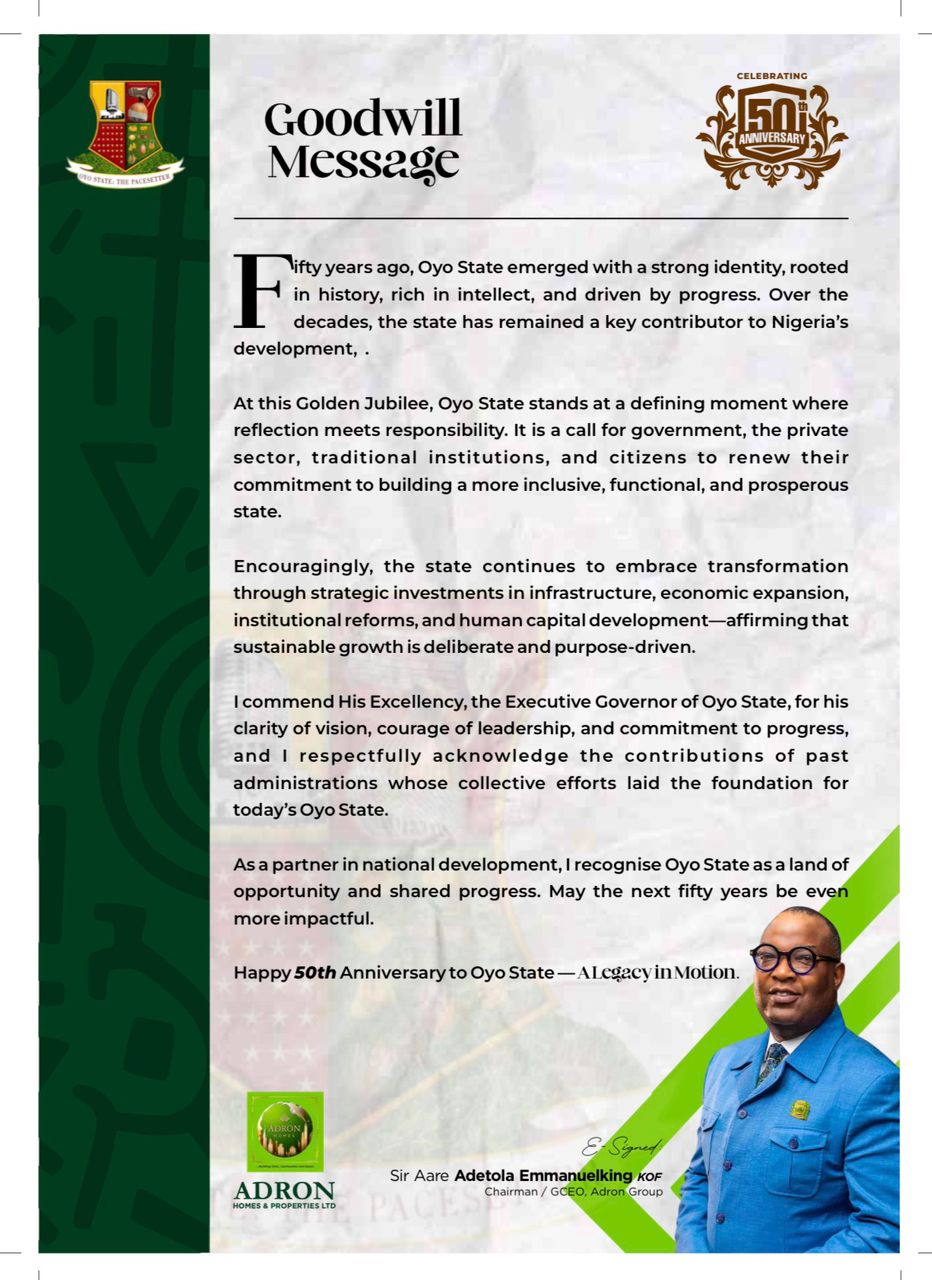
The Chairman and Chief Executive Officer of Adron Homes and Properties Limited, Aare Adetola Emmanuelking, has congratulated the Government and people of Oyo State as the state marks its 50th anniversary, describing the occasion as a celebration of resilience, cultural pride, and sustained progress.
He noted that since its creation, Oyo State has remained a strong contributor to Nigeria’s socio-economic and cultural development, emerging as a hub of commerce, education, and innovation.
According to him, the Golden Jubilee offers a moment for reflection and renewed commitment by government, private sector players, traditional institutions, and citizens toward building a more inclusive and prosperous state.
Aare Emmanuelking commended the state’s ongoing transformation through investments in infrastructure, economic expansion, and human capital development, adding that sustainable growth is deliberate and must remain purpose-driven.
He also praised the leadership of the current administration while acknowledging the contributions of past leaders whose efforts laid the foundation for today’s Oyo State.
Reaffirming Adron Homes’ commitment to national development, he described Oyo State as a land of opportunity. He wished the state continued peace and prosperity, expressing confidence that the next fifty years will bring even greater achievements for the Pace Setter State and its people.
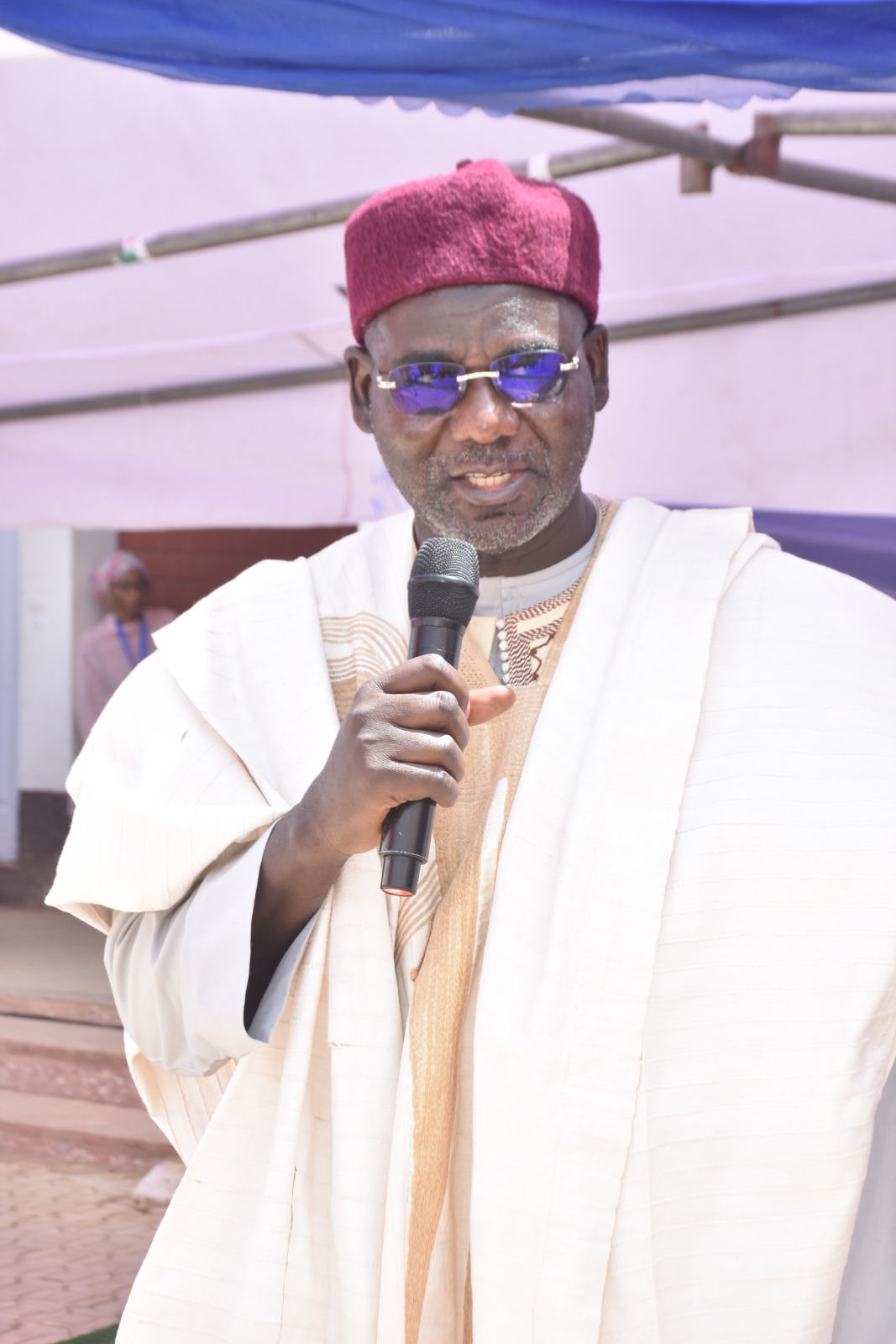
TY BURATAI HUMANITY CARE FOUNDATION CONDOLES WITH BIU EMIRATE OVER TRAGIC ATTACK
In a profound expression of sorrow, the TY Buratai Humanity Care Foundation has extended its heartfelt condolences to the families of the victims and the entire people of Biu Emirate, Borno State, following the recent tragic attack attributed to Boko Haram. This devastating assault, which occurred at a work site in northeastern Nigeria, claimed the lives of dozens, including brave soldiers committed to protecting the nation.
In a statement released to the press and signed by the Chairman of the foundation, Ibrahim Dahiru Danfulani Sadaukin Garkuwan Keffi/Betara Biu, the Grand Patron of the Foundation, His Excellency Amb. Lt. Gen. Tukur Yusufu Buratai CFR (Rtd), former Chief of Army Staff, described the incident as “one too many senseless, barbaric, and ruthless displays of inhumanity.” His Excellency emphasized the heartbreaking impact of such attacks on innocent, hardworking citizens striving to make a positive difference in their communities.
The Grand Patron praised the swift and decisive response of military personnel during this critical time, underscoring their brave commitment to safeguarding the nation. He called upon them to maintain this momentum, commending their courage and sacrifice in the face of adversity. “May Almighty Allah forgive their souls and grant them Aljannah Firdouse,” he remarked, encouraging the nation to honor their spirit of sacrifice as they rally together to rebuild and restore hope across the region.
In his statement, Gen. Buratai highlighted the importance of collective action in overcoming the challenges posed by insecurity, urging concerned citizens to increase their efforts in fostering a virile community that future generations can cherish. “Together, we can surmount these troubles,” he asserted, calling on all patriotic leaders and citizens to unite in the fight against violence and insecurity.

The TY Buratai Humanity Care Foundation remains committed to supporting initiatives that promote peace, security, unity, and prosperity. As the foundation extends its condolences to the bereaved, it also calls upon all segments of society to collaborate in creating a better and safer future. May Allah guide and protect the nation and lead it toward enduring peace. Amen.


-
 celebrity radar - gossips6 months ago
Why Babangida’s Hilltop Home Became Nigeria’s Political “Mecca”
-

 society6 months ago
Power is a Loan, Not a Possession: The Sacred Duty of Planting People
-

 Business6 months ago
Batsumi Travel CEO Lisa Sebogodi Wins Prestigious Africa Travel 100 Women Award
-
 news6 months ago
THE APPOINTMENT OF WASIU AYINDE BY THE FEDERAL GOVERNMENT AS AN AMBASSADOR SOUNDS EMBARRASSING