
society
NLC President honours police invitation today on Terrorism Allegation

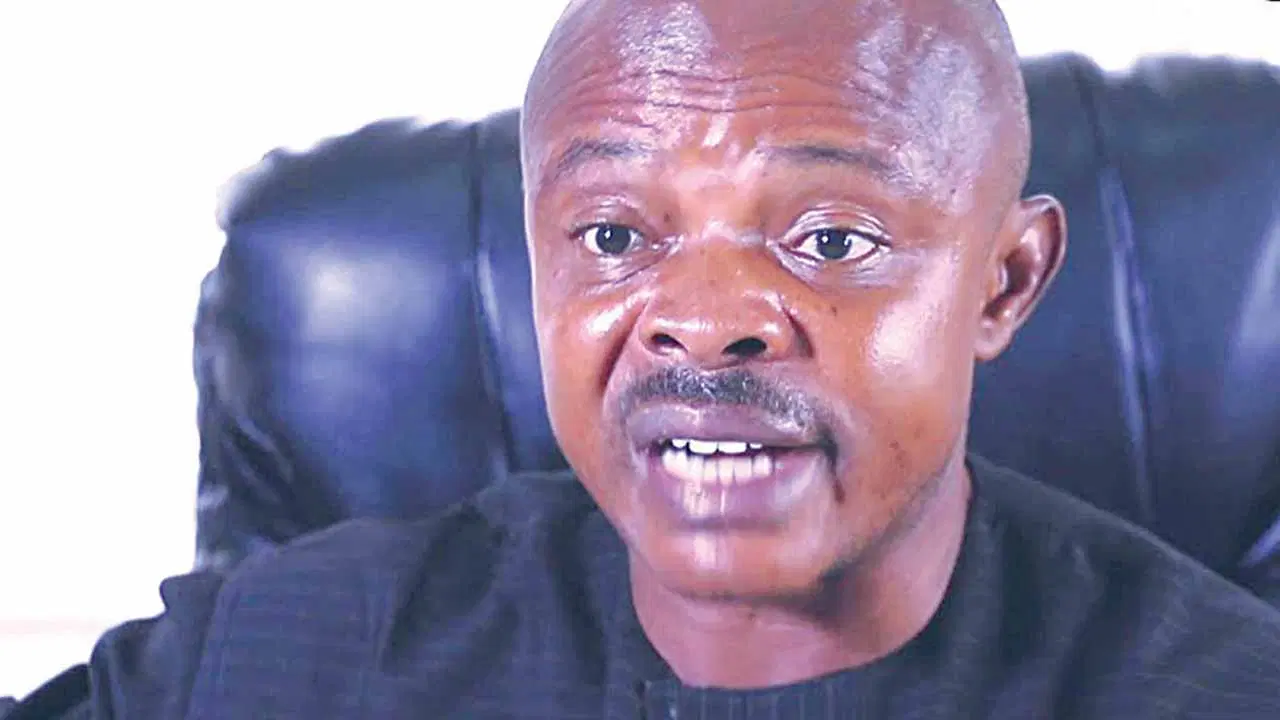
NLC President honours police invitation today on Terrorism Allegation
President of Nigeria Labour Congress, NLC, Joe Ajaero, will today appear at Force Headquarters to honour a Police summon over alleged criminal conspiracy, terrorism financing, treasonable felony, subversion, and cybercrime 11 days after an invitation by the Intelligence Response Team, IRT, arm of the Police.
Leaders of industrial unions affiliated with NLC, workers, civil society allies and some lawyers, among others, are expected to accompany Ajaero to the Police headquarters.
NLC has also directed leaders of its state councils nationwide to mobilize and embark on a peaceful procession to state police commands and hold prayer sessions in solidarity with its President and organized Labour over the current challenges facing the labour movement in the country.
Similarly, the Nigeria Union of Journalists, NUJ, has asked its Federal Capital Territory, FCT, chapter to mobilize Abuja-based journalists to the Force Headquartres in solidarity with NLC and its President, Ajaero.
This came as the Trade Union Congress, TUC, (United Kingdom) urged the British government to prevail on the federal government to end the violent repression and intimidation of trade unions.
Recall that the Police had on August 19, invited the NLC President to appear at its headquarters for questioning on August 20, over allegation of criminal conspiracy, terrorism financing, treasonable felony, subversion and cybercrime, threatening to arrest him if he failed to honour the invitation.
But on August 20, human rights activist and lawyer to the NLC, Femi Falana, SAN, explained why the President of NLC could not honour the Police invitation for him to appear.
In a circular to NLC affiliates and state councils, by the General Secretary, Emmanuel Ugboaja, NLC stated: “In response to the recent summon by the Nigeria Police Force for our President, Comrade Joe Ajaero, to appear for interrogation on trumped-up charges on Thursday, August 29, 2024, we call on all NLC affiliates and state councils to mobilize their members in Abuja and across the states to show solidarity.
All CWC members resident in Abuja and other members are expected to assemble at the National Headquarters of the NLC by 8:00 AM on Thursday (today) to accompany the President to the Police for the scheduled interaction.
“‘
In state capitals, members should gather at their respective state secretariats. From there, they will embark on a peaceful procession to their state police headquarters where they will hold a prayer session until the President’s interaction with the Police is concluded.
“This peaceful march is a united stand against the unjust actions aimed at intimidating our leadership and stifling the voice of Nigerian workers. We urge all members to remain peaceful and orderly throughout the procession and prayer session. If for any reason, the President is detained; all workers nationwide shall proceed on indefinite strike.”
NUJ directive
Similarly, the Nigeria Union of Journalists, NUJ, in a show of solidarity, has directed its FCT chapter to mobilize members in Abuja and work with other affiliates of NLC to accompany the Congress President to force headquartres.
NUJ in a statement by the National Secretary, Achike Chude, said: “We have been watching with trepidation great angst and baited breath, the unfathomable macabre dance exhibited by the nation’s police force against the leadership of the Nigerian workers, most notably President of NLC, Joe Ajaero.
“Our seeming silence was observed in the hope that the police would beat a hasty retreat from their actions and tread the path of caution and civility. We have no bones to grind with the police authorities and, as citizens of this greatly beloved but much beleaguered country, we are ever willing to cooperate with the authorities whenever demanded by national imperatives and exigencies, the police included.
“But it must never be at the expense of our union, our people, and our country. The importance of fighting for, and defending our nation state, Nigeria, cannot be over-emphasized.
”We are patriots, we are Nigerians, and we love our country, in spite of deeply inherent socio-economic contradictions that are threatening our very existence as a nation.”
United Kingdom Labour Union reacts
Meanwhile, the TUC (United Kingdom), has joined the growing list of global labour movement solidarity against perceived attacks of Nigerian trade unions and their leaders.
In a solidarity message to NLC and its President, the General Secretary TUC (UK), Paul Nowak, said: “The TUC notes with deep concern the ongoing persecution of President of NLC, Joe Ajaero. The President was summoned by the police on trumped-up charges of ‘criminal conspiracy and ‘terrorism financing’.
”This follows President Ajaero’s arrest and assault by the police last November. Earlier this month, heavily armed security forces raided and occupied the headquarters of the NLC, causing considerable damage to the building and arresting a union official.
“This violation of the NLC’s right to operate free from intimidation follows a sustained period of hostility from the Nigerian government towards the NLC and its affiliated unions, SSANU and NASU.
“The raid on NLC and continued harassment of its President come as the organisation held an emergency meeting to discuss the welfare of Nigerian workers amid peaceful #EndBadGovernance protests sparked by the country’s cost of living crisis.
“The TUC urges the UK government to call on the government of Nigeria to end the violent repression and intimidation of trade unions and ensure that trade unions in Nigeria can operate freely without fear.
”Instead of attacking unions, the Nigerian government should engage with them in social dialogue to find ways to end the cost-of-living crisis and, as the NLC put it, ‘chart a path forward that addresses the root causes of the current unrest – hunger, poverty, inflation, insecurity and widespread dissatisfaction with government policies.





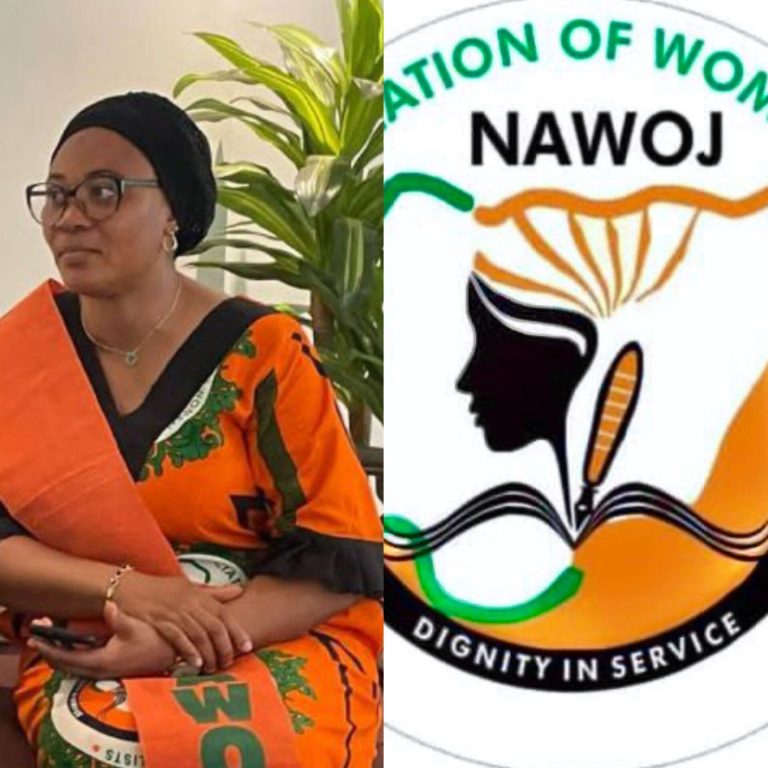
NAWOJ: SEKINAT, CHARITY GETS VOTE OF CONFIDENCE
The Nigeria Association of Women Journalists,(NAWOJ), Ogun State Chapter Executives has unanimously passed a vote of confidence on Chairman NAWOJ SEKINAT Salam and the Financial Secretary, Charity James, saying that, their leadership reflect the ideal and objectives of NAWOJ.
This was revealed in a communique issued at an Emergency meeting of the Executive held at the NUJ State Council, Iwe-Iroyin in Abeokuta.
The vote of confidence on the Leadership of NAWOJ was unanimously signed by all the five executive members that attended the meeting with the vice chairperson taking apology for official engagement outside the state capital.
According to the communique ” Consequently, NAWOJ Ogun State Chapter, reaffirms it’s unwavering support and confidence in the Chairperson and the Financial Secretary, Sekinat Salam and Charity James respectively, Urge them to continue in their commitment to purposeful leadership in the best interest of the association and the society at large”.
Speaking briefly with Journalists after the emergency Executive meeting, the Chairperson, Nigeria Association of Woman Journalists (NAWOJ), Com. Sekinat Salam, said the meeting was necessary as the news of her suspension was laughable and insulting because it is like a pot calling a kettle black in this case, saying that the Leadership of the State Council, Com. Wale Olanrewaju has no local standing to suspend her or any executive member, even he cannot be a judge in his own case.
According to her” The Leadership of the Nigeria Union of Journalists, Ogun State led by Wale Olanrewaju has always been misusing power without recourse to the constitution of this noble Union, hence has no local standing to suspend me or any executive member “.
She said only the Central Working Committee (CWC) has the constitutional rights to sanction or suspend any members found wanting after due process has been followed.
While calling on members to stay calm, Com. Sekinat Salam assured members of positive representation of NAWOJ at both the State and National level, adding the success recorded under her administration cannot be overemphasized.
She therefore called on the National leadership of NUJ to critically look into the matter, either by setting up independent committee to investigate the issues and resolve the matter as quickly as possible.
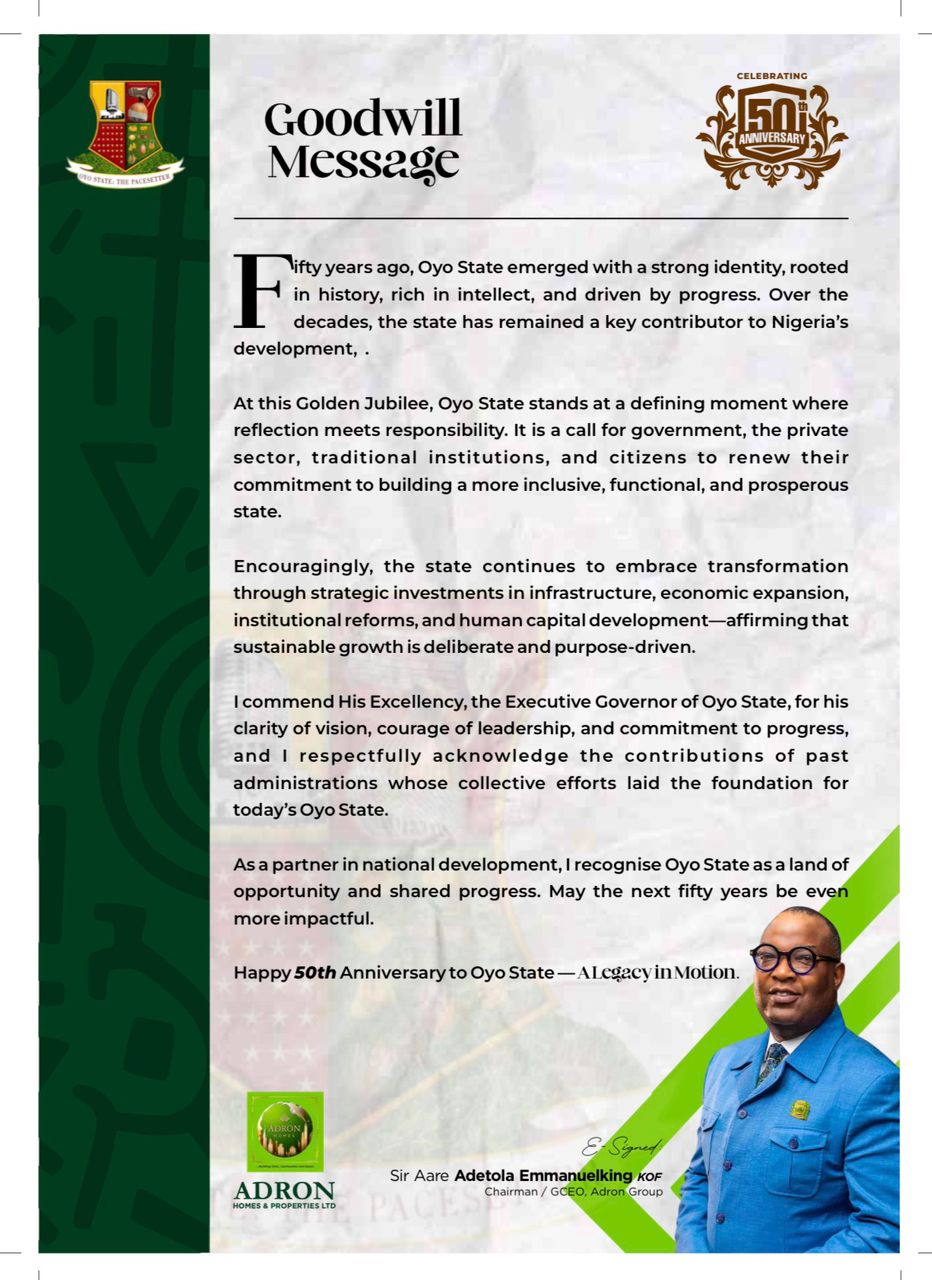
Adron Homes Chairman Congratulates Oyo State on 50 Years of Progress
The Chairman and Chief Executive Officer of Adron Homes and Properties Limited, Aare Adetola Emmanuelking, has congratulated the Government and people of Oyo State as the state marks its 50th anniversary, describing the occasion as a celebration of resilience, cultural pride, and sustained progress.
He noted that since its creation, Oyo State has remained a strong contributor to Nigeria’s socio-economic and cultural development, emerging as a hub of commerce, education, and innovation.
According to him, the Golden Jubilee offers a moment for reflection and renewed commitment by government, private sector players, traditional institutions, and citizens toward building a more inclusive and prosperous state.
Aare Emmanuelking commended the state’s ongoing transformation through investments in infrastructure, economic expansion, and human capital development, adding that sustainable growth is deliberate and must remain purpose-driven.
He also praised the leadership of the current administration while acknowledging the contributions of past leaders whose efforts laid the foundation for today’s Oyo State.
Reaffirming Adron Homes’ commitment to national development, he described Oyo State as a land of opportunity. He wished the state continued peace and prosperity, expressing confidence that the next fifty years will bring even greater achievements for the Pace Setter State and its people.
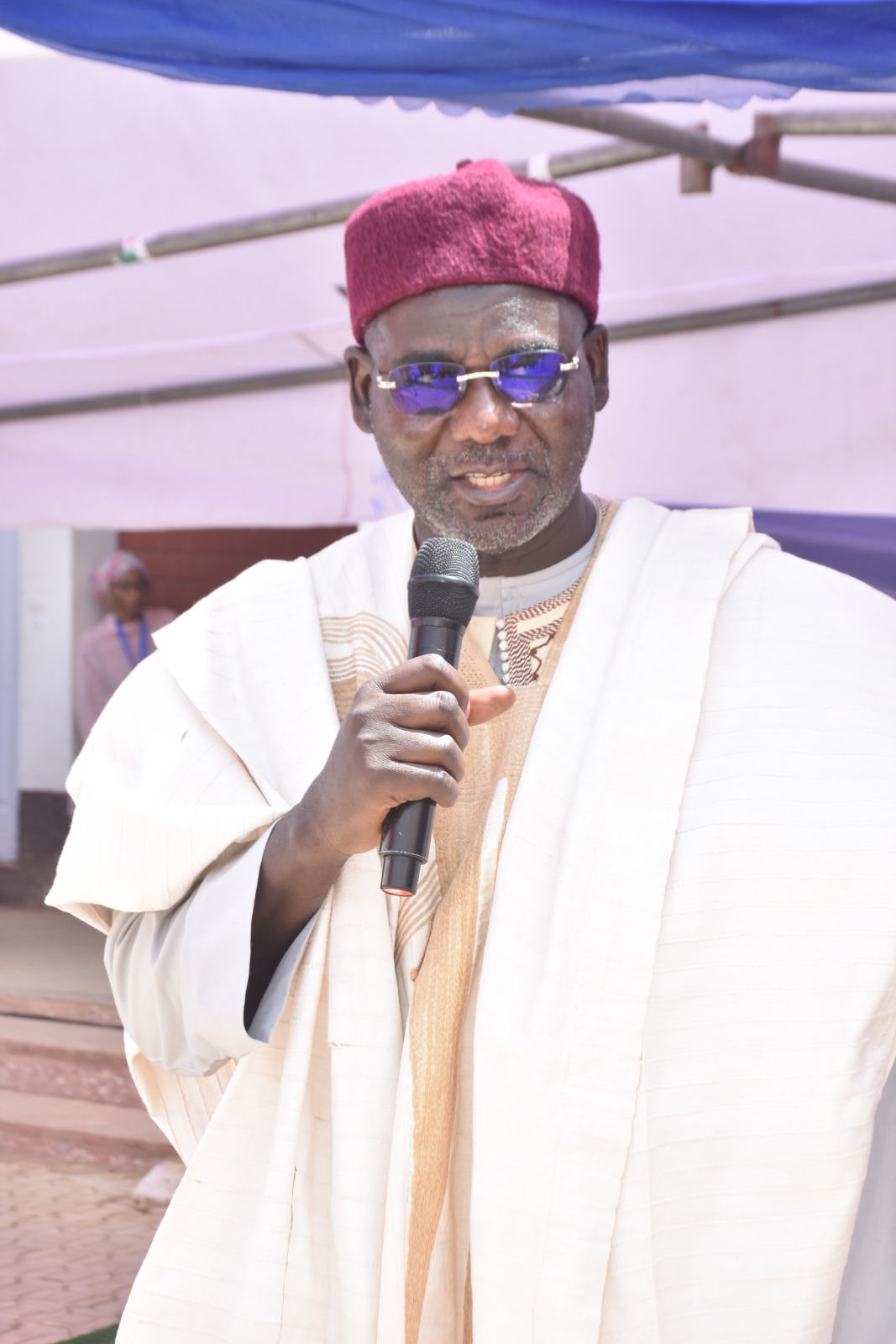
TY BURATAI HUMANITY CARE FOUNDATION CONDOLES WITH BIU EMIRATE OVER TRAGIC ATTACK
In a profound expression of sorrow, the TY Buratai Humanity Care Foundation has extended its heartfelt condolences to the families of the victims and the entire people of Biu Emirate, Borno State, following the recent tragic attack attributed to Boko Haram. This devastating assault, which occurred at a work site in northeastern Nigeria, claimed the lives of dozens, including brave soldiers committed to protecting the nation.
In a statement released to the press and signed by the Chairman of the foundation, Ibrahim Dahiru Danfulani Sadaukin Garkuwan Keffi/Betara Biu, the Grand Patron of the Foundation, His Excellency Amb. Lt. Gen. Tukur Yusufu Buratai CFR (Rtd), former Chief of Army Staff, described the incident as “one too many senseless, barbaric, and ruthless displays of inhumanity.” His Excellency emphasized the heartbreaking impact of such attacks on innocent, hardworking citizens striving to make a positive difference in their communities.
The Grand Patron praised the swift and decisive response of military personnel during this critical time, underscoring their brave commitment to safeguarding the nation. He called upon them to maintain this momentum, commending their courage and sacrifice in the face of adversity. “May Almighty Allah forgive their souls and grant them Aljannah Firdouse,” he remarked, encouraging the nation to honor their spirit of sacrifice as they rally together to rebuild and restore hope across the region.
In his statement, Gen. Buratai highlighted the importance of collective action in overcoming the challenges posed by insecurity, urging concerned citizens to increase their efforts in fostering a virile community that future generations can cherish. “Together, we can surmount these troubles,” he asserted, calling on all patriotic leaders and citizens to unite in the fight against violence and insecurity.

The TY Buratai Humanity Care Foundation remains committed to supporting initiatives that promote peace, security, unity, and prosperity. As the foundation extends its condolences to the bereaved, it also calls upon all segments of society to collaborate in creating a better and safer future. May Allah guide and protect the nation and lead it toward enduring peace. Amen.


-

 celebrity radar - gossips6 months ago
Why Babangida’s Hilltop Home Became Nigeria’s Political “Mecca”
-

 society6 months ago
Power is a Loan, Not a Possession: The Sacred Duty of Planting People
-

 Business6 months ago
Batsumi Travel CEO Lisa Sebogodi Wins Prestigious Africa Travel 100 Women Award
-
 news6 months ago
THE APPOINTMENT OF WASIU AYINDE BY THE FEDERAL GOVERNMENT AS AN AMBASSADOR SOUNDS EMBARRASSING