
Business
Why Nigeria’s Banks Still on Shaky Ground with Big Profits, Weak Capital

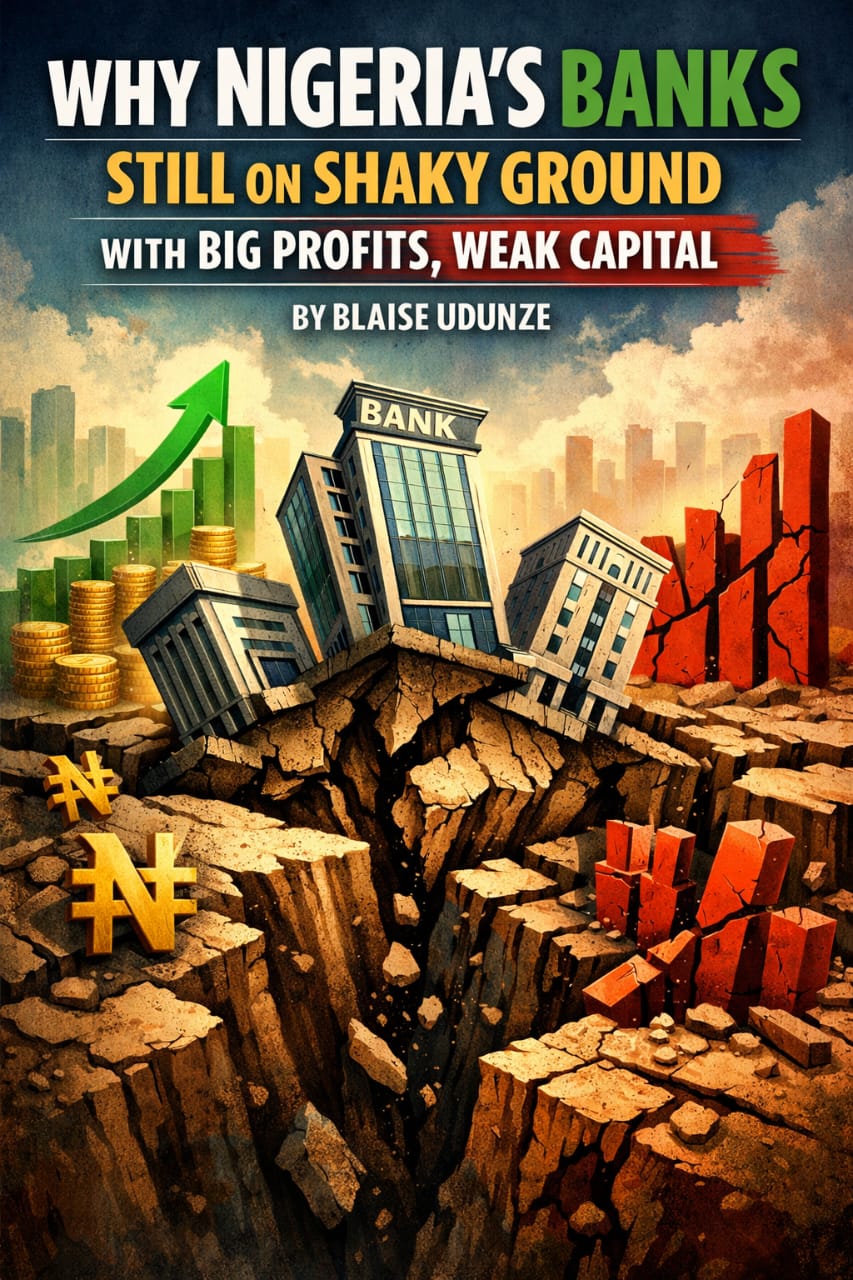
*Why Nigeria’s Banks Still on Shaky Ground with Big Profits, Weak Capital*
*BY BLAISE UDUNZE*
Despite the fragile 2024 economy grappling with inflation, currency volatility, and weak growth, Nigeria’s banking industry was widely portrayed as successful and strong amid triumphal headlines. The figures appeared to signal strength, resilience, and superior management as the Tier-1 banks such as Access Bank, Zenith Bank, GTBank, UBA, and First Bank of Nigeria, collectively reported profits approaching, and in some cases exceeding, N1 trillion. Surprisingly, a year later, these same banks touted as sound and solid are locked in a frenetic race to the capital markets, issuing rights offers and public placements back-to-back to meet the Central Bank of Nigeria’s N500 billion recapitalisation thresholds.
The contradiction is glaring. If Nigeria’s biggest banks are so profitable, why are they unable to internally fund their new capital requirements? Why have no fewer than 27 banks tapped the capital market in quick succession despite repeated assurances of balance-sheet robustness? And more fundamentally, what do these record profits actually say about the real health of the banking system?
The recapitalisation directive announced by the CBN in 2024 was ambitious by design. Banks with international licences were required to raise minimum capital to N500 billion by March 2026, while national and regional banks faced lower but still substantial thresholds ranging from N200 billion to N50 billion, respectively. Looking at the policy, it was sold as a modern reform meant to make banks stronger, more resilient in tough times, and better able to support major long-term economic development. In theory, strong banks should welcome such reforms. In practice, the scramble that followed has exposed uncomfortable truths about the structure of bank profitability in Nigeria.
At the heart of the inconsistency is a fundamental misunderstanding often encouraged by the banks themselves between profits and capital. Unknown to many, profitability, no matter how impressive, does not automatically translate into regulatory capital. Primarily, the CBN’s recapitalisation framework actually focuses on money paid in by shareholders when buying shares, fresh equity injected by investors over retained earnings or profits that exist mainly on paper.
This distinction matters because much of the profit surge recorded in 2024 and early 2025 was neither cash-generative nor sustainably repeatable. A significant portion of those headline banks’ profits reported actually came from foreign exchange revaluation gains following the sharp fall of the naira after exchange-rate unification. The industry witnessed that banks’ holding dollar-denominated assets their books showed bigger numbers as their balance sheets swell in naira terms, creating enormous paper profits without a corresponding improvement in underlying operational strength. These gains inflated income statements but did little to strengthen core capital, especially after the CBN barred banks from using FX revaluation gains for dividends or routine operations. In effect, banks looked richer without becoming stronger.
Beyond FX effects, Nigerian banks have increasingly relied on non-interest income fees, charges, and transaction levies to drive profitability. While this model is lucrative, it does not necessarily deepen financial intermediation or expand productive lending. High profits built on customer charges rather than loan growth offer limited support for long-term balance-sheet expansion. They also leave banks vulnerable when macroeconomic conditions shift, as is now happening.
Indeed, the recapitalisation exercise coincides with a turning point in the monetary cycle. The extraordinary conditions that supported bank earnings in 2024 and 2025 are beginning to unwind. Analysts now warn that Nigerian banks are approaching earnings reset, as net interest margins the backbone of traditional banking profitability, come under sustained pressure.
Renaissance Capital, in a January note, projects that major banks including Zenith, GTCO, Access Holdings, and UBA will struggle to deliver earnings growth in 2026 comparable to recent performance.
In a real sense, the CBN is expected to lower interest rates by 400 to 500 basis points because inflation is slowing down, and this means that banks will earn less on loans and government bonds, but they may not be able to quickly lower the interest they pay on deposits or other debts. The cash reserve requirements are still elevated, which does not earn interest; banks can’t easily increase or expand lending investments to make up for lower returns. The implications are significant. Net interest margin, the difference between what banks earn on loans and investments and what they pay on deposits, is poised to contract. Deposit competition is intensifying as lenders fight to shore up liquidity ahead of recapitalisation deadlines, pushing up funding costs. At the same time, yields on treasury bills and bonds, long a safe and lucrative haven for banks are expected to soften in a lower-rate environment. The result is a narrowing profit cushion just as banks are being asked to carry far larger equity bases.
Compounding this challenge is the fading of FX revaluation windfalls. With the naira relatively more stable in early 2026, the non-cash gains that once flattered bank earnings have largely evaporated. What remains is the less glamorous reality of core banking operations: credit risk management, cost efficiency, and genuine loan growth in a sluggish economy. In this new environment, maintaining headline profits will be far harder, even before accounting for the dilutive impact of recapitalisation.
That dilution is another underappreciated consequence of the capital rush. Massive share issuances mean that even if banks manage to sustain absolute profit levels, earnings per share and return on equity are likely to decline. Zenith, Access, UBA, and others are dramatically increasing their share counts. The same earnings pie is now being divided among many more shareholders, making individual returns leaner than during the pre-recapitalisation boom. For investors, the optics of strong profits may soon give way to the reality of weaker per-share performance.
Yet banks have pressed ahead, not only out of regulatory necessity but also strategic calculation.
During this period of recapitalization, investors are interested in the stock market with optimism, especially about bank shares, as banks are raising fresh capital, and this makes it easier to attract investments. This has become a season for the management teams to seize the moment to raise funds at relatively attractive valuations, strengthen ownership positions, and position themselves for post-recapitalisation dominance. In several cases, major shareholders and insiders have increased their stakes, as projected in the media, signalling confidence in long-term prospects even as near-term returns face pressure.
There is also a broader structural ambition at play. Well-capitalised banks can take on larger single obligor exposures, finance infrastructure projects, expand regionally, and compete more credibly with pan-African and global peers. From this perspective, recapitalisation is not merely about compliance but about reshaping the competitive hierarchy of Nigerian banking. What will be witnessed in the industry is that those who succeed will emerge larger, fewer, and more powerful. Those that fail will be forced into consolidation, retreat, or irrelevance.
For the wider economy, the outcome is ambiguous. Stronger banks with deeper capital buffers could improve systemic stability and enhance Nigeria’s ability to fund long-term development. The point is that while merging or consolidating banks may make them safer, it can also harm the market and the economy because it will reduce competition, let a few banks dominate, and encourage them to earn easy money from bonds and fees instead of funding real businesses. The truth be told, injecting more capital into the banks without complementary reforms in credit infrastructure, risk-sharing mechanisms, and fiscal discipline, isn’t enough as the aforementioned reforms are also needed.
The rush as exposed in this period, is that the moment Nigerian banks started raising new capital, the glaring reality behind their reported profits became clearer, that profits weren’t purely from good management, while the financial industry is not as sound and strong as its headline figures. The fact that trillion-naira profit banks must return repeatedly to shareholders for fresh capital is not a sign of excess strength, but of structural imbalance.
With the deadline for banks to raise new capital coming soon, by 31 March 2026, the focus has shifted from just raising N500 billion. N200 billion or N50 billion to think about the future shape and quality of Nigeria’s financial industry, or what it will actually look like afterward. Will recapitalisation mark a turning point toward deeper intermediation, lower dependence on speculative gains, and stronger support for economic growth? Or will it simply reset the numbers while leaving underlying incentives unchanged?
The answer will define the next chapter of Nigerian banking long after the capital market roadshows have ended and the profit headlines have faded.
Blaise, a journalist and PR professional, writes from Lagos and can be reached via: [email protected]





Recapitalisation Without Transformation is a Risk Nigeria Cannot Afford
BY BLAISE UDUNZE
In barely two weeks, Nigeria’s banking sector will once again be at a historic turning point. As the deadline for the latest recapitalisation exercise approaches on March 31, 2026, with no fewer than 31 banks having met the new capital rule, leaving out two that are reportedly awaiting verification. As exercise progresses and draws to an end, policymakers are optimistic that stronger banks will anchor financial stability and support the country’s ambition of building a $1 trillion economy.
The reform, driven by the Central Bank of Nigeria (CBN) under Governor Olayemi Cardoso, requires banks to significantly raise their capital thresholds, which are set at N500 billion for international banks, N200 billion for national banks, and N50 billion for regional lenders. According to the apex bank, 33 banks have already tapped the capital market through rights issues and public offerings; collectively, the total verified and approved capital raised by the banks amounts to N4.05 trillion.
No doubt, at first glance, the strategy definitely appears straightforward with the idea that bigger capital means stronger banks, and stronger banks should finance economic growth. But history offers a cautionary reminder that capital alone does not guarantee resilience, as it would be recalled that Nigeria has travelled this road before.
During the 2004-2005 consolidation led by former CBN Governor Charles Soludo, the number of banks in the country shrank dramatically from 89 to 25. The reform created larger institutions that were celebrated as national champions. The truth is that Nigeria has been here before because, despite all said and done, barely five years later, the banking system plunged into crisis, forcing regulatory intervention, bailouts, and the creation of the Asset Management Corporation of Nigeria (AMCON) to absorb toxic assets.
The lesson from that experience is simple in the sense that recapitalisation without structural reform only postpones deeper problems.
Today, as banks race to meet the new capital thresholds, the real question is not how much capital has been raised but whether the reform will transform the fundamentals of Nigerian banking. The underlying fact is that if the exercise merely inflates balance sheets without addressing deeper vulnerabilities, Nigeria risks repeating a familiar cycle of apparent stability followed by systemic stress, as the resultant effect will be distressed banks less capable of bringing the economy out of the woods.
The real measure of success is far simpler. That is to say, stronger banks must stimulate economic productivity, stabilise the financial system, and expand access to credit for businesses and households. Anything less will amount to a missed opportunity.
One of the most critical issues surrounding the recapitalisation drive is the quality of the capital being raised.
Nigeria’s banking sector has reportedly secured more than N4.5 trillion in new capital commitments across different categories of banks. No doubt, on paper, these numbers may appear impressive. Going by the trends of events in Nigeria’s economy, numbers alone can be deceptive.
Past recapitalisation cycles revealed troubling practices, whereby funds raised through related-party transactions, borrowed money disguised as equity, or complex financial arrangements that recycled risks back into the banking system. If such practices resurface, recapitalisation becomes little more than an accounting exercise.
To avert a repeat of failure, the CBN must therefore ensure that every naira raised represents genuine, loss-absorbing capital. Transparency around capital sources, ownership structures, and funding arrangements must be non-negotiable. Without credible capital, balance sheet strength becomes an illusion that will make every recapitalization exercise futile.
In financial systems, credibility is itself a form of capital. If there is one recurring factor behind banking crises in Nigeria, it is corporate governance failure.
Many past collapses were not triggered by global shocks but by insider lending, weak board oversight, excessive executive power, and poor risk culture. Recapitalisation provides regulators with a rare opportunity to reset governance standards across the industry.
Boards must be independent not only in structure but also in substance. Risk committees must be empowered to challenge executive decisions. Insider lending rules must be enforced without compromise because, over the years, they have proven to be an anathema against the stability of the financial sector. The stakes are high.
When governance fails, fresh capital can quickly become fresh fuel for old excesses. Without governance reform, recapitalisation risks reinforcing the very weaknesses it seeks to eliminate.
Another structural vulnerability lies in Nigeria’s increasing amount of non-performing loans (NPLs), which recently caused the CBN to raise concerns, as Nigeria experiences a rise in bad loans threatening banking stability.
Industry data suggests that the banking sector’s NPL ratio has climbed above the prudential benchmark of 5 percent, reaching roughly 7 percent in recent assessments. Many of these troubled loans are concentrated in sectors such as oil and gas, power, and government-linked infrastructure projects, alongside other factors such as FX instability, high interest rates, and the withdrawal of Covid-era forbearance, which threaten bank stability.
While regulatory forbearance has helped maintain short-term stability, it has also obscured deeper asset-quality concerns. A credible recapitalisation process must confront this reality directly.
Loan classification standards must reflect economic truth rather than regulatory convenience. Banks should not carry impaired assets indefinitely while presenting healthy balance sheets to investors and depositors.
Transparency about asset quality strengthens trust. Concealment destroys it. Few forces have disrupted Nigerian bank balance sheets in recent years as severely as exchange-rate volatility.
Many banks still operate with significant foreign exchange mismatches, borrowing short-term in foreign currencies while lending long-term to clients earning revenues in naira. When the naira depreciates sharply, these mismatches can erode capital faster than any credit loss.
Recapitalisation must therefore be accompanied by stricter supervision of foreign exchange exposure, as this part calls for the regulator to heighten its supervision. Banks should be required to disclose currency risks more transparently and undergo rigorous stress testing at intervals that assume adverse currency scenarios rather than best-case outcomes. In a structurally import-dependent economy, ignoring FX risk is no longer an option.
Nigeria’s banking system has long been characterised by excessive concentration in a few sectors and corporate clients, which calls for adequate monitoring and the need to be addressed quickly for the recapitalization drive to yield maximum results.
Growth in most advanced economies comes from the small and medium-sized enterprises that are well-funded. Anything short of this undermines it, since the concentration of huge loans to large oil and gas companies, government-related entities, and major conglomerates absorbs a disproportionate share of bank lending. This has continued to pose a major threat to the system, as the case is with small and medium-sized enterprises, the backbone of job creation, which remain chronically underfinanced. This imbalance weakens the economy.
Recapitalisation should therefore be tied to policies that encourage credit diversification and risk-sharing mechanisms that allow banks to lend more confidently to productive sectors such as agriculture, manufacturing, and technology rather than investing their funds into the government’s securities. Bigger banks that remain narrowly exposed do not strengthen the economy. They amplify its fragilities.
Nigeria’s macroeconomic conditions, which are its broad economic settings, are defined by frequent and sometimes sharp changes or instability rather than stability.
Inflation shocks, interest-rate swings, fiscal pressures, and currency adjustments are not rare disruptions; but they have now become a normal part of the economic environment. Despite all these adverse factors, many banks still operate risk models that assume relative stability. Perhaps unbeknownst to the stakeholders, this disconnect is dangerous.
Owing to possible shocks, and when banks increase their capital (recapitalization), it is required that banks adopt more sophisticated risk-management frameworks capable of withstanding severe economic scenarios, with the expectation that stronger banks should also have stronger systems to manage risks and survive economic crises. In Nigeria today, every financial institution’s stress testing must be performed in the face of the economy facing severe shocks like currency depreciation, sovereign debt pressures, and sudden interest-rate spikes.
Risk management should evolve from a compliance obligation into a strategic discipline embedded in every lending decision.
Public confidence in the banking system depends heavily on credible financial reporting.
Investors, analysts, and depositors need to be able to understand banks’ true financial positions without navigating non-transparent disclosures or creative accounting practices, which means the industry must be liberated to an extent that gives room for access to information.
Recapitalisation provides an opportunity to strengthen the enforcement of international financial reporting standards, enhance audit quality, and require clearer disclosure of capital adequacy, asset quality, and related-party transactions. Transparency should not be feared. It is the foundation of trust.
One thing that must be corrected is that while recapitalisation often focuses on financial metrics, the banking sector ultimately runs on human capital.
Another fearful aspect of this exercise for the economy is that consolidation and mergers triggered by the reform could lead to workforce disruptions if not carefully managed. Job losses, casualisation, and declining staff morale can weaken institutional culture and productivity. Strong banks are built by strong people.
If recapitalisation strengthens balance sheets while destabilising the workforce that powers the system, the reform risks undermining its own economic objectives. Human capital stability must therefore form part of the broader reform strategy.
Doubtless, another emerging shift in Nigeria’s financial landscape is the rise of digital financial platforms that are increasingly changing how people access and use money in Nigeria.
Millions of Nigerians are increasingly relying on fintech platforms for payments, microloans, and everyday financial transactions. One of the advantages it offers, is that these services often deliver faster and more user-friendly experiences than traditional banks. While innovation is welcome, it raises important questions about the future structure of financial intermediation.
The point here is that the moment traditional banks retreat from retail banking while fintech platforms dominate customer interactions, systemic liquidity and regulatory oversight could become fragmented.
The CBN must see to it that the recapitalised banks must therefore invest aggressively in digital infrastructure, cybersecurity, and customer experience, while cutting down costs on all less critical areas in the industry.
Nigerians should feel the benefits of recapitalisation not only in stronger balance sheets but also in faster apps, reliable payment systems, and responsive customer service.
As banks grow larger through recapitalisation and consolidation, a new challenge emerges via systemic concentration.
Nigeria’s largest banks already control a significant share of industry assets. Further consolidation could deepen the divide between dominant institutions and smaller players. This creates the risk of “too-big-to-fail” banks whose collapse could threaten the entire financial system.
To address this risk, regulators must strengthen resolution frameworks that allow distressed banks to fail without triggering systemic panic, their collapse does not damage the whole financial system, and do not require taxpayer-funded bailouts to forestall similar mistakes that occurred with the liquidation of Heritage Bank. Market discipline depends on credible failure mechanisms.
It must be understood that Nigeria’s banking recapitalisation is not merely a financial exercise or, better still, increasing banks’ capital. It is a rare opportunity to rebuild trust, strengthen governance, and reposition the financial system as a true engine of economic development.
One fact is that if the reform focuses only on capital numbers, the country risks repeating a familiar pattern of churning out impressive balance sheets followed by another cycle of crisis.
But the actors in this exercise must ensure that the recapitalisation addresses governance failures, asset quality concerns, risk management weaknesses, and transparency gaps; and the moment this is done, the banking sector could emerge stronger and more resilient.
Nigeria does not simply need bigger banks. It needs better banks, institutions capable of financing innovation, supporting entrepreneurs, and building economic opportunity for millions of citizens.
The true capital of any banking system is not just money. It is trust. And whether this recapitalisation ultimately succeeds will depend on whether Nigerians see that trust reflected not only in financial statements but in the everyday experience of saving, borrowing, and investing in the economy. Only then will bigger banks translate into a stronger nation.
Blaise, a journalist and PR professional, writes from Lagos and can be reached via: [email protected]

FirstBank Makes Home Ownership Possible for Nigerians with Single-Digit Interest Rate Loan
For millions of Nigerians, homeownership has long felt like an ambition deferred. Squeezed by rising property prices, persistent double-digit inflation and high commercial lending rates, the dream of owning a home has remained just that – a dream.
But that narrative is quietly changing. Thanks to FirstBank.
The N1 Trillion Intervention Reshaping Access
In partnership with the Ministry of Finance Incorporated Real Estate Investment Fund (MREIF), FirstBank has unveiled a mortgage opportunity that could redefine access to housing finance in Nigeria.
Backed by the Federal Government’s N1trillion mortgage fund, the initiative is designed to empower Nigerians with affordable, long-term credit to own their homes.
9.75% Interest Rate in a 30% Lending Environment
MREIF is priced at 9.75% per annum, dramatically lower than prevailing commercial loan rates. Eligible Nigerians can access up to N100 million and repay within 20 years. This translates into significantly more manageable monthly repayments and greater long-term financial stability.
Built for Salary Earners, Entrepreneurs and the Diaspora
The MREIF mortgage facility has been structured to be inclusive. It is available to salary account holders, business owners and diaspora customers. Whether you are a young professional aiming to exit the rent cycle, an entrepreneur building generational stability, or you’re a Nigerian abroad looking to secure assets locally, the product opens a pathway that has historically been out of reach for many.
Taking the First Step
For those who have been waiting for the right time, this is definitely it. The question is no longer whether homeownership is possible. The real question is: will you act before the window narrows?
Visit https://www.firstbanknigeria.com/personal/loans/mreif-home-loan/ and in no time you could be the latest homeowner in town.

Alpha Morgan Bank Deepens Presence in Abuja with New Branch in Utako
Marking another milestone in its expansion drive, Alpha Morgan Bank has opened a new branch in Utako, Abuja, reinforcing its strategy of building closer institutional ties within key business communities and bringing its financial expertise closer to individuals, and enterprises driving the city’s growth.
The new branch, located at Plot 1121 Obafemi Awolowo Way, Utako, Abuja is strategically positioned to serve individuals, entrepreneurs, and corporate clients within Utako and surrounding districts.
The expansion follows the Bank’s recently concluded Economic Review Webinar held in February 2026, as the bank continues to position as a thought-leader in the financial services industry.
Speaking on the opening, Ade Buraimo, Managing Director of Alpha Morgan Bank, said the move underscores the Bank’s commitment to accessibility and service excellence.
“Proximity matters in banking. As communities grow and commercial activity expands, financial institutions also evolve to meet customers where they are. The Utako Branch allows us to deliver our services to people in that community efficiently while maintaining the high standards our customers expect,”
The Utako location will provide a full suite of retail and corporate banking services, including account opening, deposits, transfers, business banking solutions, and financial advisory support.
Customers and members of the public are invited to visit the new Utako Branch to experience the Bank’s approach to satisfying banking.


-

 society6 months ago
Religion: Africa’s Oldest Weapon of Enslavement and the Forgotten Truth
-

 news3 months ago
WHO REALLY OWNS MONIEPOINT? The $290 Million Deal That Sold Nigeria’s Top Fintech to Foreign Interests
-

 society6 months ago
“You Are Never Without Help” – Pastor Gebhardt Berndt Inspires Hope Through Empower Church (Video)
-

 Business7 months ago
GTCO increases GTBank’s Paid-Up Capital to ₦504 Billion