
celebrity radar - gossips
Odumakin Bombs Opadokun

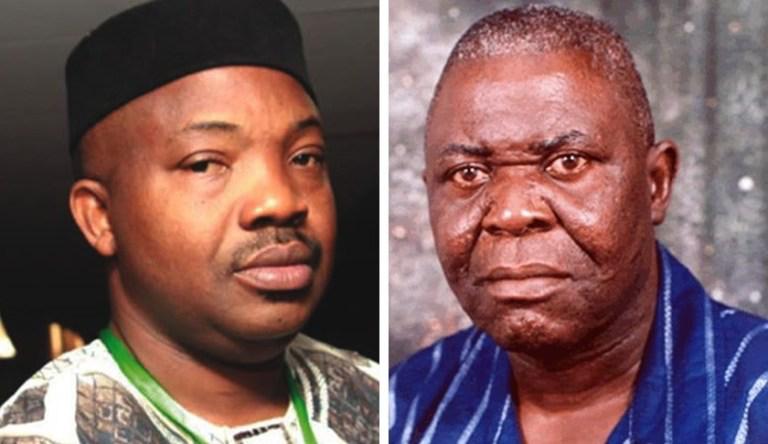
Chief Ayo Opadokun, former Secretary – General of Afenifere has been taken to the cleaners by Yinka Odumakin…
“Well, I think Opadokun is not telling the truth. In Yorubaland it is not cultural to say an elderly man lied, so I will not say he lied. I think either out of malice about the circumstances of our parting or possibly because he hangs around Tinubu too much and he is getting influenced. What he said totally negated the true account of how we met.”
“My joining Afenifere, myself and my colleagues were received at an open rally into the group by Chief Ayo Adebanjo, late Ganiyu Dawodu and other leaders at Oworonshoki at a rally. If we were nonentities coming from nowhere, they definitely will not receive us at a rally.”
“Before coming to Afenifere, some of us are fully formed politically, we have led students movements, we were involved in various kinds of struggles and before then I was the Publicity Secretary of National Conscience Party (NCP) formed by the late Gani Fawehinmi.”
“I had cut my teeth. I was part of a team that has been working with leaders like Chief Abraham Adesanya in Joint Action Committee of Nigeria (JACON), which was a conglomeration of pro-democracy forces, Afenifere, while he, Opadokun was in Abacha’s detention. I enjoyed perfect working relationship with Afenifere leaders like Adesanya, Bola Ige and others.”
“So, for him to now say he was watching me for six months and the rest is total fallacy. After receiving us into Afenifere, I remember that time Chief Adebanjo said myself and Omoseyinde should go and collect form to go the House of Representatives in 1999. But we humbly rejected the offer and respectfully told him that we didn’t join Afenifere to seek positions but that our aim is to build the organization.”
“The first assignment we were given was to go and conduct the AD primaries in Ondo state to pick the governorship candidate. Myself, Dr. Omoseyindemi and others led the team to go and conduct the primary that led to the emergence of late Adebayo Adefarati as AD candidate in 1998. In that process, Mr. Opadokun said I should go work with him.”
“He may be right that I wrote minutes for him but I can remember vividly that the first minutes I wrote for him, after that day, Chief Adebanjo openly said ‘I like the language of this minutes’. That was the minutes of Afenifere that I wrote but which he Opadokun read. Let him deny it.”
“Most of the press briefings that he was signing, I was the one writing them, both minutes of meeting and press releases, but I don’t want to take the credits. But Mr. Opadokun was taking credits as if he wrote them. Taking credits for those things doesn’t matter to me. What is important to me is the collective interest of the group. One thing I saw in Opadokun was that he has a very large ego.”
“He feels big when he cuts other people down. To him, everything is about ‘ I, me, myself’. I did this, I did that’. Everything about him is in the first person pronoun ‘I’. Let us even assume that his account was correct. How old is he today and how old am I? if myself and him were contemporaries, I can never assist him in doing anything, maybe he will assist me because he is not a man of better intellect than I am.”
“I am not being immodest. But he is much older than I am. There is a clear gap between us. I repeat, if we were contemporaries, he can’t claim that he has better intellect than me. Even if that was the circumstance of our meeting, I will not be ashamed of it but his account is false.”
“On why we parted, at a point, when Tinubu came in as governor in 1999, he took Opadokun, one Engr Salami, Akinyelure and others into one committee where they are going to be deciding appointments, contracts. But within a short time, I think he wanted to be feeling too important and Tinubu cut him to size.”
“So, they fell out. By the time they fell out now, he became so critical of Tinubu in Afenifere and Tinubu himself said it with his mouth that he was looking for ways to get Opadokun out of Afenifere which was his strength then. Some Tinubu’s associates who were journalists, who were publishing a newsmagazine started selling a story in Afenifere that Opadokun had gone to collect money from Babangida. That was the time Babangida was trying to run for elections in 2003. They claimed that Opadokun had received N40 million to give Babangida all the information about Yorubaland.”
“Then I was working directly with him and people started accusing me that myself and Opadokun have both shared the money together. These are issues I don’t want to talk about. I am saying this because he has poked his fingers into my mouth. These are things I have kept within me and I have not shared with anybody.”
“At a stage, I remember that Papa Abraham Adesanya called one of the editors of that newsmagazine and I was there, three of us and papa said ‘ I want hard evidence on this stories you have published so I can deal with this matter. But when they failed to bring any hard evidence, Papa left it until sometimes in 2002, the Afenifere in Kwara came to officially report him to Afenifere that he was doing anti-party activities, that while Afenifere was supporting AD, Opadokun was working hand-in-hand with late Kwara governor, Mohammed Lawal in ANPP.”#
“I remember that a committee was set up under Ganiyu Dawodu. I think Olu Falae was in that committee and Prince Dayo Adeyeye. He was invited but he refused to attend that panel and eventually he was removed as the General Secretary of the group. So, maybe he had expected me to go with him as a sign of solidarity in things I do not know anything about.”
“Since after that time, our relationship got strained and so it was not surprising to me that he is granting interviews now to bring me down and belittle me. But deep in his hearts of heart, he will know that my relationship with him added values to him. Let me also add that I am not the only person he is doing that to. I remember one day I was talking to the late Tunde Adebiyi and he was crying owing to the negative things Opadokun was saying about him. Opadokun believes that when he cuts people down, that is when he can feel big.”
“I didn’t join through him. You can verify from Chief Adebanjo and Dr. Omoseyindemi. They are both alive. We were received at an open rally and you can also go to media houses because we were shown on television. For Opadokun to be writing that history, it is unfortunate. His account is totally false and an attempt to rewrite history.”
“With all sense of modesty, I will not fault Chief Opadokun if he says that Tinubu is superior to every other person in Yorubaland because that is where his bread is being buttered. So, there can’t be any superior man to the man that pays your bills. I recalled that about three months ago, a friend was telling me that since I had relationship with Opadokun, I should talk to him to go and find something to do rather than hanging around Tinubu and regaling young boys with stories of Awolowo, Action Group in Tinubu’s parlour. It is an irony of history and I pray that God should not let me end up like that in my twilight.”
“For a man with such a rich past to now be celebrating a man of questionable character in his twilight is most unfortunate. But I am also not surprised because I remember that in the year 2000, Opadokun was to release his memoirs of NADECO days titled Freedom Jail. He had finished the book, it had been printed and he took a copy to.”
“Tinubu to see. After visiting Tinubu, he came back and was so fidgety and panicking. He later gathered some boys and all-night they were busy removing a page from that book. What was on the page? It was a page where he narrated how Tinubu sent some boys to go and set Ejigbo NNPC on fire during Abacha regime. And that it when those boys were arrested and they were going to mention Tinubu’s name, that he fled the country.”
“He thought he was telling that story to boost Tinubu’s image as one of those pro-democracy forces who gave Abacha hell, but when Tinubu saw the implication, he asked him to go and remove it. So, overnight he had to get blades to tear that page off in all the books. So, Tinubu has always been superior to the truth as far as Opadokun is concerned. I am not surprised.”
“When you psychoanalyze him, you come to certain conclusions. I remember there is this activist who was part of Afenifere and is a Minister now. He knew Opadokun when he went back to UNILAG to do law. He told me that there was a day they were having inter-hall match at UNILAG and the hall that Opadokun belonged was playing against another hall. Because he was older than every other person, they asked him to be the referee.”
“It now happened that towards the end of the game, the opposing house was beating his own house leading by a goal. Just about two minutes to the end of the match, a player from the opposing team just tackled a player from Opadokun’s house somewhere around the middle of the field and not in the 18-yard box and Opadokun just pointed to the penalty spot and awarded a penalty to his team. I learnt it was so bad that even members of his own house that he was trying to favour, screamed ‘Haba!, this is pure ojoro! and they started chasing him all around the field.”
– Culled from Daily Independent





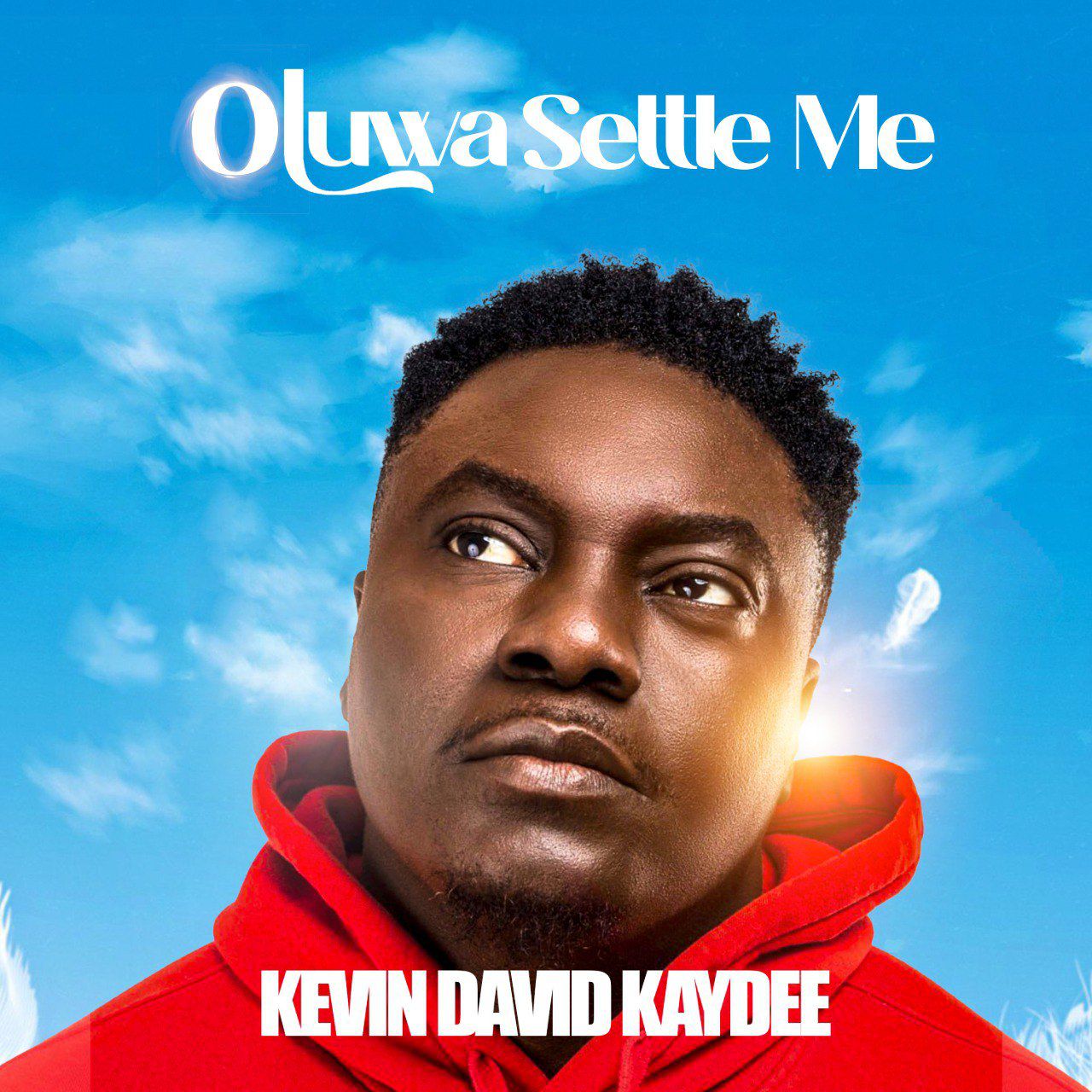
Kevin David Kaydee Releases Inspiring Single “Oluwa Settle Me”
Rising music artist Kevin David Kaydee has released a powerful new single titled Oluwa Settle Me, a soulful Afro-inspired anthem that blends heartfelt prayer with modern rhythm.
“Oluwa Settle Me” captures the everyday cry of many believers seeking breakthrough, peace, and divine favour. With emotionally rich melodies and uplifting instrumentation, the song expresses a sincere plea to God for complete answers to life’s pressing questions—career, destiny, relationships, and spiritual fulfilment.
Drawing from Afrocentric sounds and contemporary gospel influences, the track stands out for its simplicity, sincerity, and spiritual depth. Kevin David Kaydee delivers the message with passion, creating a worshipful atmosphere that resonates across age groups and cultures.
The song’s message of hope and dependence on God positions it as more than just music,it is a prayer set to melody. By fusing spirituality with modern lifestyle rhythms, “Oluwa Settle Me” reflects the growing wave of gospel music that speaks directly to real-life struggles while pointing listeners back to faith.
As gospel music continues to evolve across Africa and beyond, Kevin David Kaydee’s latest release reinforces music as a powerful tool for encouragement, reflection, and spiritual connection.
“Oluwa Settle Me” is now gaining attention among gospel music lovers for its relatable message and soulful sound, marking another significant step in the artist’s growing musical journey.
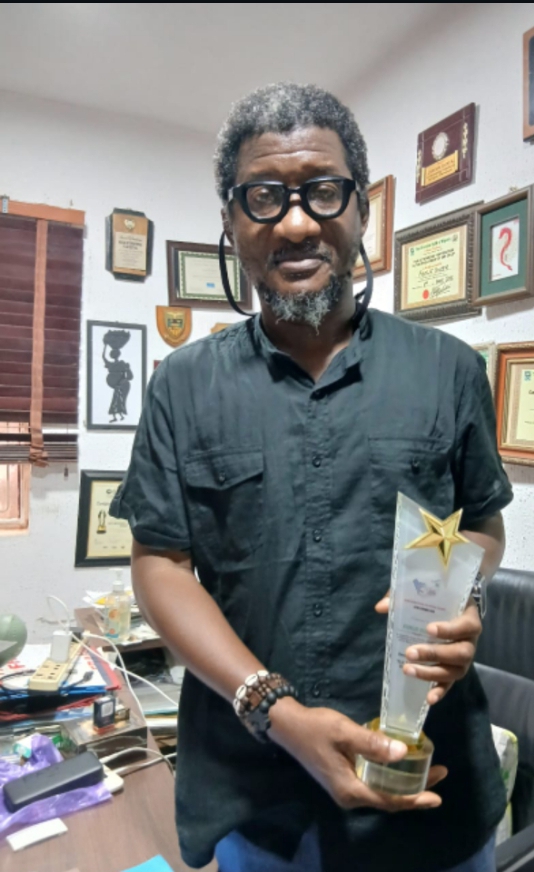
**Another Feather for Nollywood Icon Fidelis Duker
*Lagos, Nigeria* — In a remarkable celebration of artistic achievement, renowned Nollywood figure Fidelis Duker received yet another prestigious accolade last weekend, solidifying his role as a key player in the growth of the Nigerian and African film industries. The award was presented in a ceremony held at Duker’s Lagos office by esteemed film and theatre director, Mr. Alex Eyengho, founder of the Warri International Film Festival, alongside Marketing and Strategy Director, Mrs. Matel Eyengho.
The recent recognition builds upon Duker’s previous achievement at last year’s ECOFEST in Dakar, where he was honored with a Lifetime Achievement Award. This latest accolade is a testament to his unwavering dedication and substantial contributions to the cinematic landscape.
“I am truly humbled by this recognition,” Duker expressed during the event. In his speech, Alex Eyengho lauded Duker’s pioneering efforts in establishing significant film festivals in Nigeria, particularly the Abuja International Film Festival, which has played a vital role in promoting local talent and storytelling.
Eyengho emphasized, “Fidelis has not only paved the way for emerging filmmakers but has also helped elevate Nigerian cinema on the global stage. His creative vision and commitment inspire all of us in the industry.”
As Duker reflects on this honor, he acknowledges the importance of teamwork and collaboration in achieving success. “This acknowledgment reaffirms to my team and me that our work is being observed, and it motivates us to continue contributing to the development of our sector,” he stated.
With numerous projects on the horizon, Duker remains a relentless advocate for the growth and recognition of African cinema. His latest recognition is yet another testament to the vibrant and evolving landscape of Nollywood, as industry leaders like him continue to inspire future generations.
As the film industry anticipates the next phase of development, Duker’s continued influence signals a promising future for filmmakers in Nigeria and across the continent.
celebrity radar - gossips
E‑Money’s Grand Gesture: A Closer Look at the SUV Gift to Chinedu “Aki” Ikedieze

E‑Money’s Grand Gesture: A Closer Look at the SUV Gift to Chinedu “Aki” Ikedieze
By George Omagbemi Sylvester | Published by SaharaWeeklyNG
“Public Generosity, Celebrity Loyalty and the Symbolism of Wealth in Nigeria’s Entertainment Elite.”
On Tuesday, February 17, 2026, Nigerian billionaire and entrepreneur Emeka Okonkwo, widely known as E‑Money, once again captured national attention with a lavish and highly publicised act of generosity, gifting a brand‑new 2024/2025 Ford SUV to veteran Nollywood actor Chinedu Ikedieze, affectionately called Aki, during his high‑profile birthday celebration.
The event, held in Lagos amidst a constellation of entertainers, business figures and socialites, was itself part of an annual tradition in which E‑Money marks his birthday (on February 18) with large‑scale giveaways and spectacular shows of material philanthropy. This year, he announced the gift of over 30 cars to friends, staff and family, a gesture that quickly went viral as videos and images circulated across social media platforms.
In the case of Ikedieze, E‑Money’s gift appeared to be deeply personal. During the festivities, E‑Money stood beside his elder brother, Grammy‑nominated musician KCee and recounted how Ikedieze stood by him at his 2007 wedding. The billionaire explained that the SUV was a “token of appreciation” for the enduring support the actor had shown over the years which is a narrative that blends friendship with public celebration.
Ikedieze, a Nollywood staple with a career spanning more than two decades and over 150 film credits, including the iconic Aki na Ukwa franchise, visibly reacted with humble surprise as he received the vehicle, bowing his head in respect and gratitude. The actor later shared the moment on his Instagram account with a caption celebrating the gift, further fuelling online engagement around the event.
Beyond the spectacle, this incident underscores evolving dynamics in Nigerian celebrity culture and the intersection of wealth, influence and reciprocity. Sociologist Dr. Chinedum Uche of the University of Lagos, speaking on the broader implications of such high‑profile gifts, notes: “Philanthropy that is highly publicised can reinforce social bonds, but it also reflects a culture where generosity is intertwined with reputation economy; where giving becomes as much a social signal as it is an act of kindness.” The quote highlights how public acts of wealth transfer among elites serve layered social functions that extend beyond pure altruism.
Critics of such displays argue that ostentatious giveaways, particularly in a country with stark economic disparities, risk amplifying social envy and exacerbating perceptions of inequality. Economist Dr. Ifunanya Nwosu from the Lagos Business School observes: “In societies marked by economic stratification, celebrity largesse may inspire admiration, but it can also inadvertently highlight structural inequities; prompting questions about systemic investment in public welfare versus individual generosity.”
Still, supporters maintain that E‑Money’s annual tradition (which has in past years included cash gifts to his brother KCee, comedians and even domestic staff) reflects genuine gratitude and a commitment to uplifting his immediate circle, albeit within the private sphere.
For Ikedieze, the SUV stands both as a heartfelt gesture from a longtime friend and a public affirmation of their enduring relationship. As the video of the moment continues to circulate, the broader narrative has ignited discussions about the role of private wealth in public life, celebrity culture and how acts of giving are interpreted in contemporary Nigerian society.
In a landscape where influence and generosity often play out in equal measure on public stages, E‑Money’s gift to Aki is more than a headline, it is a flashpoint in ongoing debates about wealth, friendship and visibility in Nigeria’s entertainment and entrepreneurial ecosystem.


-

 celebrity radar - gossips6 months ago
Why Babangida’s Hilltop Home Became Nigeria’s Political “Mecca”
-

 society6 months ago
Power is a Loan, Not a Possession: The Sacred Duty of Planting People
-
 society5 months ago
Religion: Africa’s Oldest Weapon of Enslavement and the Forgotten Truth
-

 news6 months ago
THE APPOINTMENT OF WASIU AYINDE BY THE FEDERAL GOVERNMENT AS AN AMBASSADOR SOUNDS EMBARRASSING
You must be logged in to post a comment Login