
society
Impeachment: Group Cautions Rivers CJ Against Playing into the Hands of Rivers Lawmakers


Impeachment: Group Cautions Rivers CJ Against Playing into the Hands of Rivers Lawmakers
The Africa Centre for Democracy and Leadership (ACDL) has issued a strong caution to the Chief Judge of Rivers State, Justice Simeon Chibuzor-Amadi, on the critical need for judicial independence in the face of the ongoing impeachment proceedings against Governor Siminalayi Fubara and Deputy Governor Prof. Ngozi Odu.
The group’s intervention comes at a pivotal moment, as the Rivers State House of Assembly, under Speaker Martins Amaewhule, has ramped up its efforts to oust the executive duo.
This follows a series of dramatic shifts, including a recent U-turn by four lawmakers who recommitted to the impeachment push after briefly advocating for dialogue, citing alleged media attacks from the governor’s camp as evidence of bad faith.
The Assembly’s latest resolution to forward a request for an investigative panel to the Chief Judge marks a formal escalation, confirming that impeachment notices have been served in line with constitutional requirements.
The group warned that the judiciary must safeguard its independence amid the escalating political crisis, which stems from long-standing tensions between the governor and factions in the Assembly.
The Africa Centre for Democracy and Leadership stated that the Chief Judge should exercise utmost caution to avoid being drawn into what it described as partisan maneuvers by the lawmakers.
The group, through its Executive Director, Barrister Nedu Ekwueme, emphasized that the role of the Chief Judge in appointing a seven-member panel of unquestionable integrity must remain free from external influence or pressure.
Barrister Nedu Ekwueme said: “The judiciary must remain the last bastion of hope for justice and fairness in our democracy.”
He continued: “We caution Justice Chibuzor-Amadi against allowing himself to be manipulated by lawmakers whose actions appear driven by vendetta rather than constitutional duty.”
Barrister Ekwueme further stated: “This impeachment process has all the hallmarks of a political witch-hunt. The Chief Judge must not play into the hands of these lawmakers, as doing so would erode public trust in the judiciary and set a precedent for future abuses of power.”
The Africa Centre for Democracy and Leadership pointed out that historical precedents in Nigeria demonstrate the dangers of hasty or improperly constituted panels, citing cases where courts later intervened to correct procedural flaws despite constitutional provisions.
Barrister Nedu Ekwueme noted: “We have seen in the past how hasty judicial panels have fueled crises rather than resolved them, as in the cases of Governors Rashidi Ladoja of Oyo State, Peter Obi of Anambra State, and Joshua Dariye of Plateau State, where impeachments were nullified due to violations of due process.”
He added: “Rivers State cannot afford another round of needless turmoil; the Chief Judge should prioritize due process over expediency.”
The group stressed the importance of strict adherence to constitutional guidelines, including the requirement for the panel to investigate allegations thoroughly within three months and report back to the people.
Barrister Nedu Ekwueme asserted: “The people of Rivers deserve leaders who focus on development, not distractions. By cautioning the CJ, we aim to prevent a scenario where the judiciary becomes a pawn in this high-stakes game, ultimately harming the state’s progress.”
The Africa Centre for Democracy and Leadership called on the Nigerian Bar Association, civil society organizations, and other stakeholders to closely monitor the process and uphold judicial independence.





Celebrating Chinedu Nsofor’s birthday with the Bethnews Publisher
…A visionary expert and a distinguished writer
~By Oluwaseun Fabiyi
Oluwaseun Fabiyi, a Lagos-based journalist and publisher of BethNews Media International magazine, celebrates Chinedu Nsofor’s birthday, extolling the young man’s dynamic character and exceptional writing abilities.
In a formal statement released on Tuesday, Oluwaseun commended Chinedu Nsofor as an influential young leader whose enduring legacy will transcend time. The statement read: “Today, I personally celebrate your birthday and the profound impact you are making. As a trusted associate, astute politician, successful entrepreneur, and dedicated community developer, your visionary leadership has catalyzed significant growth and created numerous opportunities for those around you. We at Work While in School Media BethNews Media are honored to be part of your remarkable journey and contributions.”
Your consistent support throughout our journey has harmoniously combined faith and teamwork, fostering our confidence and ambitions. May this special day overflow with joy.
Your trailblazing career serves as a powerful inspiration to young people, shining like a beacon of excellence. With leadership skills honed in Nigeria and abroad, you embody perseverance, innovation, and a steadfast commitment to achieving exceptional results.
Your stories of perseverance and resolve, where you’ve skillfully turned challenges into opportunities and brought your vision to life, have undoubtedly enhanced our collective experiences, and we are forever grateful for the honor of acknowledging your accomplishments.
As I commend your wisdom and divine direction in life, may your future days flourish with success and rapidity.
Your stature as a globally renowned technocrat is matched by the humility and brilliance that define your illustrious career. May your birthday celebration be a testament to your success, with divine wisdom guiding your path and peace filling your heart.


society
United Kingdom of Atlantis Issues Comprehensive Public Disclaimer Warning Against Unauthorized Coin Promotion
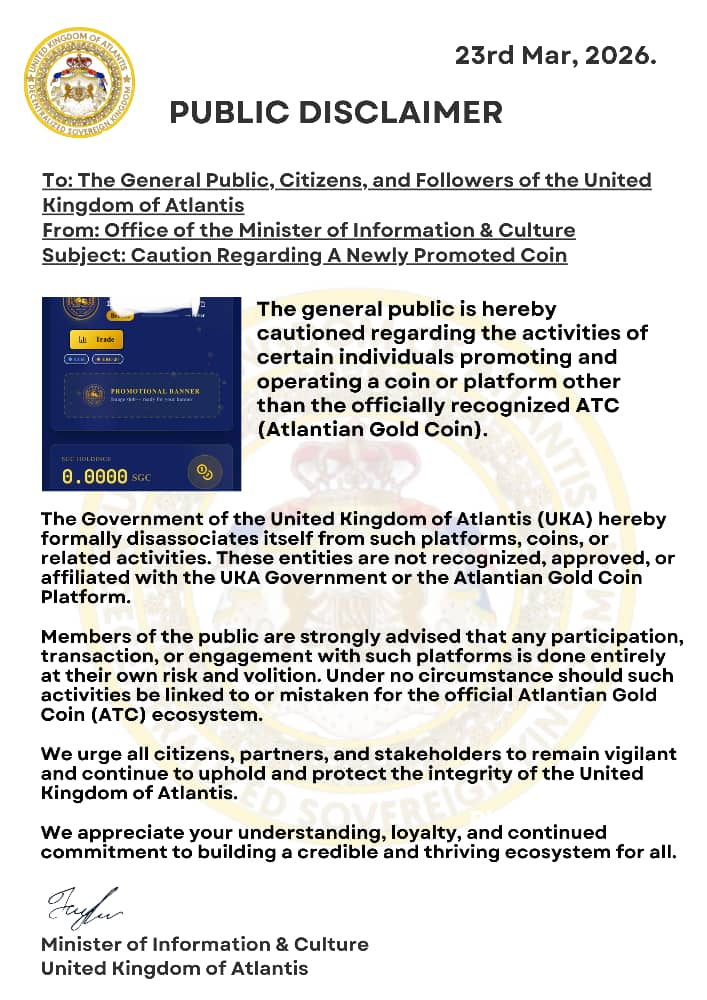
United Kingdom of Atlantis Issues Comprehensive Public Disclaimer Warning Against Unauthorized Coin Promotion
23rd March, 2026 – The Office of the Minister of Information & Culture of the United Kingdom of Atlantis (UKA) has issued an official public disclaimer cautioning citizens, followers, and the general public about the activities of individuals promoting and operating a coin or platform that is *not* the officially recognized Atlantian Gold Coin (ATC).
### Official Statement from the UKA Government
The Government of the United Kingdom of Atlantis formally *disassociates* itself from any such unauthorized platforms, coins, or related activities. These entities are *not recognized, approved, or affiliated* with the UKA Government or the official Atlantian Gold Coin (ATC) ecosystem. The UKA reaffirms its commitment to protecting its citizens from fraudulent financial schemes and maintaining the credibility of its national monetary instruments.
### Key Highlights of the Public Disclaimer
1. *Public Warning*: The general public is advised that participation in, transaction with, or engagement in these unauthorized platforms is undertaken entirely at the individual’s *own risk and volition*. The UKA will not provide any protection or recourse for losses incurred from such engagements.
2. *No Association*: The UKA government explicitly states that the unofficial coin should *not* be linked to or mistaken for the legitimate Atlantian Gold Coin (ATC) platform. Any branding or naming similarity is purely coincidental and unauthorized.
3. *Call for Vigilance*: Citizens, partners, and stakeholders are urged to remain vigilant and to uphold and protect the integrity of the United Kingdom of Atlantis. The government encourages proactive verification of all financial products to safeguard national economic stability.
4. *Appreciation*: The government expresses gratitude for the public’s understanding, loyalty, and continued commitment to building a credible and thriving ecosystem for all Atlantians. This support is vital for the sustainable development of the UKA’s financial infrastructure.
5. *Actionable Advice*: The Minister of Information & Culture advises citizens to conduct thorough due diligence, seek official certifications, and consult authorized financial institutions before investing in any coin or digital platform.
### Minister’s Emphasis on Transparency & Security
The Minister of Information & Culture emphasizes that the UKA is dedicated to maintaining transparency and security within its financial ecosystem. The government has established regulatory frameworks to ensure that only authorized and vetted financial instruments operate within the Atlantian economy. The public is encouraged to report any suspicious activities related to unauthorized coins or platforms to the appropriate authorities.
### Impact on the Atlantian Economy
The unauthorized promotion of alternative coins poses risks of financial fraud, market disruption, and reputational damage to the legitimate Atlantian Gold Coin (ATC). The UKA’s disclaimer aims to protect investors and preserve trust in the national monetary system, fostering a safe environment for economic growth and innovation.
Next Steps for Stakeholders
– *Verification*: Check official registries for approved financial products.
– *Reporting*: Submit information on suspicious platforms to the UKA regulatory authorities.
– *Education*: Engage in public awareness campaigns about the risks of unregulated financial instruments.

Crisis Everywhere, Governance Nowhere: What The Omoluabi Ethos Demands
Nigeria stands at a crossroads, gripped by multiple crises while governance appears slow, distant, and at times absent. From rising insecurity to deepening economic strain, citizens face daily hardships that demand urgent and decisive leadership. Yet the response has often seemed reactive rather than strategic, leaving millions to navigate uncertainty on their own in a country of over 200 million people.
Security challenges continue to spread at an alarming rate. The insurgency in the North East, now over 15 years old, persists despite repeated military campaigns. In 2025 alone, hundreds of civilians were killed in attacks across Borno, Zamfara, and Plateau states, while kidnapping for ransom has become a thriving criminal enterprise. More than two million Nigerians remain internally displaced in the North East, and several rural communities across the North West and North Central have effectively fallen outside full state control. What began as a regional crisis has evolved into a nationwide threat, weakening agriculture, disrupting supply chains, and discouraging investment.
Economic realities offer little comfort. Nigeria’s GDP grew by about 3.87 percent in 2025, up slightly from 3.38 percent in 2024, yet this growth has not translated into improved living standards. Inflation, though moderating from over 30 percent in 2024 to around 15 percent in early 2026, continues to erode purchasing power. Food inflation remains particularly severe, with staples rising beyond the reach of average households. With a minimum wage that struggles to match the cost of living, millions of Nigerians now spend a disproportionate share of their income on basic survival.
Poverty and food insecurity deepen the strain. An estimated 129 million Nigerians live below the poverty line, while nearly 100 million face varying levels of food insecurity. Malnutrition rates among children remain high, and access to basic healthcare and education continues to decline in vulnerable communities. The informal sector, which employs over 80 percent of the workforce, remains largely unregulated and unstable. Official unemployment figures hover around 4.9 percent, but this masks widespread underemployment and precarious work conditions that offer little economic security.
Fiscal pressures further complicate the situation. Recent reforms, including the removal of fuel subsidies and the unification of exchange rates, have improved government revenue and reduced the fiscal deficit to about 4.5 percent of GDP. However, these gains have come at a steep social cost, with transport, energy, and food prices rising sharply. Public debt stands at roughly 34 percent of GDP, while oil production, Nigeria’s primary revenue source, continues to underperform. Although output recovered to about 1.5 million barrels per day in 2025, it remains below both OPEC quotas and national targets due to theft, pipeline vandalism, and chronic underinvestment.
These challenges are deeply interconnected and point to a broader governance deficit. Insecurity disrupts farming and trade, economic hardship drives poverty, and limited fiscal space constrains effective intervention. The result is a cycle of vulnerability that continues to tighten around millions of citizens.
The Omoluabi ethos offers a clear alternative. It represents leadership defined by character, discipline, accountability, and an unwavering duty to the people. Under such a framework, security would be treated as a sacred responsibility, not a recurring crisis. Government would act with urgency and coordination to protect lives and property, while economic policy would be deliberately people centred, focused on reducing the cost of living, stabilising prices, and supporting small businesses and agriculture. Growth would be measured not just in statistics but in the improved welfare of citizens.
Public institutions under this ethos would function with purpose and discipline. Ministries would operate with clear targets, coordination, and accountability for results. Fiscal decisions would reflect prudence, balancing reforms with social protection so that citizens are not crushed under the weight of policy adjustments. Above all, leadership would be empathetic and present, grounded in the daily realities of the people and responsive to their needs. Governance, in this sense, would not be distant or abstract but a visible commitment to improving lives.
Measured against this standard, the present stewardship of the Nigerian state clearly falls outside the Omoluabi ethos. Persistent insecurity, rising living costs, and the widening gap between economic indicators and lived reality reflect a leadership approach that lacks the discipline, accountability, and people centred focus that define that value system. Rather than embodying empathy and responsibility, governance has often appeared distant, reactive, and insufficiently attuned to the human consequences of its decisions. The issue, therefore, is not merely one of policy but of principle. Until leadership aligns with values that prioritise service, accountability, and the welfare of the people, the crises will endure and the question will remain, se na like this we go de dey?


-

 society6 months ago
Religion: Africa’s Oldest Weapon of Enslavement and the Forgotten Truth
-

 news3 months ago
WHO REALLY OWNS MONIEPOINT? The $290 Million Deal That Sold Nigeria’s Top Fintech to Foreign Interests
-

 society6 months ago
“You Are Never Without Help” – Pastor Gebhardt Berndt Inspires Hope Through Empower Church (Video)
-

 celebrity radar - gossips2 months ago
Dr. Chris Okafor Returns with Power and Fire of the Spirit -Mounts Grace Nation Altar with Fresh Anointing and Restoration Grace on February 1, 2026