
society
THE RUBBER STAMP REPUBLIC: How Akpabio’s Senate Is Risking Nigeria’s Constitutional Balance and Why Adams Oshiomhole’s Rebuke Matters

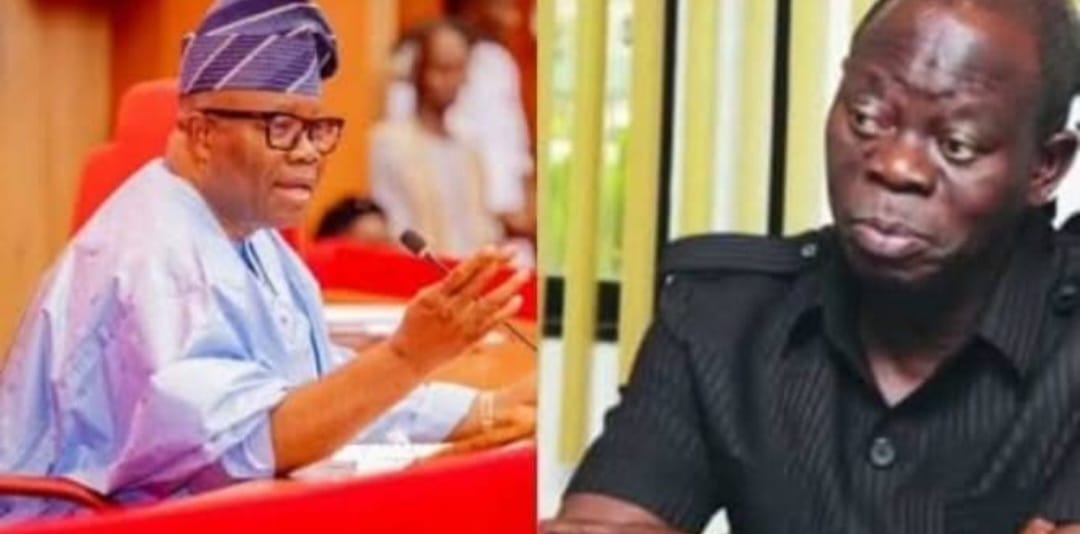
THE RUBBER STAMP REPUBLIC:
How Akpabio’s Senate Is Risking Nigeria’s Constitutional Balance and Why Adams Oshiomhole’s Rebuke Matters.
By George Omagbemi Sylvester | Published by SaharaWeeklyNG.com
There are moments when a single sentence on the floor of the Senate does more than scold; it indicts. When Senator Adams Oshiomhole (a former national chairman of the ruling All Progressives Congress and a man familiar with the corridors of power) rose to tell the Senate, “I am not a rubber-stamp senator,” he did not merely defend his dignity. He tore at the gossamer veil that has been draped over the relationship between Nigeria’s legislature and the executive: a relationship fast drifting from healthy cooperation into dangerous subservience. Oshiomhole’s public rebuke of Senate President Godswill Akpabio is not theatre. It is a red flag; one that deserves urgent national attention.
The charge is simple, brutal and constitutional in its implications: bills are being “PASSED LIKE WATER,” rushed through without meaningful scrutiny, with little or no recorded debate on their merits, implications or fiscal consequences. Where the National Assembly was designed by the 1999 Constitution to act as a check on the executive (to scrutinize appointments, investigate maladministration, examine budgets and secure accountability) the spectacle of rapid, transactional lawmaking substitutes speed for substance and convenience for duty. In recent weeks and months Nigerians have watched executive proposals and packages move through the chambers with unusual haste; critics argue this pattern has become more frequent under the leadership of the 10th Senate.
Senate President Akpabio has predictably pushed back. He insists the National Assembly is not a “RUBBER STAMP” and that collaboration with the executive is not the same as capitulation; he has argued that co-operation, when properly managed, produces results for citizens. That defence matters (the legislature is not, and must not become, an adversary of reform for its own sake) but rhetoric cannot substitute for records. When the public sees an avalanche of bills moving in lockstep with executive timetables, and when senior senators themselves stand and object to the process, the perception of erosion becomes a political reality.
Why does this matter beyond partisan point-scoring? Because the health of Nigeria’s democracy depends on functional checks and balances. A rubber-stamp legislature undermines three critical safeguards: oversight of the executive, the protection of minority interests and the rigorous vetting of appointments and policies that affect billions of naira and the lives of millions. Scholars who study legislatures warn that when parliaments abdicate oversight, governance becomes less transparent and more corruptible; policy errors are more likely to persist because there is no robust forum to challenge assumptions or demand evidence. The literature on “rubber-stamp” legislatures (including detailed academic reviews of the National Assembly’s oversight function) shows that weak oversight is not merely a political embarrassment, it has real consequences for accountability, public finance and security.
Look at the facts on the ground. Over the past year the National Assembly has entertained sweeping constitutional amendment packages and a rolling procession of executive bills that critics say were given hurried consideration. Independent media tracking and civil-society guides to legislative oversight have documented that while committees sometimes perform their duties, plenary sessions (where the public record is made) show a worrying willingness to clear matters rapidly without full debate. The result: citizens and civil society are deprived of the opportunity to interrogate policy choices and to hold lawmakers to account. That is not democratic oversight; it is managerial convenience.
Oshiomhole’s rebuke also carries an internal sting: it came from within the governing party. When a senior party stalwart publicly accuses the chamber led by his party colleague of turning itself into a rubber stamp, it suggests fracture lines; not merely disagreements about procedure, but tensions over the very independence of the legislative arm. The symbolism is stark: if the Senate bows too readily to the executive, party structures will likewise be perceived as instruments of consolidation rather than forums of democratic contestation. That perception corrodes public trust in all institutions.
What must be done? First, the Senate must publish and enforce rules that guarantee adequate time for debate, full committee scrutiny and public input before any bill is read into law. Transparency is an antiseptic to slippage into clientelism. Second, senators should restore the practice of substantive plenary debate; not performative monologues, but documented interrogations that place ministers, appointees and policy proposals under the public microscope. Third, civil society, the media and professional bodies must keep score: regular, public scorecards on committee activity, attendance, report adoption and oversight visits will create an objective record that citizens can use to demand standards. Finally, the executive must accept that leadership in a presidential democracy is not the same as unchecked rule; genuine partnership respects institutional autonomy. Useful models and guides already exist (from local think-tanks and international parliamentary practice) on how oversight is supposed to work.
The warning signs are not hypothetical. Case studies from across Nigeria’s recent history show that when legislatures fail to exercise oversight, poor contracting, budget padding and unchecked patronage follow. A strong, independent National Assembly is the single best institutional hedge against the centralisation of power and the decay of public finance. Conversely, a legislature that feeds at the table of the executive without asking inconvenient questions accelerates governance failure. The stakes are national: budgets, appointments, security strategy and the integrity of electoral laws. A rubber-stamp Senate is not a political curiosity; it is institutional rot.
This editorial is not naive about the real-world politics of governing. Cooperation between the arms of government is necessary. But co-operation must be distinct from acquiescence. When senior members of the Senate (elected to represent diverse constituencies and to protect the public purse) declare themselves unwilling to be mere endorsers of executive will, the chamber should welcome that spirit as a reminder of its constitutional duty, not punish it as inconvenient dissent. Oshiomhole’s words should have been a summons to conscience, not a flashpoint.
In the end, the choice facing Nigeria’s lawmakers is straightforward: to be guardians of the constitution or to be managers of the president’s agenda. The difference is not cosmetic. Guardians probe, challenge, demand answers and if necessary, refuse. Managers placate, rubber-stamp and expedite. For the survival of Nigeria’s fragile democratic gains, the Senate must choose the harder path; the path of parliamentary independence, rigorous oversight, and public accountability. If it fails, the country will not merely misgovern; it will outsource its democracy. And that is a cost no nation can afford.
George Omagbemi Sylvester is a political analyst and columnist. Published by SaharaWeeklyNG.com





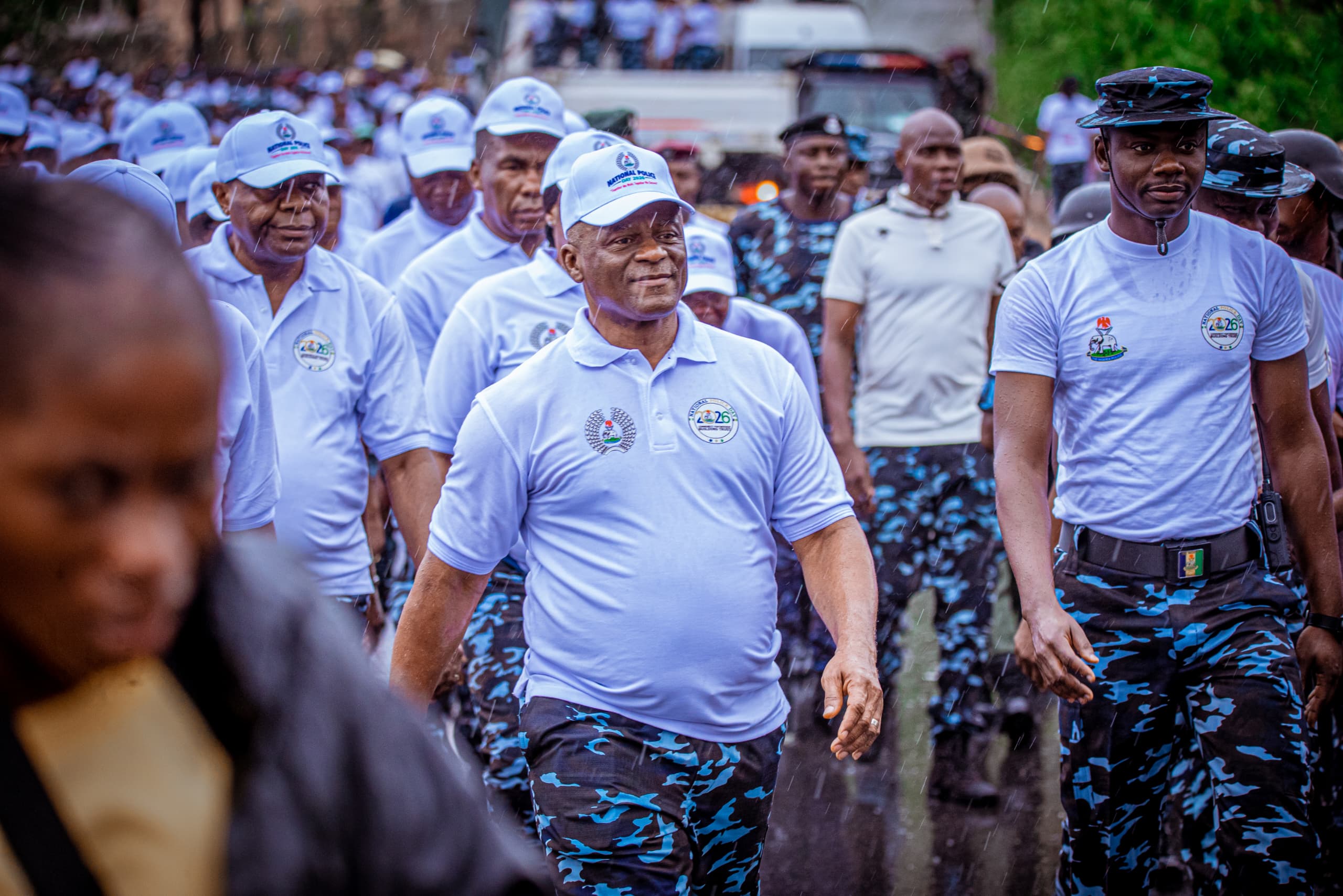
Police Day 2026: IGP Disu Leads Nationwide Walkathon To Strengthen Community Trust
The Inspector-General of Police, Olatunji Disu, on Tuesday led the management team, alongside officers and personnel of the Nigeria Police Force, in a nationwide walkathon to commemorate the 2026 National Police Day.
The event, held across state capitals and the Federal Capital Territory, formed part of activities marking Day Two of the annual celebration, themed “Community Partnership: Building Trust.”
The symbolic exercise, which drew participation from both police personnel and members of the public, was aimed at showcasing unity, discipline, and a renewed commitment to community policing and public safety.
According to the Force leadership, the walkathon underscores the Nigeria Police Force’s resolve to strengthen public trust, deepen engagement with citizens, and enhance collaboration in tackling security challenges across the country.
Participants described the initiative as a practical step toward bridging the gap between law enforcement and the communities they serve, while also promoting physical fitness and mental well-being among officers and civilians alike.
With the theme reflecting a shared responsibility for safety, the Police reiterated that sustainable security can only be achieved through active partnership with the public.
The event concluded with a renewed call for collective action under the banner: “Together We Walk, Together We Secure,” emphasizing unity of purpose in building a safer and more secure society for all Nigerians.


society
Dr. Chris Okafor invokes divine retribution upon individuals blackmailing the Grace Nation church
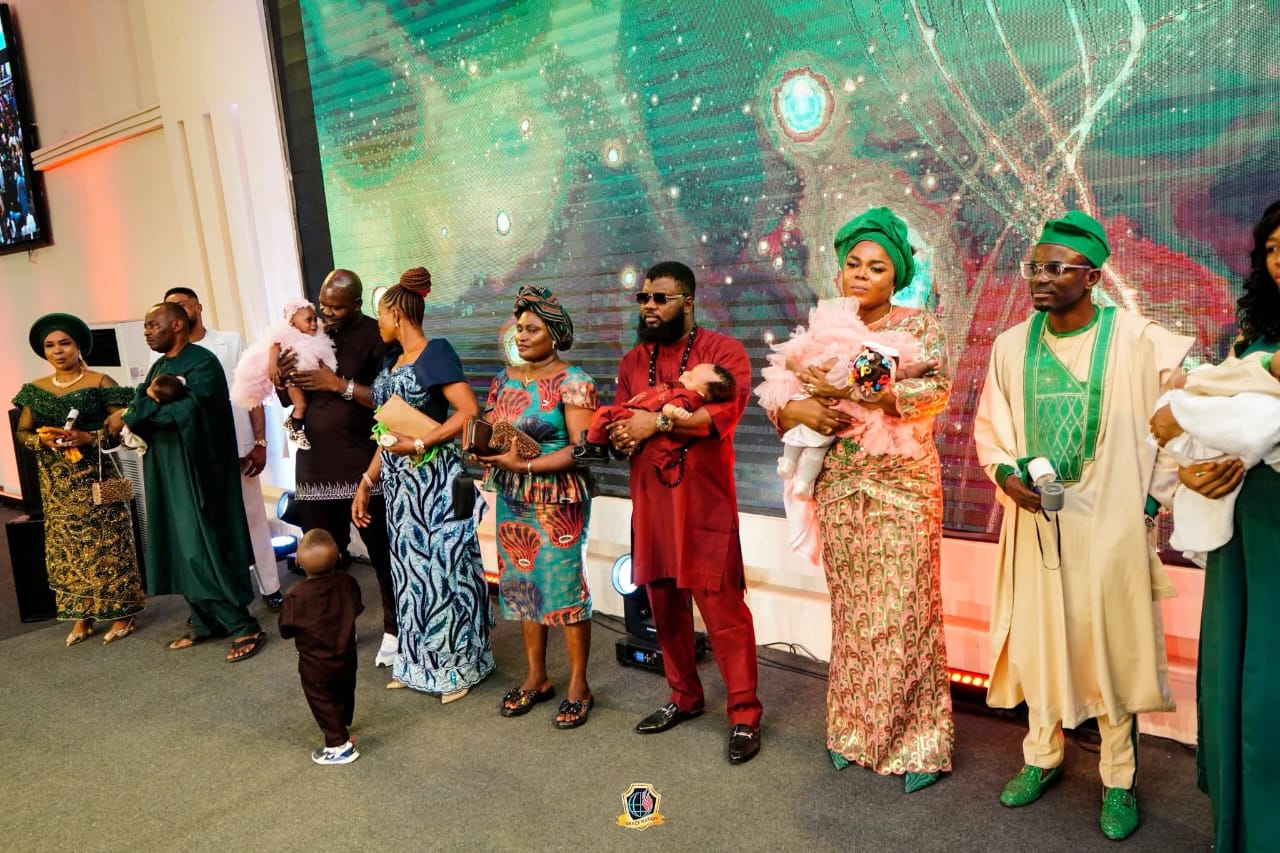
Dr. Chris Okafor invokes divine retribution upon individuals blackmailing the Grace Nation church
… Affirming God’s omnipotence to unveil malicious schemes.
To be frank, the ability of Doris Ogala and her associates to withstand the arduous challenges set by Senior Pastor Dr. Chris Okafor of Grace Nation Global at the culmination of the Harvest of Babies 2026 conference, the church’s flagship event, continues to elude me.
It’s advisable not to offend a powerful spiritual leader like Prophet Chris Okafor to avoid potential consequences, as seen in the situation with Doris Ogala, who was rebuked by the prophet; can she rectify the situation through confession?
Insiders close to the man of God claim that despite relentless online bullying and blackmailing, the Generational Prophet remains resolute, stating that God’s power has been evident throughout the commission’s existence. The reason for this wonderful statement is found in the scriptures, “Upon this rock I shall build my Church, and the gates of hell shall not prevail.” The more falsehoods are spread about the church and its leader, the more God elevates the church and propels him to greater heights, he asserted. He emphasized that blessings and fruitfulness are antidotes to curses, noting that God continues to bestow blessings upon the church, including miracles and the gift of children, which is one reason for the grand finale of the annual family liberation program, The Harvest of Babies.
However, the man of God issued a curse on each person speaking ill of the church, blackmailing, and uttering all sorts of falsehoods against the church, declaring that if they refused to repent within a few days, the earth would swallow them and their family members, stating that they would be of no use to themselves, their families, or society at large.
The spiritual leader cautions his followers to beware of such individuals including Doris Ogala who may taint their faith, and urges them to treat these persons as emissaries of the devil, avoiding them altogether.
Recall that the 2026 harvest of babies concluded with a remarkable birth of a miracle baby boy to a woman on the third day of the conference, accompanied by the dedication of several other miracle babies, all to the glory of God.
Christopher Sunday David writes from
Austria
“Together We Walk, Together We Secure”: Police Launch 2026 Walkathon In Abuja
The Nigeria Police Force has announced plans to host a walkathon in commemoration of the 2026 National Police Day, aimed at promoting unity, peace, and stronger community partnership.
The event is scheduled to take place on Tuesday, March 31, 2026, with participants expected to converge at the Force Headquarters Abuja by 6:00 a.m., where the walk will commence.
According to the organisers, the walkathon is designed to bring together members of the public, stakeholders, and security personnel in a show of solidarity and shared commitment to national security.
With the theme, “Together we walk, together we secure,” the initiative underscores the importance of collaboration between the police and citizens in maintaining peace and safety across the country.
Members of the public have been encouraged to participate in the exercise, which forms part of activities lined up to mark this year’s National Police Day celebration.
It is believed that the walkathon would not only foster closer ties between the police and the communities but also serve as a platform to promote awareness on collective responsibility in ensuring a safer society.


-

 society6 months ago
Religion: Africa’s Oldest Weapon of Enslavement and the Forgotten Truth
-

 news4 months ago
WHO REALLY OWNS MONIEPOINT? The $290 Million Deal That Sold Nigeria’s Top Fintech to Foreign Interests
-

 society6 months ago
“You Are Never Without Help” – Pastor Gebhardt Berndt Inspires Hope Through Empower Church (Video)
-

 celebrity radar - gossips2 months ago
Dr. Chris Okafor Returns with Power and Fire of the Spirit -Mounts Grace Nation Altar with Fresh Anointing and Restoration Grace on February 1, 2026